|
- Interim Update 10th August 2011
Copyright
Reminder
The commentaries that appear at TSI
may not be distributed, in full or in part, without our written permission.
In particular, please note that the posting of extracts from TSI commentaries
at other web sites or providing links to TSI commentaries at other web
sites (for example, at discussion boards) without our written permission
is prohibited.
We reserve the right to immediately
terminate the subscription of any TSI subscriber who distributes the TSI
commentaries without our written permission.
The
US Recession
From John Hussman's latest weekly comment:
"Coupled with the slowdown in year-over-year GDP growth, the composite of economic and financial evidence we presently observe has always and only been associated with ongoing or immediately impending recessions. This is not an opinion or a viewpoint, but a fact of the data."
..."I emphasize the word "composite," because there is simply no single, infallible indicator of oncoming recession. In order to infer information from noisy data, you have to combine multiple lines of evidence to amplify the "signal" and suppress the "noise." ...Any single indicator, whether it is GDP growth, the Shiller P/E, the forward operating earnings yield, the ISM index, the position of the S&P 500 versus its 200-day moving average, the jobs number, or anything else, is invariably subject to random factors that reduce its information content. The only way to get at the "truth" is to look for a convergence of signals that share common information components but whose "noise" components aren't terribly correlated with each other. The problem at present is that multiple lines of evidence suggest more than just a "healthy correction" in the stock market, or a "soft patch" in the economy."
The US economy never really exited the recession that began in 2007, although the official prognosis was that the recession ended in June of 2009. We suspect that sometime during the next 12 months it will be officially recognised that the US economy re-entered recession during the second quarter of 2011. The
Fed pledges to keep the short-term interest rate at zero forever
What the Fed actually said in the statement issued after this week's FOMC Meeting was:
"The Committee currently anticipates that economic conditions -- including low rates of resource utilization and a subdued outlook for inflation over the medium run -- are likely to warrant exceptionally low levels for the federal funds rate at least through mid-2013." In today's financial markets, two years is almost "forever".
The US has just experienced the weakest economic recovery in its history with the "risk free" short-term interest rate near zero the whole time. It should therefore be obvious that keeping the interest rate at zero doesn't help. At least, it should be obvious that the main problem confronting the US economy is not associated with a too-high interest rate. Why, then, does the Fed continue to believe that the economy stands a good chance of strengthening if the official short-term interest rate is kept at zero?
The problem is that the Fed is referring to a playbook in which all the plays are wrong. All the plays have always been wrong, it's just that the wrongness is more readily apparent now than it has been in the past.
In the chapter on economic weakness, the Fed's playbook has only two suggestions: 1) push interest rates below where they would otherwise be, and 2) pump more money into the economy. Both of these 'plays' are counter-productive because they both make it more difficult for the market to efficiently allocate scarce resources.
On the positive side of the ledger, as central bankers continue to bumble from one crisis to the next there will be increasing awareness that the central-banking playbook is horribly flawed. Eventually, there could even be widespread recognition that the whole concept of a central bank is horribly flawed.Treasury
bonds are still a popular 'safe haven'
The S&P downgrade of long-term US federal debt was followed by a huge one-day gain in T-Bonds. The price gain in T-Bonds was due to a large price decline in equities, meaning that the S&P news had no effect on the "safe haven" status of the Treasury market. There was never a good reason to expect that it would.
T-Bonds would probably have pulled back on Tuesday as the stock market rebounded, but the Fed's promise to keep its interest rate target at zero forever gave them another boost.
This week's big up-move pushed 10-year T-Note futures above last year's peak and almost all the way up to the December-2008 peak. The 'big picture', which is illustrated below, now allows for two distinct possibilities: The market is about to complete a multi-year "double top" prior to the start of a major decline, or the market is preparing to break out to the upside from a multi-year consolidation. We think it's more likely to be the former, but we aren't going to bet on it.
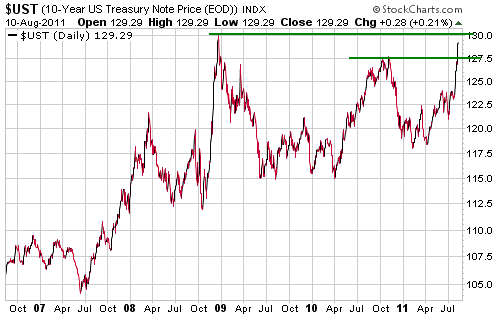
The bond market is now as 'overbought' as the stock market is 'oversold', so a significant correction is likely. Almost regardless of the 'big picture', it is reasonable to expect that bonds will give back some of their recent gains as equities recoup some of their recent losses.The Stock Market
It's just as well we have central banks to stabilise the markets.
Otherwise there would be huge volatility, with the Dow Industrials Index regularly moving by more than 400 points in a day.
In the email alert sent in response to Monday's extraordinary market action, we wrote:
"A number of indicators had already reached extremes at the end of last week. These indicators generally became even more extreme on Monday. Of particular note, the NASDAQ's McClellan Oscillator ended at a 20-year low of -119 on Monday. This is slightly lower than the extreme it reached in October of 2008. We have to go back to the 1987 stock market crash to find a lower value.
The stock market is probably in the early part of a 1-3 year cyclical decline, but this is definitely not the time to START positioning for a bearish outcome. It makes no sense to sell, or hedge, in the immediate aftermath of a crash."
The stock indices rebounded strongly on Tuesday and then collapsed again on Wednesday. There is no evidence, yet, that the senior indices have reached short-term bottoms, but it looks like Monday was the "internal" low for the move. The reason is that far fewer individual stocks made new 52-week lows on Wednesday than on Monday (for example, the number of NASDAQ stocks making new lows was over 700 on Monday and only 239 on Wednesday). Also, Wednesday's McClellan Oscillator readings were comfortably above Monday's extremes.
The following daily chart shows the crash in the NASDAQ100 Index (NDX) -- from a multi-year high just three weeks ago to a 9-month low this week. At a minimum, a normal rebound from here would take the NDX back to former support (now resistance) at 2200, while the maximum rebound potential is probably defined by the moving averages at 2280-2300.

It's unlikely that an intermediate-term bottom is in place.
Aside from the gold and silver miners, energy (oil, gas and uranium) stocks are the only stocks that we are interested in buying at this time.
Gold and the Dollar
Gold and Silver
Over much of this year we've greatly under-estimated the upside of the US$ gold price. We thought that gold would do very well in terms of most other major currencies, which it certainly has. We also expected gold to do very well against the broad stock market and most non-monetary commodities, which, again, it certainly has. However, we expected that US$ strength would suppress its performance in US$ terms.
Gold has just rocketed up to around $1800/oz. It has gone parabolic and is now very 'overbought' on a short-term basis, but having come this far it wouldn't surprise us if it continued through to the big round number ($2,000/oz). Not immediately, as there should be at least one intervening correction to the 50-day moving average, but before year-end.
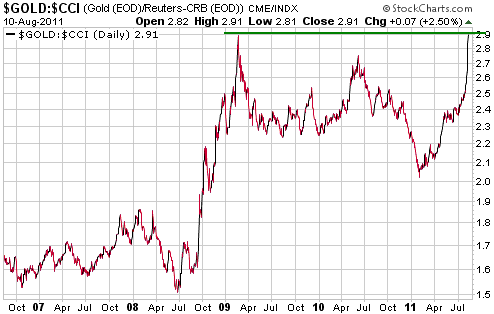
The following chart shows that relative to commodity prices in general (as represented by the CCI), gold is now testing its Q1-2009 peak. We remain bullish on gold relative to most other commodities, but gold/CCI's near-vertical rise over the past 6 weeks suggests that there is now significant short-term risk.
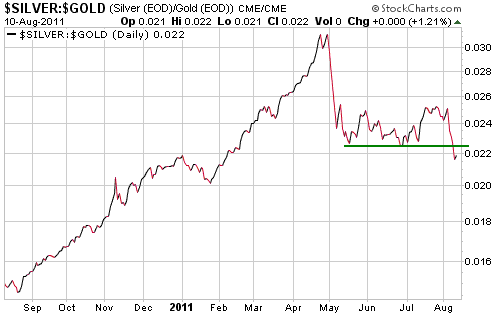
The next chart shows that the silver/gold ratio has just broken decisively below its lows of the past few months. This signals that the shift away from risk is accelerating.
Given that the breakdown in the silver/gold ratio occurred in parallel with the stock market becoming dramatically 'oversold' on a short-term basis, we question its sustainability. However, it will be prudent to assume that the breakdown is genuine until/unless subsequent market action proves otherwise.
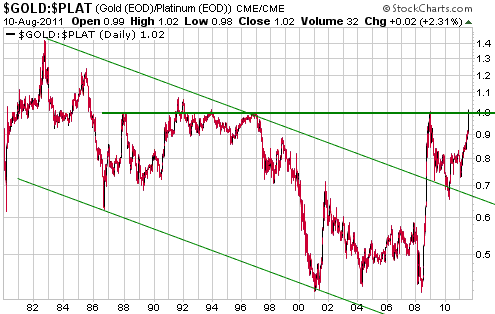
As a result of recent market action, gold now has a slightly higher price than platinum. Based on what has transpired over the past 20 years, this suggests that platinum will outperform gold from here. However, we are disinclined to bet on strength in platinum relative to gold, for fundamental and technical reasons. From a fundamental perspective, a global recession would likely result in much weaker platinum demand from the motor-vehicle and jewellery industries. From a technical perspective, the following chart of the gold/platinum ratio shows that a) gold was priced about 40% higher than platinum in the early 1980s, and b) a secular trend change (from down to up) might have occurred in 2008.
Gold Stocks
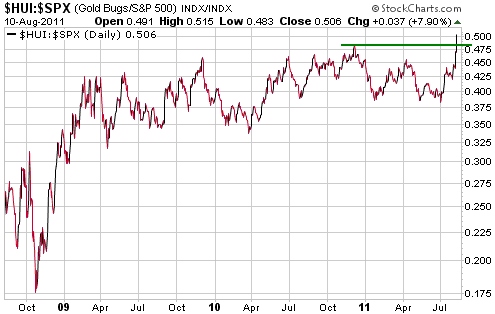
From Tuesday's email alert: "Gold stocks have recently been pulled upward by the surging gold price and pushed downward by the collapsing stock market. The result is that while the HUI has just made a new 2-year low relative to gold, it has almost reached an all-time high relative to the S&P500 Index (the HUI/SPX ratio ended Monday's session within 2% of the all-time high reached late last year). In other words, the gold-stock indices continue to under-perform gold bullion, but they are holding up much better than the broad stock market."
In the two trading since we wrote the above, the HUI/SPX ratio moved to a new all-time high. This came about because the surging gold price enabled the gold sector to rise on Wednesday in the face of a tumbling stock market. The situation is illustrated below.
Also, from Tuesday's email alert: "We could soon see a rebound in the broad stock market alongside a sharp pullback in the gold price, resulting in the HUI falling relative to the S&P500 but holding up better than gold." This still applies.
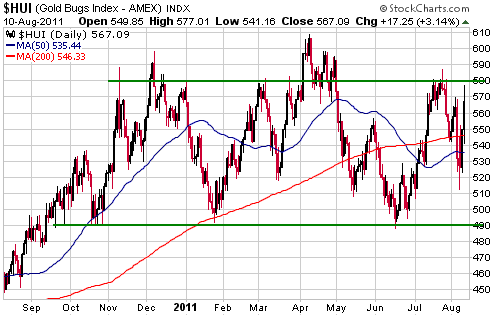
The week's extreme volatility throughout the financial world hasn't significantly changed the HUI's chart pattern. There is strong resistance in the 580s and strong support in the 490s.
Currency Market Update
When the financial world shifts towards risk, the US$ tends to weaken relative to other currencies and gold tends to weaken relative to silver. By the same token, when the financial world shifts away from risk (towards safety) there tends to be relative strength in the US$ and strength in gold relative to silver. This leads to the positive correlation between the Dollar Index and the gold/silver ratio illustrated by the following chart.
The problem now facing us is that the gold/silver ratio has just broken out to the upside, which is the expected/normal response to financial-market turmoil, but the Dollar Index has remained within its narrow multi-month trading range. In a similar vein to what happened in August of 2008, this week's upside breakout in gold/silver SHOULD have been accompanied by an upside breakout in the dollar.
The dollar's failure to respond in a meaningful way to the market-wide shift away from risk ushers in the following possibilities:
1. The shift away from risk will prove to be short-lived, in which case the breakout in the gold/silver ratio will not be sustained.
2. It's different this time.
3. As occurred during the final few months of 2007 and the first half of 2008, concern about the Fed's monetary profligacy is temporarily overriding all other considerations.
4. The Dollar Index is lagging, but will soon make a catch-up move.
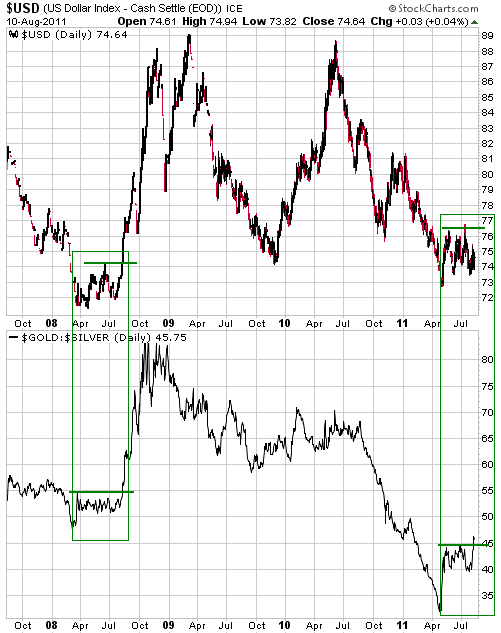
We are now short- and intermediate-term "neutral" on the US$ (a change from "bullish") pending more clues on which of the above scenarios is playing out. A daily close above 76.5 would indicate that it's Scenario 4 and would automatically result in our US$ outlook returning to "bullish".
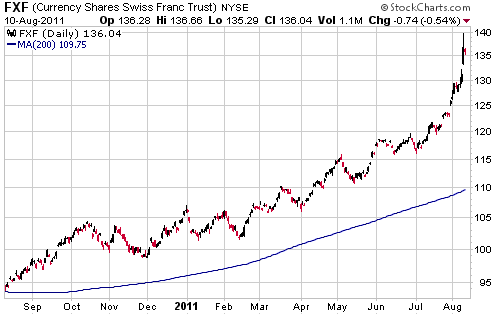
Last week we noted that Market Vane's bullish consensus for the Swiss Franc (SF) had reached a mind-boggling 97%. The upside blow-off in this currency continued over the past few days, resulting in our minds becoming boggled to an even greater extent by a bullish consensus of 98%. So, only 2% of the traders surveyed by Market Vane are now bearish on the SF.
The following chart of the Swiss Franc Trust (FXF) shows that the parabolic up-move went vertical earlier this week. This creates a speculative opportunity in FXF put options with expiry dates of December-2011 or later, but bear in mind that blow-offs such as this reflect irrational market behaviour and can therefore go further than a rational observer would expect.
Please don't email us asking for specific trading suggestions for options. We occasionally mention option trades at TSI, but our view is that the vast majority of people should stay away from options trading because very few people end up making any money out of it. We usually only buy options as a form of insurance, although every now and then we can't resist placing a speculative bet using options.
Update
on Stock Selections
Notes: 1) To review the complete list of current TSI stock selections, logon at
http://www.speculative-investor.com/new/market_logon.asp
and then click on "Stock Selections" in the menu. When at the Stock
Selections page, click on a stock's symbol to bring-up an archive of
our comments on the stock in question. 2) The Small Stock Watch List is
located at http://www.speculative-investor.com/new/smallstockwatch.html
 Dragon Mining (ASX: DRA). Shares: 74M issued, 75M fully diluted. Recent price: A$1.21 Dragon Mining (ASX: DRA). Shares: 74M issued, 75M fully diluted. Recent price: A$1.21
In the 8th August Weekly Update we said we would add DRA to the TSI Stocks List if it dropped to A$1.05, but we ended up adding it at A$1.10 via the email alert sent on Tuesday morning (Australian time). DRA has gold mines and exploration-stage gold projects in Finland and Sweden.
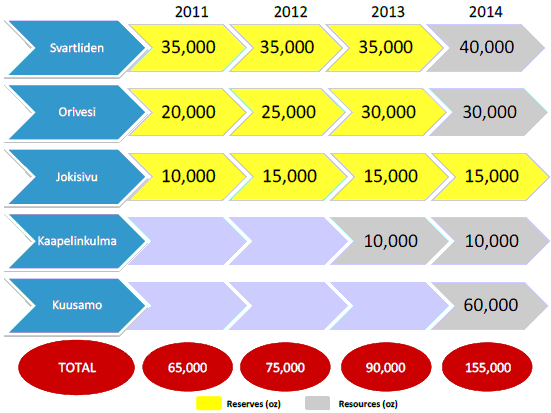
The following chart from the company's presentation shows the gold production that each project is expected to deliver in 2011 through to 2014. Note that the Svartliden project is in Sweden and the other projects are in Finland. Also note that while the company is expected to produce gold at an annualised rate of 65K ounces during the second half of this year, total 2011 production is likely to come in at around 58K ounces.
Most of DRA's potential growth is associated with the exploration-stage Kuusamo project. This project has a high-grade open-pit resource -- currently 383K ounces grading 5.4 g/t. The plan is to expand the resource to around 1M ounces via a 100,000m drilling program. Drilling results have generally been very good, to date.
We expect that the main company-specific upward drivers of the share price over the months ahead will be cash-flow generation at the existing mines and drilling results at Kuusamo.
DRA stands a good chance of moving up to at least A$2.00 over the next 9 months.
Quick comment on GSS and JAG earnings
GSS reported its latest quarterly financial results after the close of trading on Monday. We thought the results were in line with the guidance provided by the company in mid July, so we can't explain why the stock dropped as low as US$1.78 on Tuesday morning. It has since rebounded to US$2.40.
JAG reported its latest quarterly financial results after the close of trading on Wednesday. There was nothing surprising in JAG's results.
Both GSS and JAG should do well during the second half of this year, partly due to operational turnarounds but mostly due to the much higher gold price. GSS has a lower valuation than JAG, but JAG is further advanced along the 'turnaround path' and has the potential to deliver some blowout cash flow numbers over the next two quarters.
Clifton Star (CFO.V) remains "halted"
If you are a CFO shareholder, you should be thankful that the Canadian regulators are working hard to protect your interests. Heaven forbid that you should be able to trade these shares before the company has crossed all the t's and dotted all the i's that the regulators insist must be crossed and dotted.
Once we get updated information regarding the likely date for the resumption of trading, we'll let you know.
Chart Sources
Charts appearing in today's commentary
are courtesy of:
http://stockcharts.com/index.html

|









