|
- 10 October 2001
Pushing
on a String?
The "pushing on a string" analogy,
when applied to monetary policy, refers to the inability of the central
bank to stimulate the expansion of credit if borrowers are unwilling/unable
to borrow and/or lenders are unwilling/unable to lend. Under certain conditions
it doesn't matter how much the central bank cuts official interest rates,
the money supply doesn't expand.
It is obvious that the US Fed is not
"pushing on a string", at least not yet. Every significant drop in long-term
US interest rates has precipitated another mortgage financing/re-financing
binge, causing the money supply to mushroom. Furthermore, the Fed has clearly
demonstrated its ability to add liquidity at its whim to meet each new
crisis (invariably, a crisis that they helped create). Eventually, prices
will react to these monetary injections. The question is when, not if,
prices will move higher to account for the increased supply of dollars.
The US
Stock Market
Current Market Situation
A pullback in the US stock market did
not get very far before stocks once again reversed higher. We think the
reason for this is that the level of fear remains high and traders have
been very quick to adopt a bearish posture or reinforce an existing bearish
posture. This is evidenced by the high put/call ratios in the days leading
up to Wednesday's rally (the overall put/call ratio was 0.97 on Tuesday
and 0.96 last Friday). Everyone 'knows' that the market is going to drop
to test the Sep-21 low and many are trying to position themselves accordingly.
However, the market seldom does what everyone knows is going to happen.
In this case, even if a test of the previous lows is still in the cards
the market must first convince a lot of participants that it is not.
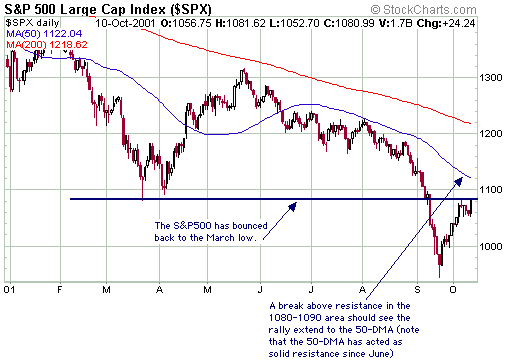
Wednesday's bounce did not achieve
very much from a technical standpoint. The S&P500 Index (see chart
below) and the NASDAQ Composite Index closed right at the lows reached
last March/April (those prior lows now act as resistance) and the December
S&P500 Futures were not able to move above the intra-day peak made
on October-04. If the market can move decisively above yesterday's closing
levels then the likely short-term targets would be the 50-day moving-averages
at around 1120 for the S&P500 and 1770 for the NASDAQ. We would be
very surprised if the 50-DMAs were exceeded during the current rebound.
The commencement of US military retaliation
has had no discernible effect on any of the markets. This is not surprising
since it was well known that the retaliation was about to commence and
the air attacks to date have achieved no more or no less than most people
would have expected. The market environment does, however, remain unusually
news-sensitive. An unexpected military success or failure or another terrorist
act on US soil would result in a sharp move in the stock market, although
we doubt that such news would disrupt the market's trajectory beyond the
very short-term. The expected trajectory is a rebound that fails after
first giving a large boost to bullish sentiment, a drop to test the Sep-21
low that completely rebuilds the wall of worry, and then a sustainable
rally.
Gold and
the Dollar
Mortgaging the Future
Following is an extract from the Interim
Update of October-25 last year:
"Hedging has been popular in the
gold industry for many years, but nowhere has it been more popular than
in Australia. Virtually every Australian gold producer is hedged to some
extent, and many producers have already committed more than 50% of their
total reserves via forward sales and call options. Therefore, investors
in Australian gold stocks have some cause for concern. After all, it is
one thing to be losing money on your gold stock investments when the gold
price is falling, but it would be much more painful to see your gold stocks
decline during a gold price rally.
Having reviewed the reports of some
of Australia's largest 'hedgers' and having spoken to gold stock analysts
on the same subject, we doubt that any of the major Australian producers
are potential 'Ashantis'. Newcrest is one of the most aggressive hedgers
with commitments totaling around 7.0M oz, or about 61% of its reserves
(23% of resources). It is not subject to margin calls and the average exercise
price on its commitments is well above the current spot price. The exercise
prices are, of course, based on assumptions regarding lease rates and would
be reduced if gold lease rates moved higher. The problem we see with Newcrest
(and several other companies) is not that it will 'blow-up' if the gold
price rises sharply (it won't), but simply that the hedging programme has
severely limited any upside from a gold price rise. For example, in the
case of Newcrest, virtually all production for the next 3-4 years is already
committed. Another problem we have with Newcrest is that it continues to
hedge and has increased its total commitments by around 800,000 oz over
the past 12 months (note: since it delivered almost 1.0M oz of gold into
existing hedge contracts over the past year it must have entered into 1.8M
oz of new contracts in order to have achieved the net increase). Note that
we are only considering commitments, not the total hedge position. Put
options are not considered because they provide downside price protection
without limiting the upside (the company has the choice of either delivering
into the option contract or letting the contract expire)."
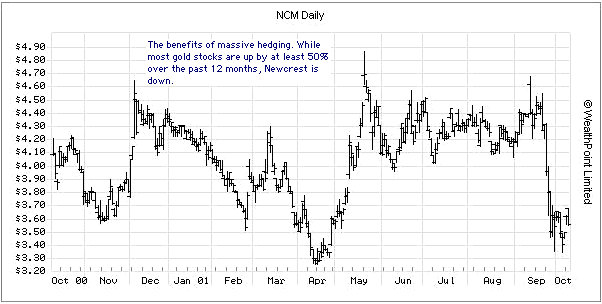
Two weeks ago UBS Warburg downgraded
their earnings expectations for Newcrest Mining (ASX: NCM). Despite (actually,
because of) a substantial increase in the A$ gold price, the actual average
sale price achieved by NCM is now likely to fall as a result of the way
its hedge book is structured. NCM has some great mining assets, but it
is now in the ridiculous position of seeing its profits fall as
the A$ gold price rises. Why would any gold stock investor be interested
in owning shares in this company? Judging by the performance of the stock
price, not many are.
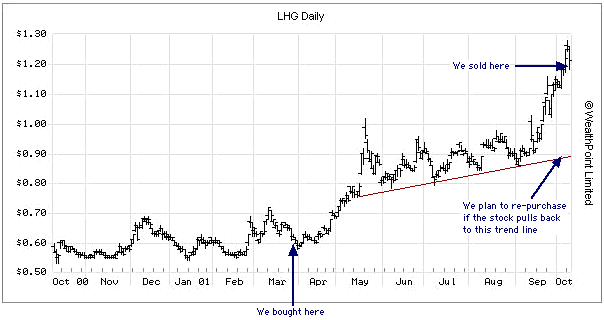
Below are 12-month charts of NCM and
Lihir Gold (LHG). This is an interesting contrast since, of all the medium
and large Australian gold producers, LHG provides the greatest leverage
to the spot gold price. This leverage was the main reason we added it to
the Portfolio in March of this year.
One thing we've never really been able
to figure out is why they do it - why do some gold company managements
all but eliminate their companies' exposure to the spot gold price? After
all, the stock prices of the heavily-hedged companies fare just as poorly
as the stock prices of the lightly-hedged companies when the gold price
is trending lower, then dramatically under-perform when the gold price
rises. It is blatantly obvious that the shareholders of a gold mining company
are severely disadvantaged if that company commits a substantial portion
of its future production at a fixed price. Buyer beware!
Current Market Situation
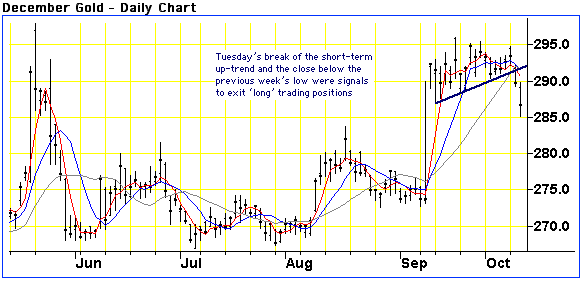
In the October-01 WMU we warned that
the current phase in gold's bull market appeared to be nearing its end
and recommended against doing any further buying of gold stocks. Then,
in Market Alert #54 e-mailed to subscribers after the close of trading
on Tuesday, we said that we planned to immediately sell our short-term
trading positions in gold stocks (while retaining our core investment position).
In the e-mail we noted the break of the short-term up-trend as illustrated
on the below chart.
We placed greater emphasis on gold's
recent short-term technical failure than we might normally do, for a number
of reasons. Firstly, the Commercial net-short position and the corresponding
speculative net-long position in COMEX gold futures had become substantial.
This would not have been a problem in itself since the speculators tend
to be on the right side of the market most of the time, but it meant that
a rally failure would probably be met with a rush of long-covering by speculators.
Secondly, as strong as the gold price appeared to be over the past few
weeks the rally (basis the December gold contract) had not exceeded the
intra-day peak reached back in May. This was a subtle sign of weakness.
Thirdly, bullish sentiment amongst traders in the gold market had reached
a level normally associated with a short-term peak. This was not only evidenced
by the build-up of speculative long positions and the results of sentiment
surveys, but also by the conversion of a very high-profile gold bear (Andy
Smith of Mitsui) from bear to bull. We don't consider Andy Smith to be
a contrary indicator, but his 'conversion' added to the market's optimistic
sentiment. Fourthly, interest in gold had clearly increased as a result
of the terrorist acts and the associated on-going tensions. We don't, however,
consider that the recent events provide a firm basis for a sustainable
gold rally. Our emphasis has been, and continues to be, on the deteriorating
quality/relative-value of the US$ as a result of massive inflation. We
expect the gold price to move much higher as the effects of Dollar inflation
start to be more widely recognised, with any shocking events potentially
providing short-term spikes along the way.
So, where to now? So far, what we have
is overly bullish sentiment and a downside break in the short-term trend.
The longer-term trends in all the financial markets remain very supportive
of higher gold and gold stock prices. As such, what we are most likely
seeing is a correction within an on-going bullish trend.
As far as how long this correction
will last, our thinking is anywhere from 3 weeks to 3 months. The key will
be how long it takes to inject a healthy level of pessimism back into the
gold market. A signal that bullish sentiment has been sufficiently curtailed
to enable the start of another rally will be a large reduction in the speculative
net-long and commercial net-short positions. Until this happens we will
remain on the sidelines as far as gold stock trading positions are concerned,
but will retain exposure to any event-related gold rally via our core investment
position. We emphasise that it will be important to be patient and wait
for the risk/reward ratio to swing decisively in our favour before re-establishing
long trading positions.
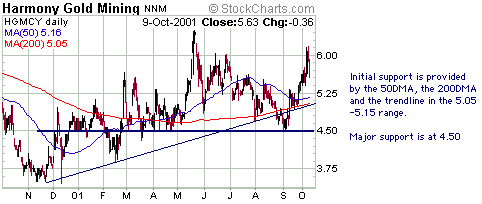
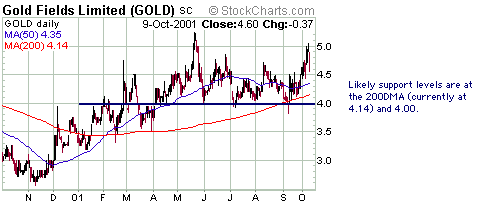
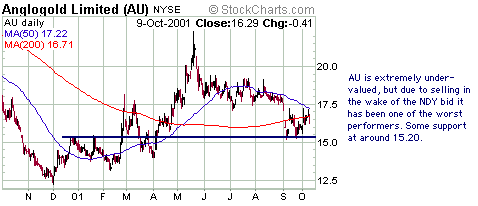
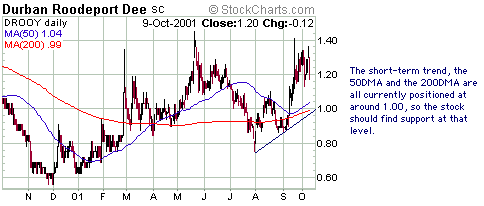
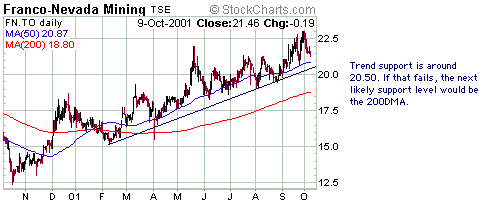
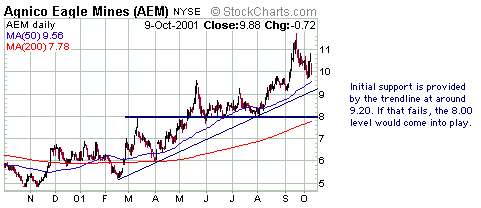
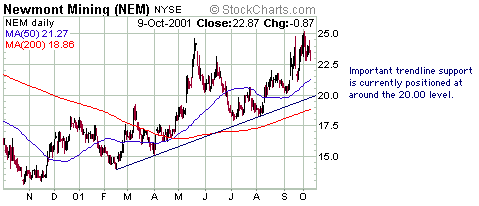
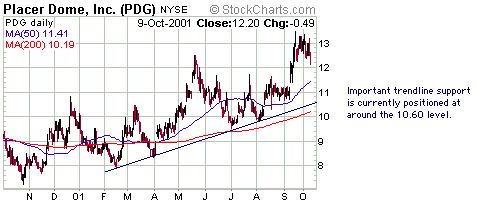
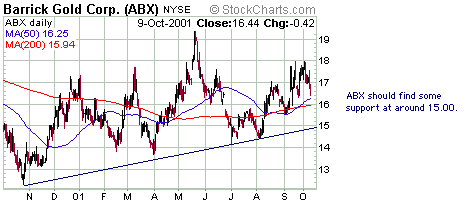
The following charts of several popular
gold stocks are provided to give some indication of the probable extent
of this correction (the charts do not include yesterday's trading action).
Beside each chart we've noted the approximate support levels - levels that
should hold assuming the continuation of an overall bullish trend. Some
of the trendlines and support levels shown on the charts are well-defined
and the ability, or otherwise, of the stocks to hold above these levels
over the coming weeks will give us clues regarding the sustainability of
the gold market's overall up-trend. Note that gold stock prices have dropped
quite sharply over the past few days and are probably already close to
short-term lows. Also, during today's trading in Asia the spot gold price
dropped to around $280, an area that should provide some short-term support.
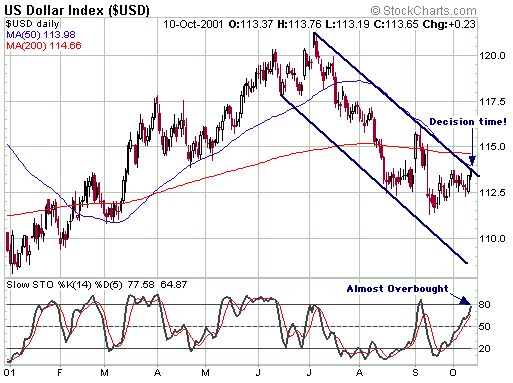
In Market Alert #54 we mentioned that
the breakdown in the gold price had not yet been confirmed by an upside
breakout in the Dollar Index. This is still the case. However, the following
chart indicates that the Dollar is very close to breaking out of its 4-month
downtrend. Any further strength in the Dollar over the remainder of this
week would suggest that we have seen at least a short-term trend reversal
in the currency market.
Changes
to the TSI Portfolio
As per Market Alert #54, gold stock
trading positions were sold. LHG was sold at $1.17 (for a profit of 89%)
and the NDY Nov $1.25 calls were sold for 16c (for a profit of 255%).

|









