|
- Interim Update 10th October 2012
Copyright
Reminder
The commentaries that appear at TSI
may not be distributed, in full or in part, without our written permission.
In particular, please note that the posting of extracts from TSI commentaries
at other web sites or providing links to TSI commentaries at other web
sites (for example, at discussion boards) without our written permission
is prohibited.
We reserve the right to immediately
terminate the subscription of any TSI subscriber who distributes the TSI
commentaries without our written permission.
The
Employment Numbers Hubbub
In the midst of a sea of data pointing to a deteriorating US
economy, the Bureau of Labor and Statistics (BLS), a US government
agency, reported last Friday that the unemployment rate had fallen
from 8.1% to 7.8%. This prompted former General Electric CEO Jack
Welsh to tweet: "Unbelievable jobs numbers…these Chicago guys
will do anything.. can't debate so change numbers." This, in
turn, prompted an almost universal expression of outrage. It was
widely acknowledged that a) the employment situation is lousy, b)
the substantial drop in the unemployment rate reported by the BLS
was strange, and c) the strange number probably boosts the
re-election prospects of Obama. But be that as it may, how dare
anyone suggest that the fine people at the BLS would deliberately
skew the data!
From our perspective, one of the inadvertently funniest reactions to
Welsh's "tweet" came from John Mauldin. In his
weekly letter Mauldin wrote:
"Before we wade into the data...I want to analyze the reaction.
What if someone said, "The military is manipulating the data from
Iraq and Afghanistan in order to help the election of the current
administration," (whether Republican or Democrat)? The appropriate
response to such a statement would be to suggest that such a
characterization was demeaning to the professionalism and integrity
of our military professionals. I think it is doubtful that a
statement like that would get much airplay or gain much credence in
the public discourse. The military is a well-respected institution
in the United States."
We thought it would go without saying that the US military now
routinely manipulates the data emanating from its various war zones,
having learned a harsh lesson from the failure to effectively
manipulate the media coverage of the Vietnam War. But apparently
not. The US military, an organisation that by its own admission
can't account for about 25% of its spending, is beyond reproach,
according to Mauldin. Unfortunately, Mauldin is correct when he
states that the military is a well-respected institution in the
United States. That's part of the problem.
Getting back to the employment numbers, Jack Welsh was almost
certainly wrong to claim that the numbers reported last Friday were
deliberately altered to benefit Obama. It simply wouldn't be
possible to secretly manipulate BLS data in such a way. Changing the
numbers to suit one party is not something that could be done by
having a quiet word to a senior person at the BLS, because the
people at the top of the BLS wouldn't be the ones who put the
numbers together. Rather, tallying the final numbers would involve
dozens, perhaps even hundreds, of individuals. Getting this many
people involved in a scheme to report a false number would be
impractical, and reporting a number that many people in the
organisation knew to be false would be very risky. In other words,
Welsh was probably wrong due to the near impossibility of doing what
he implied was done.
While last Friday's numbers probably weren't deliberately altered to
benefit the Obama administration, the widespread outrage provoked by
Welsh's comment was, itself, outrageous. The BLS and the other
government agencies that compile economic data only exist for
propaganda purposes. To put it another way, these agencies only
exist so that the government can exert some control over the
statistics that are reported to the public. There is no other reason
for the government's involvement in such data-gathering and
reporting endeavours. If the economic numbers compiled by government
agencies were genuinely useful outside the political process, then
private companies would compile them.
Unlike in China, where the government reports whatever numbers it
wants to report, in the US the government exerts control over the
economic statistics by controlling the calculation methodology. The
calculation methodology is adjusted over time to skew the results in
the government's favour, regardless of which party happens to be in
power. In this way, the employees of the statistics agencies can
honestly go about their work and come up with numbers that bear no
resemblance to reality.
The Stock Market
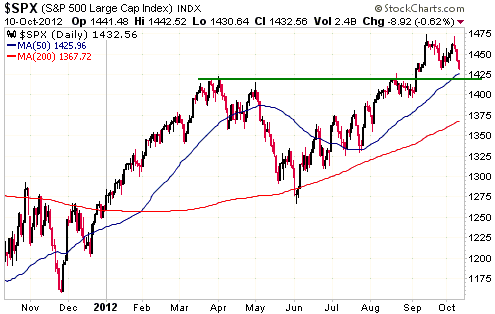
The S&P500 Index (SPX) has pulled back to just above important
support in the 1420s. If there is going to be another -- likely final -- move to
a new high for the year, the SPX will probably hold above 1420 on a daily
closing basis. This means that a solid daily close below 1420 would be
preliminary evidence that an intermediate-term top is in place.
Gold and the Dollar
Silver
Both silver and gold are alleviating their short-term 'overbought' conditions by
trading sideways. This is more evident in silver's chart than in gold's chart.
By early September silver had become very 'overbought', and despite the Fed's
announcement of a new QE program it has essentially gone nowhere over the
ensuing 5 weeks.
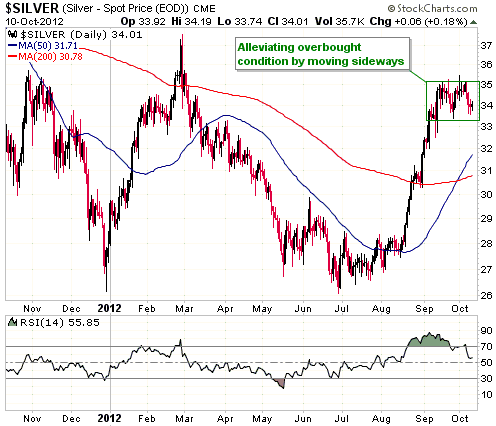
Silver's recent price action is evidence that an intermediate-term peak was NOT
put in place last month. The reason is that the vast majority of
intermediate-term peaks in the silver market are quickly followed by sharp
declines. In fact, there is often a single-day decline of more than 5% soon
after an intermediate-term peak in the silver price.
To create a new low-risk short-term buying opportunity, silver will have to move
down to the region of its 50-day and 200-day moving averages. This currently
means $30-$32, but note that both moving averages are now rising.
Gold Stocks
Current Market Situation
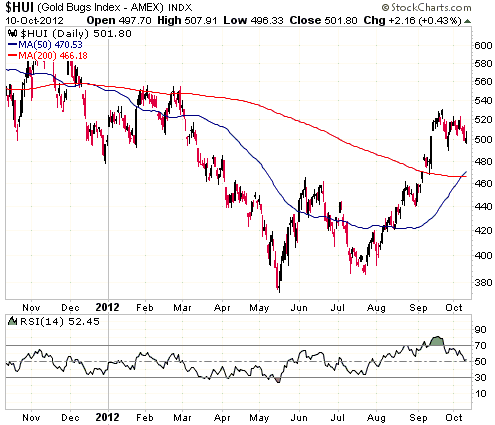
In last week's Interim Update we wrote that short-term HUI corrections almost
always accomplish two things -- a price decline to near the 50-day moving
average and a decline by the daily RSI(14) to the 40-50 range. The following
daily chart shows that the HUI's 50-day MA is now around 470, which suggests
that the correction isn't complete. The chart also shows that the RSI hit the
top of its expected bottoming range during the first half of this week.
Our guess is that the correction will end within the next seven trading days at
no more than 6% below the current price.
Updating an interesting comparison
In the 16th May 2012 Interim Update (right at an intermediate-term bottom for
the gold-stock indices, as it turned out) we presented a chart comparison
between the NASDAQ Composite Index from the time of the 1987 crash and the XAU
from the time of the 2008 crash. Here is an updated version of the same chart:
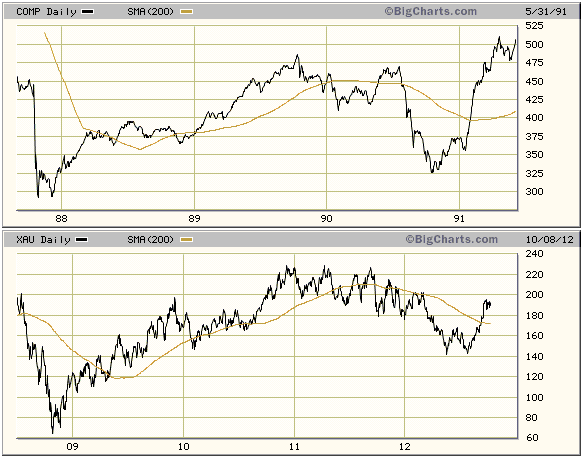
Back then we wrote that while we wouldn't hang any hats on the NASDAQ-XAU
comparison illustrated above, we did think that useful information could be
gleaned from it. In particular:
"For starters, although these are two different markets at two different
times subject to very different fundamental backdrops, there is a potentially
important similarity. We are referring to the fact that the NASDAQ suffered a
crash, followed by a 2-year rally, followed by a substantial correction lasting
about one year that retraced more than half of the preceding 2-year rally, all
within the context of a long-term bull market, and to the strong likelihood that
the XAU is in the process of doing something similar. For seconds, imagine (or
remember, if you were involved in the US stock market at that time), what
sentiment towards NASDAQ stocks was like in October-November of 1990. With the
market having just given back almost two years of hard-fought gains, the
negativity was almost palpable. Very few people had any inkling of what was to
come and that one of the best buying opportunities in history was staring them
in the face. For thirds, notice the NASDAQ's price action immediately following
its 1990 bottom. What eventually evolved into a major upward trend began with a
choppy 1-2 month rebound and then a 1-month correction that retraced about half
the gain from the bottom. At this point most people probably thought the bearish
trend was still in force. It wasn't until the market broke above the peak of the
initial rebound that bullish conviction began to grow."
The correction that followed the XAU's initial 1-2 month rebound was actually
deep enough to test the May low, but apart from that the XAU appears to be
recovering from its soul-destroying 2011-2012 downturn in similar fashion to how
the NASDAQ recovered from its crushing (for anyone who was 'long' throughout)
1989-1990 downturn.
As the NASDAQ trended upward during the 1990s, belief in the bull market's
staying power increased and the market became increasingly speculative. It
should be a similar story with the gold sector over the years ahead, although we
probably won't show the above comparison again. It has served its purpose, and
there is no good reason to expect that the XAU's bull market will continue to
mimic the major twists and turns of the NASDAQ's bull market.
Country risk in general and Bolivia risk in particular
South American Silver (SAC.TO) is an exploration-stage silver mining company
that first came to our attention in mid-2010 when it was trading at
C$0.50-$0.70. Although it appeared to offer very good value at that time, we
never seriously considered adding it to the TSI Stocks List. This was due to its
flagship Malku Khota project being located in Bolivia, a very high-risk country.
At that time the Bolivian government had already demonstrated its willingness to
expropriate the assets of foreign companies.
The stock price of SAC subsequently moved a lot higher along with the silver
price and the prices of most other silver mining stocks. Consequently, if we'd
entered the stock at C$0.50-C$0.70 in mid 2010 and then exited in late 2010 or
the first half of 2011, we could have recorded a profit of 200%-400%. However,
the profit would have been due more to good luck than to good judgment. This is
because the political risk we were concerned about could have materialised at
any time. As it turned out, the risk materialised in 2012. First, the project
was expropriated by the Bolivian government in July of 2012, at which point the
possibility existed that SAC would receive some compensation for having their
main asset taken away. Next, the possibility of compensation evaporated.
Moreover, as well as refusing to make any compensatory payment to SAC, the
Bolivian government has just threatened to sue SAC for damages on the trumped-up
charge that the Canadian company had operated illegally in Bolivia.
Having traded above C$3.00 at one point last year, SAC now trades at C$0.33. It
would be trading even lower if not for company's sizeable cash reserve (C$30M,
or about C$0.26/share).

A characteristic of political risk is that everything always looks fine...until
suddenly it doesn't. Superficially at least, everything appeared to be going
fine for SAC during much of 2010-2011, but that was only because a possible
problem in the future hadn't yet transformed into an actual problem in the
present. This transformation could have happened at any time.
We are usually prepared to buy any investment if the price is low enough, but we
make an effort to avoid high-risk countries even when the price is low. One
reason is mentioned above: when country risk materialises, it often does so 'out
of the blue'. Another reason is that there are usually enough good opportunities
in relatively low-risk jurisdictions to keep us occupied.
The TSI Stocks List currently has some exposure to Bolivia via Orvana Minerals (ORV.TO).
Although ORV has successfully operated in Bolivia for many years, we aren't
comfortable with this exposure. We are, however, prepared to take the risk,
especially at ORV's current low stock price. This is because we estimate that
the Bolivian assets presently account for only about 40% of the company's total
value and will account for no more than 30% of the company's total value by mid
next year.
Currency Market Update
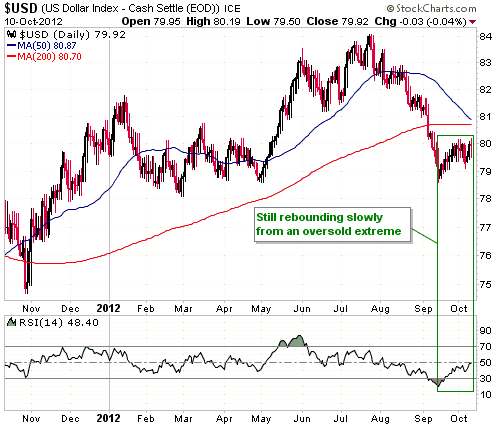
Due to anticipatory buying and selling, by the time the Fed announced its new QE
program on 13th September the markets that benefit from QE were already at
'overbought' extremes and the US$ (the market that is most clearly hurt by QE)
was already at an 'oversold' extreme. It's therefore not surprising that the
immediate reaction to the QE announcement has been followed by a few weeks of
consolidation, with the QE beneficiaries having a modest downward bias and the
Dollar Index having a modest upward bias.
The Dollar Index is no longer 'oversold', although it could gain another point
or so without calling into question the idea that the rebound from September's
low will be followed by a decline to a new multi-month low.
Update
on Stock Selections
Notes: 1) To review the complete list of current TSI stock selections, logon at
http://www.speculative-investor.com/new/market_logon.asp
and then click on "Stock Selections" in the menu. When at the Stock
Selections page, click on a stock's symbol to bring-up an archive of
our comments on the stock in question. 2) The Small Stock Watch List is
located at http://www.speculative-investor.com/new/smallstockwatch.html
 Keegan
Resources (TSX: KGN, NYSE: KGN). Shares: 76M issued, 83M fully diluted. Recent
price: US$3.62 Keegan
Resources (TSX: KGN, NYSE: KGN). Shares: 76M issued, 83M fully diluted. Recent
price: US$3.62
KGN announced an updated resource estimate for its Ghana-based Esaase gold
project on Wednesday 10th Oct. The update was extremely positive. The previous
estimate (September-2011) for the total resource was 5.19M ounces (3.64M M&I
plus 1.55M Inferred) at an average grade of 1.1-g/t, using a cut-off grade of
0.40-g/t. The new estimate for the total resource is slightly lower at 5.08M
ounces (3.83M M&I plus 1.25M Inferred), but the average grade is about 60%
higher (1.73-g/t versus 1.1-g.t) and the cut-off grade is 100% higher. So, we
are now dealing with a 5M-ounce open-pit-able gold resource that starts at
surface and has a very healthy average grade of 1.73-g/t. This appears to be an
economically-robust gold deposit.
The next milestone for KGN will be the completion of a revised Pre-Feasibility
Study (PFS) in early 2013. The revised PFS will be based on the updated resource
estimate mentioned above and selective mining of high-grade zones (as opposed to
the bulk mining on which the original PFS was based).
KGN shares gained 16% on Wednesday in reaction to the updated resource estimate,
but if anything this was an under-reaction. Unless the overall gold sector fares
much worse than expected, KGN should be a good performer in the stock market
over the next few months.
In last week's Interim Update we said that KGN was a good candidate for new
buying in the low-$3 area. It is still a good candidate for new buying -- now in
the mid-$3 area.
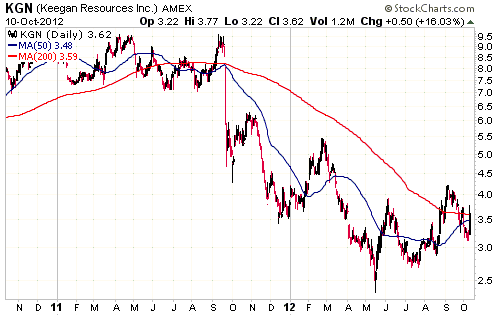
Chart Sources
Charts appearing in today's commentary
are courtesy of:
http://stockcharts.com/index.html
http://bigcharts.marketwatch.com/

|









