|
- Interim Update 10th November 2010
Copyright
Reminder
The commentaries that appear at TSI
may not be distributed, in full or in part, without our written permission.
In particular, please note that the posting of extracts from TSI commentaries
at other web sites or providing links to TSI commentaries at other web
sites (for example, at discussion boards) without our written permission
is prohibited.
We reserve the right to immediately
terminate the subscription of any TSI subscriber who distributes the TSI
commentaries without our written permission.
Yokohama "Lockdown"
An
APEC (Asia-Pacific Economic Cooperation) meeting began a few days ago
in Yokohama, Japan, and will continue for a few more days. To give you
an idea of the massive wastage of resources and the disruption caused
by such high-profile rendezvous of government representatives, here is
a brief report from a friend of ours who happens to live in the area
where the meeting is taking place:
"Apec has descended upon
us here in Yokohama. Approximately 9 minutes walk from my apartment is
where all the action has and still is taking place. Mr Obama and other
world leaders will arrive on Friday and the Minato Mirai area is awash
with thousands of police and security officials. Cars and vans -- in
fact all kinds of vehicles -- are being stopped and searched, as are
pedestrians and their belongings. Security has been high for several
weeks, however last night on a shopping expedition within the one-mile
radius I witnessed the full impact.
There are more than a
hundred police vehicles including coaches, vans, cars, bikes, and even
police boats in the harbour, all with flashing red lights. Occasional
sirens are blaring away in several directions. Police with flashlights
are searching bushes and every nook and cranny they come across. Dozens
of well-built men wearing dark suits and the telltale wires dangling
from their ears to inside their jackets, all appearing to be talking to
themselves.
On Friday when Air Force
One lands I am sure the skies will be buzzing with fighter jets and
helicopters, and SWAT teams will take up positions on the rooftops of
the surrounding buildings.
Taxi drivers and others I
have spoken to in my very broken Japanese have suffered over the past
few weeks with heavy traffic restrictions and a general invasion of
their day to day lives."
Bond Market Update
The
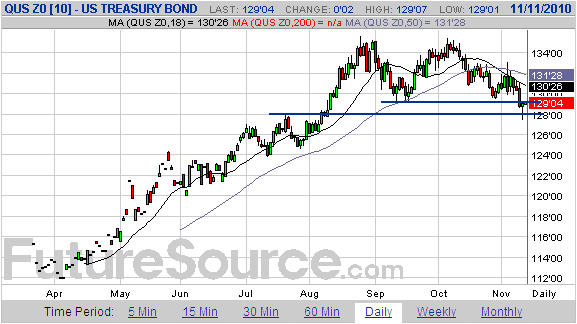
December T-Bond futures contract has support at 129 and 128, as
indicated on the following daily chart. The market closed marginally
below the higher of these support levels on Tuesday and then spiked
below the lower support on Wednesday before reversing upward. A
short-term bottom was possibly put in place on Wednesday.
These counteracting forces create the potential for T-Bonds to rally
enough to make deflation forecasters feel vindicated, although the
rally -- if it occurs -- won't have anything to do with deflation.
Instead, if it happens it will most likely be due to the combination of
Fed buying (the Fed plans to buy around $100B of treasuries per month
over the next 8 months) and fears that the most fiscally-challenged
euro-zone governments will soon default on their debts.
We continue to believe that the best way to 'play' the bond market is
to steer clear of it. That is, it is best to be neither short nor long
the T-Bond.
The Stock Market
The
stock market has a remarkable ability to ignore threats, which can lead
to losses for anyone who identifies a threat early and then takes a
position in anticipation of an appropriate stock-market reaction.
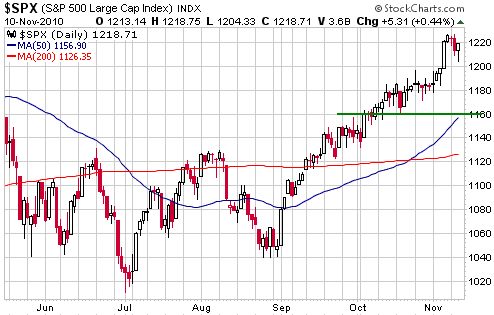
The following chart shows that the S&P500 Index has short-term
support at 1160. A normal pullback would test this support, but right
now the market seems very reluctant to pull back. We are reminded of
the final few weeks of the 2007 up-trend.
Gold and
the Dollar
Gold and Silver
A high-level central banker causes a stir by uttering a 4-letter word (gold)
Gold is no longer money, but it could resume its monetary role in the
future. In fact, part of the long-term bullish case for gold involves
its eventual return as money.
We are a very long way from the point where money is, again, gold or as
good as gold. However, a tiny step in the right direction was taken
early this week when Robert Zoellick, President of the World Bank,
suggested the reintroduction of gold into the monetary system. In a
Financial Times op-ed piece, Zoellick said that a new system should
involve today's major currencies (the dollar, the euro, the yen, the
pound, and a freely exchangeable renminbi) and should consider using
gold as an "international reference point of market expectations about inflation, deflation and future currency values."
Zoellick's idea is extremely vague and seems to entail the use of gold
as some sort of official yardstick within a modified version of the
current monetary system, which actually wouldn't be a significant
improvement over what we have today. This is definitely not something
to get excited about and is not even a reason for much optimism, but as
the saying goes: a journey of a thousand miles begins with a single
step.
Current Market Situation
The most interesting price action of late has been in the silver
market. Silver rose steadily during September, but volatility began to
increase in October. Last week, the price trajectory turned parabolic.
The result was that in US trading on Tuesday morning (9th November) the
silver price reached $29.30, which meant that it had gained about 30%
in only six weeks and was more extended relative to its 10-week moving
average than it had been at any time over the past 10 years.
Spectacular price advances in the commodity futures markets invariably
prompt the futures exchanges to increase margins, which the Chicago
Mercantile Exchange (CME) did on Tuesday. This provided the catalyst
for a sharp downward reversal in silver that spilled over into other
markets, but it should be noted that the sort of price action seen in
the silver market prior to the margin increase will always lead to a
sharp downward reversal. The only question is when. If the margin
increase hadn't occurred then silver's parabolic rise could perhaps
have continued for a few more days, but not for much longer.
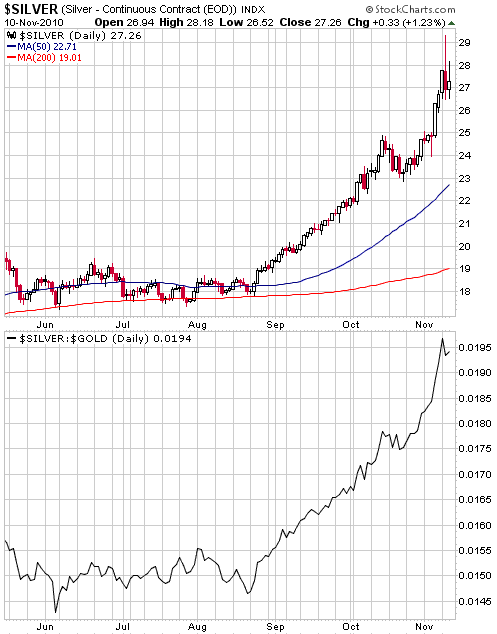
Although silver's downward reversal was impressive, there is no
evidence yet that an intermediate-term peak is in place. In particular,
the top section of the following chart shows that while there were big
intra-day swings over the past two days, on a daily closing basis there
has not been a price decline of sufficient magnitude to signal a
lasting peak. Also, the bottom section of the following chart shows
that on a daily closing basis the pullback in the silver/gold ratio has
been fairly minor to date.
We suspect that gold,
silver and the silver/gold ratio will reach intermediate-term peaks
within the next 2.5 months, but probably not until December-January. We
also suspect that there will be more margin increases before prices top
out.
Gold Stocks
In the email sent to subscribers following Tuesday's market action, we wrote:
"Gold and silver stocks
rocketed upward on Monday and continued upward at the beginning of
trading on Tuesday, before reversing direction. Tuesday's action,
comprising an initial surge and then a downward reversal, could aptly
be described as dramatic, with most senior gold/silver stocks trading
2-3 times their average daily volumes and many juniors trading 5-10
times their average daily volumes. In general, the stocks that had run
up the fastest over the past couple of weeks fell the most on Tuesday.
During Monday and the
early part of Tuesday, we did what we normally do in response to rapid
price advances: we built up our cash reserve. This happened
automatically due to the filling of above-the-market sell orders that
had been placed with the aim of catching upward spikes. In other words,
there was no need for us to watch the intra-day market action. The next
step in the on-going process will be to put some of this cash back to
work in gold/silver stocks after prices retreat to near support levels,
mostly by placing below-the-market buy orders designed to catch
downward spikes. As explained numerous times over the years, the idea
is to scale in during the purges, scale out during the surges, and then
'rinse and repeat', all the while maintaining a substantial core
position in synch with the long-term bullish trend.
For the HUI, a logical target for the current pullback is former resistance (now support) at 520.
The price action over the
first two days of this week provided a good example of the increasing
volatility that we've warned would occur as gold, silver and the
related mining stocks approached intermediate-term peaks. More drama is
likely over the next couple of months."
The HUI rebounded on Wednesday, which opens up the possibility that the
'correction' was a single-day event and that the short-term upward
trend has already resumed. However, Tuesday's downward reversal was
accompanied by such heavy trading volume that there will more likely be
at least a few days of consolidation before the rally resumes in
earnest.
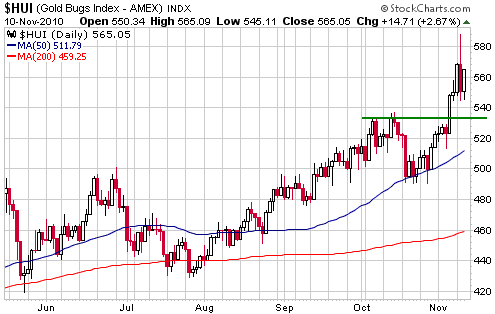
In our email alert we said that support at 520 was a logical target for
the pullback. As indicated on the following daily chart, there is also
some support in the mid-530s that could limit the decline.
To state the obvious: a daily close by the HUI above Tuesday's
intra-day high of 588 would confirm that the correction had ended.
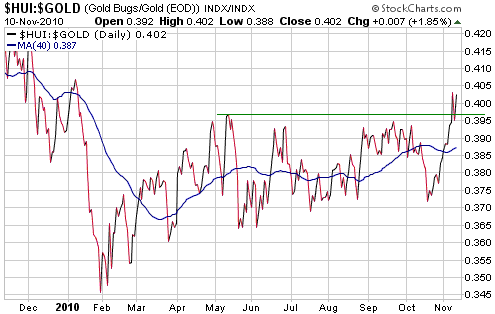
Something that could
easily have been lost amongst this week's topsy-turvy price action is
that the HUI/gold ratio finally exceeded its May-2010 peak. This
removes the only remaining bearish divergence of note and increases the
probability that new highs will be seen within the coming month.
Currency Market Update
The Long-Term Trend
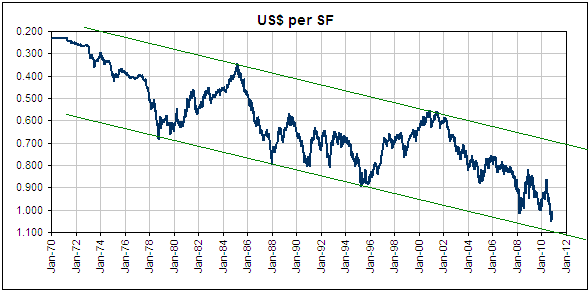
We've been showing versions of the following long-term chart in TSI
commentaries for about 8 years. When we first showed the chart it was
to help make the point that the US dollar's bear market had a long way
to go, but the chart's message is now very different. Now, the chart
indicates that the US dollar's bear market could be almost complete.
The chart shows the Swiss-Franc/US$ exchange rate with an inverted
scale, which means that the line on the chart rises when the US$ is
strengthening against the SF and falls when the US$ is weakening
against the SF. Since 1970 there has been a very long-term trend
towards US$ weakness against the SF (as befitting the SF's lower rate
of inflation), but within the context of this very long-term trend
there have been major cyclical advances and declines. Furthermore, the
pattern from 1970 through to the present has entailed US$ declines
lasting 8-10 years interspersed with US$ advances lasting about 6
years. If the pattern continues then an 8-10 year decline is nearing
completion.
There is no guarantee
that the pattern will continue. In fact, a reasonable argument could be
made that with a committed inflationist at the helm of the Federal
Reserve and a dangerous mixture of socialists and corporatists running
the US Federal government, the US$ is destined to move well below the
bottom of its long-term channel. However, we think it is more likely
that the dollar (in SF terms) will remain channel-bound, for the same
reason that the channel has defined the dollar's progress for the past
40 years. The reason is that no government wants a relentlessly strong
currency. All governments operate under the mistaken belief that
persistent currency strength creates economic drag, so if their
currency appreciates beyond a certain point their efforts to weaken it
tend to expand until eventually a major trend reversal occurs.
Right now the fundamental backdrop doesn't support the idea that the
US$ is about to embark on a 6-year advance, but when a major trend is
in its embryonic stage its fundamental drivers usually aren't obvious.
Also worth mentioning is that even if the dollar is close to a major
bottom, the bottoming process could last 1-2 years. For example, the
dollar's first major post-1970 decline ended in October of 1978, but a
consistent new upward trend didn't begin until about two years later.
In the mean time, there was a huge rally in the gold market.
Current Market Situation
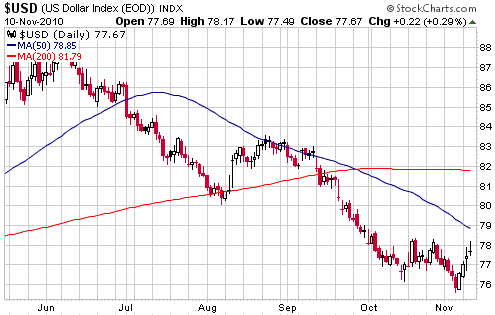
The following daily chart shows that there has been a 2-point rebound
in the Dollar Index from its early-November low. A routine
counter-trend rebound would take the market up to the vicinity of its
50-day moving average, which is now only about 1 point above the
current price.
We are on alert for signs that the Dollar Index's rebound is more than
just the routine counter-trend variety, but we haven't yet seen any.
The currency market remains tied to the stock market, so evidence of an
important US$ bottom is likely to emerge at around the same time as
evidence of an important stock market peak.
Update
on Stock Selections
(Notes: 1) To review the complete list of current TSI stock selections, logon at http://www.speculative-investor.com/new/market_logon.asp
and then click on "Stock Selections" in the menu. When at the Stock
Selections page, click on a stock's symbol to bring-up an archive of
our comments on the stock in question. 2) The Small Stock Watch List is
located at http://www.speculative-investor.com/new/smallstockwatch.html)
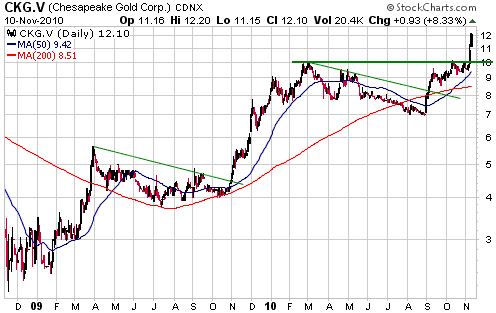
 Chesapeake Gold (TSXV: CKG). Shares: 38M issued, 45M fully diluted. Recent price: C$12.10 Chesapeake Gold (TSXV: CKG). Shares: 38M issued, 45M fully diluted. Recent price: C$12.10
CKG broke above resistance at C$10 on Monday and then moved quickly up to C$12.
We've mentioned in
previous commentaries that we expect CKG's huge Metates gold project in
Mexico to eventually be acquired by a major gold mining company at a
price that equates to more than $20 per CKG share. This is as specific
as we can be, because even though there has been sufficient engineering
done to complete a PEA (Preliminary Economic Assessment), the project's
value will ultimately be determined by whether or not a large-cap
mining company will be prepared to plough a few billion dollars into
mine construction. Moreover, it is not reasonable to assume that just
because the Metates project can be shown to have very robust economics
at current metal prices, the project will necessarily be developed into
a mine.
The reality is that due to financial and physical resource limitations,
there are more elephant-sized (10+ million-oz) gold deposits in the
world than it will be possible to develop into producing mines over the
next several years. One of the challenges for we speculators, then, is
to figure out which junior-owned 'elephants' will attract the senior
miners.
We remain bullish on CKG due to the huge leverage to the gold price
that it offers. However, we are aware of the risk that this leverage is
based on the potential for the project to be developed into a mine and
that mine development may never occur. Furthermore, we think that this
particular risk is greater for CKG's Metates project than for the
elephant-sized Livengood project owned by International Tower Hill
Mines (AMEX: THM). For new buying we would therefore favour THM over
CKG.V, although both stocks are good speculations. Both stocks are also
short-term 'overbought'.
Chart Sources
Charts appearing in today's commentary
are courtesy of:
http://stockcharts.com/index.html
http://www.futuresource.com/

|









