|
- Interim Update 11th January 2012
Copyright
Reminder
The commentaries that appear at TSI
may not be distributed, in full or in part, without our written permission.
In particular, please note that the posting of extracts from TSI commentaries
at other web sites or providing links to TSI commentaries at other web
sites (for example, at discussion boards) without our written permission
is prohibited.
We reserve the right to immediately
terminate the subscription of any TSI subscriber who distributes the TSI
commentaries without our written permission.
The 'problem' of a
flat yield curve
PIMCO's Bill Gross recently wrote:
"If a bank can borrow at near 0% then theoretically it should have no problem making a profit. What is important, however, is the flatness of the yield curve and its effect on lending across all credit markets. Capitalism would not work well if fed funds and 30-year Treasuries perpetually co-existed at the same yield, nor if commercial paper and 30-year corporates did as well. It is not only excessive debt levels, insolvency and liquidity trap considerations that delever both financial and real economic growth; it is the zero-bound nominal yield, the assumption that it will stay there for an "extended period of time" and the resultant flatness of yield curves which are the culprits."
This brief excerpt from Gross's January-2012 "Investment Outlook" reveals some important misconceptions.
First, one indispensable characteristic of capitalism is that all prices are determined by the free market, which means that you can't have capitalism and have an institution (a central bank) with the power to set interest rates. In other words, it makes no sense to say "Capitalism would not work well if fed funds and 30-year Treasuries perpetually co-existed at the same yield" because there would be no fed funds rate under true capitalism.
Like most commentators on the economy and the financial markets, Bill Gross doesn't know what capitalism is. He seems to believe that capitalism involves commercial banks levering up their balance sheets by piggybacking loans on top of reserves provided by a central bank.
Second, the "zero-bound nominal yield" is solely a function of central bank manipulation. In a free market the nominal interest rate would always be comfortably above zero, even during a period of deflation. This is because a dollar in the hand today will always be worth more than the promise of a dollar in the future. Also, in a free market nobody would ever deliberately lend money at a negative real interest rate.
Third, there is no inherent problem with a flat yield curve. In fact, if money were sound, that is, if money typically held or increased its purchasing power over long periods of time, the "yield curve" would usually be flat or almost flat. To put it another way, the steep yield curves witnessed at various times over the past 50 years are due to central bank manipulation of interest rates and the use of inflation-prone money. This doesn't mean that if the money were sound then any particular person or corporation or government could necessarily borrow money for 10 years at the same rate as they could borrow money for 1 month. Differences in short-term and long-term rates would still occur based on borrower-specific considerations, but if there were no credit risk and the money could be relied upon to maintain its purchasing power then long-term interest rates would be roughly the same as short-term interest rates most of the time.
The Stock Market
The US stock market - current situation
For the purpose of this discussion we will define a "volatility surge" as a rise in the VIX to more than 40. Over the past 15 years, after a volatility surge has ended the VIX has always dropped to 18 or lower prior to the start of the next volatility surge. Also of relevance is that the VIX ended up dropping as low as 15 during the declining-volatility periods that followed the 2008 and 2010 volatility surges.
This means that unless it is different this time, the VIX will drop to 18 or lower (possibly as low as 15) prior to the start of the next volatility surge. Another way of putting it is that the VIX will probably move below 18 before the next large stock market decline gets underway.
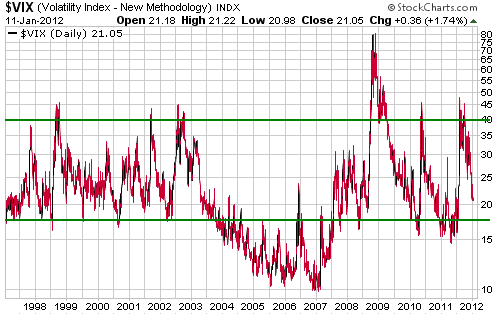
In our money management we tend to approach the market with an if/then perspective. This means that our thinking generally goes something like this: If the market does A then we will do B, if the market does C then we will do D, and if the market does E then we will do F. Applying this line of thinking to the VIX: If the VIX drops below 18 then it will be appropriate to BEGIN scaling into bearish speculations.
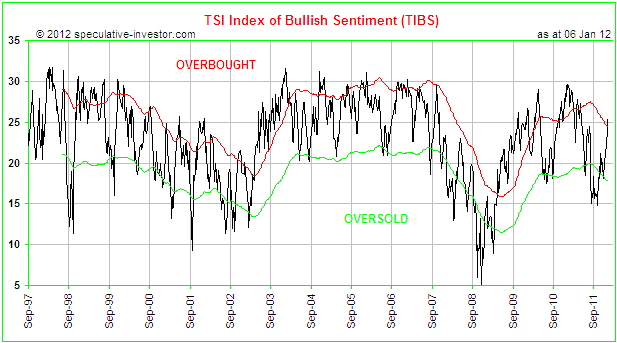
The US stock market is not yet sufficiently 'overbought' to create a low-risk shorting opportunity, but it is getting there. Sentiment, for instance, after having been strongly supportive for a couple of weeks spanning late September through to early October and moderately supportive over the bulk of the final five months of last year, now appears to be overly optimistic considering the economic backdrop. To substantiate this statement we present, below, a chart showing that the TSI Index of Bullish Sentiment (TIBS - a weighted average of six sentiment indicators) has just moved into the top one-third of its normal range. It wouldn't surprise us if TIBS moved a few points higher within the next few months, but the minimum level of optimism required for a substantial downward trend is now in place.
China stock market risk subsides
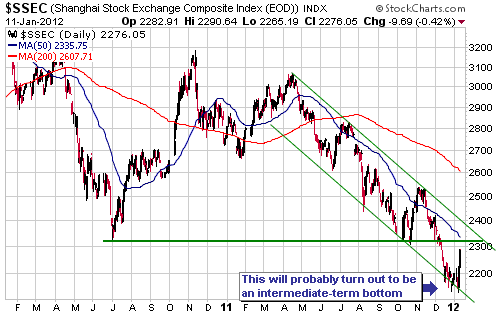
There was a strong rebound in the Shanghai Stock Exchange Composite Index (SSEC) during the first half of this week. Although the following daily chart shows that this week's rebound hasn't pushed the SSEC above resistance of any significance, there is a good reason to believe that China's stock market has just made an intermediate-term bottom. The reason is that China's government has signaled its intention to ease monetary conditions with the express purpose of boosting the stock market. Moreover, monetary conditions have already begun to ease, with year-over-year growth in China's M2 money supply accelerating from 12.7% to 13.6% over the past month.
The following comment from our 5th December 2011 Weekly Update is relevant:
"Although we remain bearish on China's economy, at current prices [the SSEC was at 2360 at the time] we are neither bearish nor bullish on China's stock market. In China, the stock market is not an indicator of anything other than the public's desire to gamble on stocks and the government's desire for stock prices to rise or fall. Stock prices have essentially gone nowhere in China over the past three years because the general desire to gamble in this market has remained at a low level and the government's focus has been elsewhere.
If the SSEC breaks below support at 2300 and continues to decline then at some point the government will almost certainly take action to reverse the trend. This could create a good buying opportunity."
We aren't interested in 'going long' China's stock market right now. The main point we wanted to make is that with the government now taking action to reverse the trend, this is not a good time to be 'short' China's stock market.
Gold and the Dollar
Gold
Here we go again
A few of our readers have expressed concern about a recent article posted by Clive Maund. The article's theme is captured by the following excerpts:
"...the price pattern that is forming in gold, and in silver, looks bearish in the extreme. As we can see on the 2-year chart for gold, a large bearish Descending Triangle has developed since it put in its highs, above a clear line of support at $1520 - $1530. Unless gold can abort the pattern by succeeding in breaking out above its descending upper boundary shown as the red trendline on the chart, then it is destined to break down, which will effectively mark the end of the bullmarket and this implies the onset, or rather the rather the [sic] rapid deepening, of the deflationary downwave that will then engulf many countries that have so far escaped its worst effects such as debt-wracked Britain and the US. If you want to know how bad it will get, you have simply to study what has already occurred in Greece and Spain - and it could get a lot worse than that with food shortages, riots, and cities going up in flames."
"...realization that the Large Specs may be "draining" ahead of a major bearmarket episide [sic] in gold and silver is just a theory, but it certainly fits with the ominous price patterns in gold, silver and the PM stock indices, and also with the horrendous outlook for 2012, which promises to be the year when deflationary forces, held at bay for so long, and magnified by further increases in debt and derivatives, wreak havoc upon world markets and economies."
Oh dear. Every time the gold market experiences an intermediate-term correction it is interpreted as a warning that a deflationary collapse is about to happen.
Rather than imagining how gold's price pattern could evolve and speculating on what it could mean from a fundamental perspective if reality ended up matching the product of our imagination, let's check some real-world fundamental evidence. The fact is that the year-over-year (YOY) rate of growth in US True Money Supply (TMS) is currently about 14%, and that December-2011 was the 36th consecutive month in which the YOY rate of TMS growth was 10% or more. If the YOY rate of TMS growth remains above 10% for two more months, which it almost certainly will, then it will be the longest period of double-digit money-supply growth in US history. To put it another way, the reality is that the US is in the midst of a record-breaking period of monetary inflation.
Could it be that the gold market 'knows' something, such as that the rate of monetary inflation is about to plunge? Based on past performance, the answer is no. Never before has the gold market been prescient in this regard. A classic example occurred during 1976-1980, when the gold price continued to rally for years after the monetary backdrop turned bearish. Another example occurred in 2005-2008, when gold was first slow to react to tight monetary conditions and then continued to fall for two months after the Fed began to flood the financial system with new money.
It should always be kept in mind that charts tell you what has happened, not what is going to happen. Chart patterns are often deceptive. It is not uncommon, for example, for a bullish-looking chart pattern to lead to a bearish outcome and for a bearish-looking chart pattern to lead to a bullish outcome. This doesn't mean that charts can't be put to good use, but the people using them should understand their limitations.
Current Market Situation
Looking back over the past 10 years, the current correction is most similar to those of 2004 and 2006. The similarities are evident on the following three charts (from top to bottom, the charts show the corrections of 2004, 2006 and 2011). The blue line on each chart is the 325-day moving average.
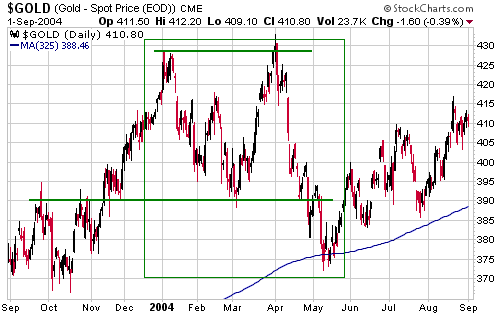
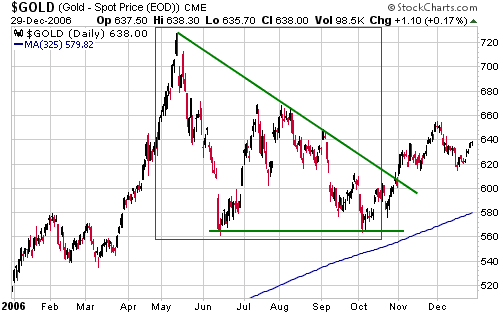
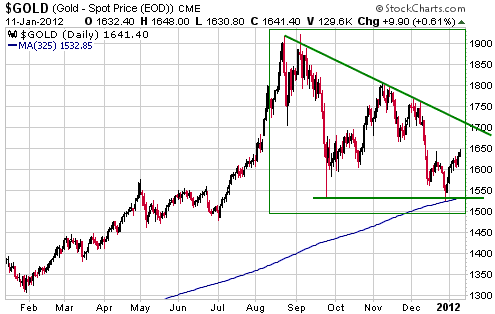
There is no guarantee that the gold market won't get a lot weaker, but at this stage there is no good reason to expect that it will. The price action looks similar to earlier intermediate-term corrections, sentiment over the past few weeks has matched what would typically be seen around an important price low (the above-linked article is a good example of the almost-palpable negativity that has recently been apparent), and there isn't a shred of genuine fundamental evidence to support the assertion that deflation is imminent.
That being said, the relatively low-risk short-term buying opportunity in both gold and silver bullion that we identified in late December no longer exists. That's especially so with silver, which traded as low as $26 on 29th December and has since rebounded to around $30.
Bank stocks and gold
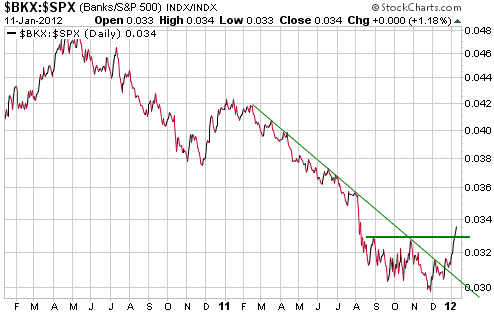
The BKX/SPX ratio (the banking sector relative to the broad stock market) is an indicator of the underlying trend in the gold market, in that gold tends to strengthen when bank stocks are relatively weak and weaken when bank stocks are relatively strong. BKX/SPX generally isn't useful as a leading indicator for gold, because important turning points in the BKX/SPX ratio often occur at around the same time as important turning points in the gold market; however, the performance of BKX/SPX can help us understand why gold has done what it has done.
The following chart shows that BKX/SPX began to build a base in August of last year and has just completed its basing pattern. Clearly, bank stocks have bottomed on an intermediate-term basis relative to the broad stock market, which goes at least part of the way towards explaining why gold is immersed in an intermediate-term correction.
Note that the BKX/SPX chart doesn't tell us the likely duration of the banking sector's period of relative strength.
Gold Stocks
Big picture comment
Many people view the gold sector's performance over the past year as inexplicable, which has caused them to fall back on various manipulation theories. A point we have tried to make is that far from being inexplicable, the gold sector's performance during the current long-term bull market continues to be similar to its performance during the only other long-term gold-stock bull market of the post-gold-standard era (the bull market of the 1960s-1970s). The same point was recently made by Jordan Roy-Byrne
in the article posted HERE. So, the main reason that gold stocks haven't yet lived up to the expectations of many people is that the expectations have been unrealistic.
Based on the gold sector's performance during the secular bull market of the 60s-70s as well as on the way other (non-gold) secular bull markets have unfolded, the next major multi-year advance in the gold sector will probably begin within the next 12 months. It could begin very soon, but it could also begin as late as the final quarter of this year.
Current Market Situation
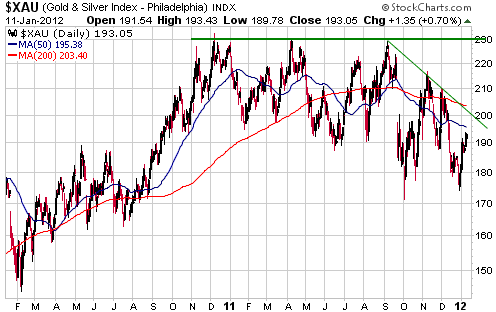
The following daily chart shows that the XAU has rebounded by around 10% since its late-December bottom. Even if the late-December low proves to be the intermediate-term variety (as per our current outlook), the next multi-week peak will likely be followed by a decline that retraces at least 50% and possibly as much as 100% of the initial rally. Based on past performance, a two-thirds retracement of the initial rally is most likely.
We don't have a strong opinion on where the initial rally will peak. However, the XAU has considerable resistance at 195-205, so it won't surprise us if the initial rally peaks within this range.
Currency Market Update
We have nothing new to say about the currency market, so we'll just reiterate our view that the Dollar Index is probably close to a short-term peak. This is particularly so in terms of time, because a short-term US$ peak will most likely be in place by early February even if the debt-crisis news out of Europe prompts a final blow-off to the downside in the euro.
Based on the way gold has recently traded, a near-term blow-off decline in the euro that pushed the Dollar Index up to 83-85 would probably NOT result in gold bullion breaking below its December low.
Update
on Stock Selections
Notes: 1) To review the complete list of current TSI stock selections, logon at
http://www.speculative-investor.com/new/market_logon.asp
and then click on "Stock Selections" in the menu. When at the Stock
Selections page, click on a stock's symbol to bring-up an archive of
our comments on the stock in question. 2) The Small Stock Watch List is
located at http://www.speculative-investor.com/new/smallstockwatch.html
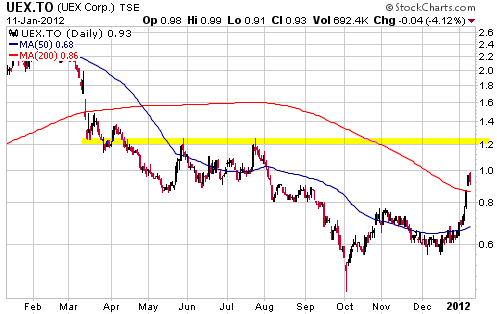
 UEX Corp. (TSX: UEX). Shares: 203M issued, 219M fully diluted. Recent price: C$0.93 UEX Corp. (TSX: UEX). Shares: 203M issued, 219M fully diluted. Recent price: C$0.93
It was recently reported in the Canadian press that UEX's CEO, Graham Thody, had bought 444,500 shares on the open market over the past month. Details on the insider buying of UEX shares can be found
HERE.
Significant on-market buying by a company's CEO is generally a positive sign, and the market's reaction to this positive sign is the most plausible explanation for the sharp rise in UEX's stock price over the past week.
The following chart shows that UEX's stock price will meet significant resistance in the C$1.20s if the rally continues. Depending on your overall positioning and the amount of buying you did at lower levels, it could make sense for you to take some money off the table if UEX moves up to near C$1.20 in the near future.
Pretium Resources (TSX: PVG). Shares: 87M issued, 92M fully diluted. Recent price: C$15.63
PVG's relative strength over the past 12 months has been remarkable, in that it has risen by around 140% while most exploration-stage gold mining stocks have fallen by at least 30%.
Prior to this week, PVG's relative strength was due to the following:
a) The company has the best combination of management, mineral deposit and balance sheet in the junior gold/silver mining sector.
b) Despite the attributes listed in a), the company was significantly under-valued by the market 12 months ago.
c) Exploration and engineering work over the past year substantially increased the size and economic potential of the high-grade component of PVG's Snowfield-Brucejack project.
The catalyst for this week's surge was news that PVG will list on the New York Stock Exchange on 12th January. The NYSE listing should lead to additional demand for the shares, especially after it becomes clear that the junior gold mining sector has commenced a new intermediate-term advance.
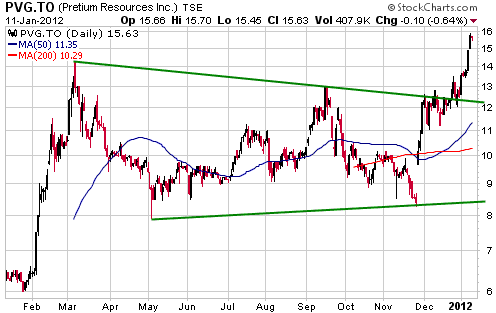
For stocks such as PVG about which we are long-term bullish, our strategy involves trading around a core position. This means that we routinely add to our position during extreme weakness and do some selling into extreme strength, all the while maintaining significant exposure in line with our long-term bullish outlook. With PVG, it's time to consider doing some selling.
Things to take into account:
- Depending on the overall market environment the NYSE listing could prompt additional gains during the final two trading days of this week, but it's possible that the near-term effect of this news has already run its course.
- C$18 is the chart-based target created by the recent upside breakout. This is highest level that PVG could reasonably be expected to reach in the near future (the next couple of weeks).
- An updated preliminary economic assessment (PEA) for the Brucejack project is scheduled to be complete within the next two months. The updated PEA will likely show very positive economics.
Batero Gold (TSXV: BAT). Shares: 53M issued, 67M fully diluted. Recent price: C$2.05
BAT is in the TSI Small Stocks Watch
List.
BAT is expected to announce the first resource estimate for its Batero-Quinchia project in Colombia before the end of this month. There's a good chance that the resource estimate will reveal that BAT is under-valued, which creates the potential for a quick upward re-rating of the stock in the near future.
Chart Sources
Charts appearing in today's commentary
are courtesy of:
http://stockcharts.com/index.html

|









