- Interim Update 11th January 2017
Copyright
Reminder
The commentaries that appear at TSI
may not be distributed, in full or in part, without our written permission.
In particular, please note that the posting of extracts from TSI commentaries
at other web sites or providing links to TSI commentaries at other web
sites (for example, at discussion boards) without our written permission
is prohibited.
We reserve the right to immediately
terminate the subscription of any TSI subscriber who distributes the TSI
commentaries without our written permission.
Our financial
performance in 2016
We don't attempt to provide a
one-size-fits-all portfolio, because such a thing doesn't exist in the
real world. Instead, we provide investing and speculating ideas. Most of
these ideas are in the form of stocks and options listed at the TSI Stock
Selections page, although we sometimes mention ideas that don't get
included in the formal list.
From the emails we have received over
the years and from common sense, we know that different subscribers use
the information presented at TSI in different ways and in doing so achieve
very different results. Results will vary depending on the
money/risk-management techniques that are employed (not being a portfolio,
the TSI stocks/options list doesn't incorporate the money-management
techniques that should be used when speculating or investing) and on the
specific TSI ideas that are put into practice. We therefore can't report a
percentage gain or loss that an individual would have achieved by using
the TSI information. The best we can do is report our own performance.
We own most, but not all, of the stocks included at the TSI Stock
Selections page, and there are positions that we take in our own accounts
that never get mentioned at TSI. However, the opinions espoused and the
positions (stocks and options) mentioned at TSI generally reflect what we
are doing with our own money.
At around this time last year we
reported that over the course of 2015 our equity portfolio (stocks,
options, warrants and cash in brokerage accounts) had a net gain of 8.5%
in US$ terms, which was neither a good result nor a disaster. Performance
in 2016 was much better, thanks primarily to our gold-stock exposure.
2016 was a triple-digit year for us, meaning that our equity portfolio
had a net gain of more than 100% in US$ terms. However, our performance
was given a hefty boost late in the year by our participation in a pre-IPO
financing* that wasn't available to the general public and had a lot more
to do with luck than good judgment. In the absence of this boost we would
have achieved a net gain of 75% over the course of the year. We view this
lower figure as a better indication of performance. We certainly could
have done better given the spectacular profit-generating opportunities
that arose within the equity sectors that we were focused on, but we are
reasonably satisfied considering that the gain was achieved whilst
maintaining an average cash reserve of 35%-40%.
By far the biggest
positive contributor to the aforementioned result was the huge rally in
the gold-mining sector during the first half of the year (the rally from
the January-2016 bottom was the gold-mining sector's largest 6-month
advance from a multi-year low in at least the past 50 years). We
substantially underperformed the gold-mining indices and ETFs during the
first half of the year because, as is our practice, we began the selling
process too early. Specifically, by the time the HUI reached the 230s at
the end of April we had already cut our gold-stock exposure in half, with
a lot of the selling having taken place by mid-March when the HUI was in
the 180s. We therefore left plenty of money on the table during the first
half, but this conservatism stood us in good stead during the second half
of the year. During the second half of the year we substantially
outperformed the gold-mining indices and ETFs due to our cash buffer and
strength in some of our non-gold commodity stocks.
*FYI, the stock is Patriot One Technologies (PAT.V), which quickly
rose from a pre-IPO financing level of C$0.15 to C$1.50. The company is
developing a microwave-based system that enables the non-invasive and
convenient detection of concealed weapons.
Comparing China and US
monetary inflation
It's interesting to compare
China's rate of monetary inflation with the US rate of monetary inflation,
which is what we've done in the following chart. The chart shows the
changes in the supplies of Yuan and US dollars since 2000, with both money
supplies scaled to have a starting value of 100.
The US banking
system (the central bank plus the commercial banks) hasn't been shy about
creating new money, but its inflationary efforts pale in comparison with
those of its Chinese counterpart. For example, from January-2000 to
November-2016 the US money supply expanded by about 350% and China's money
supply expanded by about 900%.
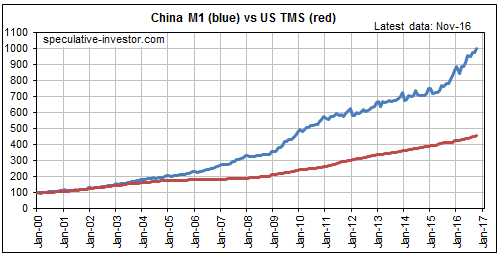
Notice that the gap between the money supplies of China and the US has
widened at an accelerated pace over the past two years. This means that
China's government has only been paying lip service to reining-in the
country's credit bubble and the associated investment bubbles.
The
bottom line: China's inflation problem is destined to become bigger and
the Yuan is destined to become weaker.
The uranium revival
continues
The price of uranium (U3O8) has
rebounded from an ultra-depressed level of around US$18/pound to around
$23/pound. At $23/pound the price is still so low that almost all uranium
mining would be unprofitable, but this fact hasn't prevented
uranium-mining equities from 'going on a tear' over the past two weeks.
The news-related excuse for the enthusiasm is that the uranium production
of Kazakhstan, the country that accounts for about 40% of global
uranium-mining output, will be reduced by 10%.
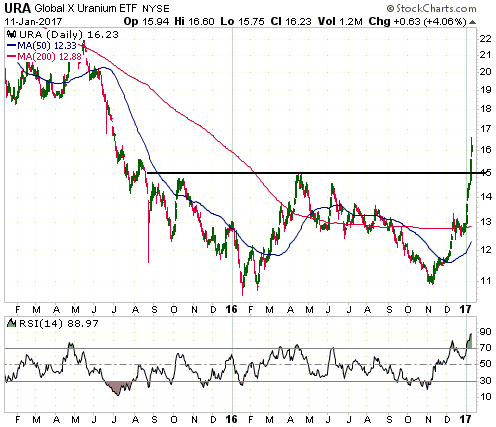
URA, an ETF proxy
for the uranium-mining sector of the stock market, is up by 25% since the
beginning of the year and up by 50% since last November's low. This is
URA's most impressive rally in years.
URA is obviously 'overbought'
on a short-term basis, but it has broken out from a long-term base and is
likely to gain additional ground before making a peak that holds for more
than a few weeks. The top of the base (former resistance) near $15 should
now act as support during a routine correction.
There is a URA position in the TSI Stocks List. This position will be
exited if URA trades at $19 within the coming 4 weeks.
The Stock Market
The US
The surge in the NASDAQ100 Index (NDX) continued unabated over the first
three days of this week. The NDX has now risen for 7 days in a row,
although as indicated by the RSI at the bottom of the following daily
chart it is only slightly 'overbought'.
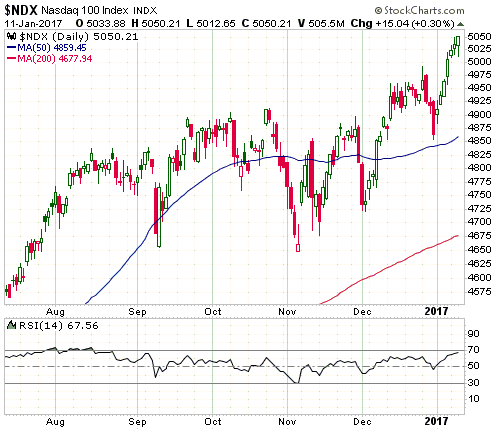
It looks like the US stock market will not reach a short-term top
until the financial news networks have had the opportunity to celebrate
"Dow 20,000". Wednesday's close was within 50 points of this milestone.
The UK
The recent surge in the NDX pales in
comparison with the recent surge in London's FTSE100 Index.
As
illustrated below, the FTSE has been on an incredible run. It has just
risen for 12 days in a row, on 16 of the past 17 days and on 22 of the
past 25 days. The nearly-uninterrupted 5-week ramp to the upside has
resulted in the FTSE's daily RSI equaling its 10-year high, indicating
that on a short-term basis the market is now as 'overbought' as it has
been at any time over the past 10 years.
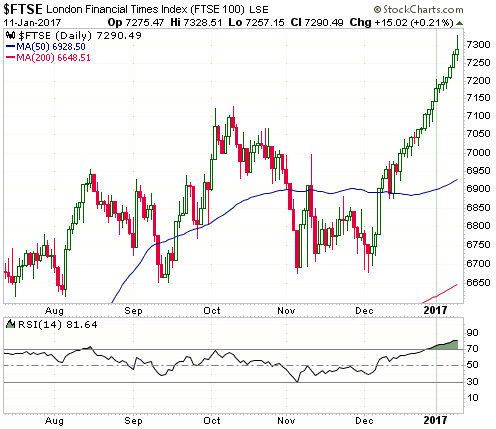
There were two other times over the past 10 years that the FTSE's
daily RSI got as high as it is today (the low-80s) and they were both in
the first half of 2013. The first time it happened was in January-2013,
after which the market experienced a minor 1-2 week pullback before
resuming its advance. The second time it happened was in May, after which
the market suffered a substantial (around 15%) 1-month decline to below
its 200-day MA. Refer to the following daily chart for more detail.
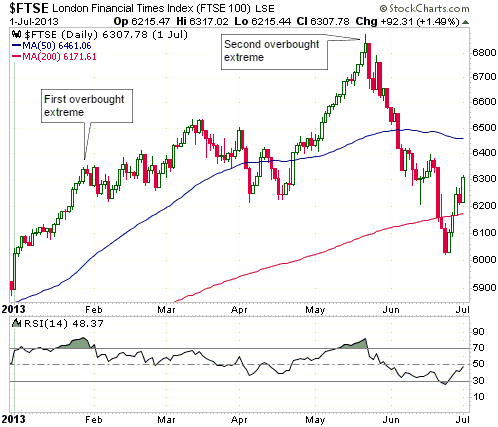
The difference between the minor correction following the January-2013
overbought extreme and the far more serious correction following the
May-2013 overbought extreme was evident from the first day of the
correction, in that the day of the May-2013 peak was immediately followed
by a large single-day decline. We will be on the lookout for a similar
signal over the days ahead.
Gold and the Dollar
Gold
2017 Forecast
Our 2016 forecast
for gold bullion was:
"We expect that there will be a sustained
turn to the upside from a Q1-2016 low, but that the upward trend over the
remainder of the year will be choppy and that gold will end the year with
a net gain of 'only' 10% (or thereabouts). This would be similar to what
happened in 2000-2001, which appears to be the best analog to the present
situation."
This expectation was close to the mark, as gold
turned upward from a first-quarter low and ended the year with a gain of
8.7%.
Annual forecasts always involve more guesswork than analysis,
but last year's gold forecast was relatively straightforward. This was
because the speculative net-long position in Comex gold futures had
recently fallen to its lowest level in more than 10 years and because the
fundamental backdrop was neutral and seemingly set to turn bullish within
the ensuing 1-2 months. This made it very likely that gold had either
already bottomed or would soon do so, with an intermediate-term rally to
follow. At the same time, the historical record suggested that a massive
price gain was unlikely.
This year's forecast is anything but
straightforward. Prior to year-end we wrote that a strong Q1 rebound was
likely (an expectation that is in the process of being met), but the
set-up for a longer-term rally is not YET in place. In particular, the
fundamental backdrop is currently bearish -- albeit not as bearish as it
was a month ago -- and the sentiment situation is nowhere near as
constructive as it was at this time last year.
We therefore expect
that the December-2016 low ($1125) will be breached during the second or
third quarter of 2017. Beyond that, our only expectation is that a very
important bottom will be put in place for the US$ gold price before
year-end in parallel with a major top for the Dollar Index.
Current Market Situation
The US$
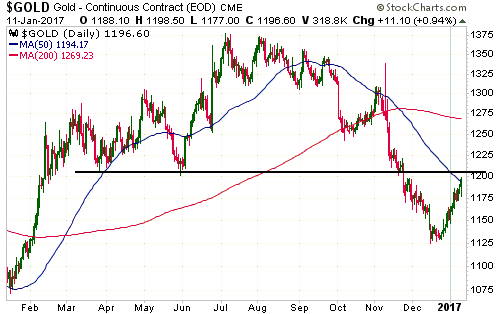
gold price was expected to rise at least far enough during the first
quarter of this year to test resistance near $1200. As evidenced by the
following daily chart, this minimum upside target has essentially been
reached.
The fact that the minimum target was achieved with no
significant interruptions to the rally makes it more likely that our
maximum upside target for the Q1 rally will be achieved. Our maximum
upside target is the 200-day MA, which is presently near $1270.
We
expect a 1-2 week consolidation beginning within the next few days
followed by a resumption of the rally.
Gold Stocks
2017
Forecast
Our 2016 forecast for the gold-mining sector (as
measured by the HUI) was:
"After the US$ gold price turns
upward, the gains achieved by the gold-mining indices are likely to
greatly outstrip the gains achieved by gold. This is consistent with what
happened in the past and with the dramatic relative weakness of the
gold-mining indices over the past few years.
We expect that the HUI
will gain at least 50% within two months of a major Q1-2016 bottom and end
the year at least 100% above whatever low it makes during the first
quarter."
As it turned out, the HUI bottomed in Q1 (19th
January, to be precise), gained a lot more than 50% within two months of
the bottom and ended the year 83% above the low it made during the first
quarter (it ended the year at 182 and the first quarter low was 99). Our
expectation for the year-ending level was therefore slightly too
optimistic, although we revised our outlook in the 4th May Interim Update
when the HUI was at 210. At that time we wrote: "...our guess is that
the HUI will end this year within 15% of its current level." This
guess (that's all it was) turned out to be correct.
Turning to the
forecast for 2017, prior to the start of this year we wrote that a strong
rebound was in store for the gold-mining sector during the first quarter
of 2017. The rebound is expected to take the HUI to at least 220 and
possibly as high as 250.
The gold-mining sector should again
outperform gold, although this year's outperformance will not be as
pronounced as last year's and will have a different driver. Whereas last
year's strength in the gold-mining sector relative to gold bullion was
primarily driven by the enormous declines in gold-mining stocks relative
to gold over the preceding few years (it was largely a catch-up), the main
reason for this year's outperformance will be general strength in
commodity-related equities. That is, we expect the gold-mining sector to
be supported by a broad-based rise in the demand for commodity plays.
Performing better than gold bullion probably won't, however, lead to
substantial 12-month returns for the gold-mining indices. A reasonable
expectation is that the Q1 rebound will be followed by a choppy market
over the remainder of the year.
By "choppy" we mean that there will
be no major trends, although we expect that there will be tradable swings
in both directions. One of these tradable swings is likely to result in
the December-2016 low (160) being tested or perhaps even undercut during
the second or third quarter of the year, but we do not expect the
January-2016 low (99) to be tested.
Our guess is that the HUI will
end 2017 at 200 +/- 10%. This is obviously not an exciting forecast, but
our goal is to be realistic rather than exciting.
Aside from the
trading opportunities presented by the sector-wide swings from
'overbought' to 'oversold' and back again, we expect that 2017 will
generate excellent opportunities to profit from large rises in the prices
of individual gold-mining juniors. But unlike the first three quarters of
last year when a lot of 'turkeys' flew to great heights, this year the
gold-mining sector will be more of a stock-picker's market.
Current Market Situation
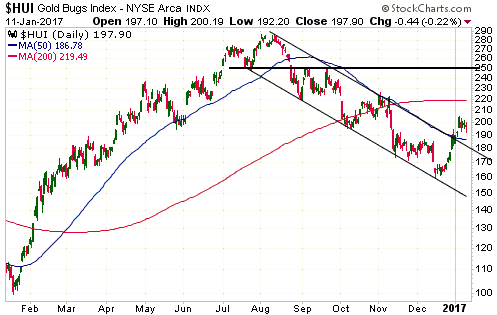
Since
breaking decisively above the top of a well-defined channel on Thursday
5th January, the HUI has consolidated. We expect that the consolidation
will be limited on the downside by the 50-day MA (currently at 186 and
beginning to turn upward) and be followed by a rise to around 220.
The Currency Market
The euro didn't follow
through on its December break below major support at 105, opening up the
possibility that the downside breakout was the false kind (a bullish
signal). However, it hasn't yet done enough on the upside to confirm that
December's downside breakout was false. To do so it must achieve a solid
close above 106.
We continue to anticipate a short-term euro
rebound to as high as 109.5 prior to the resumption of the currency's
longer-term bearish trend.

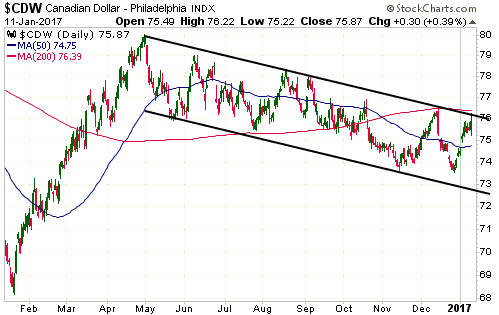
The Canadian dollar (C$) has just returned to the top of the channel
that has defined its performance since the end of April last year. This
means that it is now in an interesting position. It is about to either
break out to the upside and potentially rise to test last year's peak near
80 or reverse downward and begin working its way back to its channel
bottom. Note that an upside breakout would be indicated by a daily close
above 76.4.
We don't have an opinion on which way the C$ will break over the days
ahead. A lot will depend on what happens to the US stock market, because
the commodity-price strength that is helping the C$ appears to be linked
to strength in the US stock market.
Updates on Stock Selections
Notes: 1) To review the complete list of current TSI stock selections, logon at
http://www.speculative-investor.com/new/market_logon.asp
and then click on "Stock Selections" in the menu. When at the Stock
Selections page, click on a stock's symbol to bring-up an archive of
our comments on the stock in question. 2) The Small Stock Watch List is
located at http://www.speculative-investor.com/new/smallstockwatch.html
 Exiting
the Energy Fuels warrants (TSX: EFR.WT)
Exiting
the Energy Fuels warrants (TSX: EFR.WT)
Last September we
added the Energy Fuels (EFR.TO, UUUU) warrants to the TSI List at C$0.61.
The warrants have an exercise price of US$2.45 and an expiry date of
September-2021.
Based on the mid-point of the 11th January closing
bid-offer spread (C$1.24-C$1.40), these warrants are up by 116% since
being added to the List. They have more than 4.5 years of remaining life
and huge long-term upside potential, so there is no urgency to sell.
However, to reflect our view that the rapid run-up in the prices of
uranium-mining equities is beginning to create opportunities to take some
money off the table, we are going to remove the EFR warrants from the TSI
List and record the gain.
Note that if you own the EFR warrants but
not the underlying stock, it would probably make sense to retain the
warrants.
Chart Sources
Charts appearing in today's commentary
are courtesy of:
http://stockcharts.com/index.html