|
- Interim Update
11th June 2014
Copyright
Reminder
The commentaries that appear at TSI
may not be distributed, in full or in part, without our written permission.
In particular, please note that the posting of extracts from TSI commentaries
at other web sites or providing links to TSI commentaries at other web
sites (for example, at discussion boards) without our written permission
is prohibited.
We reserve the right to immediately
terminate the subscription of any TSI subscriber who distributes the TSI
commentaries without our written permission.
TANSTAAFL
and the present-future tradeoff
When the central bank lowers interest rates in an effort to
prompt greater current spending it brings about a wealth transfer
from savers to speculators of various stripes. While this is
unethical, in economics terms it isn't the main issue. The main
issue, and the reason that monetary stimulus doesn't work as
advertised, is TANSTAAFL (There Ain't No Such Thing As A Free
Lunch). At a very superficial level (the level at which all
Keynesian economists operate) the interest-rate suppression policies
appear to provide a free, or at least a very cheap, lunch, but the
bill ends up being much higher than it would have been if it had
been paid up front.
The likes of Bernanke, Yellen and Draghi admit that their so-called
"monetary accommodation" hurts savers in the present, but they claim
that the benefits to the overall economy outweigh the disadvantages
to savers. Central bankers are apparently -- at least in their own
minds -- endowed with a god-like wisdom that both enables and
entitles them to determine who should become poorer and who should
become richer, all with the aim of elevating the economy. For
example, here's
how the ECB justified last week's reductions to interest rates
from already-absurdly-low levels:
"The ECB's interest rate decisions will...benefit savers in the
end because they support growth and thus create a climate in which
interest rates can gradually return to higher levels."
And:
"A central bank's core business is making it more or less
attractive for households and businesses to save or borrow, but this
is not done in the spirit of punishment or reward. By reducing
interest rates and thus making it less attractive for people to save
and more attractive to borrow, the central bank encourages people to
spend money or invest. If, on the other hand, a central bank
increases interest rates, the incentive shifts towards more saving
and less spending in the aggregate, which can help cool an economy
suffering from high inflation. This behaviour is not specific to the
ECB; it applies to all central banks."
Only the final sentence of the above excerpt is true (it's true that
the ECB is just as bad as other central banks). In order to believe
the rest, you must have a poor understanding of economic theory.
'Time' is the most important element that central bankers are either
deliberately or accidentally ignoring when they make the sort of
statements included in the above ECB quote. Increased saving does
not mean reduced spending; it means reduced spending on consumer
goods in the present in exchange for greater spending on consumer
goods in the future. By the same token, reduced saving does not mean
increased spending; it means increased consumer spending in the
present in exchange for reduced consumer spending in the future.
Isn't it obvious that this tradeoff between current and future
consumer spending will happen most efficiently and for the greatest
benefit to the overall economy if it is allowed to happen naturally,
that is, if interest rates are allowed to reflect peoples' actual
time preferences? To put it another way, isn't it obvious that if
people are in a financial position where it makes sense for them to
increase their saving (reduce their current spending on consumer
goods) in order to repair balance sheets that have been severely
weakened by excessive prior consumer spending, then the worst thing
that a policymaker could do is put obstacles in the way of saving
and create artificial incentives for additional borrowing and
consumer spending?
It obviously isn't obvious, because monetary policymakers around the
world continue to do the worst things they could do.
The Stock Market
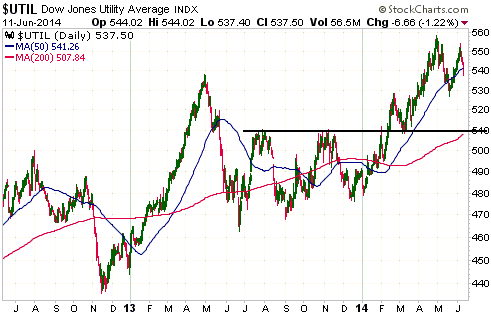
In the US stock market, the Dow Utility Average (UTIL) confirmed
an intermediate-term trend reversal (from up to down) last month when it closed
below its 50-day MA. As is often the case, the confirmation of the downward
trend reversal happened when the market was 'oversold'. This set the stage for a
rebound, which appears to have just run its course.
UTIL has strong support at around 510 (see chart below). We suspect that this
support will be tested within the next two months.
We've said that the Russian stock market is the only broad stock market that we
are interested in being 'long', but there is one other stock market that appears
to offer a sufficiently bullish risk/reward to warrant a long position. We are
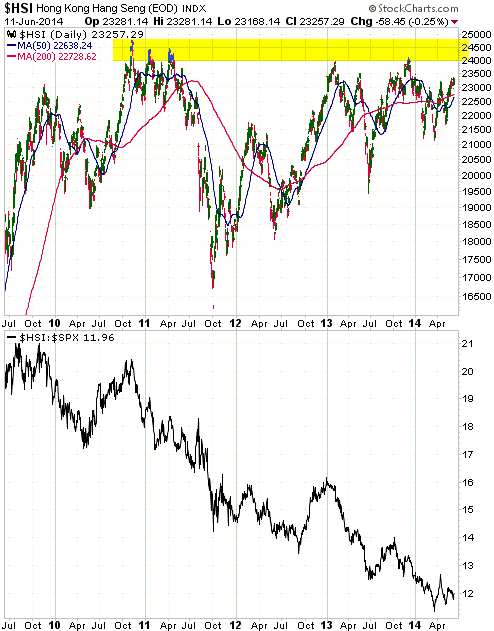
referring to the Hong Kong stock market, as represented by the Hang Seng Index (HSI).
The HSI has essentially traded sideways over the past four years (refer to the
top section of the following chart) in what could be a long-term continuation
pattern within a secular bull market. This sideways price movement combined with
earnings growth has resulted in the Hong Kong stock market attaining an
attractive valuation in price/earnings terms (current P/E is about 12) and
price/book terms (current price/book is about 1.5). Furthermore, the sideways
movement in the Hong Kong market combined with the upward trend in the US market
has resulted in a 5-year decline in the HSI/SPX ratio (refer to the bottom
section of the following chart) and a valuation for the HSI that is roughly half
the current valuation of the SPX.
The HSI is likely to outperform the SPX by a wide margin over the next few years
and could also provide satisfactory absolute returns.
Gold and the Dollar
Gold and Inflation Expectations
All else remaining the same, an increase in inflation expectations will be
bullish for gold. However, all else never remains the same. A more generally
correct statement regarding the relationship between gold and inflation
expectations is: it is bullish for gold when inflation expectations rise
relative to nominal interest rates and bearish for gold when inflation
expectations fall relative to nominal interest rates, regardless of whether
inflation expectations are rising or falling in absolute terms.
Consequently, a decline in inflation expectations could be linked to increasing
UPWARD pressure on the gold price as long as nominal interest rates were falling
at a faster pace than inflation expectations, and a rise in inflation
expectations could be linked to increasing DOWNWARD pressure on the gold price
as long as nominal interest rates were rising at a faster pace than inflation
expectations. By the same token, a rise or a fall in nominal interest rates
could be associated with upward or downward pressure on the gold price,
depending on what was happening at the time to inflation expectations.
A simpler way of phrasing the above is: Low or declining real interest rates are
bullish for gold and high or rising real interest rates are bearish for gold,
where the real interest rate is the nominal interest rate minus the EXPECTED
rate of money depreciation. The word "expected" is put in capitals to emphasise
the fact that the quantity that must be deducted from the nominal interest rate
to come up with today's real interest rate is not a measure of PREVIOUS
purchasing-power loss, such as the CPI. Instead, it's the amount of
purchasing-power loss that the 'market' thinks will happen in the future that
must be used to determine the real interest rate. In other words, the way that
most analysts calculate the real interest rate is wrong.
That being said, most of the time it won't matter whether the real interest rate
is estimated by using a measure of how much purchasing power was lost by money
over the past 12 months or by using a measure of how much purchasing power the
market expects money to lose in the future. The reason is that most of the time
there won't be much difference between what happened to money purchasing power
over the past 12 months and what the market expects to happen to money
purchasing power over the next 12 months. There will, however, be a big
difference at major turning points. For example, inflation expectations (as
indicated by the yield spread between standard Treasury notes and Treasury
Inflation Protected Securities) began to move upward at a rapid pace in January
of 2009, but the CPI's 12-month rate of change maintained a downward trend until
July of 2009.
Moving on, we expect that nominal US interest rates on 2-year through to 30-year
Treasury securities will be lower at the end of the year than they are today. If
this outlook for nominal interest rates is correct then the real interest-rate
backdrop will become increasingly bullish for gold over the next 6 months as
long as there is not a significant decline in inflation expectations. Higher
inflation expectations will not be required.
Gold and Gold Stocks
Current Market Situation
Gold and the HUI need to close back above $1280 and 220, respectively, to
confirm that the short-term trend has reversed from down to up, but as noted in
the email alert sent to subscribers after Tuesday's trading session there is
evidence that a short-term bullish scenario is developing.
Here's a repeat of what we wrote in the aforementioned email:
"There is nothing in the price action of gold, silver or the HUI to suggest
that this week's bounce is anything more than a counter-trend move within a
continuing short-term downward trend. However, the outperformance of the junior
end of the gold sector, as indicated by the GDXJ/GDX ratio, has gone from
interesting to dramatic. Furthermore, GLDX, a proxy for exploration-stage
juniors, has also begun to outperform GDX, and both GDXJ and GLDX have just
closed above their 50-day moving averages for the first time since March.
Significant upside in gold and the HUI is needed soon -- ideally within the next
few days -- to confirm the bullish signals being sent by GDXJ and GLDX. In the
absence of near-immediate confirmation there will remain plenty of uncertainty
as to whether a turning point has finally been reached, but the evidence as it
stands right now is enough to shift our short-term outlooks for gold and gold
stocks (basis the HUI) back to "bullish"."
And here's a daily chart of GDXJ showing this week's break above the 50-day MA:
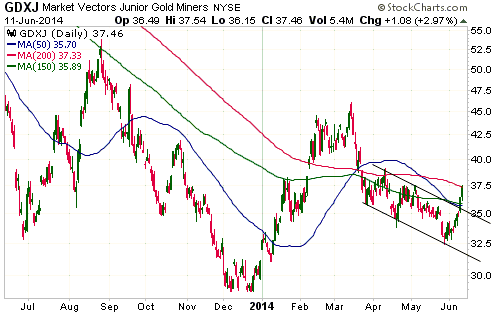
Note that GDXJ has also broken decisively above its 150-day MA, but at this
stage hasn't quite managed to get above its 200-day MA. Instead, it ended
Wednesday's session right at this longer-term MA.
The HUI hasn't yet broken above the first resistance of importance (see chart
below), but GDXJ has been leading to both the upside and the downside so it is
normal that the HUI is lagging.
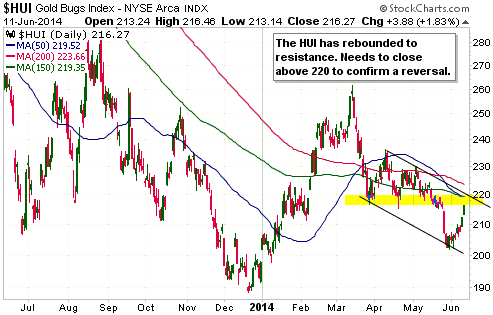
IF our short-term view change is correct then it should be validated within the
next few days via daily closes above $1280 (for gold) and 220 (for the HUI). In
other words, it shouldn't take long for the market to indicate whether our
stance is right or wrong.
JPM's Gold Derivatives
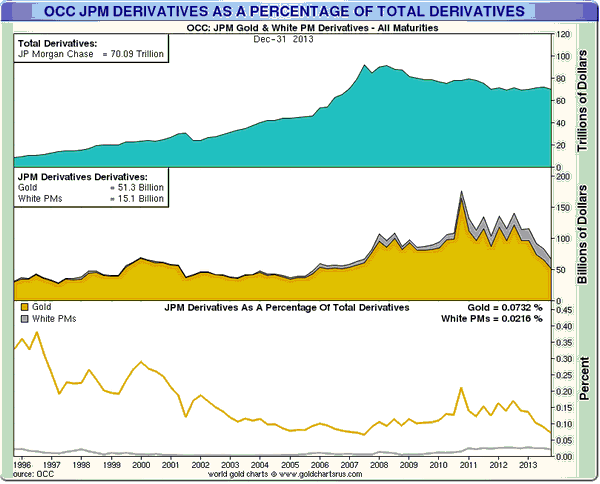
There is an amazing collection of charts at
Sharelynx.com. Charts showing notional values of derivatives are recent
additions to this collection and included in these is the following chart
showing, from top to bottom, the notional value of JP Morgan's total
derivatives, the notional value of JPM's gold derivatives, and the ratio of
JPM's gold derivatives to its total derivatives. Notice that JPM's exposure to
gold-related derivatives is less than one tenth of one percent of its total
derivatives exposure, and that gold's relative importance has declined over the
past 18 months from what was already an insignificant level.
Given this information, how much time do you guess that JPM's senior management
devotes to the gold market?
If your answer is "very little", then you are probably correct. If your answer
is "a tiny fraction of the time that manipulation-focused bloggers and
newsletter writers spend pontificating on JPM's gold-and-silver-related
activities", then you are probably also correct.
Updates
on Stock Selections
Notes: 1) To review the complete list of current TSI stock selections, logon at
http://www.speculative-investor.com/new/market_logon.asp
and then click on "Stock Selections" in the menu. When at the Stock
Selections page, click on a stock's symbol to bring-up an archive of
our comments on the stock in question. 2) The Small Stock Watch List is
located at http://www.speculative-investor.com/new/smallstockwatch.html
 We
are adding a short-term position in Endeavour Mining (EDV.TO, EVR.AX) to the TSI
List at Wednesday's closing price of C$0.77. The stock broke below support at
C$0.75 a couple of weeks ago, but there was no follow-through to the downside
and it is now beginning to strengthen along with the gold-mining sector. A daily
close above C$0.80 would confirm an upward reversal and suggest that a move to a
new high for the year was underway. We
are adding a short-term position in Endeavour Mining (EDV.TO, EVR.AX) to the TSI
List at Wednesday's closing price of C$0.77. The stock broke below support at
C$0.75 a couple of weeks ago, but there was no follow-through to the downside
and it is now beginning to strengthen along with the gold-mining sector. A daily
close above C$0.80 would confirm an upward reversal and suggest that a move to a
new high for the year was underway.
We perceive short-term upside potential of about 50%. For this potential to be
maintained, EDV must not close below C$0.71.
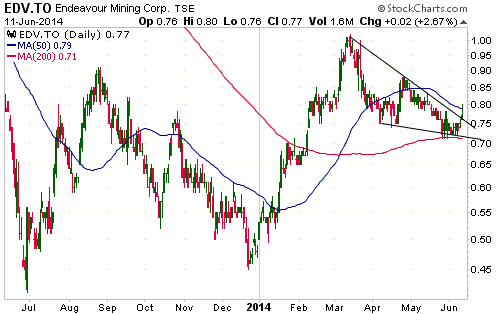
Chart Sources
Charts appearing in today's commentary
are courtesy of:
http://stockcharts.com/index.html

|









