|
- 12 June, 2002
The US
Stock Market
Current Market Situation
We always try to avoid reading explanations
of why the markets did what they did on any given day, but we couldn't
help notice the headlines following yesterday's modest recovery in the
stock indices. Apparently, stocks rallied as a result of a rumour that
Microsoft, the world's biggest supplier of PC software, was going to pre-announce
higher profits for this quarter. We thought this was quite funny since
a) 2 months ago MSFT surprised the market by lowering its guidance for
the current quarter, and b) Intel, the world's biggest supplier of PC hardware,
just lowered its guidance last week. If Intel's business is worse than
it was 2 months ago, how could MSFT's possibly be better? Is MSFT now forcing
the PC manufacturers to install 2 copies of Windows in every PC?
MSFT's balance sheet is so strong and
accounting regulations are so flexible that the MSFT senior management
will be able to report whatever profit they want to report. It's just ridiculous
to think that there has been a significant improvement in the PC business
since last week when Intel lowered its revenue and gross margin forecasts.
From a technical perspective things
are now getting interesting for MSFT (see chart below). In the latest Weekly
Update we said that a rebound to $55 would present another good opportunity
to buy put options on this stock. The stock closed at $55.54 on Wednesday
and the January-2003 $45 put options are now back below $3.00 (they closed
at $2.85). The stock is selling at 10-times sales and 40-times earnings,
so the downside risk is huge from a valuation perspective. Now is a reasonable
time to buy (the put options, that is, not the stock).

In the latest Weekly Update we included
a decisionpoint.com chart that compared the NASDAQ100 Index with the NASDAQ100
volatility index. The chart emphasised that although the NASDAQ100 had
moved down to near last year's low, volatility had not spiked higher.
The following chart comparing the S&P100
Index (OEX) with the OEX Volatility Index (VIX) tells a similar story.
Volatility has remained at a fairly low level even though the OEX is getting
perilously close to last September's low. This provides further confirmation
of our view that a plunge below the September-21 low is going to occur
before this decline is over.
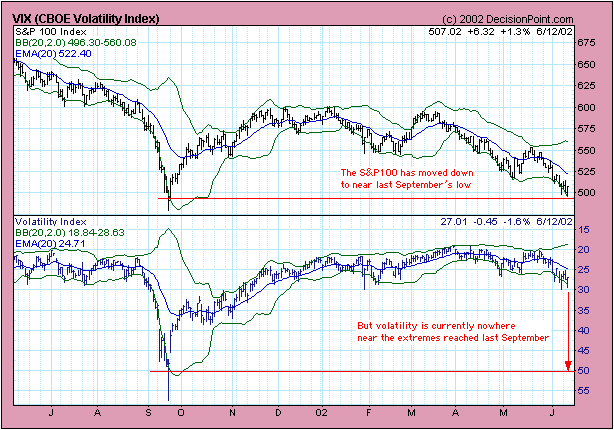
We haven't yet seen the sort of spike
in volatility that would be associated with a major bottom and put-option
volumes remain low (put/call ratios have been high but this has resulted
more from a lack of call buying than from heavy put buying). However, there
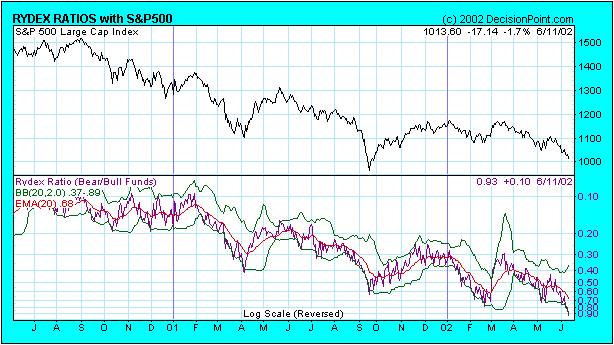
are some signs that sentiment is approaching a bearish extreme. For example,
the Rydex Ratio, which measures the amount of money in Rydex bear funds
relative to the amount of money in Rydex bull funds, has moved up to 0.93
(see chart below). In other words, there is now almost as much money in
bear funds as there is in bull funds. As recently as January of 2001 there
was only 9c in bear funds for every dollar in bull funds.
We still don't know the answer to the
question: Will the market plunge immediately or will we get an intervening
rally before it plunges? What we do know is that the trend is down and
there is no evidence that the trend is about to change.
Gold and
the Dollar
A Comparison of Gold Stock Valuations
Below is a rough and ready comparison
of eight of the world's largest gold producers ranked in order of PE ratio
(lowest to highest). Note that:
a) We've estimated production, revenue
and earnings for 2002 based on information provided by the companies or
by annualising the results from the latest quarterly reports.
b) The figures for Kinross Gold assume
that the takeovers of TVX and Echo Bay have already been completed, that
is, we've assumed that TVX and Echo Bay will make a full year's contribution
to KGC's results.
c) Estimates are based on a gold price
of $300
d) Since AEM is expected to show a
large increase in production and a large reduction in costs during 2003
we've used, in this comparison, the projected 2003 production and the consensus
2003 earnings estimate for AEM.
e) The "cash costs" reported by companies
can be misleading. For example, most of the large NA producers have consistently
reported much lower cash costs than their SA counterparts yet the major
SA producers have been far more profitable. For example, ABX has, over
the past two years, generally reported a "cash cost" to produce an ounce
of gold that is much lower than the costs reported by Harmony and Gold
Fields, yet ABX would have made no profit over this period without the
help of its hedge program. Harmony and Gold Fields, on the other hand,
have been able to generate healthy profits even though they have sold all
of their gold at the spot price. To get around this difference in accounting
we calculate a mining company's cost to produce an ounce of gold as follows:
We subtract reported earnings from reported revenue to get a total, all-in
cost figure. We then divide this total cost by the number of ounces produced
to get a cost per ounce.
| Name |
Symbol |
Recent Price (US$) |
Market Cap (US$M) |
2002 Prod (Koz) |
2002 Rev ($M) |
2002 Earnings ($M) |
Cost per oz prod (US$) |
Reserves (M oz) |
Mkt Cap $ per oz reserves |
Price/ Sales |
Price/ Earnings |
| Harmony Gold |
HGMCY |
14.38 |
2,416 |
3,000 |
900 |
212 |
229 |
42 |
58 |
2.7 |
11.4 |
| Gold Fields |
GFI |
12.48 |
5,866 |
4,324 |
1,350 |
392 |
222 |
83 |
71 |
4.3 |
15.0 |
| Anglogold |
AU |
29.40 |
6,350 |
5,500 |
1,500 |
356 |
208 |
59 |
108 |
4.2 |
17.8 |
| Kinross Gold |
KGC |
2.32 |
2,102 |
2,000 |
600 |
80 |
260 |
19 |
111 |
3.5 |
26.3 |
| Goldcorp |
GG |
10.38 |
2,221 |
600 |
164 |
75 |
148 |
5 |
444 |
13.5 |
29.6 |
| Agnico Eagle |
AEM |
15.33 |
1,272 |
400 |
120 |
40 |
200 |
4 |
318 |
10.6 |
31.8 |
| Newmont |
NEM |
29.00 |
9,860 |
7,500 |
2,500 |
170 |
311 |
97 |
102 |
3.9 |
58.0 |
| Barrick Gold |
ABX |
20.24 |
10,909 |
5,500 |
1,912 |
188 |
313 |
82 |
133 |
5.7 |
58.0 |
Below is the same comparison, but this
time the estimates have been based on a gold price of $400. Once again
the companies have been ranked in order of PE ratio. Note that we haven't
accounted for the adverse effects that hedging will have on the earnings
of ABX, AU and NEM if the gold price rises to $400. ABX's hedge book in
particular will be a major detractor from earnings during a substantial
gold rally. We also haven't accounted for the increase in reserves that
would occur due to a higher gold price.
| Name |
Symbol |
Recent Price (US$) |
Market Cap (US$M) |
2002 Prod (Koz) |
2002 Rev ($M) |
2002 Earnings ($M) |
Cost per oz prod (US$) |
Reserves (M oz) |
Mkt Cap $ per oz reserves |
Price/ Sales |
Price/ Earnings |
| Harmony Gold |
HGMCY |
14.38 |
2,416 |
3,000 |
1,197 |
420 |
|
|
|
2.0 |
5.8 |
| Gold Fields |
GFI |
12.48 |
5,866 |
4,324 |
1,796 |
704 |
|
|
|
3.3 |
8.3 |
| Anglogold |
AU |
29.40 |
6,350 |
5,500 |
1,995 |
703 |
|
|
|
3.2 |
9.0 |
| Kinross Gold |
KGC |
2.32 |
2,102 |
2,000 |
798 |
219 |
|
|
|
2.6 |
9.6 |
| Newmont |
NEM |
29.00 |
9,860 |
7,500 |
3,325 |
748 |
|
|
|
3.0 |
13.2 |
| Barrick Gold |
ABX |
20.24 |
10,909 |
5,500 |
2,543 |
630 |
|
|
|
4.3 |
17.3 |
| Agnico Eagle |
AEM |
15.33 |
1,272 |
400 |
160 |
68 |
|
|
|
8.0 |
18.8 |
| Goldcorp |
GG |
10.38 |
2,221 |
600 |
218 |
113 |
|
|
|
10.2 |
19.7 |
In both of the above comparisons Harmony
is the clear winner. In fact, it offers the best value in terms of market
cap relative to production, market cap relative to reserves, price relative
to sales and price relative to earnings. This doesn't guarantee that the
Harmony stock price will out-perform the stock prices of the other major
gold producers over the coming 6 months, but it sure doesn't hurt.
The 1970s Road Map
There is no point in looking at what
happened over the past 20 years as a guide to what is going to happen over
the remainder of this decade. The secular bull market in financial assets
that dominated the markets during the 1980s and 1990s has ended and new
secular trends are emerging. Based on evidence gathered over the past two
years these new trends will encompass a strengthening gold price and a
weakening US$. As a result of the massive inflation that has occurred over
the past few years and the requirement of the world's monetary authorities
to keep the supply of fiat currency expanding at all costs, two other trends
that will almost certainly become apparent as the current decade progresses
are the trends towards higher interest rates and commodity prices. So,
we think it is fair to say that the first decade of this century will have
a lot more in common with the 1970s than with either the 1980s or 1990s.
As such, in an attempt to develop some sort of road map regarding what
we should expect to happen over the next few years it makes some sense
to look at what happened during the 1970s. With this concept in mind we
have, over the past several weeks, done a couple of comparisons between
the rally in gold stocks that began at the major bottom in November of
2000 and the gold stock rally that began at the major bottom in January
of 1972.
The below chart shows how the current
rally in the HUI (AMEX Gold BUGS Index) is proceeding relative to the great
gold stock rally of 1972-1974.
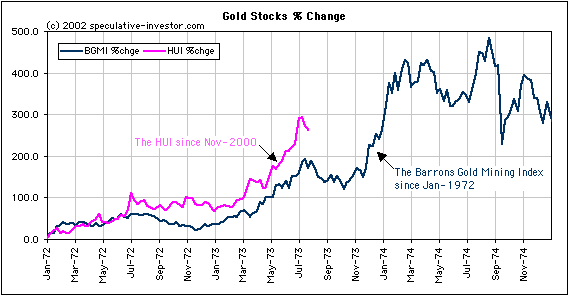
At this stage of the 72-74 rally there
was a 3 month correction followed by an almost vertical rise. If a similar
situation developed now we would see gold stocks drift lower into late-August
and then rocket higher during the September-November period. Since gold
stocks have been traveling in the opposite direction to both the US$ and
the overall stock market a 3-month correction in gold stocks would be unlikely
to occur unless there was a 3-month recovery in the Dollar and the stock
market.
Multi-month counter-trend moves in
the gold, stock and currency markets at this time would mesh almost perfectly
with our original forecasts for this year (we forecast that the biggest
downward moves in the Dollar and stocks and the biggest upward move in
the gold price would occur during the final few months of the year). However,
although a prolonged correction in the gold market would not be unusual
given the preceding strength and the huge speculative long positions that
will need to be unwound at some point, we can't envisage the stock market
or the US$ beginning multi-month recoveries from current levels. As such,
the odds favour the current correction in the gold market being considerably
shorter than 3 months.
It is probably going to be over much
sooner but we suggest keeping late-August in mind as a worst case end-date
for the current correction in the gold market. This is a correction in
an on-going bull market, but bull markets never make it easy for investors
to hang on for the ride. Peter Lynch, one of the most successful mutual
fund managers of all time, said that during the period when he managed
Fidelity's Magellan Fund more people lost money investing in this fund
than made money despite the fund's exceptional performance. This is because
a lot of people would always jump into the fund after a period of high
returns and exit after experiencing a significant draw-down.
Current Market Situation
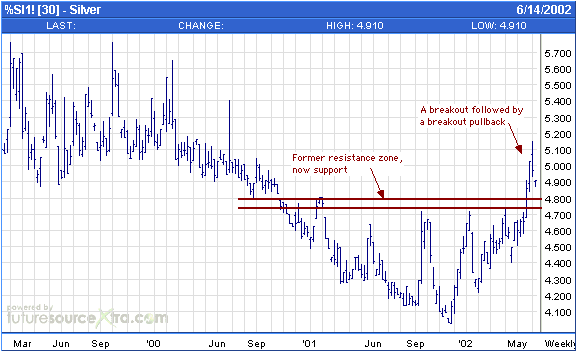
Because it recently achieved a major
upside breakout the silver market is currently a good gauge of the underlying
strength in the precious metals market. In particular, if the current pullback
in the silver price finds support at, or above, the previous resistance
in the 4.75-4.80 range (we think it will), then all we are seeing is a
normal breakout pullback that will soon be followed by a run-up to 5.80.
The major gold stocks might have bottomed
on Tuesday morning, but even if they did it is not reasonable to expect
them to surge straight back to their late-May highs. The stocks were pushed
sharply higher by momentum traders, most of whom would have been washed-out
during the decline of the past 2 weeks. A period of what is commonly referred
to as "backing and filling" is probably now required before the next rally
begins.
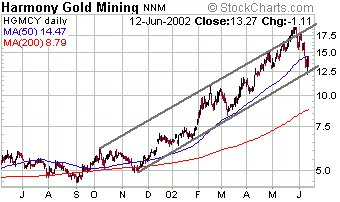
Harmony Gold Mining traded as low as
$12.15 on Tuesday and closed at $13.27 yesterday. This means that buyers
at the current price are paying about 10-times earnings for one of the
best-managed, fastest-growing companies in a growth industry. Although
there are no guarantees that it won't become even better value in the short-term,
investors who want to buy it but are waiting for even lower prices are
really pushing their luck.
Update
on Stock Selections
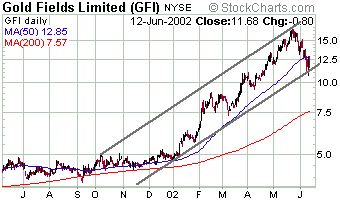
Below are charts of HGMCY and GFI.
Both stocks tested their short-term up-trends earlier this week.
We were stopped out of 2 of our commodity
stocks over the past few days, OXY for a 16% profit and CRU for a 23% loss.
CRU's exit from the Portfolio is unfortunate because the company is probably
going to report some good news relating to its Nalunaq gold project at
some point over the next few weeks. C'est la vis.
Bob Moriarty at www.321gold.com recently
posted an article that includes a few paragraphs about American Bonanza
(TSX: BZA), a speculative gold stock that was added to the Portfolio last
month. Here is the link to Bob's article: http://www.321gold.com/editorials/moriarty/moriarty060902.html
BZA is a highly leveraged play on
the gold price, but anyone who wants even more leverage can buy the BZA
warrants that began trading earlier this week (BZA.WT). The warrants expire
in 2 years and the exercise price is C$0.15 during the first year and C$0.17
during the second year. With BZA trading at $C0.20 the warrants are worth
around C$0.09. BZA can be likened to a call option on the gold price, so
these warrants are like a call option on a call option on the gold price!
We've previously mentioned the Resolute
Mining options that trade on the ASX under the symbol RSGO. They have 3
years to expiry, have an exercise price of A$0.80 and are a reasonable
speculation at the current price of A$0.27.
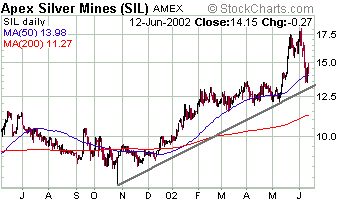
Apex Silver continues to look good
from both fundamental and technical perspectives.
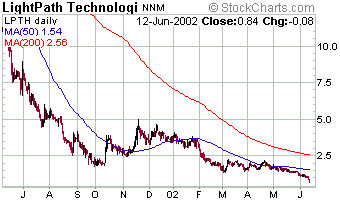
LightPath Technologies (LPTH) looks
horrible from a technical perspective, but looks great from a fundamental
valuation perspective. The stock market is 100% about value, but over the
short and even the medium-term there is often a large gap between objective
value (what a company should be worth based on its earnings, cashflow,
assets, management, etc.) and subjective value (what investors are willing
to pay for the company). These gaps are always closed...eventually. LPTH
will remain under pressure as long as the downtrend in the optical communications
sector continues, but we expect the trend in this sector to reverse sharply
higher at some point over the next few months.
By the way, in order to take full advantage
of the bull market in gold stocks you will need to be able to trade on
the Canadian stock exchanges. Canadian stocks can be bought/sold from most
countries, but not every broker provides such a service.

|









