|
- Interim Update 12th June 2013
Copyright
Reminder
The commentaries that appear at TSI
may not be distributed, in full or in part, without our written permission.
In particular, please note that the posting of extracts from TSI commentaries
at other web sites or providing links to TSI commentaries at other web
sites (for example, at discussion boards) without our written permission
is prohibited.
We reserve the right to immediately
terminate the subscription of any TSI subscriber who distributes the TSI
commentaries without our written permission.
The Stock Market
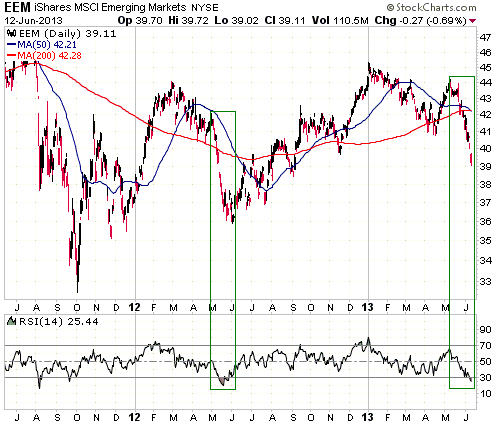
Displayed below is a daily chart of EEM, an ETF designed as a
proxy for emerging-market equities. Apart from a deceptive 'head fake' to the
upside during April of this year, EEM's performance over the past few months
looks eerily similar to its performance during the first half of last year.
We have no interest in going 'long' the emerging-market ETF at this time, but if
we were 'short' (we aren't) we would now be getting ready to exit.
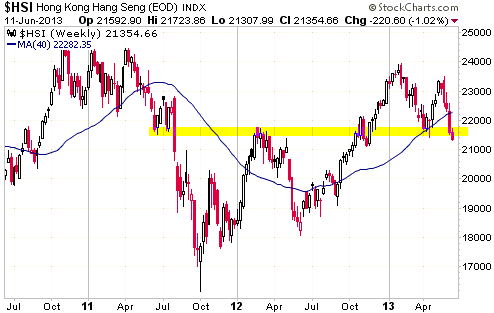
Next up is a weekly chart of Hong Kong's Hang Seng Index (HSI). The HSI broke
below support at 21,500 and made a new low for the year on Wednesday 12th June,
thus leaving no doubt that the early-2013 high was the intermediate-term
variety. However, it is working on its 5th weekly decline in a row and is
sufficiently 'oversold' to suggest that a short-term bottom will be in place by
the end of this month.
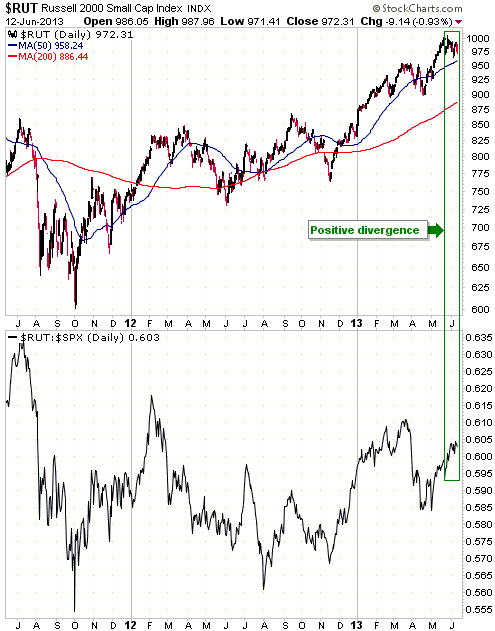
Our final stock market chart compares the Russell2000 Small Cap Index (RUT) with
the RUT/SPX ratio (small-cap US stocks versus large-cap US stocks). The RUT/SPX
ratio usually moves with the broad market, but sometimes diverges. The
divergences can be significant.
The recent pullback in the RUT and most other stock indices has gone with
strength in the RUT/SPX ratio, meaning that small-cap stocks have held up better
than large-cap stocks during the recent period of stock market weakness. This is
a bullish divergence.
Our view continues to be that the short-term decline probably isn't complete,
but marginal new highs are likely within the next few months.
STOP PRESS:
We just checked the Asian markets before putting today's report to bed. There
has been substantial weakness in Asian equity trading on Thursday 13th June,
with Japan's stock market leading the way. Japan's Nikkei225 Index ended the day
down 844 points (6.35%) at 12445, a new low for the move. As we write the Hong
Kong market is still trading and is down 585 points at 20769, its lowest level
since last September. Looks like we were too quick to exit our DXJ put options.
Gold and the Dollar
Gold
Absurd attempts by the Indian government to curb gold demand
Gold in India has recently traded at unusually high premiums to the
international "spot" price. This is mainly due to attempts by India's government
and central bank to restrict the supply of gold and to make gold less attractive
by artificially raising its price. For example, as noted in an
article posted at Mineweb.com last Friday: "...the Reserve Bank of India
has advised banks not to sell gold coins to retail customers. This is the third
day in quick succession this week that both the apex bank and the Indian
government have initiated curbs on gold. While the import duty was hiked to 8%
just yesterday*, the apex bank has also imposed restrictions on banks and non
banking financial institutions for providing loans against gold coins as well as
units of gold ETFs and gold sales by private agencies."
Leaving little doubt regarding the increasingly anti-gold stance of Indian
officialdom, India's Finance Minister P Chidambaram recently said: "I hope a
day will come when we regard gold as any other metal, it just shines a little
more than copper or bronze."
India's government and central bank haven't decided to wage a war against gold
ownership for philosophical reasons or to bring about real improvement in the
economy. What we have here is just another in a very long line of examples of
government trying to manipulate prices to conceal a problem. In this case, the
government of India perceives the current account deficit as a problem. The
current account deficit is largely an effect of rapid monetary inflation
(India's money supply expanded by 16.4% in 2010, 17% in 2011 and 13.8% in 2012),
but rather than tackle the inflation problem in the only way that counts (by
stopping or substantially slowing the growth in the money supply) the government
is trying to stop people from buying gold. The thinking is that most of the gold
bought each year by the residents of India is imported and thus adds to the
current account deficit.
The Indian government's attempts to curtail gold demand in order to address an
inflation problem make almost as much sense and have the same chance of working
as the plan hatched by the US government during the 1970s to tackle the
inflation problem of the time by handing out "Whip Inflation Now" buttons.
India's inflation problem WILL (no ifs, buts or maybes) worsen if the money
supply continues to grow rapidly, thus boosting the Indian public's desire to
own gold. If India's government makes it too costly or difficult to obtain gold
via legal methods, then more people will obtain gold via the black (that is,
free) market.
*Last week's hike in the gold import duty was from 6% to
8%, but at the beginning of last year the duty was only 2%. India's gold import
duty has therefore quadrupled within the space of 18 months.
Current Market Situation
The gold market continues to consolidate. As shown on the following daily chart,
there is some trend-line support near this week's intra-day lows. Note, though,
that trend-line support/resistance is always somewhat arbitrary and less
reliable than lateral support/resistance defined by previous turning points. As
also shown on the following chart, lateral support lies at $1350.
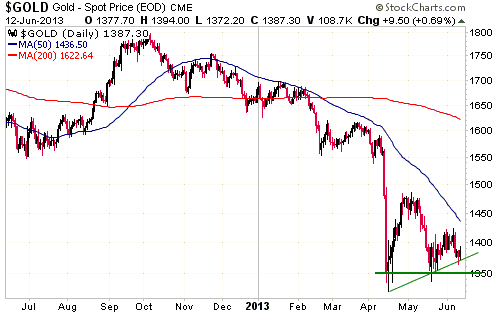
Our view remains that the gold market bottomed in April and successfully tested
its low in May, but the recent price action hasn't done anything to substantiate
this view. As a minimum, for substantiation we would now need to see a daily
close above the early-June high ($1423.30).
The most bullish short-term factor is the upside potential created by the
extreme negativity in the market. It seems that even the long-term gold bulls
are now resigned to additional short-term weakness. The most bearish short-term
factor is gold's inability to rally in response to the recent weakness in both
the US$ and the stock market.
In the coming Weekly Update we plan to discuss "tapering" (as related to "QE")
and explain why the eventual/inevitable QE tapering is not something that gold
bulls should be concerned about.
Gold Stocks
Current Market Situation
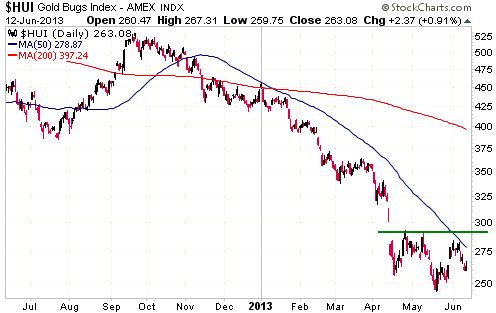
Nothing happened over the first three days of this week to either support or
invalidate our view that the HUI is building a base. We await further
developments.
Resource Nationalism (stealing in the name of "the people")
One of the most interesting recent developments in the gold mining sector was
this week's announcement by Kinross Gold (KGC) that it had failed to come to
terms with the Ecuadorian government and will consequently be walking away from
the Fruta Del Norte (FDN) gold project in Ecuador. Good analysis of the Kinross-FDN-Ecuador
situation is located
HERE.
FDN has one of the world's best undeveloped gold deposits, which is why KGC paid
$1B for the project in 2008. Therefore, the decision to walk away and take a
$700M write-off would not have been taken lightly. The decision was taken
because the extremely lucrative FDN project was made non-viable by the onerous
taxes that Ecuador's government insisted on imposing.
The main sticking point was the government's determination that there must be a
70% "windfall profits" tax, which would cause 70% of the mine's profits to go to
the government whenever the gold price was above a certain level. So-called
"windfall" taxes greatly reduce the reward/risk profiles of mining projects due
to the extremely cyclical nature of the mining business. It is only the
possibility of generating the occasional "windfall" profit that makes it worth
the risk of investing hundreds of millions or billions of dollars in the
development of a new mine.
Due to the Ecuadorian government's insistence that KGC's shareholders take all
the risk while "the people" take well over half the profit, "the people" will
end up with nothing.
We assume that KGC's stock price dropped sharply in the wake of the FDN news due
to disappointment that reasonable terms could not be agreed between the company
and the government. Given the terms that could be agreed, the decision to
abandon FDN was almost certainly the right one (the wrong decision was to buy
the project in the first place, considering the obvious political risk). It not
only reduces KGC's risk profile but also sends a useful message to other
governments around the world.
Currency Market Update
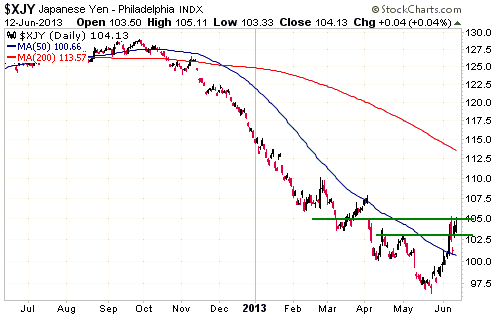
The Yen is in the midst of its best rally since a major downward trend began in
earnest last October. As illustrated by the following daily chart, it has broken
decisively above its 50-day MA and short-term resistance at 102.5. There is more
resistance at 105.
Regardless of whether the overall downward trend is or isn't complete, there is
short-term upside potential to 110-112.
We currently have a small long-term position in the Yen (about 10% of our cash
reserve is Yen-denominated) that we will probably hold until the currency
becomes 'overbought' on a long-term basis or we see evidence that Japan's
monetary inflation rate is headed much higher. At this stage, Japan's monetary
inflation rate during 2013 has not been meaningfully different to its monetary
inflation rate in 2012 or 2011 or 2010 or almost any other year of the past ten
that you care to mention.
We also currently have a small short-term position in the Yen via FXY
September-2013 call options. Our intention is to take profits on this position
if Yen futures rally to around 110 within the next two months.
Update
on Stock Selections
Notes: 1) To review the complete list of current TSI stock selections, logon at
http://www.speculative-investor.com/new/market_logon.asp
and then click on "Stock Selections" in the menu. When at the Stock
Selections page, click on a stock's symbol to bring-up an archive of
our comments on the stock in question. 2) The Small Stock Watch List is
located at http://www.speculative-investor.com/new/smallstockwatch.html
 Pretium
Resources (TSX and NYSE: PVG). Shares: 102M issued, 109M fully diluted. Recent
price: US$8.25 Pretium
Resources (TSX and NYSE: PVG). Shares: 102M issued, 109M fully diluted. Recent
price: US$8.25
PVG announced the results of the Feasibility Study (FS) for its Brucejack
high-grade gold project on Tuesday of this week. Cutting to the chase: the FS
was unequivocally positive and further de-risks the project.
Here are the salient details in table format:
|
|
Pretium Resource (PVG) |
|
Project Name |
Brucejack |
|
Location |
BC, Canada |
|
Engineering Study / Date |
FS / Jun-2013 |
|
Planned Mine Type |
Underground |
|
M&I Resource (oz) |
8.5M |
|
Avg Resource Grade |
13.6 g/t |
|
P&P Reserve (oz) |
7.3M |
|
Metallurgical Recovery |
96% |
|
Strip Ratio |
n/a |
|
Avg Annual Production (oz) |
321K |
|
Cash Cost (per oz) |
$458 |
|
All-In Cost (per oz) |
$508 |
|
Mine Life |
22 years |
|
Initial Capital Cost ($M) |
664 |
|
Assumed Gold Price (US$) |
1415 |
|
NPV ($M) |
1980 |
|
IRR |
39.2% |
|
Capital Payback Period |
2.0 years |
|
Project Ownership Percent |
100% |
|
NPV of Company Stake ($M) |
1980 |
|
Current Stock Price (US$) |
8.25 |
|
Share Count (M) |
105 |
|
Current Market Cap ($M) |
866 |
|
Net Cash ($M) |
60 |
|
Current Enterprise Value ($M) |
806 |
|
EV/NPV |
41% |
|
Current Discount to NPV |
59% |
|
EV + Capital Cost (EVCC) |
1470 |
|
EVCC/NPV |
0.74 |
The project economics displayed in the above
table are based on a gold price of $1415/oz. The project would be economically
robust at a significantly lower gold price (the estimated Internal Rate of
Return is 13.7% at a gold price of only $800/oz), but we are comfortable
assuming a gold price of around $1400 when we do our valuations. Despite the
fact that $1400 is slightly higher than the current gold price, we think the
current price will seem low a year from now.
The last row of the above table contains the most important valuation measure
for a company like PVG. It shows that the sum of the stock's Enterprise Value
and the project's initial capital cost is only 0.74-times the project's post-tax
NPV. Based on New Gold's recent takeover of Rainy River Resources, an EVCC/NPV
ratio of 1.1 looks like a realistic level for a buy-out of PVG in the current
depressed market. To get this ratio up to 1.1, PVG's stock price would have to
rise to around $15.
The Brucejack project's size, location and production cost make it a highly
desirable asset for a mid-tier or major mining company. Of particular note, the
all-in cost of production at Brucejack is estimated to be only $508/oz, which is
less than half the all-in cost of most mid-tier and major gold miners. This
means that the Brucejack project has the potential to significantly reduce the
overall cost structure of most gold producers. For example, based on the costs
estimated in PVG's FS, a miner with current annual production of 1M ounces at an
all-in cost of $1200/oz could, by purchasing and developing Brucejack, increase
its overall production by about 40% (Brucejack is expected to produce 425K
ounces/year during its first 10 years of operation) and reduce its company-wide
all-in production cost by about 20%.
Therefore, it's a good bet that a takeover of PVG will happen well before the
Brucejack project enters the mine construction phase, although prospective
acquirers could wait until the results of the 10,000-tonne bulk sample program
become known during the final quarter of this year. The purpose of this program
is to verify the resource continuity assumptions made in the FS.
Apart from the bulk sample program, the only major aspect of project engineering
that remains outstanding is environmental permitting. Given that Brucejack is
being planned as an underground mine with a relatively small environmental
footprint, permitting shouldn't be a stumbling block. However, there will be a
risk until all required permits are received. Our hope and expectation is that
the project will be sold prior to the completion of environmental permitting.
Despite the fact that the FS is obviously very positive, the stock price pulled
back during the hours immediately following the announcement. This, we suspect,
happened for three reasons. First, the FS results were delivered into a very
depressed market. Second, the bottom half of the following chart shows that PVG
has gained more than 50% against the HUI since early-April. This level of
outperformance suggests that there was buying in anticipation of good news, thus
increasing the probability of a knee-jerk 'sell-on-the-news' reaction. Third,
although a good case can be made that the Brucejack project by itself is worth
almost twice PVG's current enterprise value, PVG is not cheap relative to many
other exploration-stage gold mining stocks. We note, for example, that the
market is presently assigning a value of around $650M to PVG's 10M-ounce
Brucejack project (allowing about $200M for PVG's cash and its huge low-grade
Snowfield project) and a value of only slightly more than ZERO to the 5M-ounce
Esaase gold project of Asanko Gold (AKG).
The bottom line is that PVG's fundamental story continues to progress as well as
or better than expected. If you currently have no exposure then it probably
makes sense to take an initial position in the low-US$8 area.
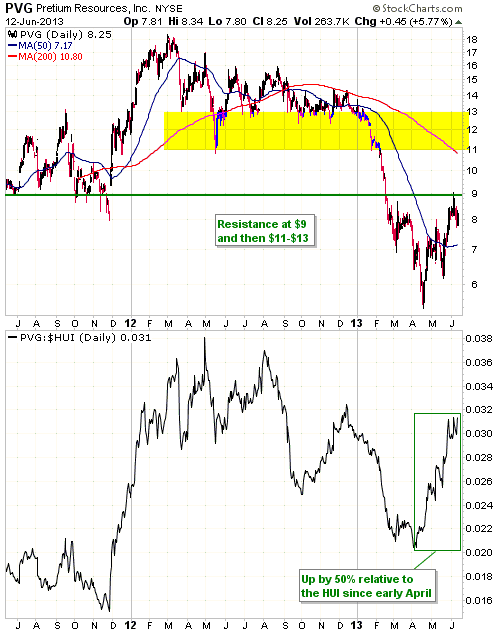
Chart Sources
Charts appearing in today's commentary
are courtesy of:
http://stockcharts.com/index.html

|









