|
- Interim Update
12th November 2014
Copyright
Reminder
The commentaries that appear at TSI
may not be distributed, in full or in part, without our written permission.
In particular, please note that the posting of extracts from TSI commentaries
at other web sites or providing links to TSI commentaries at other web
sites (for example, at discussion boards) without our written permission
is prohibited.
We reserve the right to immediately
terminate the subscription of any TSI subscriber who distributes the TSI
commentaries without our written permission.
Does a
government's debt service cost matter anymore?
Economic realists wonder about what will happen to the budgets
of various heavily-indebted governments when interest rates rise,
and rightly so. The fact is that the debt burdens of some
governments only look manageable because interest rates have been
artificially reduced to ridiculously-low levels, and it seems
obvious that these governments will become incapable of servicing
their debts after interest rates move back to more normal levels.
However, it occurs to us that a government's debt service cost
doesn't matter if the central bank owns most of the debt.
The reason is that in the US and, we assume, most other countries,
the central bank sends almost all of its profit to the government.
This means that most of the interest paid by the government on debt
held by the central bank ends up back at the government.
Consequently, as far as the government's ability to fund itself is
concerned, the interest rate it pays on debt held by the central
bank is irrelevant. Regardless of whether it pays 0.5% interest or
10% interest, it will get back almost all of the money it pays out.
The re-cycling of the interest paid on debt held by the central bank
is not something new. The significant change that has taken place
over recent years is the massive increase in the amount of
government debt held by the central bank. For example, over the past
7 years the Fed's holding of US Treasury securities has increased
from $800B (about 8.8% of the total) to $2.5T (about 14% of the
total). This effectively means that $2.5T of the US government's
debt is now interest free and will remain so for as long as it is
held by the Fed.
Japan provides us with an even better example. The
direct
debt of Japan's government is now 1.1 quadrillion Yen, which
sounds like a lot of money. It is a lot of money for a country of
Japan's size -- it is equivalent to about 10 trillion US dollars, or
almost two-times the total amount of gold mined in the history of
the world. Not only will it never be paid back, there will also
never be a serious attempt to pay it back.
Somewhere in the region of 21%-24% of the Japanese government's debt
is currently held by the BOJ, but the percentage is increasing
rapidly because the BOJ is now buying JGBs at twice the pace at
which the government is issuing them. We estimate that at its
current pace of bond-buying and at the Japanese government's current
pace of deficit spending, the BOJ will own half of the government's
debt by 2019. This means that half of the Japanese government's debt
could effectively be interest-free by 2019, regardless of what
happens to interest rates. Also, since rising interest rates only
affect the cost of servicing new debt, it seems to us that Japan's
government will be shielded from higher interest rates for as long
as the BOJ is buying more government bonds than the government is
creating.
That's why an eventual rise in interest rates to more normal levels
might not bring about the financial predicament for heavily-indebted
governments being forecasted in some quarters.
The Stock Market
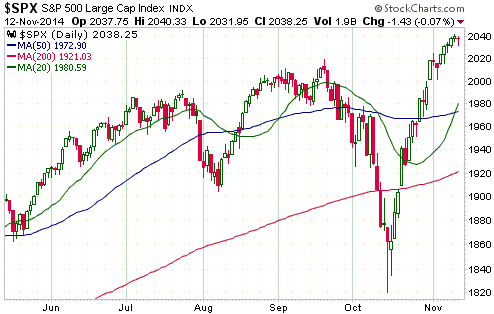
Nothing of significance happened in the US stock market over the
first three days of this week. Upside momentum is waning, but there isn't yet
any sign of a downward reversal.
Gold and the Dollar
Gold, Silver, and the Gold Mining Sector
The Swiss Gold Referendum
A referendum is scheduled to take place in Switzerland on 30th November that, if
passed by a simple majority of voters, would require the Swiss National Bank (SNB)
to hold 20% of its assets in gold. Currently, gold accounts for about 7% of the
SNB's assets.
The SNB would have 5 years to bring its gold holding up to 20% of its assets. At
current asset levels and prices it would need to purchase about 1500 tonnes of
gold to reach the targeted level, although the amount would probably end up
being greater due to additional SNB balance sheet expansion.
The SNB and Switzerland's major political parties are very much against this
referendum, ostensibly because it would limit the SNB's flexibility. Limiting
the SNB's flexibility would actually be a good thing, but we don't see how the
20% gold holding would establish any meaningful limits. The SNB could still
increase its balance sheet as much as it wanted, it would just have to buy 20
francs of gold for every 100 francs of expansion.
Rather than the main concern being a loss of flexibility, we suspect that
policy-makers are against the referendum because having a greater amount of gold
on the SNB's balance sheet would put upward pressure on the franc's exchange
rate. In a policy-making world dominated by Mercantilism and Keynesianism, a
strong currency is anathema.
We doubt that the "yes" vote will win the day, but in any case this is not a
trend-changing event in the gold market. The 300 tonnes per year that the SNB
would have to buy over the next 5 years is too small, relative to the total
aboveground gold supply, to have an effect beyond a very short-term,
sentiment-driven reaction.
The Silver/Gold Ratio
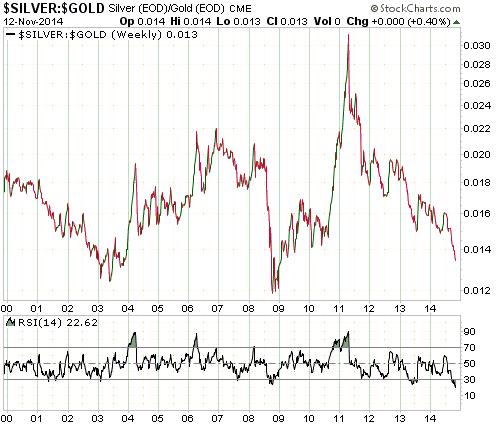
The following weekly chart shows that a) the silver/gold ratio is not far from
the major lows of 2003 and 2008, and b) the silver/gold ratio's weekly RSI is at
a 15-year low. This doesn't tell us anything about silver's prospects with
regard to the coming 12 months, but it means that silver is probably going to
trade a long way above current levels, in dollar terms and relative to gold,
within the coming three years.
Considering the performance of the silver/gold ratio and what has happened in
all the financial markets, in recent years the silver/gold ratio has clearly not
lived up to its reputation as an indicator of financial-market stress. It should
have moved higher as financial-market stress abated and confidence rose, thus
paving the way for it to reverse downward to signal the beginning of the next
major shift away from risk. Instead, it did the opposite, leaving it in no
position to signal a reversal of the risk trend.
Silver/gold's failure to perform as an economic confidence or financial stress
indicator over the past three years is, we believe, a consequence of the extent
to which silver became over-valued relative to gold during the first four months
of 2011. The correction of this massive over-valuation has trumped all other
considerations.
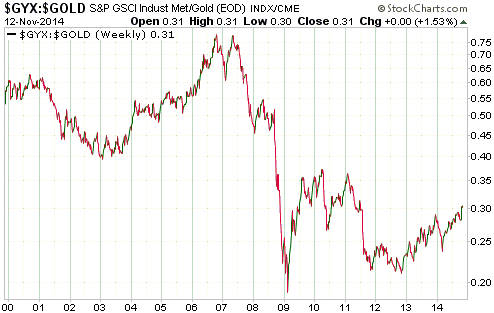
Fortunately, the GYX/gold ratio continues to do a good job of indicating the
confidence trend. GYX/gold is supposed to trend in the same direction as
financial-market and economic confidence, which is exactly what it has been
doing.
The GYX/gold ratio should reverse course and begin trending downward as soon as
the latest central-bank-sponsored boom begins to unravel.
Current Market Situation
With regard to the performances of gold bullion and the gold-mining indices over
the first three days of this week, the only noteworthy development is that there
was no follow-through to the upside. This is understandable in gold's case,
because, as we mentioned in the Weekly Update, gold ended last week near very
important resistance (refer to the first of the daily charts displayed below).
It is not surprising that gold was unable to immediately break through this
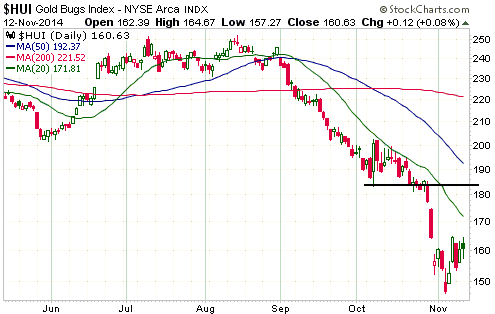
resistance, but it is surprising that the HUI has been unable to build on the
gains achieved during the final two days of last week. After all, the HUI fell
much further than gold during the days leading up to last Thursday's reversal
and remains well below its resistance equivalent to gold's $1180.
For the HUI, the first resistance of real importance lies in the 180s (refer to
the second of the daily charts displayed below). IF the short-term downward
trend ended last week then this resistance should be tested during the initial
rally from the low, which means that it should be tested within the next several
days.
We think that the HUI has a lot more upside potential than gold bullion in the
short-term and the intermediate-term, but the ultra-long-term downward trend in
the gold mining sector relative to gold bullion is likely to remain intact.

Over the past week, Market Vane's bullish percentage for silver hit a new
10-year low, and possibly a new all-time low, of 16%. At the other end of the
sentiment spectrum is the Dollar Index, in that Market Vane's bullish percentage
for the US$ just hit a new 10-year high of 84%. We know what sentiment extremes
such as this lead to, but we don't know exactly when.
The Currency Market
The Dollar Index has essentially traded sideways since hitting its daily-closing
high for the year last Thursday. It has therefore not yet signaled a downward
reversal of its short-term trend.
The US$ continues to be supported by strength in US equities relative to
European equities, with the VGK/SPY ratio, our preferred measure of European
equity performance relative to US equity performance, making a new low for the
year on Wednesday 12th November. As made clear by the following chart, the
short-term downward trend in the euro (and, therefore, the short-term upward
trend in the Dollar Index) is linked to the downward trend in the VGK/SPY ratio.
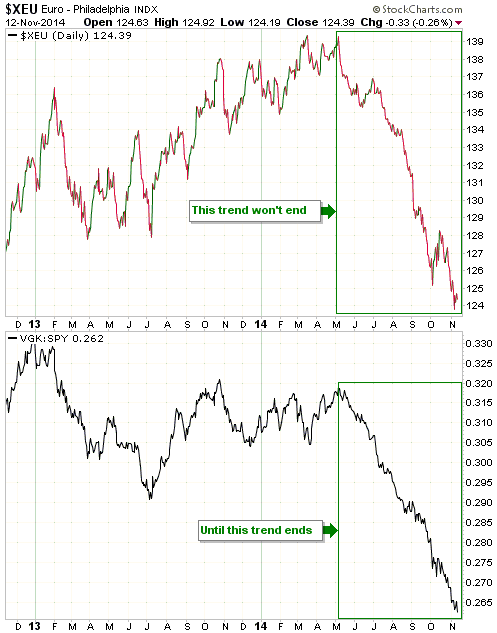
The huge speculative net-short position in euro futures is akin to potential
energy. This potential energy will be converted to kinetic energy, resulting in
a substantial rebound in the euro, after European equities stop weakening
relative to their more expensive US counterparts.
Updates
on Stock Selections
Notes: 1) To review the complete list of current TSI stock selections, logon at
http://www.speculative-investor.com/new/market_logon.asp
and then click on "Stock Selections" in the menu. When at the Stock
Selections page, click on a stock's symbol to bring-up an archive of
our comments on the stock in question. 2) The Small Stock Watch List is
located at http://www.speculative-investor.com/new/smallstockwatch.html
Chart Sources
Charts appearing in today's commentary
are courtesy of:
http://stockcharts.com/index.html

|









