|
- Interim Update 12th December 2012
Copyright
Reminder
The commentaries that appear at TSI
may not be distributed, in full or in part, without our written permission.
In particular, please note that the posting of extracts from TSI commentaries
at other web sites or providing links to TSI commentaries at other web
sites (for example, at discussion boards) without our written permission
is prohibited.
We reserve the right to immediately
terminate the subscription of any TSI subscriber who distributes the TSI
commentaries without our written permission.
The Fed:
Still crazy after all these years
In a TSI commentary back in April of 2010 we wrote that the
Japanese government was "still crazy after all these years", because
it was still trying desperately to stimulate its economy in
accordance with the Keynesian script despite blatant evidence that
the policies being implemented were counter-productive. The same
phrase (the title of a Paul Simon song) applies equally well to the
US Federal Reserve. Despite the blatant evidence that monetary
inflation is part of the problem rather than part of the solution,
the Fed keeps inflating the money supply as if doing so were going
to strengthen the economy.
The Fed, unbowed by its previous failures, announced yet another
inflation program (QE4?) at the conclusion of this week's FOMC
meeting. Here are the most important parts of its post-meeting
statement:
"...the Committee will continue purchasing additional agency
mortgage-backed securities at a pace of $40 billion per month. The
Committee also will purchase longer-term Treasury securities after
its program to extend the average maturity of its holdings of
Treasury securities is completed at the end of the year, initially
at a pace of $45 billion per month."
"...the Committee decided to keep the target range for the
federal funds rate at 0 to 1/4 percent and currently anticipates
that this exceptionally low range for the federal funds rate will be
appropriate at least as long as the unemployment rate remains above
6-1/2 percent, inflation between one and two years ahead is
projected to be no more than a half percentage point above the
Committee’s 2 percent longer-run goal, and longer-term inflation
expectations continue to be well anchored."
The first of the above quotes from the FOMC statement indicates that
the Fed plans to directly add $85B per month, or the equivalent of
$1.02T per year, to the US money supply. This implies that the Fed's
direct actions alone (that is, not accounting for any money creation
by the commercial banks) will boost the US True Money Supply (TMS)
by around 11% over the next 12 months. The second of the above
quotes suggests that ultra-easy monetary conditions will be
maintained until the unemployment rate drops to 6.5% and/or
"inflation expectations" move above 2.5%. Inflation expectations are
already above 2.5%, but never mind.
Private counterfeiters take note: If the Fed is right then you
should redouble your efforts, because when you steal purchasing
power by creating money out of nothing you are also boosting
employment and facilitating real economic progress..
The
market reaction to the Fed
The market reaction to the Fed's new inflation
program was strangely subdued. The 'overbought' stock market did nothing and the
neutral gold market did nothing. The only significant reaction was a rally in
the 'oversold' gold mining sector.
Regardless of the initial response, if the Fed follows through and really does
add new money at the rate of $85B per month it will have a big effect on the
financial markets next year. The effect is likely to be most pronounced in the
precious metals markets and in the gold mining sector of the stock market.
Price inflation,
de-leveraging and interest rates
Unless you believe government statistics or live
in Japan or never venture out into the world to purchase basic necessities, you
probably perceive a "price inflation" problem. The reason is that in every
country that we know of apart from Japan, the so-called "general price level" is
rising at the rate of at least 5% per year. Or, to put it more aptly, money is
losing purchasing power at the rate of at least 5% per year in almost all
countries (including the US). In this case, our knowledge is based on what we
have directly observed in seven countries and feedback from friends and
acquaintances living in many other countries. Our knowledge is also based on our
investing experiences. For example, the single biggest problem faced by the gold
mining industry over the past eight years, and the main cause of the remarkably
poor performance of the average gold mining stock relative to gold bullion over
this period, has been the rapid rate of increase in the prices of the materials
and labour used by gold miners. The US$ gold price has risen at around 21% per
year, but for the average gold producer the benefit of this rise in the gold
price has been largely offset by a 16% per year increase in the total cost of
running a gold mining business. Today we are going to deal with two questions
that stem from the "price inflation" issue: First, why has there been
significant price inflation during a period of 'de-leveraging' (a period of debt
repayment, debt default and an increasing propensity to save)? Second,
considering the obvious price inflation, why are long-term interest rates so low
in so many parts of the world?
The first question is easy to answer. The fact of the matter is that on an
economy-wide basis there has been no de-leveraging. Governments and central
banks have prevented a natural de-leveraging process from occurring, which, to
take one example, is why the US economy is no closer to commencing a sustainable
recovery today than it was four years ago. The private sector has certainly
attempted to shrink its collective balance sheet with some success, but the
public sector has expanded its collective balance sheet by a greater amount. The
net result has been the continued growth in the economy-wide level of debt.
Moreover, it is important to understand that it is the change in the supply of
money, not the change in the total amount of debt that ultimately determines the
price level. Regardless of whether or not the overall economy is de-leveraging,
if the supply of money is growing rapidly -- which it has been doing in the US
and in many other countries over the past four years -- then the price
(purchasing power) of money will eventually suffer a substantial decline.
Increases in the demand for money can temporarily offset the effect on money
purchasing power of an increase in the supply of money, but the operative word
here is "temporarily". Increases in the demand for money have offset the
price-related effects of increases in the supply of money over the past four
years, but we know from the significant decline in money purchasing power that
the offset has only been partial.
As an aside, a mistake made by almost every 'deflationist' is to treat money and
debt as if they were the same. Debt is not money, it is an obligation to pay
money.
As another aside, the reason the Yen has done a relatively good job of
maintaining its purchasing power is that the supply of Yen has increased at a
relatively slow pace up until now. Specifically, over the past 5 years, 10 years
and 20 years, the rate of monetary inflation in Japan has averaged about 2% per
year. Compare this to the US, where over the past 12 years the average annual
rate of money-supply (TMS) growth has been around 9.5% and where over the past 4
years the average annual rate of money supply growth has been around 13%.
The second question (given the obvious price inflation, why are long-term
interest rates so low?) is more difficult to answer. It is a lot easier to rule
out the wrong answers to this question than to arrive at the right answer. We
can, for example, immediately rule out the idea that the bond market is reacting
to deflation, because there isn't any deflation. Powerful deflationary forces
emerged in 2008, but they have clearly been overwhelmed by the inflationary
forces created by central banks. We can also rule out the answer that goes
something like this: there may well be no deflation in the present, but the
market is looking ahead and discounting future deflation. We can rule this out
because the following chart shows that the difference between the yield on the
10-year T-Note and the yield on the 10-year TIPS (Treasury Inflation Protected
Security) is 2.55%. This yield difference is the annual rate of currency
depreciation that the market expects the government to admit to over the years
ahead, which is why we typically refer to it as the Expected CPI. Since everyone
who has been paying attention knows that the government chronically
under-reports the rate of currency depreciation, we can be sure that the
Expected CPI is less than the loss of purchasing power actually expected by the
market. In other words, the aforementioned yield difference tells us that the
market currently expects the US$ to lose purchasing power at a rate of more than
2.55% per year. And yet, at its current price the 10-year T-Note has a nominal
yield of only 1.71%. This means that the 10-year T-Note is now trading at a real
yield (nominal yield minus the expected rate of currency depreciation) of
negative 0.84% or lower. Why would any investor lend money to the US government,
or any other government, at a nominal yield that was expected to generate a real
loss over the duration of the loan?
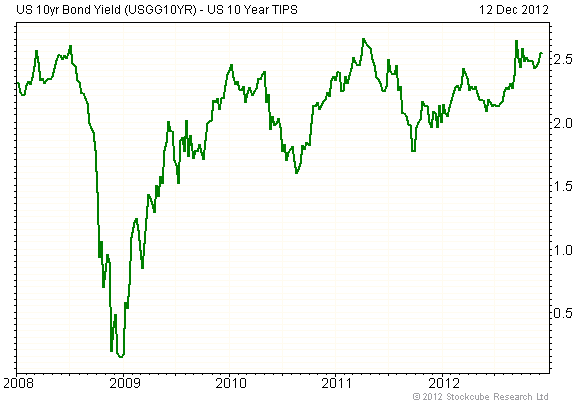
Chart Source: www.fullermoney.com
We can come up with three explanations for the negative real yield on the
long-term debt securities issued by the US government, all of which are related
in some way to the Federal Reserve.
First, there's the direct buying of Treasury securities by the Fed. The Fed
hasn't been a net buyer of bonds since the end of QE2 (June-2011), but since the
third quarter of 2008 it has added almost 2 trillion dollars of bonds to its
balance sheet. It has also just promised to buy a lot more bonds in the future.
Second, and of greater importance over the past 18 months, is the Fed's zero
interest rate policy at the short end. This policy involves making a copious
amount of short-term money available to banks at virtually no cost. If you are
borrowing and lending in the same currency and you are able to borrow at X% and
lend at X+Y% then you will earn a positive real interest rate regardless of what
happens to the purchasing power of the currency. Furthermore, your real return
could be substantial due to the leverage factor.
Third, a significant portion of the demand for long-term low-risk bonds (such as
those issued by the US federal government) comes from short-term buyers --
speculators buying with the aim of selling in less than a year and large
investors looking for a place to safely park some money for a while. This
short-term demand is linked to the Fed, because a) the Fed's ability and
willingness to monetise an unlimited amount of US government debt eliminates the
risk of direct default (the US federal government will never find itself in the
same situation as the Greek government) and b) the Fed's 'commitment' to keep
the official short-term interest rate near zero for a long time will reduce the
short-term price risk associated with holding long-term bonds until inflation
expectations get out of hand.
The phrase "until inflation expectations get out of hand" is the key to the
interest-rate-suppressing, bank-and-government-supporting, savings-destroying,
economy-distorting scheme perpetrated by the Fed. The above chart shows that the
rate of US$ depreciation currently expected by the market is at least 2.55%. Our
guess is that it is actually in the 3%-4% range. We suspect that once it moves
beyond 5%, additional attempts by the Fed to suppress rates at the short end
will lead to higher rates at the long end. This could happen as soon as the next
few months, although a large stock market decline would likely prolong the
scheme.The Stock Market
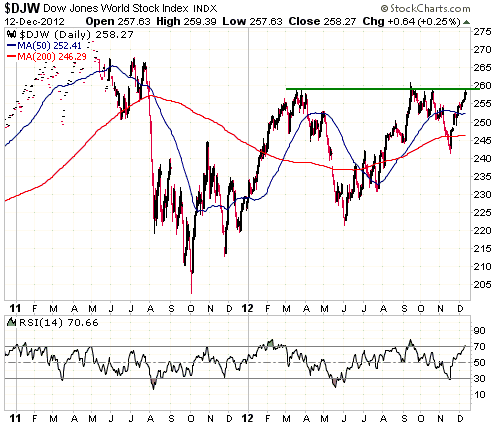
When the Fed introduced QE3 in mid-September the Dow Jones World
Stock Index (DJW) was 'overbought' and near resistance in the high-250s. The Fed
news therefore didn't lead to significant additional gains. In fact, it led to a
multi-week decline.
When the Fed introduced QE4 on Wednesday of this week the DJW was also
'overbought' and near resistance in the high-250s. Does this mean that the
outcome will be similar this time around?
Probably, although we won't be surprised if the DJW breaks above resistance
before commencing its next meaningful decline. The reason is that triple tops
are uncommon. Usually, if a market has peaked at the same level twice within the
preceding 12 months then a third test of the level will result in a breakout.
Our guess is that resistance in the high-250s will be breached, either
immediately or after a 1-2 week consolidation. However, we doubt that there will
be much follow-through to the upside before a downward trend gets underway.
Gold and the Dollar
Gold
There was almost no reaction in the gold market to the Fed's announcement of
"QE4", which could mean that short-term traders have become immune to threats
that more will be done to destroy the official money. However, the increased
rate of money pumping will have effects on the economy and these effects will
very likely result in a much higher gold price within the next 12 months.
Traders can either anticipate these effects now or be surprised by them later.
One of the effects of the accelerated pace of money pumping will be a further
reduction in the purchasing power of the US$, but the change in purchasing power
won't be uniform. It never is. Some prices will rise quickly, some prices will
rise slowly, some prices will remain the same and there will even be declines in
some prices. It generally won't be possible to differentiate between a price
rise due to the Fed's money pumping and a non-artificial price rise, so people
throughout the economy will have no choice other than to treat all price changes
as if they were the result of sustainable changes in underlying supply/demand as
opposed to the result of monetary manipulations by central planners. This will
lead to greater wastage of resources and the US economy being in a weaker state
by this time next year. Rising prices (on average) and a fundamentally weaker
economy will reduce the appeal of growth-oriented investments and increase the
relative appeal of gold, leading to a much higher gold price in both nominal and
real terms.
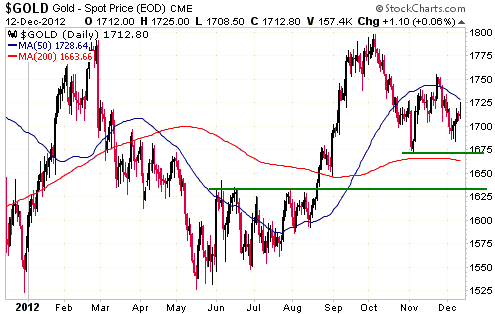
With reference to the following daily chart of the US$ gold price, it looks like
the 50-day moving average has been acting as resistance over the past six weeks.
Consecutive daily closes above this MA could therefore be taken as a signal that
a rise to intermediate-term resistance at $1800 was in progress. And with
resistance at $1800 having already been tested twice over the past 12 months,
the next rise to that level will probably be followed soon after by an upside
breakout.
The first significant line of support is the November low in the $1670s. If this
support were breached then the more substantial support at around $1630 would
probably limit the decline.
Gold Stocks
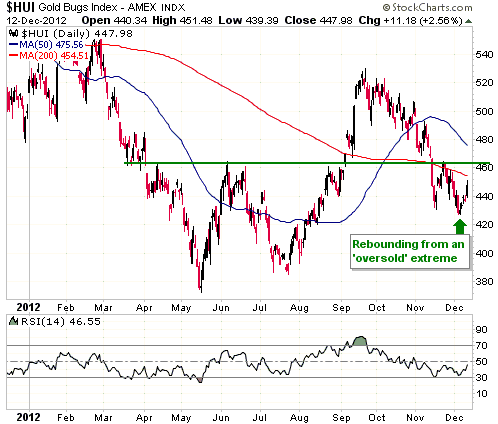
The gold-stock indices had the advantage of being 'oversold' at the time of this
week's Fed announcement. Almost everyone who was likely to sell in response to
short-term considerations had already sold. This enabled the HUI to gain 2.6% on
Wednesday 12th December despite gold's lacklustre performance.
At this stage there's no way of knowing whether the rebound will evolve into
something substantial. An important bottom could have been put in place last
week shortly after the November low was breached, but we could also be seeing a
counter-trend move back to the resistance that extends from the mid-450s (the
200-day moving average) to the low-460s. In our opinion, the latter scenario is
the more likely. If it's the latter then there will be a decline to a new low
over the coming 1-2 weeks, at which point a 'seasonal' rally -- with relative
strength at the junior end of the sector -- should begin.
Currency Market Update
Add currencies to the list of markets that didn't do much in reaction to
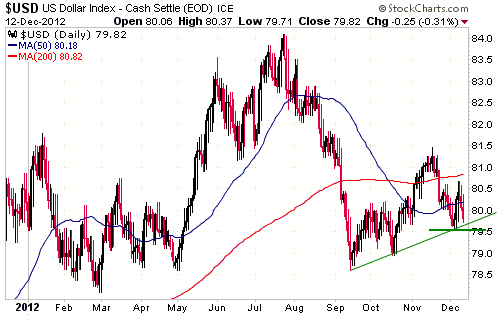
Wednesday's Fed announcement. The Dollar Index has almost made its way down to
support at 79.5, but Wednesday's decline was minor.
We are anticipating a drop to 77-78.
Update
on Stock Selections
Notes: 1) To review the complete list of current TSI stock selections, logon at
http://www.speculative-investor.com/new/market_logon.asp
and then click on "Stock Selections" in the menu. When at the Stock
Selections page, click on a stock's symbol to bring-up an archive of
our comments on the stock in question. 2) The Small Stock Watch List is
located at http://www.speculative-investor.com/new/smallstockwatch.html
Chart Sources
Charts appearing in today's commentary
are courtesy of:
http://stockcharts.com/index.html
http://www.fullermoney.com/

|









