|
- 13 February, 2002
The US
CPI and the Global Inflation Trend
Those who think of inflation and deflation
in terms of changes in prices, rather than as purely monetary phenomena,
will be forced to perform logical contortions later this year to explain
the coming sharp decline in US Government bond prices (rise in long-term
interest rates). After all, there is no direct repayment risk associated
with US Government bonds (the Fed stands ready, willing and able to monetise
all debt instruments issued by the US Government) so major bond-market
declines should be the result of indirect repayment risk (higher inflation
or the anticipation of higher inflation). However, bonds have already experienced
a substantial drop over the past 3 months and yet the ECRI's Future Inflation
Gauge is telling us not to expect any significant increase in the Consumer
Price Index this year. So, what gives?
The answer is that price increases
are not inflation. They are sometimes, but not always, an effect of inflation.
For example, consider the situation in which the US has a high inflation
rate (money supply growth rate), but the US' trading partners have even
higher inflation rates. In this case the Dollar could remain strong relative
to other currencies, thus causing the prices of imported goods to fall
in US$ terms and keeping downward pressure on domestically-produced goods
and the CPI. If the CPI does not reflect a high rate of Dollar inflation
due to the effects of even higher inflation rates in other countries, does
it really make sense to conclude that the US does not have an inflation
problem? We don't think so and neither does the bond market. The bottom
line here is that the current inflation is global in nature and is resulting
in a deterioration of bond prices throughout the world. US bond prices
are simply moving in synch with this global trend.
In this year's Barrons Roundtable discussion
Marc Faber made the point that China is likely to become the workshop of
the world - a huge manufacturing centre where goods are produced far more
cheaply than could be done in the West. As more and more of the world's
manufacturing is done in China and other low-cost countries, downward pressure
will be maintained on the prices of manufactured goods. These low-cost
manufacturing centres will, however, consume a lot more commodities, thus
putting upward pressure on commodity prices (the low-cost regions tend
to have substantial untapped human resources, but not necessarily commodity
resources).
Further to the above the effects of
inflation are far more likely to be seen, over the next 2 years, in the
prices of commodities than in the prices of manufactured goods and the
widely-watched CPI. That will, at least, be the case from the perspective
of someone in the US. Increases in the prices of raw materials will, of
course, eventually put upward pressure on other prices, but even then we
doubt that the CPI will be allowed to reflect anything like the
full effects of inflation.
The US
Stock Market
Cyclical Stocks
Applied Materials (NASDAQ: AMAT) released
its latest quarterly financial report after the close of trading on Tuesday.
The results were in-line with expectations and good enough to give the
stock a 7% boost during Wednesday's trading. Below is a 1-year chart of
AMAT.
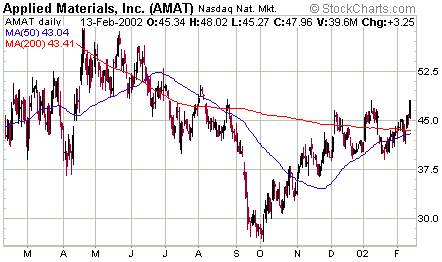
AMAT is one of the world's leading
manufacturers of semiconductor equipment. Most analysts consider the semiconductor
industry to be cyclical, although there was a time not that long ago when
the cyclical nature of these stocks was temporarily forgotten amidst dreams
of a never-ending economic expansion. AMAT, therefore, is a cyclical company
that is likely to make a lot of money at the top of the cycle and to lose
money at the bottom of the cycle (it is presently losing money).
One of the strange things about cyclical
stocks is that they tend to rally strongly just when their current fundamentals
and their medium-term prospects look terrible (near the bottom of the economic
cycle). This occurs because the market begins to anticipate the next upturn
well before there are any signs of improvement in the underlying businesses.
The best opportunities to buy cyclical stocks therefore usually occur when
their prospects appear to be dismal based on the 'news of the day'. This
is, of course, also the hardest time to buy from an emotional perspective.
From being extremely profitable in
2000, AMAT is now losing money and its business prospects look terrible.
Since the economy is probably near an intermediate-term bottom and we know
that the stock market tends to move cyclical stocks much higher well in
advance of an actual improvement in business conditions, does AMAT's recent
rally make sense and is the stock currently a buy? The answers are no and
no. Here's why:
Although AMAT is a cyclical
stock it is not priced like a cyclical stock. It is presently trading
at more than 9-times its annual revenue, meaning that it is priced as if
it already had a high profit margin and was going to achieve high revenue
and earnings growth rates as far as the eye can see. At cycle bottoms cyclical
stocks should sell for less than 2-times annual sales. Herein lies
the problem for many cyclical stocks in the tech sector - they are cyclical
but they are not priced as such.
Many commodity stocks, however, are
trading at the sort of price-to-sales ratios we would expect to see near
a cycle bottom and, in typical fashion, have rallied strongly over the
past few months despite the fact that commodity prices have only shown
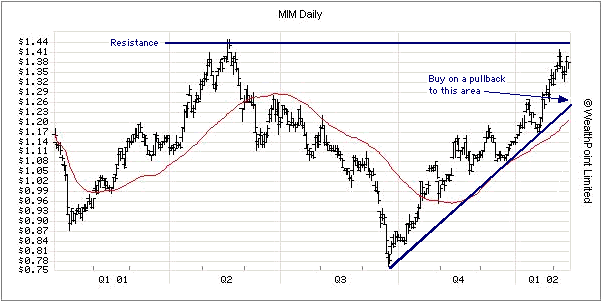
a slight improvement. Take the example of Australian-based diversified
miner MIM Holdings (ASX: MIM) which we added to the TSI Portfolio last
September (see chart below). MIM has risen by around 75% from its September
low, but is presently valued by the stock market at less one-times this
year's revenue. Despite its rally over the past few months the upside risk
with this stock still looks far greater than the downside risk and a pullback
to A$1.25-$1.30 would present a good buying opportunity for investors.
AMAT, on the other hand, looks like an accident waiting to happen. (Note:
Trading in MIM was halted today due to the company's announcement of a
new equity raising to fund the acquisition of more coal assets. Equity
fund-raisings such as this will often put short-term downward pressure
on a stock and, in this case, could provide a reasonable opportunity for
new buying over the next few days.)
Up to this point we've tended to focus
on a few fairly large, high-profile commodity-cyclicals because these are
normally the first-movers in a commodity bull market. As these larger stocks
become overbought (and assuming the commodity story continues to unfold
according to our medium-term bullish view) we'll move down the food chain
and add a few small-cap resource stocks to the Portfolio.
The S&P500 in terms of Gold
In the latest Weekly Update we mentioned
that the trend in the S&P500/gold ratio (the number of ounces of gold
it takes to buy the S&P500 Index) pointed towards the ratio falling
to 3.00-3.25 over the next few months. Such a move would necessitate the
S&P500 falling around 10% from current levels relative to the gold
price. A chart of the ratio is shown below.
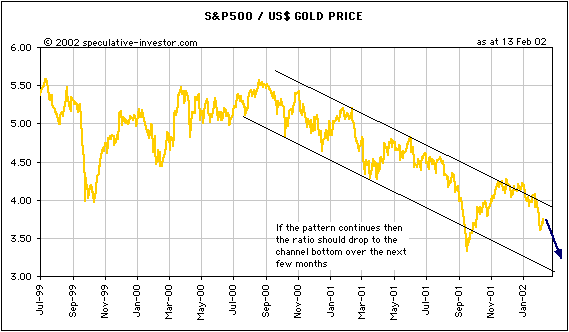
Strangely enough, the above chart suggests
that a rising gold price could actually be a net-positive for the overall
stock market because the ratio could move to the channel bottom via a 10%
fall in the S&P500 or via a 10% rise in the gold price or via some
combination of a falling S&P500 and a rising gold price.
Current Market Situation
As noted in the latest Weekly Update
the stock market commenced a rebound last Friday that could last for up
to 2 weeks. Once the rebound is complete we expect to see a drop to new
lows for this year, although we do not expect a full re-test of last September's
lows until late this year. Sentiment indicators are in the process of working-off
the 'oversold' extremes reached last week and are currently what we would
call 'mixed'. We remain short-term bearish, but would not be surprised
to see the market maintain an upward bias for another week or so. We continue
to hold QQQ March $35 put options.
One individual stock that we will be
watching closely over the coming days is Cisco. This tech bellwether led
the NASDAQ indices during the final few months of last year and recently
broke below its 200-day moving-average. The ability, or otherwise, of Cisco
to move back above its 200-DMA over the next few days will help us gauge
the underlying strength of the overall market.
Gold and
Gold Stocks
Australian Gold Stocks
Below is a 6-year chart of the Australian
Gold Stock Index (XGO). Moves such as the one made by the XGO over the
past 12 months are not followed by declines to new lows (this rally
does not look like the bear market variety). On the contrary, the chart
suggests that a major bull market is in progress. It would be normal, however,
for such a move to be followed by a pullback or a sideways consolidation
lasting several weeks.
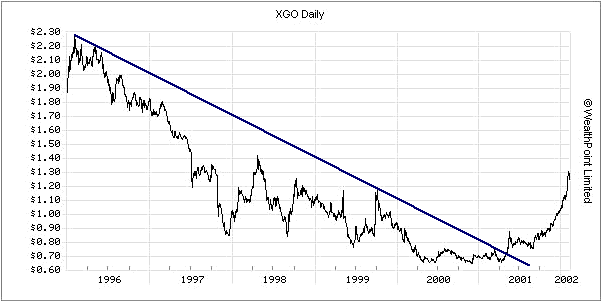
Although the XGO has risen by around
60% since last September we have not yet seen the type of rampant speculation
in the Australian gold stocks that would typically occur near a major peak.
In fact, while panic-buying of selected gold stocks was going-on in the
US market over the past few weeks the Australian gold sector has been relatively
subdued. Lihir Gold (LHG), our favourite amongst the medium-large Australian
gold producers, has been quite strong. However, unlike some of its US-traded
counterparts it has not experienced a huge upward spike and appears to
be only marginally overbought.
Gold
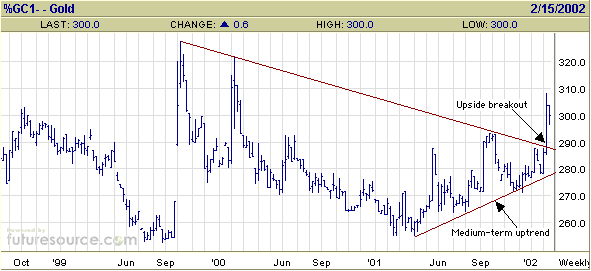
Below is a weekly chart of the gold
futures price (nearest month). There are no guarantees that a pullback
has begun, but if it has then a drop to 288-290 could occur without invalidating
the recent breakout (a drop of this magnitude would be a normal breakout
pullback) while the gold price could fall to around 279 without breaching
its medium-term up-trend.
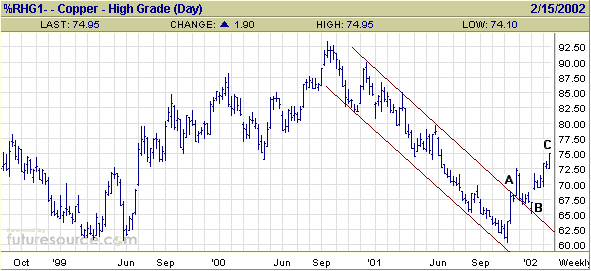
The below chart of copper futures illustrates
the pattern that often occurs following an upside breakout. The market
breaks-out (point A), pulls back (point B), and then surges to a new high
for the rally (point C).
A good position to be in right now
is to have taken enough trading profits in gold stocks during the recent
rally to be relaxed about the prospects for a pullback, but to have retained
some trading positions (in addition to a core investment position) to provide
upside exposure in case a pullback does not materialise. Note that the
downside risk in most gold stocks at this time is far greater than the
downside risk in gold itself. We do not think that the bounce in the bullion
price to $300 represents a profit-taking opportunity, but a large speculative
premium was recently built-up in many gold stocks.
The Dollar
There is no change to our currency
market view. We expect the Dollar to remain strong for another month or
so with the Dollar Index having a reasonable chance of exceeding its July-2001
peak before the end of March. We do not expect this peak to be confirmed
by new lows in the euro, the Swiss Franc or the A$ (these currencies are
expected to remain above last year's lows).
Update
on Stock Selections
Prudential Securities put out a research
report on NEM earlier this week with a SELL recommendation and a reduction
in price target from $21/share to $10/share. The timing of this report
was quite strange (why reduce the price target on an unhedged gold stock
by 50% just after the gold price has reached its highest level in 2 years?),
but we had a look at it to see what the analyst's concerns were. Here are
our thoughts:
Firstly, the analysis of the Normandy
assets and finances appears to be flawed, possibly because the Prudential
analyst is using June 2001 figures and not the latest figures. We have
no idea why he did that when the Dec-2001 figures have been available for
a few weeks. In any case, the marked-to-market loss on NDY's hedge book
currently sits at around US$240M (not the $550M quoted in the report) and
this is not an actual loss that needs to be offset against cash. Also,
the NDY management have always been extremely conservative in their reported
estimates of reserves.
Secondly, the analyst's major concern
seems to be that NEM is not replacing its reserves at a fast enough rate.
This may be a legitimate concern, but it is one that NEM can easily overcome
through acquisition. For example, the reserve life could be immediately
boosted by a few years via a takeover of Lihir Gold. Since former Franco
Nevada 'head honchos' Schulich and Lassonde will now be making the investment
decisions for NEM we can have some confidence that future acquisitions
will be astute.
Thirdly, the new Newmont will be a
must-own stock for institutional investors in a gold bull market due to
its size and liquidity.
Prior to the NDY takeover we would
not have wanted to invest in NEM because it seemed over-priced, the management
seemed mediocre and there were far better investment opportunities in the
gold sector. We wouldn't argue that it now represents good value, but it
is certainly a reasonable stock to have as part of a gold stock portfolio
because it provides good leverage to the spot gold price and geographical
diversity.

|









