|
- Interim Update 13th March 2013
Copyright
Reminder
The commentaries that appear at TSI
may not be distributed, in full or in part, without our written permission.
In particular, please note that the posting of extracts from TSI commentaries
at other web sites or providing links to TSI commentaries at other web
sites (for example, at discussion boards) without our written permission
is prohibited.
We reserve the right to immediately
terminate the subscription of any TSI subscriber who distributes the TSI
commentaries without our written permission.
Thoughts
on Bitcoin
As most of our readers are probably aware, Bitcoin is a digital
currency that relies on an internet-based peer-to-peer network. Here
is the link to Bitcoin's Wikipedia entry:
http://en.wikipedia.org/wiki/Bitcoin. And here is a synopsis of
our thoughts on this digital currency:
In a free economy there would be numerous competing currencies,
where a currency is something that is regularly exchanged for goods,
services and assets. Bitcoin would potentially be one of these
currencies. Most of these currencies would serve market niches, but
one would become far more widely used in commerce than all the
others. That is, one would become money, where money is defined as
the general medium of exchange or the most widely used currency
within an economy.
Bitcoin will never be money, and neither will any other currency
that only exists within the memory banks of computers. This is not
only because such currencies will only ever appeal to people with
computers, internet access, and confidence in the security of their
computer and the internet. It is mainly because for something to
become money in a diverse and free economy it must widely be
perceived to have value outside of its role as money. That's one of
several reasons why gold was money in many economies for many
centuries. Gold is something that most people around the world want
to own regardless of whether it happens to be money or not.
Our current money doesn't have any value outside of its role as
money, but our current money has not been chosen by the market; it
has been imposed by government. In the US, for example, only the US
dollar is legal tender. Offering serious competition to the US
dollar is not against the Constitution and is possibly not against
the law, but it may as well be unconstitutional and illegal
considering the reaction you will get from the government if you
attempt to do it.
Although Bitcoin is described as a digital currency, an argument
could be made that it is more of a "trading sardine" than a genuine
currency. For those who aren't familiar with the term "trading
sardine", as explained in Seth A. Klarman's book "Margin of Safety"
it comes from "the old story about the market craze in sardine
trading when the sardines disappeared from their traditional waters
in Monterey, California. The commodity traders bid them up and the
price of a can of sardines soared. One day a buyer decided to treat
himself to an expensive meal and actually opened a can and started
eating. He immediately became ill and told the seller the sardines
were no good. The seller said, 'You don't understand. These are not
eating sardines, they are trading sardines." Our point is that
although it was originally intended to function as a currency,
Bitcoin has become more of a speculative plaything. That's why its
exchange rate (see chart below) has experienced a 'roller-coaster
ride'. The first parabolic rise in the relative value of this
"currency" occurred during April-June of 2011 and ended in a crash
after incidents of Bitcoin theft spawned security fears. The second
parabolic rise began in January of this year and is still in
progress.
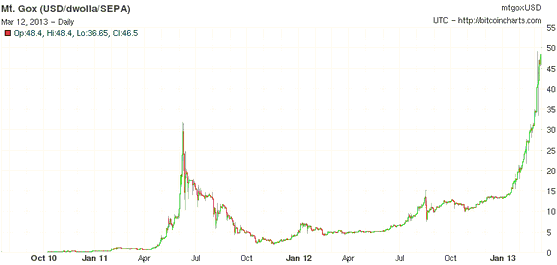
Chart Source:
www.bitcoincharts.com
We have nothing against Bitcoin and have no opinion on what will
happen to its exchange rate. Our view is that it will never be money
and that right now it is more of a speculative plaything than a
currency.
Broker
Survey
Casey Research recently surveyed their readers
about the full-service and online brokers they use, and how they rate various
aspects of those brokers' services. The survey results are
HERE.
We use multiple brokers across four geographical/political regions (US, Canada,
Australia and Europe). The on-line broker that we use the most is
Interactivebrokers.com, because it provides access to numerous markets around
the world and allows us to trade in the local currency of each international
market. The full service broker that we use the most is Canaccord in Canada,
because it gives us access to private placements.
The Stock Market
A myth? Not exactly.
From John Hussman's latest
Weekly Comment:
"Myth 1: As long as quantitative easing is underway, stocks will advance
indefinitely.
This first myth is embodied in statements like "since 2009, there has been an
85% correlation between the monetary base and the S&P 500" -- not recognizing
that the correlation of any two data series will be nearly perfect if they are
both rising diagonally. As I noted last week, since 2009 there has also been 94%
correlation between the price of beer in Iceland and the S&P 500. Alas, the
correlation between the monetary base and the S&P 500 has been only 9% since
2000, and ditto for the price of beer in Iceland (though beer prices and the
monetary base have been correlated 99% since then). Correlation is only an
interesting statistic if two series show an overlap in their cyclical ups and
downs.
If you want to talk about causation, the case for X causing Y is more compelling
if the fluctuations in X precede fluctuations in Y. Even in that case, we say
that X "causes" Y only if observing X gives us additional information beyond
previous movements in Y itself. In the case of quantitative easing, much of what
we observe as "causality" actually runs the wrong way. Market declines cause QE
in the first place, and the result is a partial recovery of those declines."
There's nothing wrong with the above outline of how QE and the stock market are
inter-related, but it is only part of the story. Three important aspects are
missed. First, while it's true that there generally won't be a strong
correlation between money-supply growth and stock market performance over a
complete cycle, there is a strong tendency for major changes in the money-supply
growth rate to lead major stock market trends. Unfortunately (from a practical
speculation standpoint), the lead-time varies greatly. For example, the
2000-2002 and 2007-2009 bear markets were both preceded by substantial declines
in the monetary inflation rate, but the lead-time was less than one year in the
first case and almost three years in the second case. Second, once an equity
bear market is in full swing it will typically run its course even if the Fed
ramps up the money supply. For example, sharp increases in the rate of US
monetary inflation commenced in Q1-2001 and September-2008, but in the first
instance it didn't prevent an equity bear market from continuing until Q4-2002
and in the second instance it didn't prevent the stock market from crashing
during September-November of 2008. Third, while it is normal for a large market
decline to precede the introduction of monetary stimulus, the QE programs of
last September and December were introduced when the stock market was near a
multi-year high. This makes the current situation unprecedented.
In our opinion, the on-going monetary stimulus hasn't eliminated the risk of a
large stock market decline, but it has increased the risk of being short the
stock market.
Current Market Situation
It seems that North Korea's first family gets crazier with each new generation.
Kim Il-sung was crazy, Kim Jong-il was crazier, and the recently-enthroned Kim
Jong-un is showing signs of being the craziest yet. The youngest Kim has
recently threatened to destroy neighbouring South Korea, declared "null and
void" the 1953 armistice that ended the Korean War, and ordered 'his people' to
prepare for war. Unlike the average lunatic this one has a nuclear arsenal at
his disposal. The arsenal is small and of dubious quality, but still...
Although the stock market isn't always good at discounting risks, we expect that
an increase in the probability of Kim Jong-un attempting to make good on his
threats will be reflected by pronounced relative weakness in South Korea's stock
market. We are therefore paying a lot more attention than usual to the
performance of South Korea's stock market, as represented on the following chart
by South Korea i-Shares (EWY).
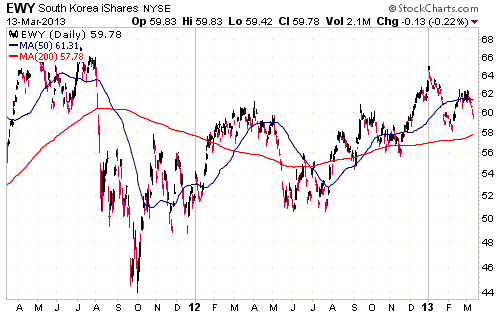
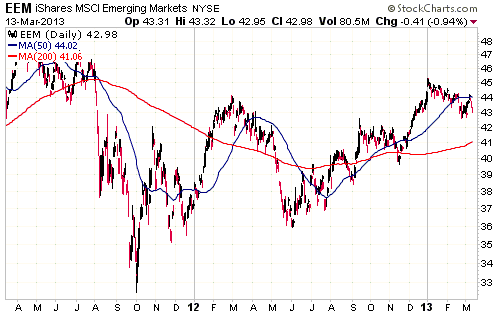
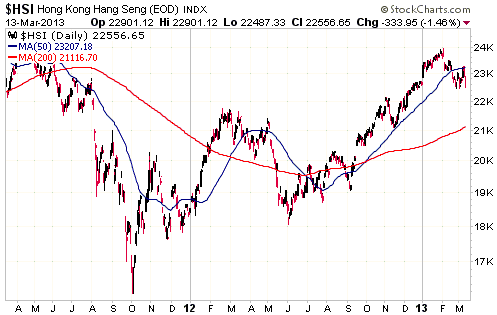
EWY has had a downward bias since the beginning of this year, but its weakness
to date hasn't been out of the ordinary. We note, for example, that the Emerging
Market ETF (EEM) has also had a downward bias since the beginning of this year
and that Hong Kong's Hang Seng Index (HSI) is near a 3-month low. Charts of the
EEM and the HSI are displayed below. In other words, at this stage the markets
don't believe that Kim Jong-un's war of words will turn into a war of bombs and
missiles.
Gold and the Dollar
Gold
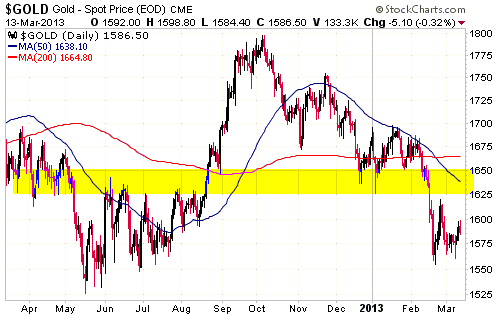
Nothing of significance happened in the gold market over the first three days of
this week. The US$ gold price bumped up against minor resistance at $1600, but
resistance-wise the big test lies at $1625-$1650. A solid break above $1650
would signal an end to the correction.
Market Vane's bullish percentage for gold remains near a 10-year low.
Gold Stocks
The HUI hasn't negated last week's reversal but also hasn't provided us with any
additional evidence that a sustainable price low is in place.
There has recently been a lot of discussion about the sorry state of the TSX
Venture Exchange, the stock-exchange home of about 1400 small-cap mining
companies. It has been pointed out by knowledgeable sources that about half of
these junior mining companies have dangerously low cash reserves (working
capital of less than $1M) and are therefore at risk of going out of business, or
at least being de-listed from the TSXV, within the next 12 months. Some will be
able to arrange the financial deals needed to keep themselves going, but it's a
good bet that around 500 of these tiny cash-strapped companies will go bust
and/or be de-listed unless there is a dramatic improvement in the market
environment over the next several months, that is, unless it soon becomes much
easier to raise money at a reasonable cost. Such an improvement is not out of
the question, but it's not a high-probability outcome.
As an aside, the well-financed stocks will benefit from the elimination of many
cash-poor companies. As companies go out of business or are de-listed there will
be less competition for investor interest.
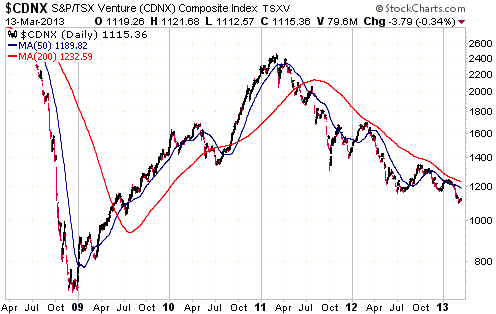
An improvement in financing conditions for small exploration-stage mining
companies will be preceded by a clear-cut upward trend reversal in the TSX
Venture Exchange Composite Index (CDNX). As illustrated by the following chart,
the CDNX is presently near its lowest level since mid-2009.
A trend reversal could occur at any time, but there is no evidence that it has
already occurred.
Most of the exploration-stage mining stocks in the TSI List are fully funded
through to at least the final quarter of this year and none of them have an
urgent/immediate need to raise new money.
Update
on Stock Selections
Notes: 1) To review the complete list of current TSI stock selections, logon at
http://www.speculative-investor.com/new/market_logon.asp
and then click on "Stock Selections" in the menu. When at the Stock
Selections page, click on a stock's symbol to bring-up an archive of
our comments on the stock in question. 2) The Small Stock Watch List is
located at http://www.speculative-investor.com/new/smallstockwatch.html
 Index
changes go into effect on Monday 18th March. Due to index-tracking funds
repositioning themselves in preparation for the changes, this could result in
stocks that are being added to indices rising sharply and stocks that are being
deleted from indices falling sharply on Friday 15th March. Friday's moves in
reaction to index changes would likely be retraced early next week. Index
changes go into effect on Monday 18th March. Due to index-tracking funds
repositioning themselves in preparation for the changes, this could result in
stocks that are being added to indices rising sharply and stocks that are being
deleted from indices falling sharply on Friday 15th March. Friday's moves in
reaction to index changes would likely be retraced early next week.
Sabina Gold and Silver (SBB.TO) is the only TSI stock that will potentially be
affected by this round of index changes. SBB is being deleted from the S&P/TSX
Global Mining Index and the S&P/TSX Global Base Metals Index. This could lead to
a sell-off in SBB shares on Friday. Whether it does or not will depend on
whether new buying on the part of value investors is sufficient to counteract
the selling of index-tracking funds.
An index-related SBB sell-off on Friday should be viewed as both a short-term
and a long-term buying opportunity.
Rye Patch Gold (TSXV: RPM). Shares: 146M. Recent price: C$0.425
We added RPM to the TSI Stocks List last October as a speculation on
the outcome of a court case involving the disputed ownership of
mineral claims. At that time the court case was scheduled to happen
before year-end, but Coeur d'Alene Mines (CDE), RPM's opponent,
managed to delay the proceedings until the second half of 2013. We
think that RPM will win the case and that the legal victory will
lead to a large increase in its stock price, but due to the fact
that this was supposed to be a short-term trade we've been looking
for an opportunity to exit.
As a result of the extreme sector-wide weakness a good opportunity
to exit never materialised, but the opportunity presented by RPM's
recent strong rebound is good enough considering the overall market
environment.
We have removed RPM from the TSI Stocks List and recorded a loss of
18.3% based on our October-2012 entry price of C$0.52 and the 13th
March 2013 closing price of C$0.425.
Chart Sources
Charts appearing in today's commentary
are courtesy of:
http://stockcharts.com/index.html

|









