|
- Interim Update 13th April 2011
Copyright
Reminder
The commentaries that appear at TSI
may not be distributed, in full or in part, without our written permission.
In particular, please note that the posting of extracts from TSI commentaries
at other web sites or providing links to TSI commentaries at other web
sites (for example, at discussion boards) without our written permission
is prohibited.
We reserve the right to immediately
terminate the subscription of any TSI subscriber who distributes the TSI
commentaries without our written permission.
Reminder about TSI schedule change
About
12 hours after today's Interim Update is posted we will be leaving on a
13-day trip (a mixture of business and pleasure) and won't be back in
the office until 27th April. Consequently, the next regular TSI report
will be the Interim Update scheduled for Thursday 28th April.
While we are away we'll provide a brief market commentary in a blog
format every 3-4 days, or more frequently if market action warrants.
Assuming that nothing dramatic happens over the final two trading
sessions of this week, the first of these brief comments will be
emailed to subscribers next Tuesday (19th April).
Caught in a trap
In
the 14th March Weekly Update we explained that the current round of
"quantitative easing", which is affectionately known throughout the
financial world as QE2, would probably end as scheduled in June of this
year, and that the Fed would begin preparing the financial markets for
this eventuality via carefully placed hints during the preceding 2-3
months (note: many hints have already been dropped by the constantly
chattering bunch responsible for 'managing' the US monetary system). We
also explained that QE would almost certainly continue, in fits and
starts, until a major inflation problem could no longer be denied,
implying that June's expected cessation of QE would prove to be
short-lived.
Any cessation of QE will very likely be short-lived for two
inter-related reasons. First, QE and the other policies implemented to
address the financial crisis and economic downturn of 2007-2009 have
not only prevented the underlying problems from being rectified, they
have created additional problems (they have prompted additional
mal-investment and depleted the pool of real savings). This means that
greater economic weakness lies in store. Second, senior policy-makers
and the most influential economists believe that QE provides genuine
support during hard economic times. This pretty much guarantees that
the next period of blatant economic weakness will be met with more of
the same ill-conceived policy responses. In a nutshell, we are seeing
the intervention-related downward spiral described by Ludwig von Mises
generations ago, with government/CB intervention causing problems
(unintended consequences) that provide the justification for more
interventionist measures, that lead to bigger problems, and so on.
It is fair to say, then, that the Fed is trapped by the combination of
its prior policy errors and the ignorance of its leadership. The prior
errors will inevitably lead to problems that, due to the ignorance of
the Fed chairman and his close associates, will prompt more policy
errors.
In fact, due to earlier mistakes the Fed might now be in such a
'pickle' that the economic outcome would be disastrous even if its
current leadership were replaced by people with a good understanding of
how monetary inflation affects the economy. For a full discussion of
why this is the case, please refer to John Hussman's 11th April commentary.
For the abridged version, please read on. (Note that when we put
quotation marks around inflation in the following discussion it means
that we are using the popular, albeit misleading, definition of the
word: a rise in the general level of consumer prices.)
Although the Fed now pays a miniscule rate of interest on bank
reserves, for all intents and purposes the Monetary Base (the total
supply of paper notes and coins plus commercial banks' reserves at the
Fed) can be thought of as non-interest-bearing cash. There is a
well-defined relationship between the amount of non-interest-bearing
cash in the US economy (the US Monetary Base), the level of short-term
interest rates (say, the yield on the 3-month T-Bill), and "inflation",
in that an increase in the Monetary Base relative to the overall
economy (nominal GDP) WILL have "inflationary" consequences UNLESS
there is a reduction in the short-term interest rate of sufficient
magnitude to maintain the competitiveness of non-interest-bearing cash.
To further explain via a general example, if the Fed suddenly increased
the Monetary Base and the interest rate remained the same, the extra
cash would be akin to a 'hot potato' as far as the current holders of
the economy's non-interest-bearing cash were concerned. This would lead
to "inflationary" consequences after the 'hot potato' was tossed into
the economy, that is, after the commercial banks loaned their excess
reserves in order to achieve a better return. Furthermore, the same
situation would arise if the total quantity of non-interest-bearing
cash remained the same while the risk-free short-term interest rate
increased, in that the higher interest rate would create an
irresistible incentive to reduce holdings of non-interest-bearing cash.
Again, there would be "inflationary" consequences as the cash began to
'ripple' through the economy. However, an increase in the quantity of
non-interest-bearing cash would not necessarily have "inflationary"
consequences if it coincided with a decrease in the interest rate
offered by highly liquid risk-free short-term investments such as
T-Bills, which is what happened over the past few months (the recent
large increase in the Monetary Base was associated with a decline in
the T-Bill yield from 0.16% to 0.04%, thus mitigating the immediate
"inflationary" consequences of QE2). Also, a rise in interest rates
would not have "inflationary" consequences if it coincided with a
sufficient contraction in the Monetary Base.
The above is a little more convoluted than we'd like, but the bottom
line is this: without a contraction in the US Monetary Base, an
increase in short-term (3-month or less) interest rates would cause the
demand for non-interest-bearing cash to plunge (banks would rush to
lend their excess reserves), leading to a surge in consumer prices.
Based on Hussman's analysis of the historical data (refer to the
above-linked commentary), the best part -- or the worst part, depending
on your perspective -- is that the Fed has boosted the quantity of
non-interest-bearing cash to such an extent that in order to avoid a
surge in "inflation", the first few steps during the Fed's next
rate-hiking campaign would have to be accompanied by a gargantuan
contraction in the Monetary Base. For example, just getting the T-Bill
yield up to 0.25% without a large "inflationary" impetus would now
require a $600B-$700B contraction in the Monetary Base (the complete
reversal of QE2)!
The Fed is caught in a trap of its own making from which there is no
escape. At some point in the future it will have to begin hiking its
official interest rate target in an effort to clamp down on
"inflation", but rate hikes would cause "inflation" to get worse unless
they were accompanied by the sort of reduction in the Monetary Base
that would substantially add to the woes of the property market and
cause the stock market to tank. To put it another way, there doesn't
appear to be any way that the Fed will ever be able to quell
"inflation" without bringing about large declines in the asset prices
it has worked so hard to elevate. So, what's a Fed chairman to do?
We suspect that he will try to postpone a financial market calamity by
paying banks NOT to lend their excess reserves. The mechanism to do
this was put in place in September of 2008, when the Fed received the
approval of Congress to pay interest on bank reserves (the Fed had
previously not been allowed to pay interest on these deposits). By
raising the interest rate that it pays on bank reserves to a
sufficiently high level, the Fed could theoretically counteract the
incentive to lend these reserves into the economy that would otherwise
stem from a rise in the risk-free short-term market interest rate. In
doing so the Fed would only be 'kicking the can down the road', in that
it would be adding to the total quantity of excess bank reserves (the
interest payments would boost reserves) and therefore adding to the
eventual "inflation" problem. However, 'kicking the can down the road'
seems to be the preferred modus operandi of the political and
bureaucratic elite.
The Stock Market
The
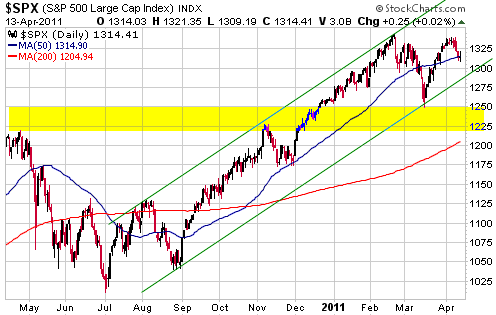
S&P500 Index moved up to near its February high last week and has
since dropped back to its 50-day moving average. The situation is
illustrated below. As long as it holds above 1300 (on a daily closing
basis) during any additional consolidation over the days immediately
ahead it will be reasonable to assume that a move to new multi-year
highs lies in the near future.
A move by the
S&P500 to new multi-year highs is probable, but we remain concerned
about downside risk. Volatility and sentiment indicators continue to
show that complacency reigns supreme amongst the unwashed
equity-investing masses, which is a good reason for us to be
non-complacent. Also, there is some uncertainty in our minds as to how
the market will react to the coming end of QE2. On the plus side:
'seasonality' remains bullish, and the price action is currently not
'overbought' given that the senior stock indices have essentially
traded sideways over the past two months.
In our own accounts there are currently no short-term speculations. We
can therefore sit back and watch the daily fluctuations with detached
amusement.
There are two other charts that we'll feature in today's stock market
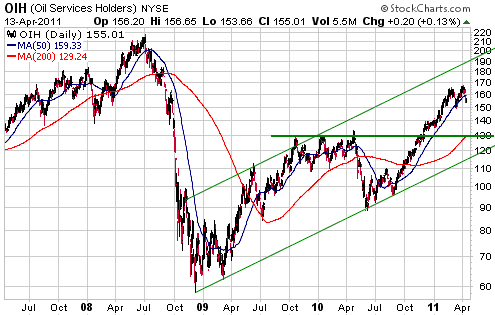
discussion. The first is a daily chart of the Oil Services ETF (OIH)
and the second is a daily chart of Brazil's Bovespa Index (BVSP).
If the oil-and-gas services sector hasn't been the best-performing
sector of the stock market since the financial world began to react to
the promise of more Fed money-pumping last August, it must have been
close it. As evidenced by the following chart, OIH moved up in almost a
straight line from late August of 2010 through to the third week of
February this year, at which time a 'choppy' consolidation got
underway. At least, it looks like a consolidation, but it could also
turn out to be a topping pattern.
If the consolidation interpretation is right then OIH will soon break
to a new high for the year, perhaps leading to a rise to the top of the
2.5-year channel. It should be kept in mind, though, that the OIH's
advance is linked more to monetary inflation and the advance in the
overall stock market than to bullish fundamentals for O&G services
companies. When the overall equity rally ends, so too will the OIH
rally.
The OIH's additional short-term upside potential is probably enough to
offset its short-term downside risk, but on an intermediate-term basis
the risk appears to be markedly higher than the remaining upside.
The Brazilian stock
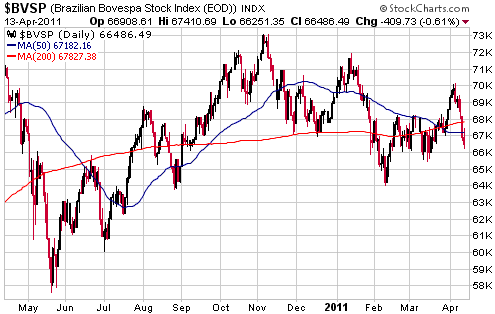
market, as represented on the following chart by the Bovespa Stock
Index (BVSP), has made a sequence of declining tops beginning in early
November of last year. The price action could be indicative of a
lengthy consolidation, but it could also indicate that Brazilian
equities are now almost six months into a bear market.
In this case and in most cases, the price action in isolation doesn't
distinguish between the start of a bear market and a bull market
correction. If it did then nobody would ever be caught 'holding the
bag' during a bear market. However, the price action will eventually
provide some clues as to whether or not the long-term trend is still up.
The clue that we'll mention today relates to the 50-day MA (the blue
line on the chart) relative to the 200-day MA (the red line on the
chart). Notice that the 50-day MA has crossed below the 200-day MA, an
occurrence that 'technical analysts' call a "death cross" because it
supposedly signals the death of a bull market. We don't like the term
"death cross" because in our experience this MA crossover is a bearish
omen no more than 50% of the time. The rest of the time it indicates
that a downward correction is close to an end; that is, the rest of the
time it marks a buying opportunity. For example, the BVSP suffered a
so-called "death cross" in June of last year -- just after it had
bottomed for the year. The point is that bull markets regularly
'correct' by enough to cause the 50-day MA to cross below the 200-day
MA, and then return to their upward paths.
A "death cross" only lives up to its name if the market that has
experienced the 'bearish' MA crossover rebounds to a lower high and
then declines to a lower low. In the BVSP's case, a rebound to a lower
high ended in early April. If the February low is now taken out, we
will have evidence that the bull market is dead. On the other hand, if
the BVSP reverses upward and takes out its early-April high we will
have evidence that the bull market is intact and that the MA crossover
happened in the vicinity of a correction low.
Gold and
the Dollar
Gold
As mentioned in a number of earlier commentaries, there's a good chance
that the next intermediate-term peak in the gold price will be marked
by either a pronounced downward reversal in the silver/gold ratio or by
the silver/gold ratio failing to confirm new price highs in the gold
market. An example of the latter occurred in 2006, when the silver/gold
ratio made a clear-cut peak in mid April and the gold price continued
upward for about three more weeks. The following chart illustrates what
happened (the green solid line on the chart is the silver/gold ratio
and the candlesticks represent the gold price).
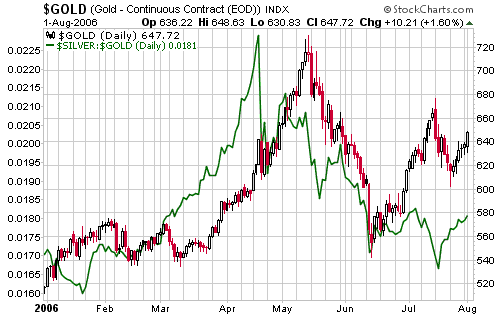
In 2006, the dramatic
mid-April plunge in the silver/gold ratio made it clear that an
intermediate-term trend change had happened or was about to happen (as
we pointed out at the time, by the way). Note, though, that to be
significant a non-confirmation wouldn't necessarily have to be as
blatant as the one that happened during April-May of 2006. From here
on, we would take any multi-week period of strength in gold relative to
silver as a signal that an intermediate-term top was imminent. Another
way to put it is that an extension of the upward trend beyond the very
short-term requires continuing strength in silver relative to gold.
The silver/gold ratio closed at a new high for the move on Wednesday
13th April, so there is no evidence, yet, that the upward trend has
ended.
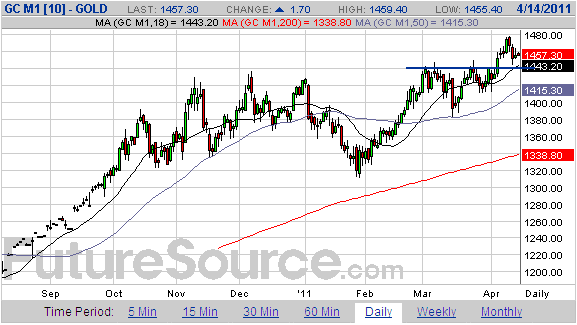
The following daily chart shows that the June gold futures contract has
pulled back over the first three days of this week to 'test' last
week's upside breakout. This is normal price action.
To avoid doing any damage to the 'technical picture', June gold should hold above $1440 on a daily closing basis.
Gold Stocks
Support/resistance for the HUI extends from 575 up to 600. As indicated
by the following daily chart, the HUI broke above the top of this range
last week but the breakout didn't hold and it has just dropped back to
the bottom of the range. The XAU has been weaker than the HUI and
closed below support on Wednesday.
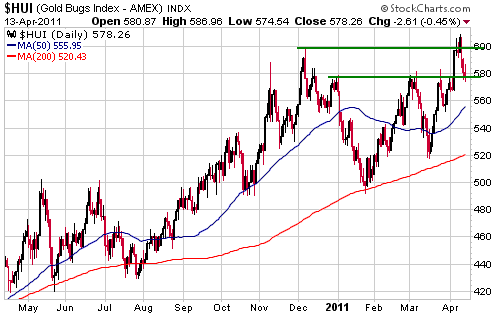
Although not the most
likely scenario, this week's price action indicates that we could have
a false upside breakout on our hands. As far as bearish price signals
are concerned, false upside breakouts are generally more reliable than
downside breakouts.
At this stage we aren't very concerned, mainly because the rally has
been led by the bullion (silver and gold bullion have been dragging the
associated equities upward) and at this stage the short-term upward
trend in the bullion market is intact. Our level of concern will
increase, though, if the HUI closes below 574.
Currency Market Update
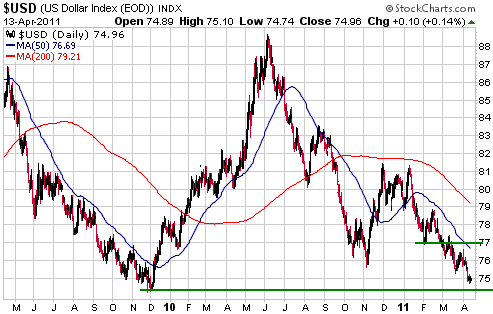
The Dollar Index has been declining slowly and steadily since the
beginning of this year, which creates the most bullish of all possible
currency-market backdrops for equities and non-monetary commodities.
Actually, in this case cause and effect appear to work both ways, in
that a slowly-declining US$ creates a bullish backdrop for equities and
non-monetary commodities while strength in equities and commodities
puts downward pressure on the US$.
We wonder how much longer the currency market will remain tranquil and
generally supportive of asset prices. One potential disturbance on the
horizon is the end of QE2, which should have implications for the US
dollar's relative value. The extent of these implications is unknown,
though, because most people are already aware that QE will end on at
least a temporary basis in June. When most people know an event is
going to happen you can be sure that the event has been discounted to
some degree in current market prices.
From a purely 'technical' perspective, another potential disturbance is
the close proximity of important support for the Dollar Index. As
evidenced by the following daily chart, the Dollar Index is now within
half a point of support defined by its November-2009 low. On one hand,
this support could prove to be a 'launching pad' for a significant
rebound. On the other hand, a break below support could cause the
decline to accelerate. Either way, it looks like an increase in
volatility lies in the near future.
We suspect that the
effect on the US$ of QE2's end will largely be determined by its effect
on the stock market. If the stock market shrugs off the temporary
cessation of Fed money-pumping, then the currency market will probably
do the same. However, if the stock market begins to trend downward as
QE2 nears its conclusion, then a meaningful US$ rally will likely occur.
As previously advised, a pronounced downward reversal in the
silver/gold ratio would likely mark a US$ bottom or the start of a US$
bottoming process.
Update
on Stock Selections
(Notes: 1) To review the complete list of current TSI stock selections, logon at http://www.speculative-investor.com/new/market_logon.asp
and then click on "Stock Selections" in the menu. When at the Stock
Selections page, click on a stock's symbol to bring-up an archive of
our comments on the stock in question. 2) The Small Stock Watch List is
located at http://www.speculative-investor.com/new/smallstockwatch.html)
 Catalpa Resource (ASX: CAH). Shares: 178M issued, 184M fully diluted. Recent price: A$1.59 Catalpa Resource (ASX: CAH). Shares: 178M issued, 184M fully diluted. Recent price: A$1.59
CAH's managers brought the Edna May mine into production on time and on
budget last May, but their record since then has been characterised by
over-promising and under-delivering. The most recent example occurred
on Monday of this week when the company reduced its production forecast
for the current financial year (the year ended 30 June 2011) by
13,000-16,000 ounces. This is due to a combination of issues, including
systemic equipment failures, all of which have supposedly now been
addressed.
This is the second significant reduction to the current year's
production forecast over the past six months. Furthermore, in between
these production downgrades the company's management 'rubbed salt into
the wounds' of existing shareholders by doing a poorly-timed equity
financing.
The upshot is that whereas six months ago we were expecting that CAH's
operations (100% of Edna May plus 30% of Cracow) would deliver
120K-130K ounces of gold production during the 12-month period ended
30th June 2011, the production over this period is now likely to be
only 90K-100K ounces.
We aren't happy, but we are continuing to hold. This is because the
value is there, and because the risk is relatively low given a) the
evidence that Edna May will go close to achieving its design parameters
once the latest issues are resolved and b) the fact that CAH gets 30K
ounces of gold production per year from the stable Newcrest-managed
Cracow operation.
Our A$2.50/share target for the stock remains valid, although it is
obviously going to take longer to achieve than originally expected.

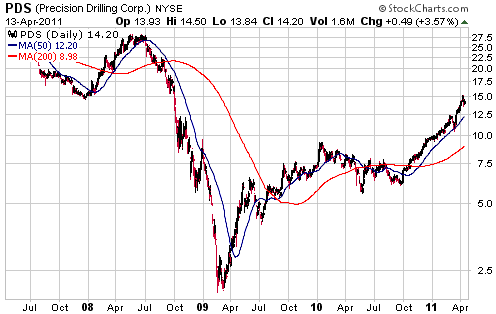
Precision Drilling (NYSE: PDS, TSX: PD). Shares: 276M issued, 291M fully diluted. Recent price: US$14.20
We are going to remove PDS from the TSI Stocks List. Due to the fact
that the timing of our initial recommendation of the stock (July-2008)
was almost as bad as it could possibly be, this long-term trade will go
into the record books as a loss of 28.9%. However, based on the average
price at which we suggested buying the stock the end result looks much
better. For example, we suggested buying PDS four times during
February-March of 2009 at US$2.50 or lower.
Our short-term outlook for PDS is the same as our short-term outlook
for the oil-and-gas service sector: neutral. The stock is 'overbought',
but the potential exists for what would probably turn out to be a final
multi-week surge. Our concern is that the rally is 'long in the tooth'
and that intermediate-term downside risk is substantial.
Clifton Star Resources (TSXV: CFO). Shares: 35M issued, 40M fully diluted. Recent price: C$4.07
There should be some significant news relating to the Duparquet gold
project within the next three weeks, in that CFO's JV partner on the
project (Osisko) is expected to soon announce a resource re-estimate
and report the results of the remaining holes from last year's drilling
program.
Based on the way that Osisko has seemingly gone out of its way to
downplay the potential of the Duparquet project over the past year, we
expect that the coming resource estimate will be extremely
conservative. In particular, Osisko is likely to use a cut-off grade of
0.60-g/t for the Duparquet resource estimate, versus the 0.35-g/t it
uses when computing the resource for its 100%-owned Malartic project
(the higher the assumed cut-off grade, the lower the calculated
resource). However, we understand that CFO will be doing its own
resource estimate for comparison purposes.
The following daily chart shows that CFO broke above resistance at
C$4.00 last week and is now pulling back to 'test' the breakout. It is
therefore fair to say that the price action has recently become more
constructive.
We think that CFO is a buy in the low-C$4 area, especially for
longer-term speculators (those with timeframes of at least 6-12
months).
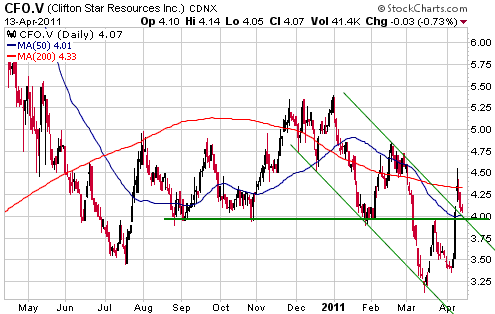
Chart Sources
Charts appearing in today's commentary
are courtesy of:
http://stockcharts.com/index.html
http://www.futuresource.com/

|









