- Interim Update 13th May 2015
Copyright
Reminder
The commentaries that appear at TSI
may not be distributed, in full or in part, without our written permission.
In particular, please note that the posting of extracts from TSI commentaries
at other web sites or providing links to TSI commentaries at other web
sites (for example, at discussion boards) without our written permission
is prohibited.
We reserve the right to immediately
terminate the subscription of any TSI subscriber who distributes the TSI
commentaries without our written permission.
The government bond
sell-off continues
Long-dated US Treasury
securities, represented on the following chart by the iShares 20+ Year Treasury
Bond ETF (TLT), continued their price declines (yield advances) over the first
three days of this week.
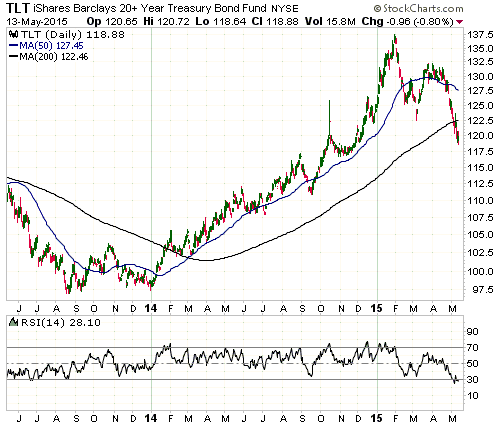
Two of the most interesting aspects of the sell-off in US government bonds are:
1) it is occurring on low trading volume, not because of a lack of conviction
but because years of bond-buying by the Fed has resulted in the market becoming
far less liquid than it used to be, and 2) it is being led by, and at least
partly driven by, the sell-off in European government bonds.
There was no way to predict exactly when a substantial sell-off in European
government bonds would get underway, but just prior to its beginning the
negative nominal yields on many of these bonds constituted one of the most
egregious examples of over-valuation in history. This was discussed in the 13th
April Weekly Update under the heading "The absurdity of negative bond yields",
at which time we summed up the situation as follows:
"...the negative nominal yields on government bonds are a function of massive
money creation during a period when central banks have reduced bond supply and
conspired to keep their targeted short-term interest rates near zero, and when
most of the new money has gone to large financial-market speculators such as
hedge funds, banks and securities dealers.
The point we want to stress today is that even though the financial world is
becoming inured to the situation and even though the situation can be explained
(especially with the benefit of hindsight), the proliferation of negative
nominal bond yields is a completely absurd development. The reason, in a
nutshell, is that time preference is always positive, which means that,
regardless of whether the economy is experiencing inflation or deflation, having
one dollar in the present should always be worth more than having a promise to
pay one dollar in the future. It's a ridiculous distortion caused by a
counter-productive monetary system that there are now many examples of one
dollar in the hand being worth less than a promise to pay one dollar in the
future."
A new multi-quarter trend is probably just beginning in Europe's government
bonds as a modicum of sanity returns to the credit market. It could be a similar
story with regard to US government bonds, although for the reasons cited in last
week's Interim Update a bearish speculation in US government bonds is not a
trade that currently appeals to us.
The Stock Market
China
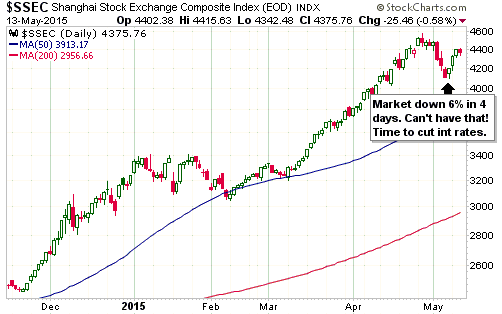
It's beginning to seem as if every time China's stock market threatens to pull
back sharply or embark on a meaningful correction, the People's Bank of China (PBOC)
will do something to boost 'liquidity'. The latest example occurred on Sunday
10th May, when the PBOC cut its lending and deposit rates for the third time in
6 months. This appeared to be at least partly a reaction to the 6% decline --
from near a 7-year high -- in the Shanghai Stock Exchange Composite Index (SSEC)
over the final four days of last week. The rate cut had the predictable and
desired effect, in that the SSEC jumped 5% over the first two days of this week.
The message is that China's stock market may well be very over-valued and
overbought, but it is dangerous to be short.
The US
For anyone who uses sensible risk management, it's NOT dangerous to be short the
US stock market at this time. Not only does the US stock market have substantial
valuation-related downside potential, but also the price-related evidence is
slowly beginning to signal a bearish outcome and the Fed is unlikely to take any
new liquidity-boosting measures until after the market has dropped a
considerable distance.
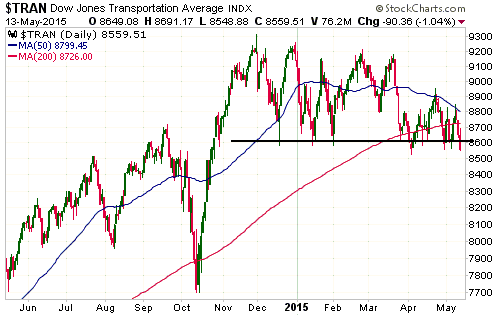
With regard to the aforementioned price-related evidence, the Dow Transportation
Average closed below critical support at 8600 on Wednesday. Previous moves below
this support have been quickly reversed, so the breakout needs to hold through
to the end of this week to be significant.
Gold and the Dollar
Gold
One gold 'fundamental' becomes more bullish
Beyond knee-jerk reactions that last a day at most, economic data are only
significant to the gold market to the extent that they cause shifts in
fundamental drivers such as real interest rates, the yield curve and credit
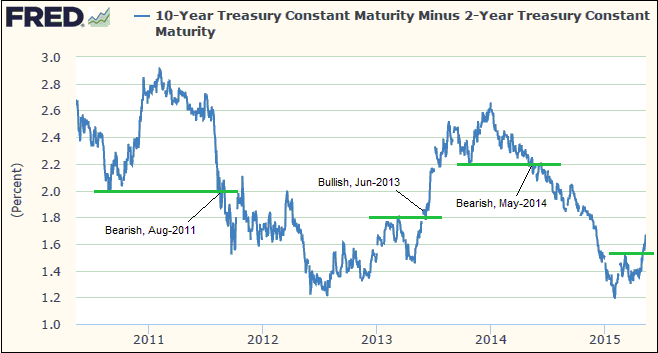
spreads. A chart reflecting the performance of the yield curve is displayed
below.
The yield curve is represented on our chart by the 10yr-2yr yield spread. A
rising 10yr-2yr yield spread implies a steepening yield curve, which is bullish
for gold because it indicates either rising inflation expectations (in the case
where the spread-widening is primarily driven by a rising 10-year yield) or
increasing risk aversion (in the case where the spread-widening is primarily
driven by a falling 2-year yield). A falling 10yr-2yr spread implies a
flattening yield curve, which is bearish for gold because it indicates either
falling inflation expectations or increasing willingness to take-on risk (by,
for example, borrowing short to lend long) . Most recently, the US yield curve
turned decisively bullish for gold in June-2013 and turned decisively bearish
for gold in May-2014 (breakouts confirm the trend changes).
In the 6th April Weekly Update we mentioned that a move in the 10yr-2yr spread
to above its Q1-2015 high would be the first sign that the yield curve was
turning from gold-bearish to gold-bullish. As illustrated below, such a move
happened over the past week. The recent widening of the yield-spread (steepening
of the yield curve) has been driven by an increase in the 10-year yield, which
indicates that it is primarily due to rising inflation expectations.
At the same time as the yield curve has become more bullish for gold, real
interest rates and credit spreads have become less bullish (real interest rates
have increased and credit spreads have narrowed). The overall fundamental
backdrop for gold therefore remains mixed. Having said that, the yield curve
tends to be the most influential fundamental driver near major turning points,
so the fact that it has recently turned more bullish for gold overshadows the
slight deteriorations in some other fundamental drivers.
Current Market Situation
In response to the steepening yield-curve and a breach of support by the Dollar
Index, the US$ gold price jumped to the top of its 2-month trading range ($1220)
on Wednesday. The top of the range is defined by multiple price peaks and also
now coincides with the 200-day MA.
Recall that the 200-day MA was our minimum target for the rebound from the March
low, but that when this target was first broached the MA was in the $1240s. It
is now around $1220 and for all intents and purposes was reached on Wednesday
13th May.
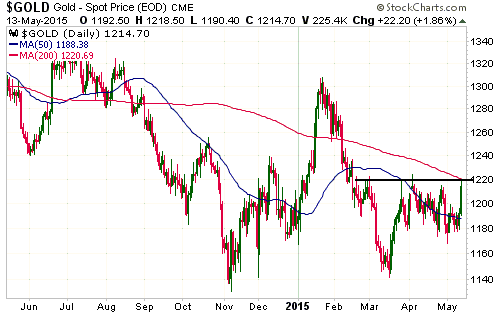
Gold is not yet close to being 'overbought' on even a short-term basis.
Consequently, we think that the odds favour a break above the $1220 resistance
level, either immediately or next week after 2-3 days of consolidation.
$1300 would be the measured (chart-based) objective following a solid daily
close above $1220, but we doubt that it will get that high before the next
multi-week peak is put in place.
Gold Stocks
Current Market Situation
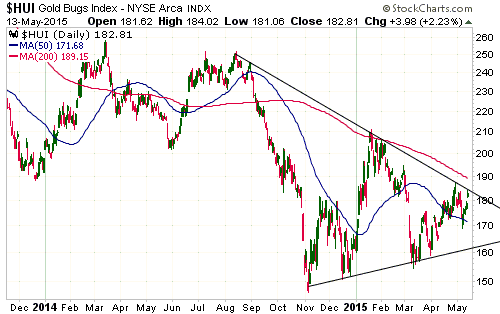
The HUI's advance appears to have been limited again this week by the trend-line
drawn from the August-2014 short-term peak. As illustrated by the HUI chart
included in the latest Weekly Update, this trend-line resistance also coincides
with the top of a long-term channel. And if that wasn't enough nearby resistance
to deal with, the declining 200-day MA is now at 189 and will soon coincide with
the aforementioned trend-line and channel top.
The weekly closes this week and next week will be informative. The HUI will have
to achieve a weekly close above intermediate-term resistance in the low-200s to
definitively signal an end to its multi-year bearish trend, but a weekly close
above 190 would be a clear, albeit preliminary, warning of a bullish reversal.
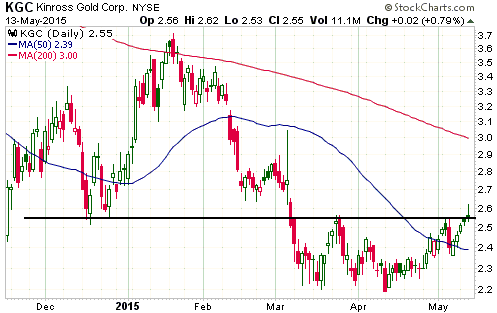
When an individual stock temporarily fails to gain as much as would normally be
expected during a sector-wide rally, it is often because the stock is struggling
with chart-related resistance. For example, the following chart shows that
Kinross Gold (KGC) has obvious resistance at US$2.55. It's a good bet that the
stock's close proximity to this resistance has limited its upside over the past
two trading days.
By the way, US$2.90-$3.00 would be the short-term chart-based target for KGC
following a daily close above $2.55.
Comments on two non-TSI junior gold miners in which we currently have no
financial interest
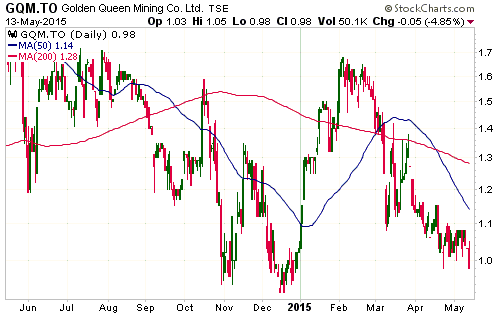
1) Golden Queen Mining (GQM.TO)
GQM is developing the Soledad Mountain gold-silver project in California. The
project is fully permitted and currently under construction. Production is
scheduled to commence in early-2016.
We came close to adding GQM to the TSI List during the final quarter of last
year, but changed our intentions when the company announced that Soledad's
reserves had been over-estimated. However, we have continued to keep an eye on
the stock.
The main reason we are mentioning GQM is the misleading way its balance sheet
has been presented since the company did a joint venture last September that
involved giving up 50% of Soledad in exchange for the bulk of the financing
needed to fund the mine construction.
The balance sheet has been presented on a consolidated basis, which means that
all of the cash held by the JV company in which GQM has a 50% stake (about $65M
at the end of March) appears as cash on GQM's balance sheet. Consequently,
anyone taking a cursory look at the balance sheet could come away with the
impression that GQM's financial position is strong, but this impression is
wrong. The reality is that GQM has direct access to none of the cash in the JV
vehicle. This cash is dedicated to funding the mine construction and cannot be
used by GQM to meet its other obligations.
The amount of cash that GQM actually has access to is less than $4M. With this
cash it must fund its business and pay its debts, including a $12M debt due on
1st July 2015. In other words, GQM's financial position is precarious. It should
be able to arrange the additional financing it needs, but our point is that the
urgent need to raise more money to address a short-term working capital deficit
is being masked by the way the company chooses to present its balance sheet.
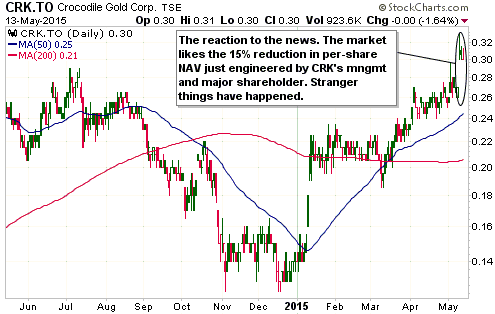
2) Crocodile Gold (CRK.TO)
CRK is currently producing gold at the rate of around 200K ounces/year from
mines in Australia. Due mainly to the large decline in the A$, in US$ terms the
company's production costs have plunged over the past 8 months and the company
has become strongly cash-flow positive (it would be a marginal or loss-making
producer without the benefit of the A$ decline). This, in turn, prompted us to
put CRK on a short list of potential future buys. It is still on this short
list, despite the value slippage resulting from a deal that was announced a few
days ago.
The deal is extraordinary. CRK is being acquired by Newmarket Gold (NGN.V), a
company with assets of roughly zero and a stock with average daily trading
volume of roughly zero. In effect, CRK is being backed into a shell company.
This is something that is sometimes done to obtain a Canadian stock exchange
listing for a privately-held company, but CRK already has a Canadian stock
exchange listing (a higher-level listing than NGN).
After the deal is completed, the combined company (Newco) will be owned 80% by
former CRK shareholders, 12% by former NGN shareholders and 8% by participants
in a $25M private placement that will be done in parallel with the merger. So,
NGN shareholders bring no assets to the table and end up with 12% of CRK's
profitable 200K-oz/year gold production. Or, to put it another way, CRK's
management appears to have just given away 12% of the company for free.
Also worth noting is that the $25M private placement is not being done for a
sensible reason such as paying off debt, it is being done to fund the cash
portion of the payment to CRK shareholders (CRK shareholders will have the
choice of receiving Newco shares or Newco shares plus cash in exchange for their
CRK shares).
Due to giving 12% of the company to NGN for free and the dilution caused by the
private placement, we estimate that this deal has reduced CRK's per-share net
asset value by about 15%. Why, then, is it happening?
We don't know. The official explanation is that it is being done in order to
bring on board some high-profile directors with extensive capital-markets
experience and useful contacts. This could be true, but if so it's an expensive
way to go about it and probably unnecessary given CRK's operational turnaround.
Another possibility is that it is being done to enable Luxor Capital, the owner
of 56% of CRK's shares, to extract some cash from the company.
Whatever the real reason behind the deal, we will be paying close attention to
the new CRK over the months ahead.
The Currency Market
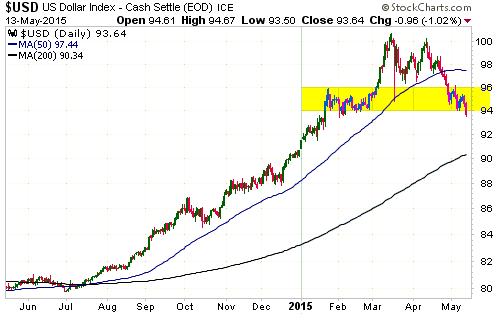
The Dollar Index closed below important support at 94 on Wednesday. If it can
sustain this downside breakout through to the end of the week it will be a
meaningful development.
The 200-day MA, which is now just above 90, remains our target for the current
decline. However, based on risk/reward considerations and as previously advised,
our intermediate-term outlook will automatically shift from "bearish" to
"neutral" if the Dollar Index trades below 92.
Updates on Stock Selections
Notes: 1) To review the complete list of current TSI stock selections, logon at
http://www.speculative-investor.com/new/market_logon.asp
and then click on "Stock Selections" in the menu. When at the Stock
Selections page, click on a stock's symbol to bring-up an archive of
our comments on the stock in question. 2) The Small Stock Watch List is
located at http://www.speculative-investor.com/new/smallstockwatch.html
Chart Sources
Charts appearing in today's commentary
are courtesy of:
http://stockcharts.com/index.html
http://research.stlouisfed.org/