|
- Interim Update
13th August 2014
Copyright
Reminder
The commentaries that appear at TSI
may not be distributed, in full or in part, without our written permission.
In particular, please note that the posting of extracts from TSI commentaries
at other web sites or providing links to TSI commentaries at other web
sites (for example, at discussion boards) without our written permission
is prohibited.
We reserve the right to immediately
terminate the subscription of any TSI subscriber who distributes the TSI
commentaries without our written permission.
The
coming mother-of-all economic busts
The extent to which monetary stimulus weakens an economy's
foundations and gets in the way of real progress will be
proportional to the aggressiveness of the stimulus. This is because
the greater the monetary stimulus, the greater the part within the
overall economy that will end up being played by 'bubble activities'
(businesses, projects, investments and speculations that only seem
viable due to artificially low interest rates and a constant,
fast-flowing stream of new money). That's why the unprecedented (at
that time) monetary stimulus of 2001-2005 led to the most severe
economic fallout in more than 50 years, and why the even more
over-the-top monetary stimulus of 2008-2013 has paved the way for an
economic downturn of even greater severity than that of 2007-2009.
We'll be writing more about the coming economic
bust over the next several months, especially if we see signs that it will soon
get underway. For now, here are a few quick, preliminary thoughts:
1) The next economic bust is likely to be worse than, and different from, the
one that occurred during 2007-2009. What we mean is that the next bust is
unlikely to be an amplified version of what happened previously. The main reason
is that almost everyone, including the monetary central planners, will be
prepared for a repeat of 2007-2009. Of particular relevance, whereas the Fed
didn't start to pump money into the economy until almost 12 months after the
start of the 2007-2009 financial crisis and economic recession (the Fed began to
cut its targeted interest rate in September of 2007, but it didn't begin to
monetise assets in a way that boosted the monetary inflation rate until
September of 2008), it's likely that the next time around the Fed will be much
quicker to ramp up the money supply. This relates to the problem that central
bankers have learned the wrong lessons.
2) Due to the much quicker application of monetary 'accommodation' to counteract
future economic weakness, the next bust could be associated with sharply rising
commodity prices. This would be due to commodity hoarding in reaction to the
belief that money is being trashed.
3) In the lead-up to and during the next economic bust, gold will probably be
the best investment because it is the most logical commodity for large investors
to hoard. It is the most logical commodity-refuge due to its global liquidity,
its globally recognised value, the fact that the amount of gold used in
commercial/industrial applications is trivial compared to the amount of gold
held for monetary/investment/speculative purposes, and the distinct possibility
that a collapse of or an existential threat to the current monetary system would
result in gold returning to its traditional role as money.
4) The next economic bust won't be caused by a geopolitical event, such as the
disintegration of Ukraine and/or Iraq, but it will likely be exacerbated by
restrictions placed on international trade due to increasing geopolitical
tension.
5) The timing of the next bust is currently unknown. Two years ago we thought
that it would be well underway by now, but it's clear that negative real
interest rates have a remarkable ability to postpone the day of reckoning.
The Stock Market
Last Friday's reversal in the S&P500 (SPX) futures from support
at 1890 indicated that a market rebound had probably begun. It is now clear that
a rebound did indeed begin last Friday.
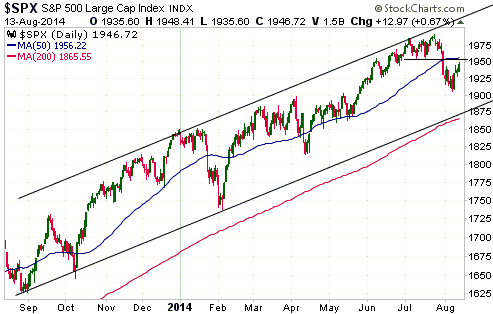
We suspect that the rebound is already close to complete in price terms. The
reason is that the SPX will encounter significant lateral and moving-average
resistance in the 1950s -- only 5-10 points above its closing price on Wednesday
13th August.
The following daily chart shows the aforementioned resistance and the channel
that has defined the SPX's progress over the past year. The channel bottom will
be the initial target if last week's low is taken out.
The three most plausible scenarios remain the same. From least likely to most
likely, they are:
1. The market is setting up for a September-October crash.
2. The market is experiencing a normal (roughly 10%) correction within a bull
market.
3. The market is gradually rolling over into a long-term decline.
Under all of these scenarios the SPX would trade below last week's low within
the next 6 weeks.
Gold and the Dollar
Gold and Silver
The gold price barely moved over the first three days of this week and is in the
same position now as it was at the end of last week. Consequently, we have
nothing new to say about gold. A few words about the silver market are
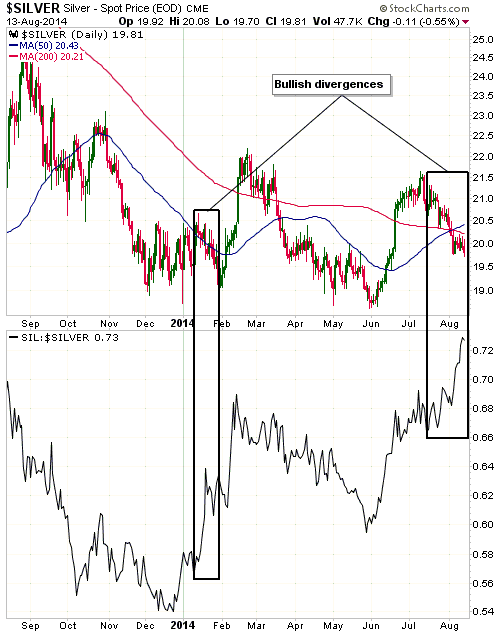
appropriate, however, due to an interesting bullish divergence.
We are referring to the divergence between the silver price and the SIL/silver
ratio (the Global X Silver Miners ETF relative to the silver price) that began
developing a few weeks ago and is now blatant. It is illustrated by the
following daily chart. Notice that a similar divergence happened in January.
The current position of the silver market looks similar to its position in
late-January -- just prior to the start of a strong multi-week rally.
Over the past several weeks we've thought that the gold price would rally to
$1400 by the end of September and that early-August was the most likely time for
such a rally to begin. There's no change in our thinking. A rally to around
$1400 in the gold price would likely be accompanied by a rally to around $23 in
the silver price.
Gold Stocks
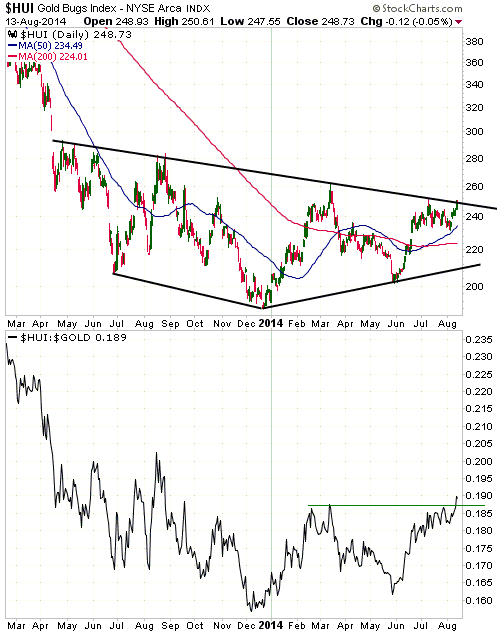
The upper half of the following chart shows that the HUI has moved up to the top
of its major basing pattern. A solid weekly close above 250 would complete the
base and provide additional evidence that a new bull market is underway. Note:
We have little doubt that a new cyclical bull market began last December, but
additional evidence to support this view is always welcome.
The HUI's return to the top of its major basing pattern has been accompanied by
two conflicting signals: a signal that an upside breakout is imminent and a
signal that there will be more consolidation prior to an upside breakout. The
bullish signal is this week's break to a new high for the year by the HUI/gold
ratio, as illustrated by the lower half of the following chart. The signal
pointing to additional consolidation is the decline in the GDXJ/GDX ratio to a
new multi-week low.
There's no way of knowing which of the aforementioned signals will turn out to
be correct, but in the grand scheme of things it shouldn't make a difference.
Our expectation is that the HUI will either break out to the upside within the
next few days or consolidate for up to two more weeks before breaking out to the
upside.
We continue to think that the HUI will trade at 300 by the end of September.
By the way, although an upward reversal and the beginning of a rally in the
silver price would certainly give silver-mining stocks a boost, at current
prices silver bullion looks better, on a risk-adjusted basis, than high-profile
silver equities such as SLW, PAAS and AG.
The Yen
Still not much monetary inflation in Japan
A popular view is that the Bank of Japan (BOJ) is inflating the Yen to oblivion.
This view is wrong. The reality is that while there is certainly a risk that the
BOJ will eventually inflate Japan's money supply at a fast pace, it is not
currently doing so.
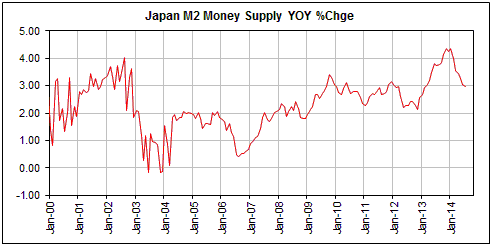
The spectacular QE program introduced by the BOJ in April of last year did have
some effect on the money supply, but the effect was nowhere near as great as
generally believed. As illustrated by the chart displayed below, the
year-over-year (YOY) rate of increase in Japan's M2 money supply rose from
around 3% in early-2013 to just above 4% near year-end, but 4% is a long way
from the explosive growth that most analysts thought would result from the BOJ's
new Yen-depreciation policy. Furthermore, the YOY rate of increase in Japan's M2
has since drifted down to 3% and appears to be on its way back to the long-term
average of 2% (we think it will be back at 2% by October). This means that Japan
is still maintaining the world's lowest monetary inflation rate, which prompts
us to ask: Why are so many analysts still blindly assuming that the BOJ is
rapidly expanding the Yen supply? Why aren't they spending the 15 minutes that
would be needed to validate -- or in this case invalidate -- their assumptions
by checking the money-supply figures available at the
BOJ web site?
An implication of the above is that the supply side of the Yen's supply-demand
equation remains bullish for the Yen's exchange rate. The supply side dominates
very long-term trends in the foreign exchange market, but the demand side often
dominates over periods of up to 2 years.
Current Market Situation
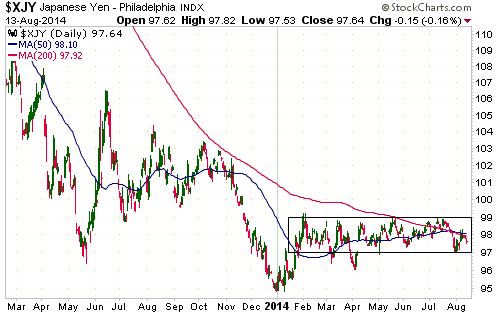
The Yen continues to oscillate within a very narrow range. A daily close above
99 in the Yen futures market would constitute an upside breakout and would
likely be followed by a flurry of short covering that could quickly move the
price up to at least 103. A daily close below 97 would constitute a downside
breakout and would likely be followed by a quick decline to test the 2013 low of
95.
Updates
on Stock Selections
Notes: 1) To review the complete list of current TSI stock selections, logon at
http://www.speculative-investor.com/new/market_logon.asp
and then click on "Stock Selections" in the menu. When at the Stock
Selections page, click on a stock's symbol to bring-up an archive of
our comments on the stock in question. 2) The Small Stock Watch List is
located at http://www.speculative-investor.com/new/smallstockwatch.html
Chart Sources
Charts appearing in today's commentary
are courtesy of:
http://stockcharts.com/index.html

|









