|
- Interim Update 13th November 2013
Copyright
Reminder
The commentaries that appear at TSI
may not be distributed, in full or in part, without our written permission.
In particular, please note that the posting of extracts from TSI commentaries
at other web sites or providing links to TSI commentaries at other web
sites (for example, at discussion boards) without our written permission
is prohibited.
We reserve the right to immediately
terminate the subscription of any TSI subscriber who distributes the TSI
commentaries without our written permission.
Inflation and nothing but inflation
Last week's surprise interest rate cut by the ECB changed
nothing at a fundamental level. It was purely symbolic. The ECB was,
in our opinion, making the point that there are no limits to how far
it will go along the inflation path, a point that had already been
made by the US Federal Reserve.
Anyone who has been bearish on gold over the past two years due to a
belief that deflation was about to happen has been on the right side
of the gold market while being as wrong as they could be in their
reasoning. They got lucky, because the gold price has fallen in
parallel with considerable inflation. In essence, they got lucky
because the Fed got lucky.
The Fed got lucky over the past two years due to the fact that its
money-pumping boosted the 'right' prices, where the right prices are
equities, bonds and real-estate investments. It was primarily luck,
because the Fed doesn't have much control over the paths taken by
the new money it creates. We note, for example, that similar bouts
of money pumping from late-2008 through to mid-2011 gave the biggest
boosts to the 'wrong' prices, most notably gold and commodities.
Now, when we say that the Fed got lucky we aren't saying that gold
bulls, including ourselves, got unlucky. We missed some signs that
the markets had entered a multi-year period during which the
pendulum would swing in favour of the central planners and the
inflation policy would appear to work. Of equal importance, the
simple fact that the 'wrong' prices had risen so far so fast during
2009-2011 created the potential for a substantial swing in a
different direction.
In any case, that the "QE" programs and the other extraordinary
measures implemented by the senior central banks have appeared to
work over the past two years will encourage more of the same and
therefore greatly reduce the probability of monetary policy becoming
prudent anytime soon. In order to get a positive change in policy,
the problems caused by previous actions will have to become
blatantly obvious. Also, from the collective view of policy-makers,
influential economists and the financial press, deflation will have
to be eliminated from contention.
Looking at it another way, there will be no limit to what central
banks will do to devalue their currencies as long as the problems
caused by earlier attempts to devalue are not blatantly obvious and
as long as deflation is generally perceived to be a realistic
possibility, so afraid are most central bankers, economists and
journalists of your money being able to buy more in the future than
it does today. Consequently, the more correct the deflation
forecasters appear to be in the short-term, the more incorrect they
will end up being.
Copper
Update
In last week's Interim Update, we wrote:
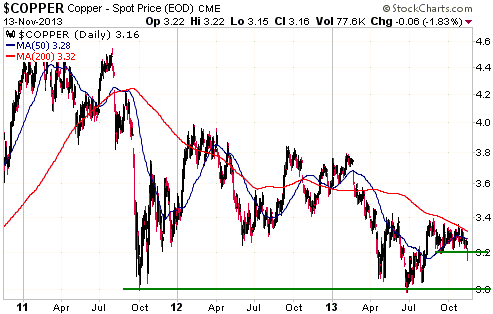
"We don't have a strong opinion about the copper market's short-term
direction, but there are hints that the price is rolling over to the downside. A
daily close below $3.20 would break copper out of its recent narrow range and
point to another test of major support at $3.00 (the following chart shows the
'technical precipice' at $3.00), while a daily close below $3.00 would suggest
that a multi-month decline to as low as $2.00 could be in store. In recognition
of this downside potential, our short-term industrial metals outlook has shifted
from "neutral" to "bearish"."
The copper price closed below $3.20 on Wednesday 13th November and has therefore
broken out to the downside from its recent narrow range. This suggests that the
more important support at $3.00 will soon be tested.
Our short-term industrial metals outlook shifted to "bearish" last week. With
downside copper-price risk to as low as $2.00 over the next several months, our
intermediate-term outlook is also now "bearish".
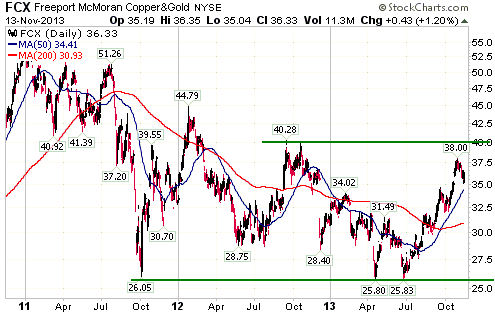
Although the copper price is breaking down and looks set to test major support
at $3.00 over the weeks ahead, the following daily chart shows that the stock
price of the world's largest listed copper producer (FCX) is still in the top
quartile of its 18-month range. This suggests to us that the downside risk in
FCX is much greater than the downside risk in copper.
A bearish FCX speculation (FCX put options, for example) is tempting with the
stock trading in the $36-$39 range, as such a speculation could benefit from
copper weakness or stock market weakness.
 The Stock Market
The US
The senior US stock indices made marginal new highs on Wednesday. This isn't a
big surprise and doesn't change anything.
The Emerging Markets
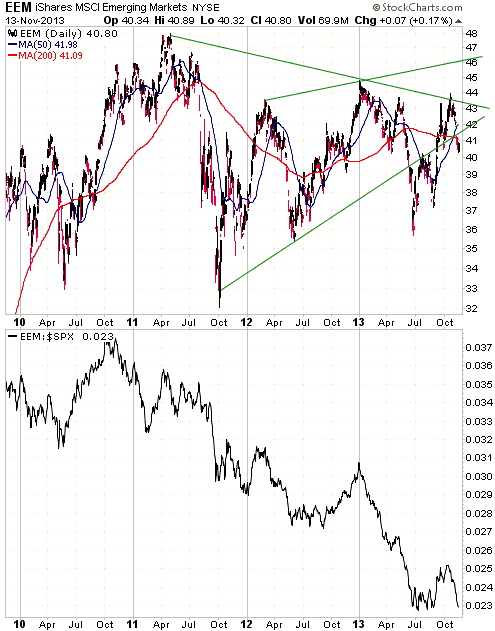
Evidence that the 'emerging markets' rally has ended continues to build. As
illustrated by the top section of the following chart, EEM (the Emerging Markets
ETF) has moved below its 50-day and 200-day moving averages. Of greater
significance, the bottom section of the following chart shows that the EEM/SPX
ratio (emerging-market equities relative to large-cap US equities) has dropped
back to the multi-year low hit during the third quarter of this year.
The bear market in the EEM/SPX ratio is now three years old and is therefore
'long in the tooth'. We doubt that this trend will continue for a lot longer,
but it doesn't yet appear to be over.
Note that although the EEM/SPX is ratio is very 'oversold', there are two
reasons to expect that EEM will fall faster than the SPX during the next
intermediate-term stock market decline. One is that monetary policy is more
stock-market-friendly in the US. The other is that the emerging markets will be
hurt by a shift away from risk.
Gold and the Dollar
Gold
The Fundamentals
Gold doesn't require more "QE" to start a new cyclical bull market. It also
doesn't need obvious evidence of rampant "price inflation" (leading indicators
suggest that such evidence won't appear until at least 2015). Instead, gold
needs evidence that "QE" has failed to bring about a self-sustaining economic
recovery.
It is more than a little surprising that QE isn't already widely seen as having
failed to cause a sustained turn for the better, but perhaps many analysts and
market participants are giving the policy the benefit of the doubt simply
because the stock market keeps going up.
Which brings us to the point that very few people appreciate just how
over-valued the US stock market is at present. The market looks moderately
expensive based on the earnings of the past 12 months, but these earnings are
the result of extremely elevated profit margins. Consequently, the valuation is
actually much higher than indicated by the P/E ratio. The inevitability of the
average profit margin returning to its historical mean creates the potential for
a substantial earnings decline within the next few years and for a cyclical bear
market in US stocks that in real terms matches the severity of the 2000-2002 and
2007-2009 episodes.
No prizes for guessing how the Yellen-led Fed will respond to the next
substantial stock market decline.
The Price Action
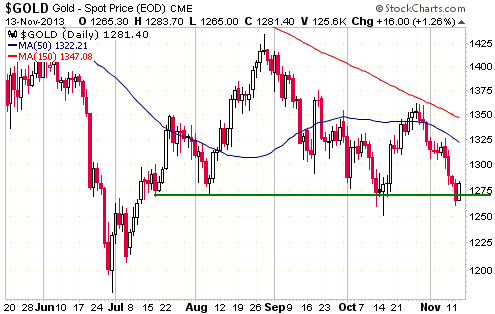
Gold has important daily-closing support at $1270 (the green line on the
following chart). On a daily closing basis, gold successfully tested this
support during August and October.
Some data services showed a daily close just below $1270 on Tuesday whereas
others showed a daily close just above $1270 on Tuesday. In any case, gold was
clearly above $1270 at the close of trading on Wednesday 13th November.
Support at $1270 for gold is similar to support at $21.00 for silver. Silver
clearly breached $21.00 on both Tuesday and Wednesday of this week, so silver
has broken out to the downside. However, this downside breakout needs to be
confirmed by an equivalent breakout in the larger and more important gold
market.
We would take a daily close below $1270 as a signal that gold and silver were
headed down to test their June lows, while a daily close above $1362 by gold
would definitively signal that THE bottom was in.
A test of the June low remains a realistic possibility. Furthermore, if such a
test is going to happen it will most likely do so within the next few weeks. At
the same time, sentiment indicators continue to point to a major bottom in the
making. We note, as evidence, that despite gold and silver prices being well
above their June lows, the Market Vane bullish percentages for these markets are
at or below the extraordinarily depressed levels reached at the June nadir.
Specifically, on Tuesday 12th November the Market Vane bullish percentages for
gold and silver were 35% and 27%, respectively, which compares with June lows of
34% (for gold) and 29% (for silver).
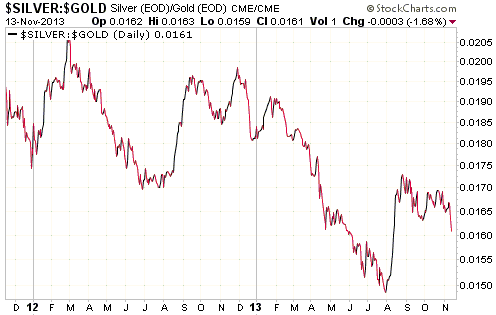
The following chart shows that the silver/gold ratio rocketed upward in August
and has trended downward since late-August. This tells us that silver has been
weakening relative to gold since the late-August price peaks for both metals.
This is typical.
It is reasonable to expect that silver will keep trending lower relative to gold
until after gold's short-term price trend turns up.
Gold Stocks
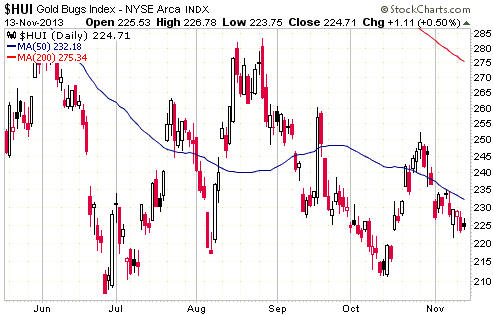
The HUI spent the first three days of this week trading back and forth within
last Friday's price range. This price action provides us with no additional
clues.
Currency Market Update
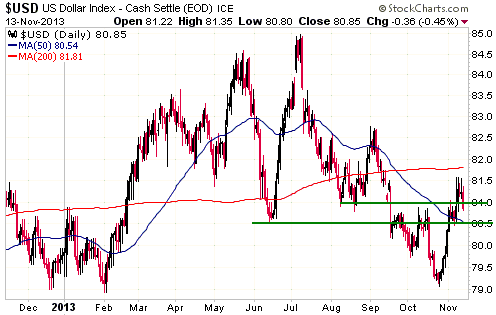
The Dollar Index broke above resistance at 80.5-81.0 last week and has since
pulled back. If this pullback is a routine consolidation within a new short-term
upward trend then it should hold above 80.5 on a daily closing basis.
We remain neutral on the Dollar Index. It is very likely that the Dollar Index
will hold above its October low over the remainder of this year, but we are
uncertain about the upside potential.
Update
on Stock Selections
Notes: 1) To review the complete list of current TSI stock selections, logon at
http://www.speculative-investor.com/new/market_logon.asp
and then click on "Stock Selections" in the menu. When at the Stock
Selections page, click on a stock's symbol to bring-up an archive of
our comments on the stock in question. 2) The Small Stock Watch List is
located at http://www.speculative-investor.com/new/smallstockwatch.html
 Sandspring
Resources (SSP.V). Shares: 132M. Recent price: C$0.24 Sandspring
Resources (SSP.V). Shares: 132M. Recent price: C$0.24
SSP is a former TSI stock selection that we are discussing today due to a very
interesting deal that was announced earlier this week. We are referring to the
"gold stream" agreement that SSP has entered into with Silver Wheaton (SLW). SLW
calls it an "early deposit gold stream agreement" to reflect the fact that it is
linked to a deposit (the Toroparu gold project in Guyana) that is a long way
from production and may never go into production.
The deal involves SLW making upfront payments totaling of $148M for the right to
purchase 10% of Toroparu's gold production at $400/oz. SSP will be entitled to
an initial drawdown of $13.5M in the near future to help with funding of the
project's Feasibility Study, with the balance of the $148M being subject to
SLW's election to proceed. The balance would be payable in instalments during
construction of the Toroparu project once all necessary mining licences have
been obtained and conditions pertaining to final feasibility, the availability
of project capital finance, the granting of security to Silver Wheaton and other
customary conditions are satisfied. If SLW elects not to proceed, then SSP can
keep the initial $13.5M payment in exchange for a stream percentage of 0.774%.
What makes this deal so interesting is that SSP gets the money it needs to fund
itself over the coming 12 months with almost no dilution of existing
shareholders. To get the same amount of money via an equity placement at
C$0.20/share (the stock price at the time the deal was announced) it would have
been necessary for SSP to increase its total share count by about 50%. That is,
raising the same money by issuing new equity would have effectively diluted the
interests of existing shareholders by about 33%. Under the SLW deal, existing
SSP shareholders only have to give up 0.77% of potential future production in
order to get the initial $13.5M payment.
Whether or not SLW ends up proceeding with the full $148M funding commitment,
this is a good deal for SSP. It means that this exploration-stage company will
most likely survive the current ultra-difficult market environment. It is also a
good deal for SLW, as that company gets an option covering 25K-ounces/year of
future production for what is, for a company of SLW's size, a small initial
outlay.
Due to its win-win nature, perhaps this deal will become a template.
We aren't going to return SSP to the TSI List, at least not yet. Its Toroparu
project is probably not economic at the current gold price (the Pre-Feasibility
Study indicated that the project would be viable above $1400/oz), its news flow
probably won't be exciting while the Feasibility-level engineering work proceeds
behind the scenes, and in the current lousy market for gold-mining shares we are
spoiled for choice. However, it will certainly be worth keeping a close eye on
and has been added to the
TSI Small
Stocks Watch List.
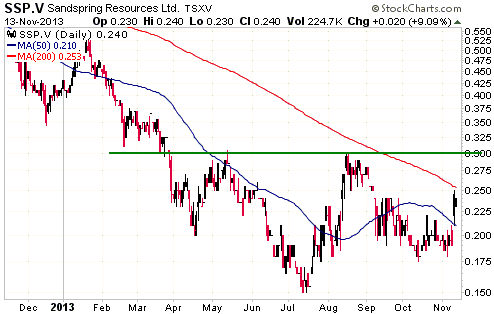
Chart Sources
Charts appearing in today's commentary
are courtesy of:
http://stockcharts.com/index.html

|









