|
- Interim Update 14th May 2008
Copyright
Reminder
The commentaries that appear at TSI
may not be distributed, in full or in part, without our written permission.
In particular, please note that the posting of extracts from TSI commentaries
at other web sites or providing links to TSI commentaries at other web
sites (for example, at discussion boards) without our written permission
is prohibited.
We reserve the right to immediately
terminate the subscription of any TSI subscriber who distributes the TSI
commentaries without our written permission.
Peak Oil
We've been wrongly bearish on oil over much of the past year. The
practical consequences of this mistake have been largely mitigated by
the fact that we've been bullish on natural gas and coal, but we
certainly wouldn't have recommended any exposure to the beaten-down
airline sector if our oil market analysis had been 'on the mark'.
As far as we can tell, the "Hubbert Peak Theory"
of oil production is a good theory in that it meshes with historical
evidence and makes predictions that are consistently borne out.
However, while "Hubbert's Peak" underpins the oil market from a
long-term perspective, we think it has very little to do with the huge
run-up in the oil price over the past 12 months. Our view is that the
currency market -- US$ weakness, to be specific -- has been the main
driver of the oil-price surge that began in early 2007, with supply
problems -- actual and perceived -- being the next most important
driver. Note that the supply problems we are referring to aren't
related to Hubbert's Peak, but are, instead, related to the
uncomfortable reality that a lot of today's oil production comes from
parts of the world that are politically unstable. It seems that if the
supply of oil is not being threatened by the manic behaviour of Hugo
Chavez in Venezuela it is being threatened by the actions of rebel
forces in Nigeria, or bombings in Iraq, or the potential for another
Arab-Israeli conflict.
Whatever the reasons for the price rise, the result is that oil is now
very expensive relative to almost everything. The price of oil in US
dollar terms or in terms of other paper currencies doesn't necessarily
mean very much because these currencies are all headed towards zero at
different speeds, but oil is presently very expensive relative to gold
(the oil/gold ratio is near its all-time high), gasoline (oil is so
expensive relative to gasoline that refinery operators are being
financially crushed), natural gas (on an energy-equivalent basis
natural gas currently trades at a 40% discount to oil), labour (the
number of hours of work needed to buy a barrel of oil is higher now
than it has ever been), and the stock market (with the exception of a
short-lived spike following Iraq's invasion of Kuwait in 1990, at no
time over the past 20 years has oil been as high as it is today
relative to the S&P500 Index). We are therefore seriously
considering the possibility that the oil price is now close to a
secular peak in REAL terms, that is, relative to other 'things'.
If there's sufficient inflation (money-supply growth) then the nominal
price of a barrel of oil could rise to $200 or even higher over the
next few years, but if so then the percentage gains in other
commodities -- most notably gold and natural gas -- would probably be
much greater.
The Stock Market
Intermediate-Term Outlook
Has the stock market discounted the worst, as the bulls claim?
To answer this question, let's take a look at the market's valuation.
The S&P500 Index currently has a price/earnings ratio of about 21,
a dividend yield of about 2.1%, and a price/book ratio of 2.75. This
combination of measures indicates that the US stock market's current
valuation is amongst the highest in its history. In fact, the only time
that the market's valuation was substantially higher than it is today
was during the final phase of the mania that ended in March of 2000.
Today's high valuation for the overall market does not, in isolation,
tell us anything about the market's likely performance over the coming
6-12 months because it is not uncommon for over-valued markets to trend
upward for lengthy periods. What it tells us, in no uncertain terms, is
that the market has NOT discounted major problems. In fact, the
S&P500's current valuation tells us that the market expects the
year ahead to be characterised by strong earnings growth, high profit
margins, relatively low interest rates, and minimal currency
depreciation. In other words, rather than having fully discounted major
problems the market has fully discounted a rosy scenario. This means
that the market will have a problem if anything other than a rosy
scenario materialises.
One likely spoiler of the rosy scenario presently being discounted by
the stock market is the resumption of the debt crisis. The market has
come to the conclusion that almost all of the banking sector's woes are
in the past, but this conclusion appears to be baseless given that the
people running the banks don't even have a clear understanding of the
ultimate extent of their companies' liabilities/write-offs.
Another likely spoiler is the next 'shoe to drop' in the "global food
crisis". The next shoe to drop will be sharp increases in the prices of
beef, pork and chicken, potentially leading to more widespread
awareness of the global inflation problem. Inflation expectations and
price/earnings (P/E) ratios are inversely correlated, so P/E ratios are
likely to be pressured lower WHEN -- not IF -- meat prices factor-in
the large increases in the cost of producing meat that have occurred
over the past 18 months.
A third potential spoiler is the on-going housing depression. House
prices will probably remain in a downward trend until at least next
year, leading to more write-downs on mortgage-backed securities and
prompting the government to 'do something' to support prices. But the
only thing the government can do to maintain prices at an artificially
high level is to implement policies that have the effect of devaluing
the currency, meaning that the official response to the bear market in
residential property will likely create an even bigger inflation
problem. Corporate earnings would probably be boosted under such
circumstances, but we suspect that the positive influence on stock
prices of higher earnings would be more than offset by a general
decline in P/E ratios.
In conclusion, the market appears to be priced for good news, not bad,
and whenever the market discounts a bright future it's appropriate to
be more cautious than usual even if the future really does look bright.
The reason is that at such times there is more scope for a negative
surprise than a positive one.
Right now it is appropriate to be very cautious because the market
appears to be discounting a rosy scenario even though the future does
not look particularly bright. This creates considerable downside risk.
Current Market Situation
The following chart shows the Dow's recent upside breakout. How bullish was this breakout and what does it portend?
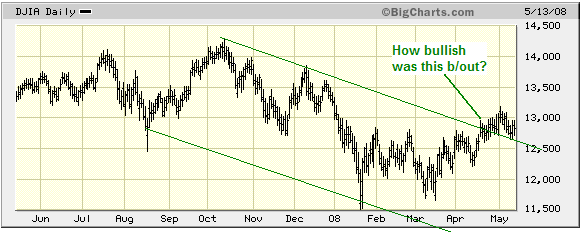
In our opinion, it's
quite possible that the Dow's April-2008 upside breakout will prove to
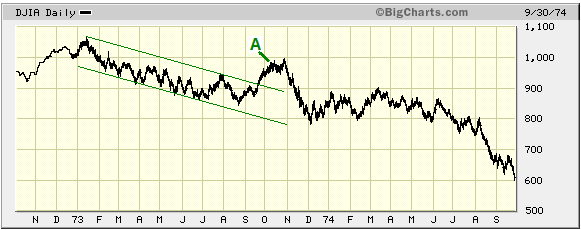
be as 'bullish' as its September-1973 breakout proved to be. As
illustrated by the following chart, the Dow's upside breakout in
September of 1973 was followed by a few weeks of modest additional
gains and then a year-long decline that lopped about 40% off its market
value. In other words, the recent breakout may not have bullish
implications beyond the very short-term.
By the way, 'point A' on the following chart (early October of 1973)
marks the end of a downward correction in the gold sector. That is,
during 1973 the end of the Dow's upward correction followed the end of
the gold sector's downward correction by about three weeks. This is
partly why we think further evidence of a bottom in the gold sector
would be a bearish omen for the broad stock market. As was the case
during 1973, the broad stock market and the gold sector are inversely
correlated at this time.
Although stock market
risk is increasing, we doubt that a rebound peak is already in place.
This is mainly because sentiment indicators aren't yet revealing the
amount of optimism that would normally be seen near the top of a
bear-market rally.
Our guess is that the bulk of the market's upside was behind it when
the S&P500 Index reached the 1420s early this month, but that
marginally higher levels will be achieved over the next few weeks.
Gold and
the Dollar
Gold
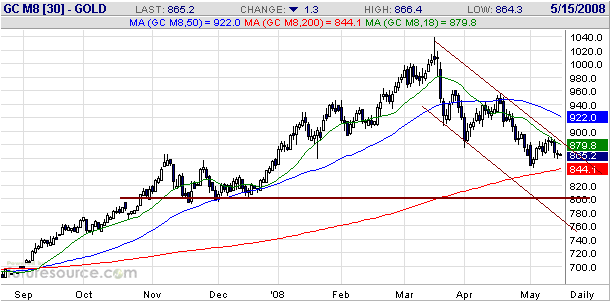
A daily chart of June gold futures is included herewith.
Gold hasn't yet done anything to indicate that a correction low is in
place, so the prospect of a quick decline to around $800 remains very
much alive. If such a decline materialises then anyone waiting for an
opportunity to buy more gold should consider it a gift and buy
aggressively.
Our short-term gold view will turn bullish following a drop below $820 or a daily close above $900, whichever happens first.
If gold drops to
around $800 then silver will probably drop to around $15. An
opportunity to buy silver near long-term support at $15 should also be
considered a gift.
Gold Stocks
The bullish MACD crossover shown on the following chart is evidence
that the HUI's correction bottomed on 1st May at around 385. However,
this bullish signal will be negated unless the HUI soon resumes its
advance.
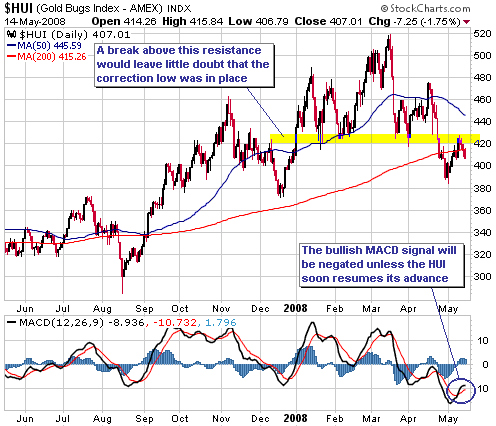
Even if a correction
low was put in place at the beginning of this month there is a decent
chance that this low will be tested before a powerful upward trend gets
going, but the test shouldn't occur yet (it shouldn't occur so soon
after the low). In fact, if the HUI were to close below 400 within the
next few days then we would assume that last week's bullish price
action was a 'head fake' and that a quick drop to the mid-300s lay in
store.
As previously advised, we think that a drop to the mid-300s would
present a good opportunity to purchase some January-2009 GDX call
options. In the mean time, we will continue to look for opportunities
to accumulate our favourite junior gold/silver stocks.
Currency Market Update
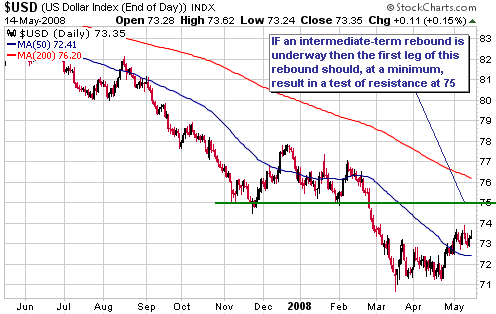
The Dollar Index bottomed in mid March, but up until now its rebound
has been unimpressive to say the least. If this rebound is part of a
new intermediate-term advance (our view), as opposed to just a routine
correction within an on-going intermediate-term decline, then at a
minimum it should reach resistance at 75 before the next multi-week
pullback commences.
If an intermediate-term US$ advance is underway then the top of the
INITIAL phase of this advance will, we think, roughly coincide with the
ultimate correction low for gold. This is what happened during 1973 and
2005.
Update
on Stock Selections
(Note: To review the complete list of current TSI stock selections, logon at http://www.speculative-investor.com/new/market_logon.asp
and then click on "Stock Selections" in the menu. When at the Stock
Selections page, click on a stock's symbol to bring-up an archive of our comments on the stock in question)
 In
the 5th May Weekly Update we presented a table of potential future TSI
gold/silver stock selections, including the prices at which we would,
or might, be interested in adding them. Below is an updated version of
the same table. In
the 5th May Weekly Update we presented a table of potential future TSI
gold/silver stock selections, including the prices at which we would,
or might, be interested in adding them. Below is an updated version of
the same table.
| Symbol |
Market |
Company Name |
Current Price
|
Comment |
| ATW |
TSXV |
ATW Ventures |
C$0.78
|
Previously said: Would probably add at C$0.75. New comment: Would definitely add at C$0.68. |
| EDV |
TSX |
Endeavour Mining Capital
|
C$6.86
|
Previously said: Would probably add at C$6.35. No change. |
| FVI |
TSXV |
Fortuna Silver
|
C$2.16
|
Previously
said: Would definitely add at C$1.60. New comment: We ended up adding
FVI at C$2.15 because we think the risk/reward is excellent at that
price and a drop to C$1.60 is now very unlikely. Refer to the 12th May
Weekly Update for details. |
| GSS |
AMEX |
Golden Star Resources |
US$2.96 |
Previously
said: Would consider adding at US$3.00. New comment: We like GSS at
US$3.00 or lower, but we are not going to add it to the TSI Stocks
List. The reason is that we want to limit our Ghana exposure to one
stock and we prefer Keegan Resources (TSXV: KGN), our current
Ghana-based gold stock, to GSS. KGN is riskier than GSS, but the
additional risk is more than offset by the additional upside potential. |
| HL |
NYSE |
Hecla Mining |
US$9.41
|
Previously
said: Would consider adding at around US$9.00. New comment: Would
probably add at US$7.80. This change is due to the recently reported
increase in production costs, and, to a lesser extent, HL's Venezuela
exposure. |
| RGLD |
NYSE |
Royal Gold
|
US$28.29 |
Previously
said: Would definitely add at US$24.00. New comment: We would still add
RGLD at $24 if given the opportunity, but there is now less chance of
the stock dropping to our nominated buy level. |
| TGB* |
AMEX |
Taseko Mines
|
US$5.12 |
Would definitely add at US$3.50. No change. |
| WGW |
AMEX |
Western Goldfields |
US$2.17 |
Previously said: Would probably add at US$2.25. New comment: See below. |
*TGB is a copper producer
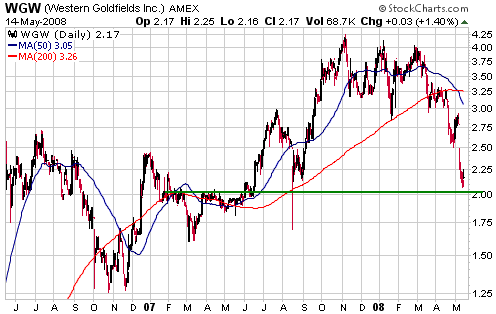
New stock selection: Western Goldfields (AMEX: WGW, TSX: WGI). Shares: 135M issued, 155M fully diluted. Recent price: US$2.17
We successfully traded WGW last year and are now returning it to the
TSI Stocks List. As evident from the following chart, the stock is down
by almost 50% from its 52-week high. Moreover, it has just dropped to
the price area that we'd previously identified as a buy zone.
We are adding WGW to
the Stocks List because the gold reserves and future gold production at
its California-based Mesquite Mine are currently being valued by the
stock market at only US$160/ounce and US$2500/ounce, respectively. This
is a fairly low valuation for a gold-mining asset in a secure location
that's close to commercial production. Having said that, there are two
reasons why the decision to add WGW wasn't a straightforward one.
First, the recent plunge in the stock price from the high-US$2 area to
the low-US$2 area was primarily driven by the company's announcement
that 2008-2009 production would be lower than expected and that
production costs would be higher than previously estimated. Second, we
don't like the fact that the company has forward sold about 45% of its
first 6 years of production at $800/ounce.
This is what we wrote about WGW's forward selling plans back in April
of 2007, when we first added it to the List and when it had the stock
symbol WGDF:
"...In general, locking
in the selling price of UP TO 12 months of commodity production will
make sense when commodity prices are near multi-year highs. But WGDF's
management is about to enter contracts to deliver gold at a
pre-determined price as far out as 2014. The thing is, nobody has any
idea where gold will be trading a few years from now. In our opinion it
will be trading well above today's level, but the risk, for miners who
commit their future production, is that major problems within the
monetary system will cause it to move to an unimaginably high price.
And if that happened then a gold mining company that had committed to
sell 'only' 45% of its annual production at a price that looked
reasonable in 2007 could end up with a large-enough mark-to-market loss
on its hedge book to render the company insolvent; and who wants to own
a gold mining company that has the potential to go 'belly up' in
response to a large rise in the gold price?
In addition, committing
to sell a significant chunk of production at what eventually proves to
be a low price could become problematic even if the company's bankers
are willing to ignore the huge mark-to-market loss. The risk is that
operational or environmental issues force the mining company to halt
its production for an extended period. If this were to happen then the
company would have to buy gold at the current market price in order to
fulfill the obligations under its hedging program.
WGDF's senior managers
obviously believe they are doing the right thing by going down the
debt/hedging route rather than diluting the stock via another equity
financing. However, we think near-term dilution would have served
long-term shareholders better than taking on the risk inherent in a
combined 6-year debt package and hedging program. In our opinion,
junior companies that need money to build mines should take-on the
maximum amount of debt they are able to take-on WITHOUT having to
lock-in the price on more than 12 months of future production."
Due to the hedging issue, when we added Western Goldfields to the TSI
List last year it was as a trade rather than as a long-term
investment/speculation. Our view at the time was that the company's
hedge book disqualified it as a long-term position. We feel the same
way now, and are therefore adding WGW as a trade with an expected
holding period of up to 6 months.
We will set a protective stop for this trade after we see some evidence
that the gold price has bottomed. In the mean time, a reasonable
approach would be to take an initial position near the current price
with the aim of scaling into a full position over the coming month.
Our upside target is US$3.00.
Chart Sources
Charts appearing in today's commentary
are courtesy of:
http://stockcharts.com/index.html
http://www.futuresource.com/
http://bigcharts.marketwatch.com/

|