|
- Interim Update 14th July 2010
Copyright
Reminder
The commentaries that appear at TSI
may not be distributed, in full or in part, without our written permission.
In particular, please note that the posting of extracts from TSI commentaries
at other web sites or providing links to TSI commentaries at other web
sites (for example, at discussion boards) without our written permission
is prohibited.
We reserve the right to immediately
terminate the subscription of any TSI subscriber who distributes the TSI
commentaries without our written permission.
If...
*If monetary inflation (creating money out of nothing) can
improve the economy then private counterfeiters provide a valuable
service and should be encouraged, not prosecuted.
The reality is that counterfeiting money cannot possibly benefit the
economy because it results in the undeserved transfer of wealth from
the rest of the economy to the counterfeiter. That it is legal for the
banking industry and the government to create money out of nothing is
not surprising; what is surprising is that so many economists believe
it to be beneficial.
*If it makes sense for the price of short-term credit (the
short-term interest rate) to be set by a committee (the "Fed" in the
US), then it makes sense for all prices to be set by committee and for
the entire economy to be centrally planned. The converse is that if
economic central planning and price fixing are inherently bad, then
there should be no central bank.
People who are consistent either believe in a free market OR believe
that it is a good idea to have a central bank. You cannot logically
believe in both.
*If government spending for the sake of spending really can help
drag an economy out of recession and is ethically justifiable (as per
the popular "Keynesian" tout), then private thievery should not be
punished during economic downturns as long as the thief spends or gives
away most of what he/she steals. The reason is that most government
spending is financed by stealing in one form or another. To put it
another way: If it is reasonable under certain circumstances to claim
that the government should steal more money then it should also be
reasonable under the same circumstances to claim that more money should
be stolen by private thieves.
*If a downturn
in the economy is the result of falling confidence, or, as some
economists like to put it, a general decline in "animal spirits", then
a sustainable recovery can be brought about by injecting the water
supply with drugs that make people believe that everything is fine.
Unfortunately, the problems that lead to economic recessions and depressions are real.
Money
Strangely,
many economists have a mental block when it comes to money. They just
can't seem to get their heads around what money is, what the quantity
of money should be, how the money supply should be measured, and how
changes in the money supply affect the economy. Even the late great
Milton Friedman had a mental block about money and unfortunately passed
it along to most of his followers. For example, the block is evident in
the latest quarterly outlook
produced by Hoisington Investment Management (HIM). The authors of this
report make a lot of good points about debt, unemployment and the
government's attempts to "stimulate" the economy via deficit spending,
but then completely lose the plot once they delve into monetary theory.
Some of their errors are discussed herewith, but we'll first note that
money is simply the general medium of exchange. Nothing more, nothing
less. All other functions of money are secondary to its role as the
general medium of exchange.
Some important logical errors are revealed by the following short excerpt from the above-linked HIM report:
"Although gold coins were
once used [as money], gold is so illiquid that it is not even
considered to be a form of near money -- though it is still widely
thought of as a store of value. Since its price can fluctuate widely
and unpredictably, it no longer serves well as a medium of exchange or
as a unit of account."
By the comment "gold is so illiquid" HIM probably means that there
isn't enough gold in the world for gold to be the general medium of
exchange. The reality, however, is that if something has the right
characteristics to be money (fungible, easily divisible and
transportable, etc.) then any quantity will be just as good as any
other quantity. For example, consider two scenarios where everything is
the same except that in scenario 1 the money supply has always been "X"
and in scenario 2 it has always been "10X". Money prices under scenario
2 will simply be 10-times higher than under scenario 1, but relative
prices will be the same (if a particular type of car costs the
equivalent of 10,000 bushels of corn under scenario 1 then it will also
cost the equivalent of 10,000 bushels of corn under scenario 2). To put
it another way, the purchasing power of each monetary unit will adjust
to whatever the total supply of monetary units happens to be.
A consequence of the above is that there is no such thing as the
correct, or optimum, supply of money. The important thing is that
whatever the supply of money happens to be, it doesn't vary by much
each year.
The total aboveground supply of gold doesn't vary by much from year to
year, which is one of the reasons gold functioned so efficiently as
money for thousands of years prior to the Twentieth Century, and why it
would, if given the chance, do a good job in the monetary role today.
The comment "Since its [gold's] price
can fluctuate widely and unpredictably, it no longer serves well as a
medium of exchange or as a unit of account" is absurd. If gold
were the medium of exchange then its price would not fluctuate widely.
The reason its price fluctuates widely is that it is NOT the medium of
exchange, but is, instead, priced in terms of unstable media of
exchange such as the US$.
To avoid being too longwinded we'll now summarise some of HIM's other money-related errors and half-truths in point form:
1. HIM states that the Monetary Base (MB) is not money, which is not
totally wrong but is also not accurate. The MB comprises bank reserves,
which are not money and are not counted in most measures of total money
supply, and currency notes in circulation, which most definitely are
money and are counted in all of the monetary aggregates that we know of.
2. HIM points out that the Fed's 2008-2009 addition of $1.2 trillion to
bank reserves did not constitute "money printing", which is technically
true. As mentioned above, bank reserves aren't counted in the money
supply. However, it is likely that the boost to bank reserves will
eventually add to the inflation problem because at some future time the
banks will lend this money into the economy in an attempt to increase
their profits.
3. HIM argues that the Fed will be unable to expand the total supply of
money as long as the problem of "overindebtedness" persists. This
conclusion is quite common and appears to stem from the mistaken belief
that the Fed's power to inflate is limited to adding bank reserves,
meaning that the Fed's ability to bring about monetary inflation is
completely dependent on the private banks being willing and able to
make new loans. It is strange that this belief still lingers even
though the Fed proved it wrong by rapidly growing the money supply
after September-2008 in parallel with a contraction in bank lending.
The Fed did this by purchasing assets from non-banks using
newly-created money, thus bypassing the "zombie" banks and pumping
money directly into the economy.
4. HIM appears to believe that money-market funds and time deposits,
which are components of M2 and M3, are money. As we've explained many
times in the past, this is not the case. Money-market funds, for
example, are investments in interesting-bearing securities that must be
sold in order to obtain money. As also previously explained, much of
the past year's decline in M2 and M3 is due to reductions in the
NON-MONETARY components of these aggregates.
The Stock Market
Capital Investment
The following excerpt from John Hussman's latest Weekly Market Comment is very interesting and revealing:
"There is little question
that we have, for more than a decade, squandered our productive
resources in the pursuit of bubbles. Almost unbelievably, real private gross domestic investment is lower today than it was 12 years ago,
and much of the gross domestic investment that we have made in the
interim has been destroyed in mispriced speculative activity such as
residential construction and commercial real estate development." [Emphasis added]
We don't know for certain because we don't have the historical data,
but we suspect that the 1930s was the only prior period in US history
when real private gross domestic investment was lower than it was 12
years earlier. And yet, many pundits continue to derisively dismiss the
view that the US economy is in a depression. We wonder how bad things
will have to get before they wake up.
Current Market Situation
After the close of trading on Tuesday, Intel (INTC), the world's
leading manufacturer of microprocessors and one of the world's most
important companies, announced its highest quarterly earnings since the
peak of the 'dotcom' bubble. These earnings were supposedly well above
expectations.
We said "supposedly" in the above sentence because the only way you
ever really know if reported earnings were above or below the market's
expectations is by the market's reaction to the news. In this case, the
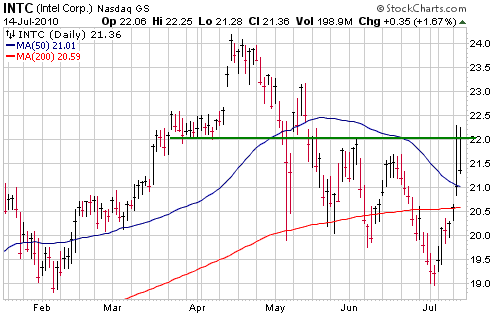
stock surged after trading commenced on Wednesday morning but then gave
up most of its gains to end the day only 1.7% higher. Furthermore, the
following chart shows that it remains below short-term resistance at
US$22.00. Clearly, the bulk of the improvement in INTC's earnings had
been anticipated.
As an aside, INTC and
some other large-cap tech stocks (including Microsoft) are trading at
attractive valuations. If we weren't so concerned about general market
risk we would probably now be accumulating these stocks.
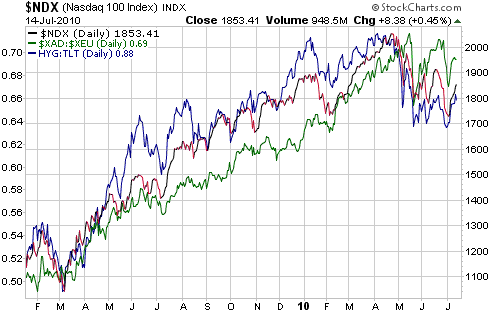
Moving on, the following chart compares the NASDAQ100 Index (NDX), the
A$/euro ratio and the HYG/TLT ratio (note: the HYG/TLT ratio is a proxy
for credit spreads -- it trends upward during periods when credit
spreads are contracting). The purpose of this chart is to show that
strength in the stock market after March-2009 was associated with
declining credit spreads and strength in the A$ relative to the euro.
The lines on the chart peaked at roughly the same time (between mid
April and early May) and now appear to be tracking each other to the
downside. This, by the way, is why we think it makes sense to bet
against the A$ at this time. If the stock market continues its downward
trend over the months ahead then the A$ should not only weaken relative
to the US$, it should also weaken relative to the euro.
We suspect that the
broad stock market has used up most of its near-term upside potential
and will resume its downward trend within the next two weeks.
Gold and
the Dollar
Gold
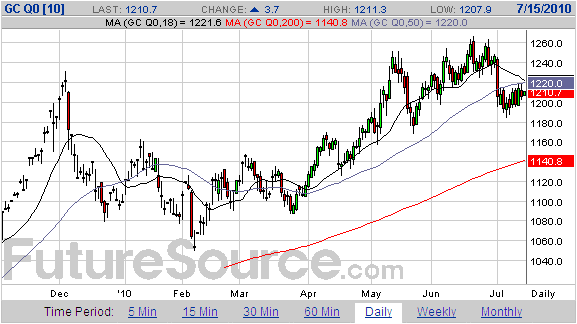
The gold price dropped sharply at the beginning of this month and has
since drifted higher. The upward drift of the past 6 trading days has
the look of a counter-trend rebound within a short-term downward trend.
If this is the case then August gold will probably break below $1200
within the next few days and begin to make its way down to the support
that extends from $1140 up to the mid-$1160s.
Gold Stocks
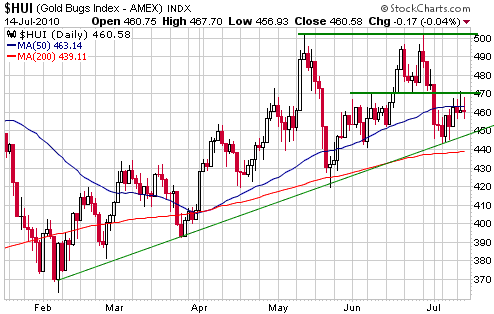
Like gold bullion, the HUI has been drifting higher since hitting an
interim low during the first few trading days of this month. The
rebound resulted in a test of resistance at 470, which is as much as
could reasonably be expected from a counter-trend move within a
short-term downward trend.
With reference to the following daily chart, the HUI's parameters are
clear. A decisive close above resistance at 470 would begin to turn the
short-term outlook positive, although we would be inclined to keep all
hedges in place until the more important resistance at 505 had been
overcome.
Consecutive daily closes above 505 would suggest that a new major
advance had begun. Also, it would open up the possibility that both
gold and gold stocks were within a few months of entering 'blow-off'
mode, which we currently view as a low-probability outcome. We'll
explain in a future commentary (most likely the coming Weekly Update)
why we do not expect an upside blow-off to begin anytime soon.
Going the other way, there is now important support at 445-450 defined
by the early-July low and a trend-line dating back to the February low.
A daily close below this support would point to significant additional
weakness.
Seasonality, the
HUI's price action, the likelihood of the broad stock market trending
lower over the coming months and the fact that Royal Gold (RGLD) has
already broken below a longer-term trend-line (refer to the following
chart for details) mean that the odds are skewed in favour of a break
below support rather than a break above resistance.

Currency Market Outlook
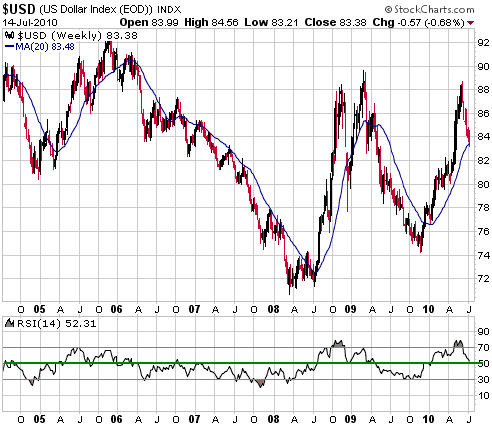
The following weekly chart of the Dollar Index shows that:
a) Corrections in cyclical US$ bear markets typically end after the
price has moved up to the vicinity of the 20-week moving average and
the weekly RSI has moved up to 50.
b) Corrections in cyclical US$ bull markets typically end after the
price has moved down to the vicinity of the 20-week moving average and
the weekly RSI has moved down to 50.
c) The 20-week moving average has just been reached and the weekly RSI has just dropped to 52.
Further to the above, if we are correct to assume that the US$ is in a
cyclical bull market then a correction low is probably not far away. We
are therefore upgrading our short-term US$ outlook to "bullish".
Update
on Stock Selections
(Notes: 1) To review the complete list of current TSI stock selections, logon at http://www.speculative-investor.com/new/market_logon.asp
and then click on "Stock Selections" in the menu. When at the Stock
Selections page, click on a stock's symbol to bring-up an archive of
our comments on the stock in question. 2) The Small Stock Watch List is
located at http://www.speculative-investor.com/new/smallstockwatch.html)
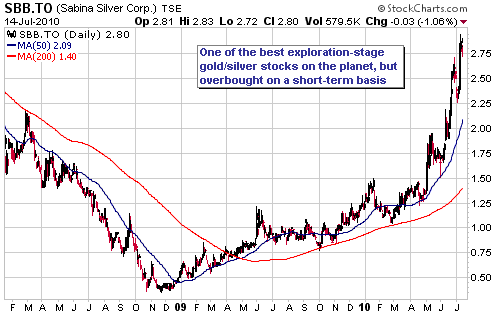
 Sabina Gold and Silver (TSX: SBB). Shares: 131M issued, 147M fully diluted (incl. Jul-2010 financing). Recent price: C$2.80 Sabina Gold and Silver (TSX: SBB). Shares: 131M issued, 147M fully diluted (incl. Jul-2010 financing). Recent price: C$2.80
SBB announced a new equity financing at the beginning of this week. It
will be raising at least C$22M by placing new shares priced at C$2.70
with Dundee Securities Corp. and a syndicate of underwriters.
We don't understand the reason for this financing considering that SBB
already has at least $50M in the bank, which is enough money to fully
fund its operations over the next two years. It is probably just more
evidence supporting our view that CEOs of junior resource companies are
embedded with a gene that prevents them from saying no when presented
with an equity-financing opportunity.
As a result of the new financing SBB will have more than $70M in the
bank, which is a LOT of cash for such a small company. Also, SBB's
per-share value has been reduced by this new financing, although it
still offers very good value.
Over the past few months we have highlighted SBB as a buy a number of
times at much lower prices. We would hold off on any new buying for now
on the basis that the stock is extended to the upside on a "technical"
basis.
The 'Gassy' Trusts
Further to discussions in TSI commentaries during the first half of
this year, we have been looking for an opportunity to exit the 'gassy'
Canadian energy trusts that comprise the TSI Energy Trust Index (TETI).
Up until now only two of the four remaining members of the TETI (Peyto
Energy and Penn West Energy) have reached the sell zones mentioned in
earlier commentaries, while the other two (Daylight Resources and
Trilogy Energy) topped at around 20% below their respective sell zones.
However, we have decided to 'bite the bullet' and remove TETI from the
TSI Stocks List now, thus realising a loss of around 20% (including
distributions).
There will be a "post mortem" analysis of this failed long-term trade in the coming Weekly Market Update.
Orvana Minerals (TSX: ORV). Shares: 115M issued, 119M fully diluted. Recent price: C$1.40
ORV announced on Wednesday morning that near today's metal prices its
construction-stage El Valle project in Spain is estimated to have a net
present value (NPV) of $363M. This equates to about $3 per share. In
addition to the El Valle project, ORV has a producing gold mine in
Bolivia and an exploration-stage copper project in the US.
News that one of its projects was worth well over double the current
stock price pushed ORV 14% higher during Wednesday's trading session.
It still offers excellent value and is a reasonable candidate for new
buying, but buying should be done over time and preferably following
sector-wide pullbacks.

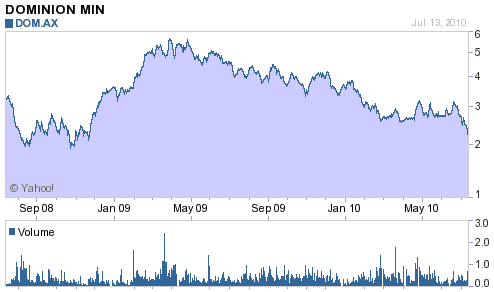
Dominion Mining (ASX: DOM). Shares: 103M. Recent price: A$2.26
DOM, an Australia-based junior gold producer, has recently been very
weak on both an absolute and relative basis, and there have been no new
developments that we are aware of to explain this weakness.
When a junior mining stock is surprisingly weak in the absence of news
it can mean that someone knows something and is selling ahead of the
coming bad news, but more often than not it has nothing to do with a
negative change in the company's situation. In DOM's case we suspect
it's the latter and that the recent decline has created a good buying
opportunity, but obviously we can't be certain (when it comes to making
investing/speculating decisions, certainty is a luxury we never have).
Despite the risk of a sector-wide correction, if we didn't already own DOM we would take an initial position at this time.
Fairborne Energy (TSX: FEL). Shares: 102M issued, 112M fully diluted. Recent price: C$4.63
We are maintaining some exposure to natural gas via FEL, a mid-tier
E&P company, and Precision Drilling (PDS), an on-shore drilling
services company.
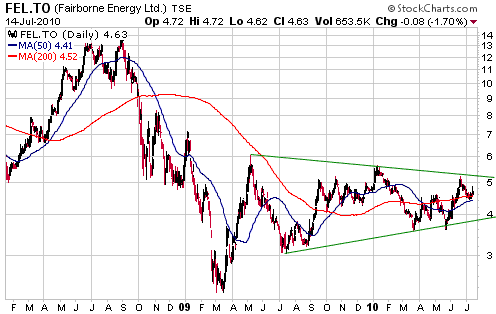
FEL's valuation is moderately low relative to most other natural gas
producers (it trades at around C$46,000 per boe/d), and its chart
pattern suggests that the next big move will be to the upside (it has
spent the past year 'coiling' within a contracting triangle). Due to
general market risk we wouldn't buy at this time, but FEL could become
a candidate for new buying if it retreats to around C$4.00 over the
coming 1-2 months.
Chart Sources
Charts appearing in today's commentary
are courtesy of:
http://stockcharts.com/index.html
http://www.futuresource.com/

|