- Interim Update 14th October 2020
Copyright
Reminder
The commentaries that appear at TSI
may not be distributed, in full or in part, without our written permission.
In particular, please note that the posting of extracts from TSI commentaries
at other web sites or providing links to TSI commentaries at other web
sites (for example, at discussion boards) without our written permission
is prohibited.
We reserve the right to immediately
terminate the subscription of any TSI subscriber who distributes the TSI
commentaries without our written permission.
Different views over
different timeframes
In writing these commentaries a
challenge we regularly face is having different views on the same market
over different timeframes. In this situation it is hard to know which
timeframe to emphasise.
A good example at the moment is the US$.
With regard to risk-versus-reward over the next 12 months or longer we are
bearish on the US$, but with regard to the next 2 months we are bullish.
We are short-term bullish mainly because the speculating community has
amassed a huge short-term bet against the US$, simultaneously creating the
potential for a sizable rebound and reducing the downside risk.
Furthermore, the potential for a sizable US$ rebound in the short-term
changes the risk/reward for other markets, chief among them being
commodities such as oil and the industrial metals. This is because broad
trends in the commodity markets are driven first and foremost by trends in
the currency market, with US$ advances linked to commodity-price declines
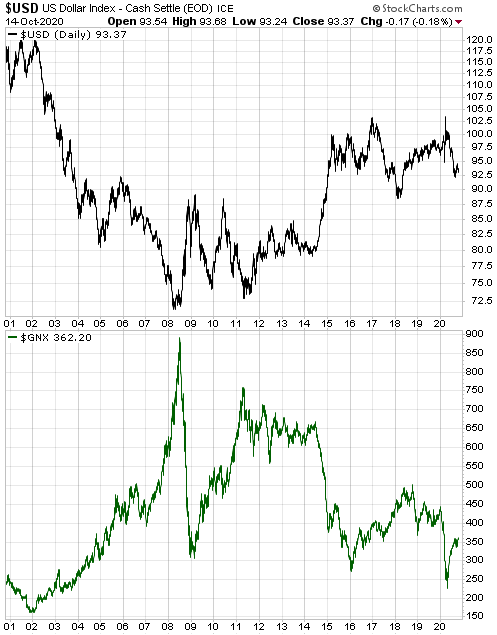
and US$ declines linked to commodity-price advances. This is illustrated
by the following chart comparison of the Dollar Index (DX) and the S&P
Spot Commodity Index (GNX).
Therefore, while we see the potential for commodity prices to trade at
much higher levels within the next 12 months, with regard to the next 2
months we are focussed more on downside risk than on upside potential in
these markets.
The question in front of us right now is: Should we
emphasise the US dollar's short-term upside potential or
intermediate-to-long-term downside potential?
In situations when
the short-term outlook clearly is skewed in the opposite direction to the
intermediate-term outlook, we tend to put more emphasis on the short-term
in our market discussions while keeping most of our specific
investing/speculating ideas in synch with the intermediate-term outlook.
We may suggest specific ways to protect against or profit from a
short-term countertrend move, but generally we view such moves as
opportunities to increase exposure to the longer-term trends.
One
risk worth highlighting is that sometimes when the stage is set for a
sizable short-term countertrend move, it doesn't happen. Instead, the
market in question becomes more stretched in the direction of the
longer-term trend. For example, although there's a good chance that the DX
will continue its countertrend rebound for another 1-2 months, we can't
rule out the possibility that the countertrend move is already complete
and that a decline to new lows for the year is imminent. If this were to
happen it would cause an extreme situation (in terms of speculator
positioning) to become even more so.
There is always a risk that
an extreme situation will become even more so, but this year the risk has
been 'front and centre' with greater frequency than ever before due to the
unprecedented actions/interventions of governments and central banks.
The Stock Market
In the latest Weekly Update we
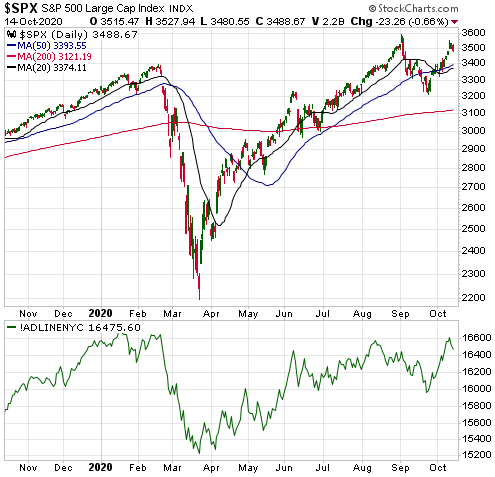
wrote that there could soon be a bullish divergence in the form of a
higher multi-month high in the NYSE Advance-Decline Line (ADL) along with
a lower multi-month high in the S&P500 Index (SPX), and that if this
happened it would further reduce the already-low probability that a large
stock market decline was about to begin.
The following chart shows
that such a divergence occurred on Monday 12th October when the SPX closed
slightly below its September high and the ADL closed slightly above its
August high.
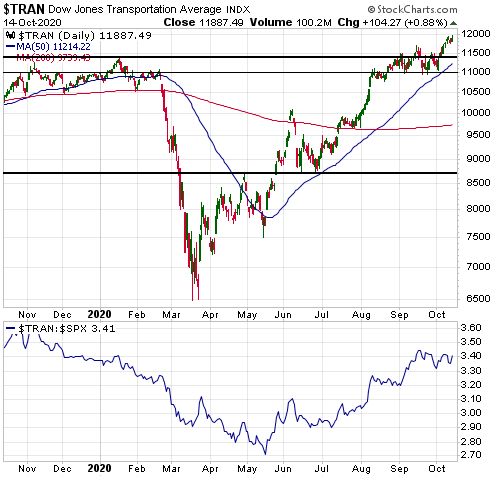
The Dow Transportation Average (TRAN) has extended its move into
all-time high territory and now looks acutely vulnerable to a negative
shift in market sentiment or economic confidence. Also, transportation
probably will be one of the hardest-hit sectors of the market IF there is
substantial post-election uncertainty in the US, because the main reason
for the recent strength in this sector is the eager anticipation of a
large fiscal stimulus package.
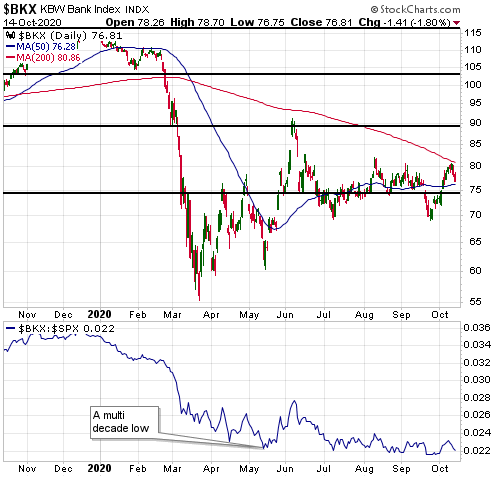
The banking sector of the stock market, as represented by the BKX, has
been a dismal performer during this year to date. As illustrated by the
following daily chart, the BKX is below its 200-day MA and the BKX/SPX
ratio is very close to a multi-decade low.
We are mentioning the
BKX today because this week is quarterly earnings season for the major US
banks. The bank earnings reported to date generally have been OK, but it
seems that there is minimal interest in owning bank stocks despite their
relatively attractive valuations.
Bank stocks don't interest us at
this time, but they could become good investments after interest rates
begin to trend upward.
Gold and the Dollar
Gold
Gold and Credit Spreads
A credit
spread is the difference in yield between a relatively high-risk debt
security such as a junk bond and a relatively low-risk debt security such
as a US Treasury Bond of the same duration. As economic confidence
increases, high-risk bonds tend to rise in price (fall in yield) relative
to low-risk bonds, causing credit spreads to contract. The reason is that
financially-weaker companies/institutions usually look less risky to debt
buyers who are optimistic about the economy. Therefore, an indicator of
what's happening to credit spreads on an economy-wide basis will indicate
the general trend in economic confidence.
Given that since March
of this year the Fed has been providing direct support to high-risk debt
securities, it could be argued that in the US the average credit spread no
longer reflects economic confidence. In particular, it could be argued
that the narrowing of credit spreads since March-2020 is due more to the
Fed's powers of persuasion (the Fed's ability to buy whatever it wants
with money conjured out of thin air) than increasing optimism about the
economy's prospects. However, the following chart shows that at least one
of the important relationships involving credit spreads has continued to
work the way it should.
The chart shows that the IEF/HYG ratio
(7-10 Year Treasury Bonds relative to similar-duration high-yield bonds),
a US credit-spread indicator, is still trending in the same direction as
the gold/GNX ratio (the US$ gold price relative to the price of a
commodity basket) most of the time. In other words, gold generally is
still doing what it should be doing, which is strengthen relative to
commodities when credit spreads are widening (that is, when economic
confidence is falling) and weaken relative to commodities when credit
spreads are narrowing.
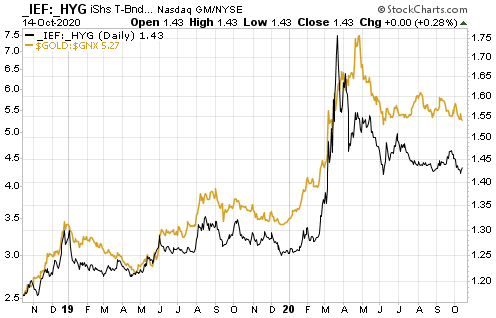
Over the first five months of this year there were huge swings in
credit spreads and the gold/commodity ratio, but since early-June both
have chopped around within horizontal ranges.
The direction that
credit spreads break out from their range of the past few months will give
us an important clue regarding what's likely to outperform/underperform
over the ensuing months. An upside breakout in our credit spread indicator
would point to relative strength in gold and weakness in the stock and
commodity markets, while a downside breakout in our credit spread
indicator would point to the opposite.
Current Market Situation
This week's price action in the
gold market has underlined the current importance to the gold price of
changes in the US dollar's exchange rate. On Monday of this week the
Dollar Index was almost unchanged and so was the gold price. On Tuesday
there was a decent bounce and the DX and a meaningful pullback in the gold
price. On Wednesday there was a small decline in the DX and a small rise
in the gold price.
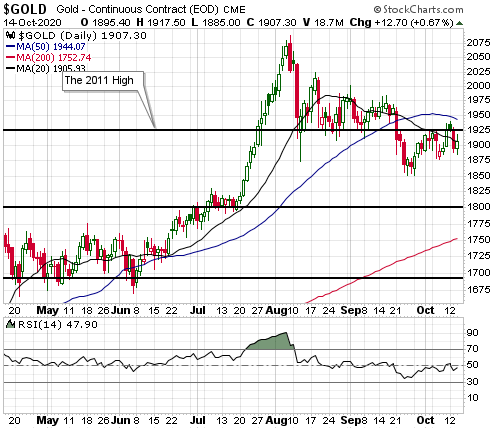
Gold is in a slightly weaker position now than
at the end of last week, but the chart pattern isn't significantly
different. The probability scale is still in favour of a correction-ending
decline to support in the low-US$1800s or lower, but whether or not this
happens will be determined to a large extent by the performance of the DX
over the days/weeks ahead. In particular, we suspect that for the US$ gold
price to drop to around $1800 in the near future the DX will have to move
above 95.
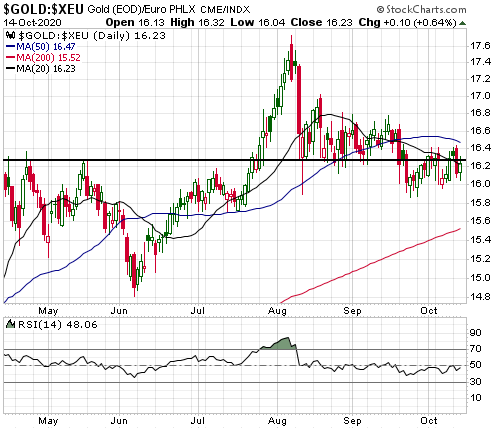
In euro terms, gold appears to be on its way to the 200-day MA in the
mid-1500s.
Gold Stocks
As has been the case for the bulk
of the past two months, the HUI's short-term chart pattern looks more
bullish (or less bearish) than gold's short-term chart pattern. Since its
early-August top the HUI has made lower highs and lower lows, which is the
definition of a downward trend. However, the downward trend looks very
much like a routine short-term consolidation within an intermediate-term
bullish trend.
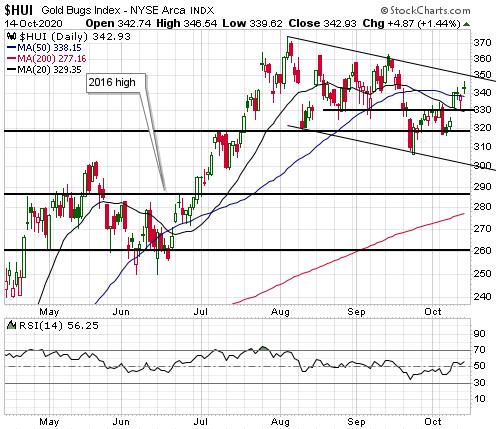
There is no evidence that the consolidation is over, so we remain
concerned about the risk of a correction-ending decline to the 260-290
range.
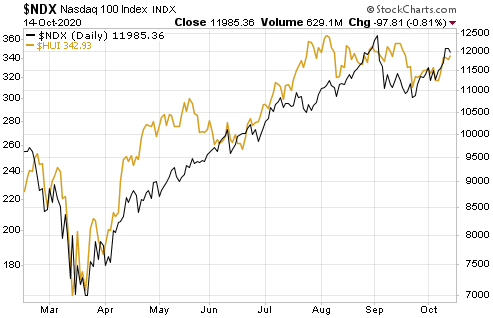
The risk of short-term weakness in the gold mining sector is
suggested by this year's positive correlation between the HUI and the
NASDAQ100 Index (NDX). The correlation is illustrated by the following
chart. The HUI and the NDX went their separate ways for a couple of weeks
in May and a couple of weeks in August, but otherwise they effectively
have been 'joined at the hip' since February. The implication is that
significant short-term weakness in the NDX, which we aren't betting on but
would not come as a surprise, would go hand-in-hand with significant
short-term weakness in the HUI.
The Currency Market
The US$ bear case
(unprecedented government deficit spending made possible by unprecedented
Fed money creation) is obvious. It is so obvious that almost everyone
believes that the US$ is on its way to much lower levels and currency
speculators, as a group, have placed massive bets against the dollar.
There are times when an overcrowded financial-market position can be
right for months on end, but that tends to happen only during the final
leg of a major trend. The US dollar's decline is still in its infancy,
meaning that we are still in a market environment where a sentiment
extreme should matter. Consequently, there's a good chance that a lot of
US$ bears will have to be shaken out of their positions before the US
dollar's cyclical decline resumes.
Very little happened over the
first three days of this week. The DX gained some ground, but on a very
short-term basis it remains in correction mode.
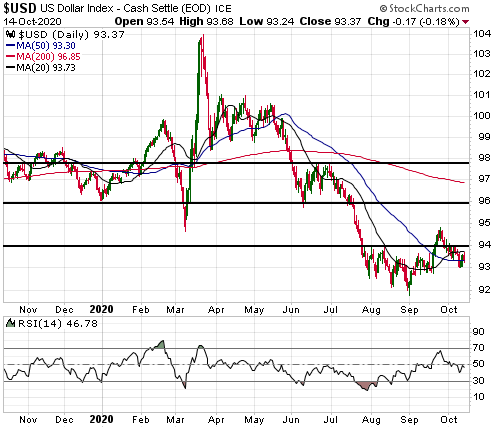
We think that the DX will have to move up to at least 96 and possibly
98 to set the stage for the next leg down, but, as mentioned earlier in
today's report, we can't rule out the possibility that the DX's rebound is
already complete and that anti-US$ sentiment is about to become even more
extreme.
Updates on Stock Selections
Notes: 1) To review the complete list of current TSI stock selections, logon at
http://www.speculative-investor.com/new/market_logon.asp
and then click on "Stock Selections" in the menu. When at the Stock
Selections page, click on a stock's symbol to bring-up an archive of
our comments on the stock in question. 2) The Small Stock Watch List is
located at http://www.speculative-investor.com/new/smallstockwatch.html
Chart Sources
Charts appearing in today's commentary
are courtesy of:
https://stockcharts.com/