|
- Interim Update 14th December 2011
Copyright
Reminder
The commentaries that appear at TSI
may not be distributed, in full or in part, without our written permission.
In particular, please note that the posting of extracts from TSI commentaries
at other web sites or providing links to TSI commentaries at other web
sites (for example, at discussion boards) without our written permission
is prohibited.
We reserve the right to immediately
terminate the subscription of any TSI subscriber who distributes the TSI
commentaries without our written permission.
China and Industrial
Metals
Mike Shedlock's 13th December blog post about China
has some interesting snippets of information. The post is titled: "China's Deserted "Fake Disneyland"; Shanghai Prices Down 40% from Peak, Inventory Clogs Market; Pollyannas Proven Wrong; Implications for US
Dollar".
The Chinese government will continue to report annual economic growth of 7%-9% and many Western analysts will continue to repeat these growth numbers as if they weren't completely fictional, but China's economy is probably now contracting. At some point the government will become concerned enough about the contraction to boost the supplies of credit and money, thus temporarily creating the impression that the economy has begun to recover. However, from now on the ability of China's government to use monetary/credit policy to sustain the illusion of strength beyond the short-term will be severely hampered by increases in living expenses.
Weakness in China's economy could result in the prices of industrial metals such as copper and iron-ore falling a great distance over the next 12 months. That being said, we are now entering a seasonally strong period for these metals and most growth-oriented markets are 'oversold'. Therefore, despite the bearish longer-term prospects the odds favour a rebound during the first few months of next year. If it occurs, this rebound could be the last good opportunity for speculators with substantial exposure to industrial metals to "get out of Dodge". The Stock Market
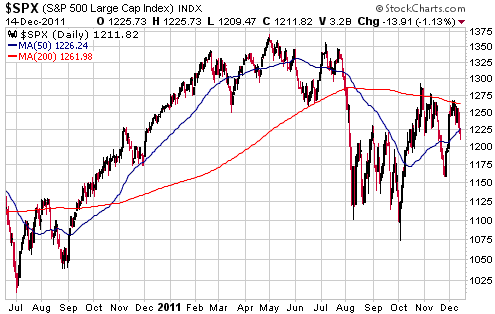
The more bullish of our two short-term scenarios appears to be playing out (refer to the 5th December Weekly Update for a chart illustrating the two scenarios). This scenario encompassed a pullback into mid December followed by a rally into the first half of January.
For this bullish scenario to remain intact, a pullback low should be in place by the end of next week at the absolute latest.
Gold and the Dollar
Gold and Silver
Gold Leasing
Published gold lease rates have recently been negative, but this doesn't mean that central banks (the only lenders of gold in size) are paying people to borrow gold. The reason is that the published lease rate is a derived quantity determined by subtracting the gold forward rate (the difference, expressed as an interest rate, between the spot price of gold and the price of gold for delivery at some future time) from LIBOR. If LIBOR happens to be lower than the gold forward rate then the published lease rate will be negative, but actual gold borrowing will not be carried out at this rate. To put it another way, gold borrowers always pay a positive lease rate.
As discussed in considerable detail in the long MetalAugmentor.com article posted
HERE, the evidence suggests that gold leasing has recently increased and that the increase in leasing activity is partly responsible for the decline in the gold price. What is most likely happening is that central banks in Europe are using gold leasing as a backdoor way of providing troubled commercial banks with liquidity. By lending gold that the commercial banks immediately sell into the market to obtain dollars, the central banks help address the short-term financing needs of commercial banks in a non-inflationary and low-profile way.
The commercial banks that receive these backdoor liquidity injections will ensure that they have no exposure to the gold price by purchasing sufficient gold futures contracts to cover their short positions in the physical market. According to Tom Szabo of
MetalAugmentor.com, who knows a lot more about the mechanics of gold leasing and hedging than we do, the gold price will tend to be weighed down by selling gold in the spot market and buying an equivalent amount in the forward market. Due to time constraints we won't get into the reason why. Furthermore, selling in the spot market and simultaneously buying in the futures market will, if done in size, expand the forward rate (the difference between the spot price and the forward price), which will, in turn, reduce the published lease rate.
Current Market Situation
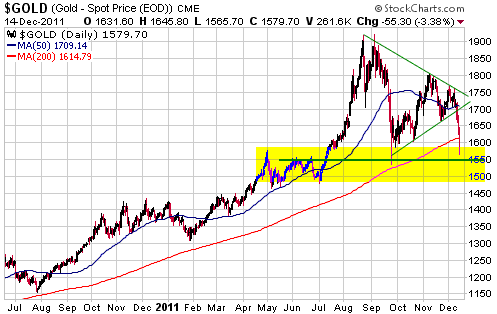
We had no way of knowing which way gold would break out of its contracting range (the triangle drawn on the daily chart displayed below). However, we said that a downside breakout followed by a decline to the mid-$1500s would create a good buying opportunity because such a decline would reduce the downside risk to almost nothing. Support extends from the high-$1500s down to the high-$1400s (the shaded are on the chart), with the most important support lying at around $1550.
As we write, gold is only about $20 above support at $1550. Also, gold has just fallen below its 200-day moving average, something that hasn't happened over the past two years but did happen on a regular basis prior to the past two years. In 2003, 2004, 2005 and 2006, a spike below the 200-day moving average occurred just prior to an important low. In 2008 gold dropped a long way below its 200-day moving average before reaching a sustainable price low, but a repeat of 2008's gold market action is very unlikely at this time.
There is no evidence that a bottom is in place, but the short-term risk/reward is now clearly skewed towards reward. We have therefore upgraded our short-term outlook from "neutral" to "bullish".
With regard to silver, we have written that a decline to near the bottom of the channel drawn on the following daily chart would create a good buying opportunity. Note that over the next few weeks the channel bottom will roughly coincide with important lateral support at around $26.50.
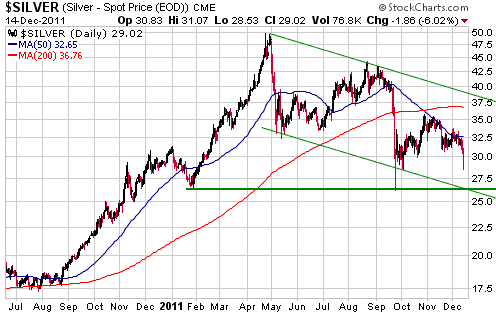
As discussed in earlier commentaries, there's a distinct possibility that the next major advances in gold and silver won't begin until the final quarter of next year. However, buying and selling opportunities should be based on real-time analysis, not forecasts. Currently, sentiment is depressed in the gold and silver markets as the prices of these metals approach levels that are likely to mark bottoms of at least short-term significance. The time for scaling in is therefore at hand.
Gold Stocks
Current Market Situation
The gold-stock indices broke below short-term support on Tuesday and followed through to the downside on Wednesday. This means that the strong 3-day rebound from the late-November low was a counter-trend move rather than the start of a new short-term upward trend. As at the close of trading on Wednesday, the intermediate-term correction that began more than 12 months ago was still in progress.
The HUI tested support at 490-500 on Wednesday before recouping some of its losses and closing at 508. The bad news is that the 490-500 support range has now been tested on four separate occasions since the beginning of the year. This is bad news because the more times a support or resistance level is tested, the higher the probability that it will eventually be breached.
One piece of good news is that the gold-stock indices have recently held up quite well relative to the bullion. Another piece of good news is that breaking below 490-500 in the near future would probably be followed by a decline to no lower than 470. This is because a decline to 470 would: a) push the HUI just below a moving-average envelope that has limited its downturns during all bull-market years except 2008, and b) push the HUI's daily RSI down to 30 (a level that, with the exception of 2008, has always marked a short or intermediate term bottom).
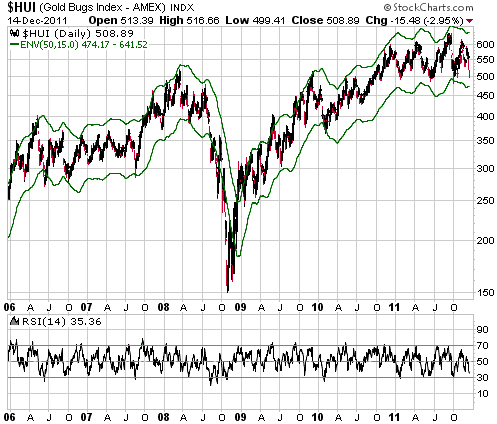
We considered upgrading our short-term gold-stock (HUI) outlook to bullish, but the downside risk is still a little too high. A decline to the 480s or lower within the next few days would prompt an upgrade.
"Naked short selling" isn't an obstacle, but your own psychology may well be
In a recent blog post at The Dollar Vigilante, Gary Kinghorn states:
"My contention is that the big financial players want to punish gold and silver owners. MF Global was just one scheme. A much more elaborate scheme is the naked short selling of the low-cost mining stocks, or even the majors. It’s virtually undetectable, unregulated and a fool-proof way of keeping a lid on the share prices (by counterfeiting shares as long-term FTDs). If JP Morgan is naked short billions of dollars of silver future positions, do you not think anyone is naked short all these mining stocks? Note: I am convinced this is going on in the US markets, but don’t have any insights into Canadian exchanges.
I know there are a lot of folks that make a living promoting the mining sector ... but I think they are somewhat naïve to the extent of the naked short issue, and the primary proof point I have is how badly all these stocks have performed compared to physical bullion, which is more difficult to control, although that’s clearly being shorted on Comex, too. If you think our capital markets are not rigged and still fair, then mining stocks may be a great way to leverage yourself to the price of bullion."
We've never seen any evidence that junior gold mining stocks (or any gold mining stocks for that matter) are influenced by "naked short selling". Also, the motivation cited in the above excerpt doesn't make sense in at least four ways. First, most market participants and ALL successful market participants are focused on making money, not on punishing other market participants. Second, small-cap gold mining stocks are subject to wild swings based on company-specific issues like drilling results, resource estimates, takeover bids or takeover-related speculation, and local political developments. As a result, they make high-risk 'shorts'. Third, the major players in the financial markets couldn't care less if "Joe Sixpack" makes a few bucks trading junior gold stocks. Fourth, if we assume that the master manipulators want to discourage investment in gold bullion (the "manipulation-is-the-be-all-and-end-all-of-the-markets" crowd usually makes this assumption), then it would be illogical for these manipulators to do anything that increased the relative attractiveness of the bullion.
In any case, we don't need to speculate about the unknowable motivations of other market participants. This is because Mr. Kinghorn states that his primary evidence supporting the claim that naked short selling has had a major depressing effect on gold stocks is how badly these stocks have performed compared to physical bullion. He goes on to say:
"If you think our capital markets are not rigged and still fair, then mining stocks may be a great way to leverage yourself to the price of bullion."
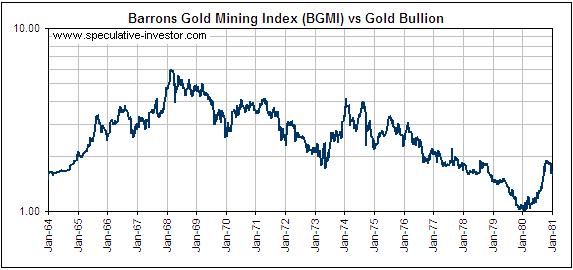
Actually, the fairness of the capital markets has nothing to do with it. The fact is that ever since the last official link between gold and the US$ was severed more than 40 years ago, gold stocks have never been a great way to leverage yourself to the price of bullion on a long-term basis. As evidence we cite the following chart of the BGMI/gold ratio (the Barrons Gold Mining Index relative to gold bullion). This chart shows that gold stocks trended downward relative to gold bullion throughout the final 12 years of the bull market that extended from the early 1960s through to January of 1980. Moreover, it shows that gold stocks, as represented by the BGMI, lost about 75% of their value relative to gold bullion during the final 5.5 years of the last great gold bull market.
Does this mean that "naked short selling" was an even bigger influence on the gold sector during the 1970s than it is today? Of course not. It means that we don't have to point to conspiracies or other nefarious activities to explain what has happened to gold stocks over the past several years.
That gold stocks provide investors with long-term leverage to upside in the bullion market is a myth we've busted in many TSI commentaries over the years. We won't regurgitate the fundamental reasons for the lack of upside leverage except to note that gold producers effectively have to invest a lot of money every year just to stand still. This is due to reserve depletion.
Substantial profits can be made from speculating in gold stocks during a long-term gold bull market, but in our opinion the stocks have to be treated as trading vehicles as opposed to investments. We don't mean that they should be bought and sold on a short-term basis in an effort to scalp a few percent here or there, but that they should generally be bought with the idea of exiting within two years. Even with stocks that are considered to be core holdings due to their long-term growth potential and other merits, there will almost always be opportunities during any 2-year period to trade around your core position by scaling out during the surges and scaling in during the purges.
One of the keys to successfully trading the gold stocks is to take a lot of money off the table when things are going swimmingly well. Unfortunately, many people create a problem for themselves by getting excited and leveraging up when things are going well. This leads to having way too much exposure -- and thus suffering huge portfolio draw-downs -- during the bad periods that ALWAYS follow the good periods. For example, the past 9 years contained a number of good and bad periods for the junior gold mining stocks. 2003 was extremely good, 2004 was rough, 2005-2006 was very good, 2007 was mediocre, 2008 was terrible, 2009-2010 was very good, and 2011 was bad. There were numerous opportunities to take massive gains during this 9-year period, but many participants in the sector were probably so blinded by dreams of extraordinary wealth and the egging-on of the gold cheerleaders that they ignored these opportunities.
When dealing in stocks and especially when dealing in thinly-traded mining juniors it pays, over the long-term, to be a liquidity provider rather than a liquidity extractor. When you step-up your buying as the price rises and step-up your selling as the price declines, you are removing liquidity from the market. As well as being unprofitable in the long run, such an approach does not provide a useful service to the market (which, by the way, is why the approach tends to be unprofitable, as the market usually doesn't reward counter-productive services). However, if you provide bids when those around you are desperately trying to get out and offers when those around you are buying with abandon, you will be acting in the useful role of liquidity provider and will stand a good chance of being rewarded for this service.
Currency Market Update
There was a high probability that the Dollar Index would break above its October and November peaks. The main question concerned the timing. We suspected that there would be some additional consolidation to facilitate a reduction in the euro short position prior to an upside breakout, but when the Fed announced no new inflationary measures at the conclusion of Tuesday's FOMC Meeting the dollar ramped upward as equities and commodities ramped downward. The result is the upside breakout shown on the following daily chart.
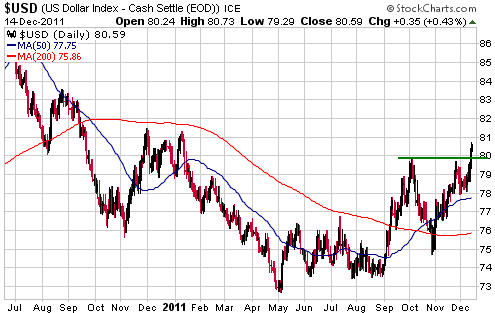
The price action of the past three trading days has undoubtedly led to more euro short positions being added to the existing large pile of euro short positions. This large and still-growing short position will eventually fuel a significant euro rebound and US$ correction, but this week's breakouts probably mean that there will be extensions to the current short-term trends prior to meaningful turning points.
Our best guess is that the Dollar Index's next short-term peak will be in the 82-85 range and occur in January.
Update
on Stock Selections
Notes: 1) To review the complete list of current TSI stock selections, logon at
http://www.speculative-investor.com/new/market_logon.asp
and then click on "Stock Selections" in the menu. When at the Stock
Selections page, click on a stock's symbol to bring-up an archive of
our comments on the stock in question. 2) The Small Stock Watch List is
located at http://www.speculative-investor.com/new/smallstockwatch.html
 Kinross Gold (NYSE: KGC, TSX: K) warrants and options Kinross Gold (NYSE: KGC, TSX: K) warrants and options
Up until today there were two series of Kinross warrants in the TSI Stocks List: the C-Series warrants and the D-Series warrants. The D-Series warrants are still a reasonable speculation in that a) they don't expire until September of 2014, b) they aren't too far out of the money (they have an exercise price of US$21.30), and c) their current price of around C$1.40 is fair relative to the price of the underlying stock. However, the C-Series warrants are now too far out of the money to be practical speculations (they have an exercise price of C$32.00) and at their current price of C$1.00 are very expensive relative to the underlying stock.
We have therefore removed the C-Series warrants from the TSI List, thus realising a loss of around 70%.
In effect, we have replaced the Kinross C-Series warrants with long-dated Kinross call options. The options of interest are the KGC January-2014 US$15.00 calls, which last traded at US$1.85 but ended Wednesday's session with a bid-ask range of US$1.98-US$2.10. For record purposes we have used US$2.00 as our starting price. Although these options are only about $1.00/unit more expensive than the C-Series warrants, they have about 4 months of additional time and an exercise price that is about $17 lower.
Provided that Kinross manages a good rally at some point over the next two years, there should be opportunities to exit the D-Series warrants and the Jan-2014 call options at multiples of their current prices.
Crocodile Gold (TSX: CRK). Shares: 310M issued, 399M fully diluted. Recent price: C$0.485
After the close of trading on Tuesday. Luxor Capital announced that it was preparing a C$0.56/share bid for 85% of CRK. Although the bid is being pitched at a 60% premium to the pre-bid market price, it isn't an attractive offer.
There is nothing to do here except wait for the bid to be formalised and see what alternatives CRK's management can come up with.
Low-priced/high-risk gold stocks that could rebound strongly during Q1-2012
In the 5th December Weekly Update we wrote:
"In addition to some of the beaten-down gold/silver microcaps in the TSI Stocks List and the TSI Small Stocks Watch List, some tiny stocks that could be reasonable speculations in anticipation of a rebound from a pre-Christmas low -- especially if they drop by an additional 10%-20% over the next couple of weeks -- are (in alphabetical order): GPD.TO, GV.V, NCG.V, RN.TO and VTR.TO."
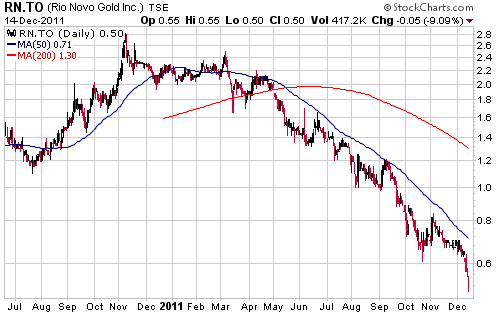
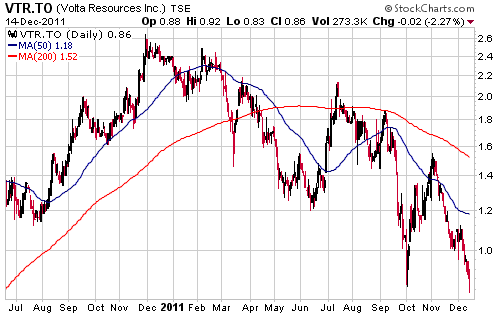
Each of the above-mentioned five stocks has since dropped by an additional 10%-20%, so a buying opportunity is at hand. We have added two of these stocks to the TSI Stocks List -- to the "Trading Positions" section of the List to denote our intention to exit within the next few months. By the way, although we are adding these stocks to reflect our view that a tradable short-term rebound will commence from whatever low is made over the coming week, they are fundamentally good enough to be longer-term speculations.
The new low-priced stocks are Rio Novo Gold (TSX: RN), which ended Wednesday's session at C$0.50, and Volta Resources (TSX: VTR), which ended Wednesday's session at C$0.86.
RN is developing three projects in South America: the Almas and Guaranta projects in Brazil and the Toldafria project in Colombia. Of these, Almas is the most advanced. RN's plan for Almas is to complete a Preliminary Economic Assessment by March-2012, complete a Feasibility Study in Q3-2012, and bring the project into production at 60K-80K ounces/year by H2-2013.
RN's total resource is about 2M ounces, about half of which is in the M&I category. It has about $30M of cash, which means that its current enterprise value is only about $28M (based on a share count of 116M) and that its in-ground gold is being valued by the market at less than $20/oz.
VTR has projects in Burkina Faso (West Africa), by far the most important of which is the Kiaka project. Kiaka's current resource is 4.26M ounces (3.0M M&I + 1.26M Inferred), and the total company resource is 5.6M ounces (3.2M M&I + 2.4M Inferred).
VTR has about $55M of cash, which means that its current enterprise value is around $78M (based on a share count of 155M) and that, like RN, its in-ground gold is being valued by the market at less than $20/oz.
A Pre-Feasibility Study and new resource estimate for the Kiaka project are scheduled to be complete in March of 2012.
A lower-risk trading opportunity
For speculators who don't want to get involved with individual microcaps, the potential for a tradable Q1 rebound at the junior end of the gold sector could be played via the Gold Explorers ETF (NYSE: GLDX). As illustrated by the following chart, GLDX has just dropped back to test its October low.
We have also added a GLDX trading position to the TSI List, using Wednesday's closing price of US$10.43 as our starting price.
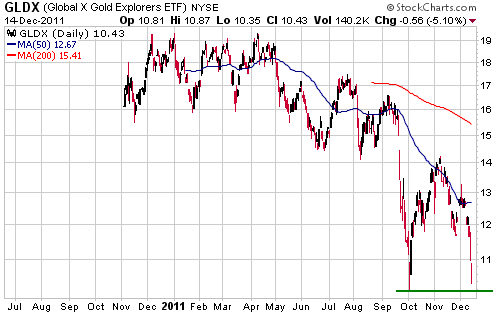
Chart Sources
Charts appearing in today's commentary
are courtesy of:
http://stockcharts.com/index.html

|









