|
- Interim Update 15th February 2012
Copyright
Reminder
The commentaries that appear at TSI
may not be distributed, in full or in part, without our written permission.
In particular, please note that the posting of extracts from TSI commentaries
at other web sites or providing links to TSI commentaries at other web
sites (for example, at discussion boards) without our written permission
is prohibited.
We reserve the right to immediately
terminate the subscription of any TSI subscriber who distributes the TSI
commentaries without our written permission.
More thoughts on the
supposed lack of "price inflation"
At the risk of appearing lazy we have copied, below, the 'guts' of a lengthy email received a few days ago from long-time TSI reader A.H. The email was sent in response to the discussion of inflation (the monetary kind versus the price kind) included in our latest Weekly Market Update, and zooms in on a very important issue. Here's what A.H.
said (in italics), with our comments interspersed:
"My personal hunch is that real efficiency and productivity have skyrocketed over the past couple of decades. If we can imagine an economy reasonably free of government intervention -- the way it was prior to World War I, say -- then I believe we would have seen remarkable declines in prices over the last 20 years or so. The efficiencies and time- and effort-saving effects due to so many new technologies like computers, email, cell phones, overnight deliveries around the world, electronic payments, and countless other innovations have made everything quicker, cheaper, more reliable, etc., etc. These changes have totally transformed my own business of real estate development and investments, for example. This "good deflation" of prices over the last few decades would have been unprecedented in world history, I believe. Therefore, I believe the low rate of current reported inflation is actually disastrous because it masks what otherwise would have been a remarkable reduction in cost of living -- and a consequent soaring of standard of living for everyone. In other words, under current circumstances even a totally stable price level would reveal criminally inflationary policies because price levels should have been drastically lower as a result of the totality of efficiencies and increased productivity."
This is an excellent point. Due to numerous technological innovations, the cost of living should be in a relentless downward trend and the general standard of living should be in a relentless upward trend. Not only have the central bank's actions prevented this benefit from materialising in the past, but the Fed has recently promised that it will more than offset the effects of improved productivity in the future such that the cost of living continues to rise by 2% per year. Given that the Fed's preferred measure of "inflation" chronically understates the loss of purchasing power, the Fed has, in effect, promised to increase the US cost of living by 5-10% per year forever more. It is appropriate to refer to this policy as criminal.
Unfortunately, most people have been brainwashed into believing that economic growth causes prices to rise, and, therefore, that a steady decline in the purchasing power of money is beneficial.
"The recent recession (perhaps still in effect?) and the current long-term disaster in the US housing industry, alone, should have caused a severe decline of prices as millions of people working in construction, real estate, carpet manufacturing, cabinet-making, refrigerators, washing machines, etc., etc. lost their jobs, with all sorts of ripple effects throughout the economy. Yet prices have stubbornly been rising regardless of which measures are used. It defies common sense that the economy could suffer such severe setbacks in the last few years while prices continue to rise at some measurable rate."
Thanks to the money-pumping of the Fed and other central banks, even the bursting of several huge real estate bubbles and the most rapid global private-sector de-leveraging in history were incapable of making the 'deflationists' look right for more than a few months. Many people view this as a good thing, but what it means is that a proper corrective process was prevented from happening and much worse is yet to come.
"We know all about the effects of the gigantic recent growth in manufacturing capacity in Chindia, South Korea, Malaysia, Vietnam, and many other parts of the world that exerted a significant downward pressure on prices of everything these new productive populations could sell to western consumers. In the face of this huge supply of far cheaper products, how could the general price level still continue to rise if not for massive inflation actually occurring under the popular radar?
The above is an all-too-short discussion of why I am convinced that even the modest price inflation admitted to by the US government testifies, in fact, to a grotesquely inflationary regime because any sensible economic analysis would conclude that the general price level should be vastly lower than it is today."
Exactly. Even the 2%-3% per year "price inflation" admitted to by the US government points to a huge inflation problem once it is recognised that there should have been a large decline in prices over the past few years.
As we periodically emphasise, the biggest adverse effect of monetary inflation is not the reduction in purchasing power that it inevitably brings about, but rather the mal-investment that it prompts. Mal-investment wastes scarce resources and consequently leads to a general reduction in wealth. Obama's
Budget Proposal
It was only a few months ago that members of the Repocrat party (the party that dominates the US political scene) fought tenaciously among themselves over a deal to raise the official US government debt ceiling, finally coming to an agreement that involved a 10-year plan to substantially reduce the Federal deficit. Any lingering doubt that the battle over the debt ceiling was a charade has just been removed by the 3.8 trillion dollar budget proposed earlier this week by President Obama.
It is obvious that the near future is never the right time to cut government spending. The right time for a cut is always the distant future. That way the spending cut can be 'planned', but never actually
implemented.
The fact that Obama's budget contains tax increases will rile the Republican wing of the Repocrat party, but government spending is the key. A tax cut that isn't funded by a spending cut will have to be funded by additional tax in the future or by the inflation tax, meaning that it isn't really a tax cut. Similarly, an increase in government spending that isn't accompanied by a tax increase in the present will result in higher taxes in the future.
Spending is the key, because the less the government spends the smaller the quantity of resources that will be directed/consumed in an inefficient, politically-motivated way, and the stronger the economy will ultimately become.Oil
Update
This week's price action suggests that a multi-week pullback in the oil market ended early this month. As illustrated by the following daily chart, oil has broken above the top of a short-term channel and is now approaching lateral resistance at $103. A break above this resistance would project a test of last year's high ($115).
For oil to do much more than test last year's high there will probably have to be a supply shock related to increasing tensions or outright war in the Middle East.
 The Stock Market
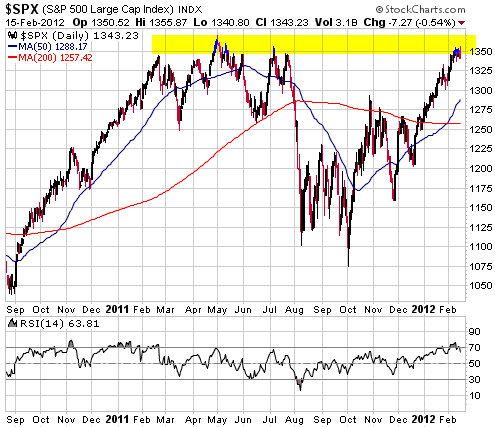
The S&P500 has traded sideways since reaching the bottom of a resistance range that extends from 1340 to 1370. It is 'overbought' by several measures including the RSI shown at the bottom of the following chart, but hasn't yet signaled a top of even short-term significance.
As noted in recent commentaries the SPX's short- and intermediate-term upside appears to be minimal, but over the next few weeks it probably won't do any worse than drop back to the 1280s.
Gold and the Dollar
Gold
Buffett's Blind-Spot
In a TSI commentary posted on 5th February, we wrote:
"The other misguided assertion is that owning gold is pointless because gold is a sterile, non-productive asset. This assertion emanates from value investors such as Warren Buffett, who like to compare the total market value of the world's gold with the combined market values of a group of large companies (Wal-Mart, Exxon, Intel, etc.) and pose a question along the lines of: What would you rather own -- a big chunk of metal that does nothing except sit in a vault or all of these phenomenal businesses? The question is meaningless, because nobody is ever faced with the choice of owning the world's gold or owning the 30 best companies in the world.
Most people have a range of investments plus some cash savings. In a world where there was no uncertainty there would be no need to maintain any cash savings, but in the real world there is always uncertainty about the future and therefore the desire -- on the part of most people -- to hold some cash in reserve. Although gold can be a very good investment at times due to the large swings in its pp discussed above, it is the portion of an investor's portfolio dedicated to cash that gold bullion is 'tailor made' to occupy. This means that gold isn't in competition with great companies such as Wal-Mart and Apple, it is in competition with the US$ and the euro and the Yen and the other national currencies."
As if on cue, this is what Warren Buffett wrote in an article
posted on 9th February:
"Today the world's gold stock is about 170,000 metric tons. If all of this gold were melded together, it would form a cube of about 68 feet per side. (Picture it fitting comfortably within a baseball infield.) At $1,750 per ounce -- gold's price as I write this -- its value would be about $9.6 trillion. Call this cube pile A.
Let's now create a pile B costing an equal amount. For that, we could buy all U.S. cropland (400 million acres with output of about $200 billion annually), plus 16 Exxon Mobils (the world's most profitable company, one earning more than $40 billion annually). After these purchases, we would have about $1 trillion left over for walking-around money (no sense feeling strapped after this buying binge). Can you imagine an investor with $9.6 trillion selecting pile A over pile B?"
He seems incapable of understanding that pile A isn't in competition with pile B. Pile A is in competition with pile C, which contains paper dollars.
Earlier in his article he laments that the US$ has lost 86% of its purchasing power since 1965 and will almost certainly continue to lose purchasing power due to the inflationary policies of the government. Why, then, would he opt for pile C over pile A?
Buffett disparages the use of gold as a store of value. At the same time, he advocates saving in terms of the US$ despite holding the belief that the US$ is going to steadily lose purchasing power indefinitely. We are impressed by his ability to simultaneously hold logically incompatible views. Clearly, he has a blind-spot when it comes to gold.
Current Market Situation
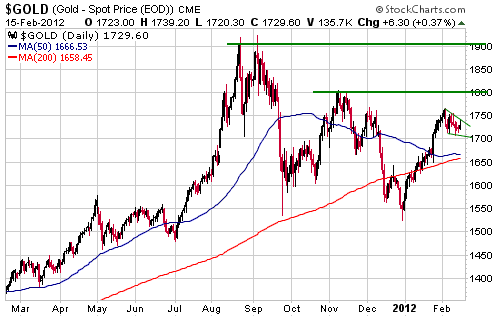
The recent price action in the gold market has the look of a minor mid-trend consolidation. The same applies to the recent price action in the silver market. Therefore, while it is possible that both gold and silver will drop back to near their 50-day moving averages before resuming their short-term upward trends, it is more likely that the short-term upward trends will resume before the 50-day moving averages are reached.
During the weeks immediately after the current consolidation comes to an end, gold will probably move up to at least $1800 and could move as high as $1900.
Gold Stocks
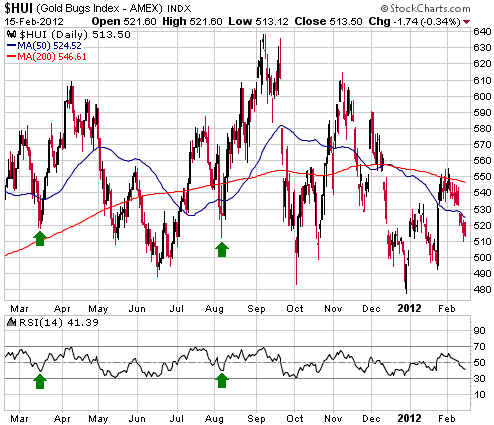
The HUI has now closed lower for 9 trading days in a row. This 9-day losing streak has pushed the daily RSI(14) down to around 40, which means that the HUI is now sufficiently 'oversold' to enable a tradable multi-week rally to begin. For example, the arrows on the following chart show that multi-week rallies began from similar RSI levels in March and August of last year. However, the chart also makes it clear that short-term downward corrections sometimes continue until the daily RSI drops to 30.
We therefore can't say anything definitive about the HUI's near-term direction. What we can say is that the short-term risk/reward is more bullish now than it was two weeks ago, mainly because risk has been reduced by the recent decline and the shift to a moderately 'oversold' position.
The possibility that weakness in the broad stock market will put significant additional downward pressure on gold stocks is a source of worry for some owners of gold stocks, but there are almost always things to worry about. Moreover, if you wait until it seems that the 'coast is clear' before buying then you will probably end up buying near an important top.
Currency Market Update
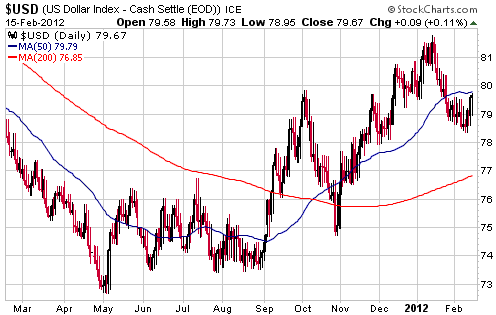
The Dollar Index declined from early January through to early February. With the stock market pausing and the news wires clogged with stories about Greece's financial troubles, the dollar has begun to retrace its recent decline.
As previously advised, we expect that the Dollar Index will maintain an overall downward bias until the speculative net-short position in euro futures has been substantially reduced. Within this overall downward bias there will naturally be periods of strength, because markets rarely get from A to B in a straight line. We are now seeing the first of these periods of strength.
It's possible that the dollar's rebound is already almost complete. It's also possible that the rebound could take the dollar all the way back to its early-January peak. There's no way of knowing. A lot will depend on the news-flow out of Europe and the magnitude of the stock market's downward correction.
Update
on Stock Selections
Notes: 1) To review the complete list of current TSI stock selections, logon at
http://www.speculative-investor.com/new/market_logon.asp
and then click on "Stock Selections" in the menu. When at the Stock
Selections page, click on a stock's symbol to bring-up an archive of
our comments on the stock in question. 2) The Small Stock Watch List is
located at http://www.speculative-investor.com/new/smallstockwatch.html
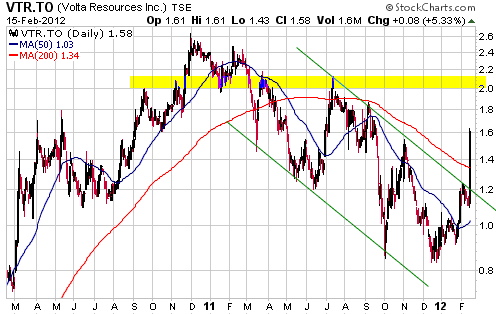
 Volta Resources (TSX: VTR). Recent price: C$1.58 Volta Resources (TSX: VTR). Recent price: C$1.58
VTR's share price was sharply higher on Tuesday in reaction to a press release announcing new drilling results. The new results were from shallow exploration holes drilled about 500 metres from the previously defined 4.2M-oz deposit at the company's Kiaka gold project in Burkina Faso.
The drilling news was justifiably greeted with enthusiasm, because:
a) The intercepts were high-grade, wide, and close to the surface.
b) Being only a few hundred metres from the existing deposit, the new gold discovery will almost certainly improve the economics of the overall project.
There's a chance that VTR's share price could pull back as far as the mid-C$1.20s within the next few weeks, thus creating a new opportunity to buy. However, it isn't a good chance. It's more likely that the time for buying has passed and that the next short-term opportunity will be the selling variety.
This week's action opens up the possibility that VTR will challenge resistance at C$2.00-C$2.10, if not over the next several days then in March in response to an updated resource estimate and pre-Feasibility Study for the Kiaka project. A move up to near this resistance would, we think, create an excellent opportunity to take profits.
For TSI record purposes, we will exit the stock if it trades at C$1.90.
Addition to the TSI Stocks List: Endeavour Mining (TSX: EDV, ASX: EVR). Shares: 254M issued, 289M fully diluted. Recent price: C$2.29
Most TSI readers will be familiar with EDV, because we have written about this company many times over the years. Previous comments are archived at
http://www.speculative-investor.com/new/EDVWTA.html.
The TSI Stocks List currently has some exposure to EDV via the EDV Feb-2014 C$2.50 warrants (TSX: EDV.WT.A), but the stock hasn't been part of the List since we took profits at C$2.70 back in September of 2010. At least, it hasn't been part of the List until today.
When we removed EDV from the List in 2010 it was producing gold from its Youga mine at the rate of about 80K ounces/year, but more than half of its net asset value was a huge cash reserve. This cash reserve meant that the risk was low, but it also meant that the stock didn't offer significant leverage to the gold price. The lack of leverage was the main reason for our decision to exit.
As a result of developments over the intervening period, EDV now offers much greater leverage to the gold price and has a more clearly defined growth path. It is currently producing gold at the rate of around 180K ounces per year from two mines -- the Youga mine in Burkina Faso and the Nzema mine in Ghana. Also, it plans to develop the Agbaou project in Cote d'Ivoire into a mine that produces gold at the rate of 70K-100K ounces/year by the end of 2013, and has additional growth potential due to its 40% stake in the exploration-stage Mali-based Finkolo project managed by Resolute Mining. Moreover, the stock is now trading about 15% lower than our earlier exit price despite the gold price being 30% higher.
The company expects to generate about US$150M of cash in 2012. This cash flow, along with its current cash hoard and credit facility, should be more than enough to take Agbaou through to production without needing to arrange additional financing.
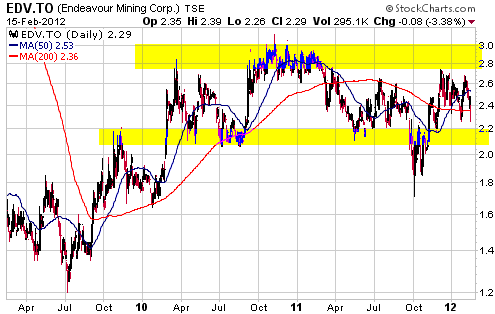
We have returned EDV to the List at Wednesday's closing price of C$2.29, a
price that is just above an area of good support (refer to the following chart
for details). We have a 12-month target of C$4.50 in mind. The target was determined by applying an 8 multiple to this year's expected cash flow and allows nothing for the growth potential provided by Agbaou and Finkolo.
By the way, in addition to trading in Canada under the symbol EDV, Endeavour Mining also trades in Australia under the symbol
EVR.
With today's addition of EDV there is now too much exposure to West Africa in the TSI Stocks List (GSS,
KGN and RSG.AX also have their main assets in West Africa). We hope to be able to address this imbalance by exiting RSG.AX within the next few months at around A$2.50.
UEX Corp. (TSX: UEX). Shares: 203M issued, 222M fully diluted. Recent price: C$0.85
In the 11th January Interim Update, with exploration-stage uranium miner UEX trading at C$0.93, we wrote:
"...UEX's stock price will meet significant resistance in the C$1.20s if the rally continues. Depending on your overall positioning and the amount of buying you did at lower levels, it could make sense for you to take some money off the table if UEX moves up to near C$1.20 in the near future."
An opportunity to do some selling near C$1.20 subsequently arrived.
The stock has since pulled back by enough to create a decent short-term buying opportunity. New buying could be appropriate in the mid-C$0.80s or lower.
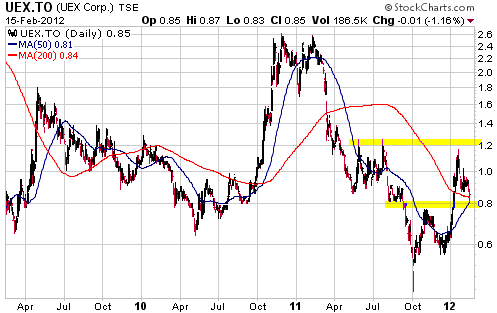
Chart Sources
Charts appearing in today's commentary
are courtesy of:
http://stockcharts.com/index.html

|









