- Interim Update 15th April 2020
Copyright
Reminder
The commentaries that appear at TSI
may not be distributed, in full or in part, without our written permission.
In particular, please note that the posting of extracts from TSI commentaries
at other web sites or providing links to TSI commentaries at other web
sites (for example, at discussion boards) without our written permission
is prohibited.
We reserve the right to immediately
terminate the subscription of any TSI subscriber who distributes the TSI
commentaries without our written permission.
Cycle low for natural
gas?
In January, we wrote the
following about the natural gas (NG) market:
"...the first
quarter is the time of the year when tradable rebounds got underway in
three of the past four years. Specifically, a significant short-term
rebound began from a first-quarter low in 2017 and intermediate-term
rebounds began from first-quarter lows in 2016 and 2018. At the same time,
the futures curve indicates that the US NG market is well supplied at the
moment. We are referring to the fact that near-term delivery is cheap
relative to delivery in 12 months.
The potential clearly exists for
a meaningful rebound from whatever low is made during Q1-2020. We suspect
that physical supply-demand fundamentals will improve and that the rebound
will be the intermediate-term variety, but we would prefer to avoid a
time-constrained bet on NG."
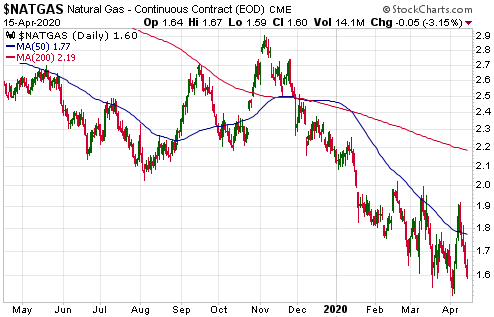
The NG price didn't bottom during
the first quarter, but it's possible that a bottoming process got underway
in March and that the cycle low occurred on 2nd April. A daily close above
US$2.00 would be preliminary evidence that at least a short-term bottom is
in place.
The futures curve still points to the US NG market being very well
supplied. A major rally probably requires a much tighter supply situation
(relative to demand), so at this stage the potential reward for a bullish
trade probably isn't anything more than a bounce to the $2.00-$2.50 range.
However, the current low prices for both oil and NG are causing a big
reduction in drilling activity, which should mean that during the second
half of this year the NG production rate is much lower at the same time as
NG demand is ramping up in response to stimulus measures and the general
return to work. In other words, the physical supply-demand situation
probably isn't going to remain as bearish as it is today..
12 Month
Forecast, updated 15th April 2020
Due to the dramatic events of
Q1-2020, the main ones being the economy-wide shutdowns, the stock market
crash that resulted from the shutdowns, and the massive central bank
buying spree prompted by collapsing asset prices and sky-rocketing job
loss numbers, an update to our 12-month forecast seems appropriate.
Unfortunately, there is so much uncertainty right now that drawing
conclusions about what the future holds in store is far more difficult
than usual. In particular, a great deal hinges on the timing of a general
return to work, which at the moment is unknown. For example, there's a
huge difference for both the financial markets and the economy between a
May-June return to work and an August-September return to work. Therefore,
while we know that our previous forecast (dated 15th January 2020) has
been largely overridden by events, at this time we simply don't have
enough information to do a comprehensive update.
What we can do
right now is address a few parts of our previous forecast that definitely
are not going to happen or will happen in a very different way, beginning
with our forecast that the next 12 months will involve a substantial (by
the standards of the past 10 years) increase in what most people think of
as "inflation".
The two overarching contributors to "price
inflation" are the change in the supply of goods/services and the change
in the monetary demand for goods/services. Thanks to the lockdowns, both
sides of this supply-demand equation have plummeted over the past several
weeks. Furthermore, with regard to big-ticket and discretionary items,
demand has fallen much faster than supply. This should lead to large
short-term declines in some of these prices.
Now, we get the
impression that most policy-makers and commentators are labouring under
the assumption that the economy can be shut down for a few months and then
restarted, such that within a short time almost everything is back to the
way it was prior to the shut-down. However, the economy doesn't work that
way. Many businesses will never be able to restart, many supply chains
will be permanently broken and many jobs will be lost forever.
Consequently, the supply side has suffered a hit that probably will take
years to recover from, even if government restrictions start being lifted
within the next few weeks and a general return to work occurs before
mid-year.
The supply side also will be hurt in the long-term by the
massive amount of money that is being thrown around by governments and
central banks in an effort to reduce the short-term pain. The reality is
that governments and central banks do not have wealth reservoirs that can
be drawn upon in times of crisis. All they can do is redistribute existing
wealth and incentivise capital consumption ('eating of the seed corn').
This will ensure that the economy is not as productive post-crisis as it
was pre-crisis.
At the same time, the new money that is being
injected into the economy will give the monetary demand for goods/services
a substantial boost AFTER the immediate crisis has passed. Note that
unlike the Quantitative Easing of 2008-2014, which involved pumping money
into the financial markets, this time around a lot of new money will be
provided directly to businesses and individuals. This means that the
inflationary effects of the current money-creation schemes will be more
apparent in everyday prices than was the case with earlier schemes.
In summary, the stage is being set for a veritable tidal wave of new
money to meet a reduced supply of goods and services. This WON'T result in
hyperinflation in the US or other developed economies in the foreseeable
future (say, the next two years), but it very likely will result in much
higher levels of "price inflation" within 12 months of the passing of the
immediate COVID-19 crisis.
We can use an analogy to explain the
change to our "inflation" forecast. Originally, we were going to take a
flight from Singapore to northern California. Now, we will be flying from
Singapore to Alaska, but we will be getting there via New Zealand.
Another part of our previous forecast that can be updated immediately
has to do with recession. Even though our leading indicators were
suggesting that a US recession would begin during H1-2020, at the
beginning of this year we guessed that the US economy would be stagnant
during 2020 and that the strong rebound in monetary inflation throughout
the developed world over the preceding six months would postpone the start
of a global recession until 2021. Due to the widespread lockdowns there is
no doubt that a global recession began in March of 2020, but there isn't
yet enough information to speculate about when the recession will end.
We also can be fairly certain that our previous forecasts regarding
oil and the oil sector will be wrong. In some industrial commodity markets
the lockdown-related supply reductions could, within a few months,
counteract the lockdown-related demand reductions, enabling prices to make
new 12-month highs by the end of this year in response to the coming
increase in monetary demand. The oil market is a different story, though.
Unless war breaks out in the Middle East, an abundance of supply probably
will weigh heavily on the price for the bulk of this year, preventing
anything more bullish than a rebound to the $40s. The low oil price
should, however, eventually take a significant toll on oil supply,
potentially paving the way for a substantial price rise during 2021.
We plan to do our next 12-month forecast update in July. Hopefully by
then the virus-related lockdowns will be over, thus removing a huge source
of uncertainty and enabling us to be more specific about all the markets
we follow.
The Stock Market
Current Market Situation
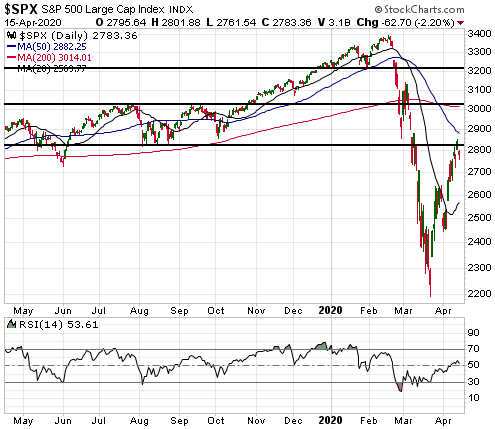
During the first three days of this week the SPX reached the middle of
the 2800-2900 target range we've had in mind for the initial post-crash
rebound before pulling back. It isn't reasonable to expect much more from
this short-term rally.
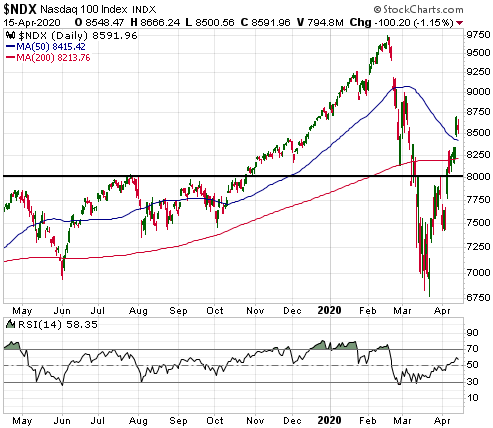
The NASDAQ100 Index (NDX) has done even better than the SPX. As
illustrated below, the NDX has broken above its 50-day MA and at the close
of trading on Tuesday was roughly where it had been at the end of last
year.
From a fundamental perspective, this makes no sense. In
effect, 'investors' (using the term as loosely as possible) are claiming
that the 100 large-cap NASDAQ stocks that comprise the NDX are, as a
group, worth as much today as they were shortly before the virus-related
shut-downs and associated collapse in economic activity. And it's not as
if the NDX's valuation at the end of last year was discounting a dire
economic future. On the contrary, the valuation was so high late last year
that it appeared to be discounting economic nirvana.
From both a
technical perspective and a sentiment perspective, however, the price
action does make sense. Crashes are always partially retraced and the
extreme negativity/fearfulness evident at the March low suggested that the
2020 post-crash rebound would be stronger than average.
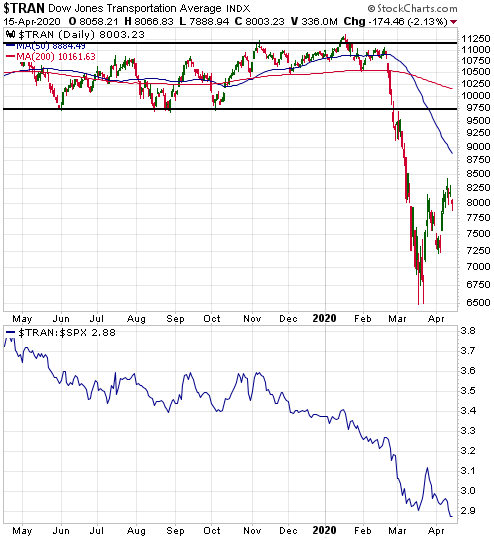
At the opposite end of the performance scale we have the Dow
Transportation Average (TRAN). Despite having fallen much further than
either the SPX or the NDX during February-March, the TRAN is still
relatively weak. This is a warning that intermediate-term downside risk
remains high.
The McClellan Oscillator (MO) surge that we wrote about in the latest
Weekly Update suggests that declines over the next few weeks won't get
very far, which would be consistent with what we have labelled as Scenario
2. This scenario involves some corrective activity over the weeks ahead,
but it doesn't involve the SPX returning to anywhere near the March low.
We mentioned that if Scenario 2 is in play then there won't be
anything more bearish in the near future than a 5% pullback in the SPX.
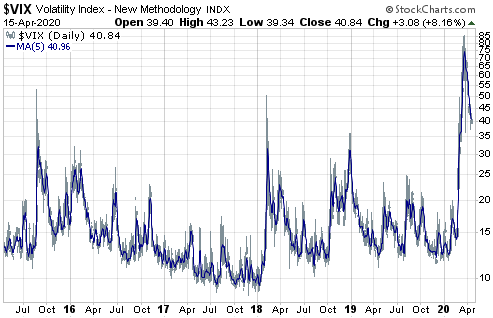
However, given that the SPX gained almost 30% from its March low to this
week's high and that both the expected volatility (as indicated by the
VIX) and the actual volatility remain unusually elevated (the following
chart shows that the 5-day MA of the VIX is still above 40), we
acknowledge that the SPX could drop by as much as 10% without doing
significant damage to its short-term upward trend.
We think that Scenario 2 is the most likely short-term outcome, but
even if a test of the March low isn't on the cards the next few weeks
could be 'testing'. It's likely that the general level of nervousness will
increase and the price action will be choppier than it has been in the
recent past. Also, it should be kept in mind that while a test of the
March low is less likely than it was just one week ago, it still could
happen. So much depends on the timing of a general return to work and the
time it takes to make effective drug-related treatments of COVID-19
readily available. (A vaccine appears to be a long way off, but there is
evidence that existing drugs can be used to good effect to greatly reduce
the risk of serious illness and death.)
A leveraged bear
fund makes a new all-time low
In TSI commentaries and blog
posts several years ago (e.g.
HERE and
HERE), we discussed the 'problem' with leveraged ETFs. The problem, in
a nutshell, is that the greater the volatility of an index and the greater
the leverage provided by an ETF linked to the index, the worse the likely
performance of the leveraged ETF over extended periods.
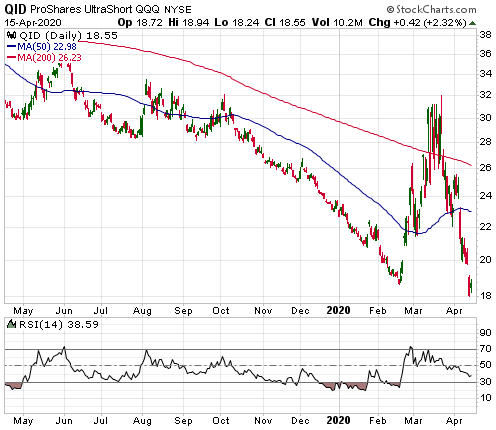
A good
example is the recent performance of QID, a fund that is designed to move
in the opposite direction to the NDX at twice the daily percentage rate.
Although the NDX was about 11% below its February-2020 all-time high at
the close of trading on Tuesday 14th April, the following daily chart
shows that QID made a new all-time low on Tuesday.
Gold and the Dollar
Gold and Silver
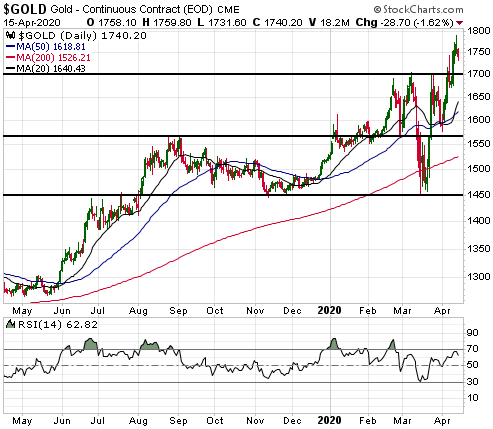
The June-2020 gold futures price, which is what's displayed on the
following daily chart, pulled back a little over the first three days of
this week. However, the spot price gained ground and has confirmed last
week's move in the futures market by breaking above its February-March
highs.
In the silver market the gap between the nearest futures price and the
spot price also narrowed over the first three days of this week, with the
May-2020 futures price (see chart below) dropping quite sharply and the
spot price gaining a little. This resulted in the futures premium (over
spot) shrinking from $0.69 to only $0.08.
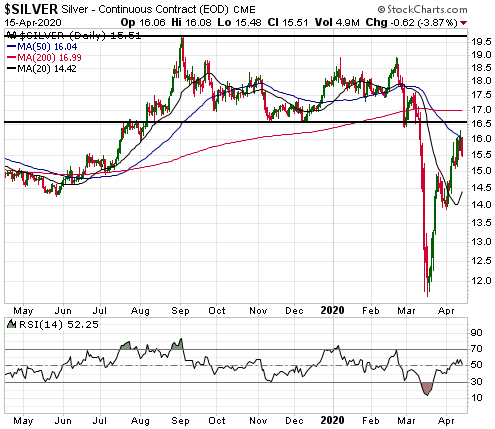
The upshot is that for both gold and silver, the relationship between
the futures and physical markets became more normal during the first three
days of this week. As far as we can tell, this is neither bullish nor
bearish.
Gold now has important support at $1690-$1700. A weekly
close below $1690 would warn that a short-term top is in place.
We
remain torn between gold's bullish fundamentals and a sentiment situation
that points to meaningful short-term downside risk. As was the case during
March, the sentiment-related risk could materialise if the stock market
takes another tumble.
Gold Stocks
The
following chart shows that within the space of less than two months the
Gold Miners ETF (GDX) went from $32 to $16 and all the way back to $32.
The HUI has done something similar. This price action could be
unprecedented, in that we are not aware of any prior case of a bona fide
stock index/ETF crash being fully retraced in such a short time.
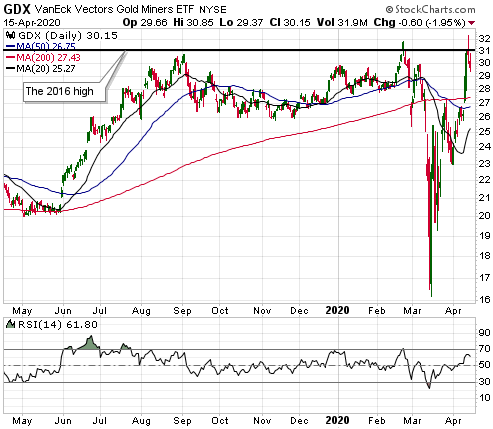
The gold sector has been performing like the broad stock market (as
represented by the SPX) on steroids. It fell faster during the
February-March financial market mayhem, but it has rebounded faster. If
financial market liquidity again contracts, the gold sector will again be
at risk of falling as fast or faster than the broad stock market.
The advantage that the gold mining sector has over most other stock market
sectors is that gold mining fundamentals are extremely bullish. In
addition to benefiting from the fundamental factors that have led to a
much higher gold price in terms of all currencies, gold miners are now
benefiting from a collapse in the price of fuel (a major cost to most gold
producers). This is especially the case for gold producers that have been
able to maintain their production rates at or near pre-crisis levels.
Despite the bullish fundamentals, the risk, as mentioned above, is
that another sudden bout of financial-market fearfulness will lead to
another large sell-off in the gold sector. This is a risk primarily
because, as was the case in late February, the gold mining indices/ETFs
are stretched to the upside at the same time as the broad stock market is
stretched to the upside.
Looking beyond the short-term, the
outlook for the gold mining sector is bullish and -- considering the way
governments and central banks are acting -- likely to remain so.
Therefore, this is not the time to substantially reduce long-term exposure
to the gold mining sector. However, some selling or hedging (via put
options) could make sense.
We did a small amount of selling over
the past two trading days and have some out-of-the-money sell orders in
place that would be filled with a modicum of additional strength, but in
the main we are relying on GDX put options to insure our gold stock
portfolio against a large short-term decline. Our most recent purchase was
the GDX $22.00 put option expiring on 19th June 2020.
There
currently is a GDX June-2020 $20.00 put option in the TSI Stocks List.
This option is now too far out of the money to provide the desired level
of insurance against a GDX price decline, so we will add the
above-mentioned GDX $22.00 put to the List. For record purposes, we'll use
the mid-point of Wednesday's closing bid-ask spread ($0.40-$0.46) as our
entry price.
Updates on Stock Selections
Notes: 1) To review the complete list of current TSI stock selections, logon at
http://www.speculative-investor.com/new/market_logon.asp
and then click on "Stock Selections" in the menu. When at the Stock
Selections page, click on a stock's symbol to bring-up an archive of
our comments on the stock in question. 2) The Small Stock Watch List is
located at http://www.speculative-investor.com/new/smallstockwatch.html
Chart Sources
Charts appearing in today's commentary
are courtesy of:
https://stockcharts.com/