|
- Interim Update 15th May 2013
Copyright
Reminder
The commentaries that appear at TSI
may not be distributed, in full or in part, without our written permission.
In particular, please note that the posting of extracts from TSI commentaries
at other web sites or providing links to TSI commentaries at other web
sites (for example, at discussion boards) without our written permission
is prohibited.
We reserve the right to immediately
terminate the subscription of any TSI subscriber who distributes the TSI
commentaries without our written permission.
Falling
prices are natural
The US government usually admits to "price inflation" of about
2%/year. As far as we can tell, the actual rate is probably at least
5%/year, but no more than 7%/year. Let's say 5%/year for the sake of
argument. Considering what the Fed has been doing on the monetary
front, 5%/year still seems low. It's certainly a long way from the
hyperinflation that some gold and commodity bulls expected to happen
by now due to the Fed's profligacy. Why?
In previous commentaries we've discussed the apparent discrepancy
between what has been happening to the money supply and what has
been happening to "price inflation". We don't want to go back over
this ground in today's report, other than to note the following:
First, there is plenty of "price inflation" if you know where to
look for it. The new all-time nominal price high for the US stock
market and the surging demand for junk bonds are two examples.
Second, monetary inflation's effects on prices are always
non-uniform and can encompass large and variable time lags, making
the exact price response impossible to predict and difficult to
correctly interpret.
In today's report we want to make the additional point that the
central bank's historical effect on the "general price level" is
much greater than most people realise, for a reason that never
occurs to most people: the natural tendency in a market economy is
for prices to trend downward over time.
Most people have been conditioned to believe that rising prices are
the natural way of things and that a strengthening economy leads to
higher prices. The opposite is actually true. Real economic growth
involves producing more via greater productivity and/or population.
If more is produced within an economy and the money supply remains
constant, then the so-called "general price level" will have a
downward bias. In other words, if the supply of money is stable then
the increasing production of goods and services will lead to lower
prices for most goods and services. The purchasing power of money
will increase over time.
An implication of the above is that to bring about a rising trend in
consumer and producer prices the central bank must first engineer
sufficient monetary inflation to counter the natural downward trend
in prices. In the US, for example, increases in production due to
productivity improvements and population growth would probably
result in an average rate of decline in the "general price level" of
about 3%/year, so if prices are rising at 5%/year it effectively
means that monetary inflation is adding about 8%/year to the price
of the average good/service. It actually isn't that straightforward,
but the general point is valid.
If you are having trouble imagining the combination of falling
prices and strong growth, just take a look at the computer industry.
In this industry the rate of real growth has been so rapid up until
now that even the Bernankes of the world have been unable to prevent
prices from falling.
The Stock Market
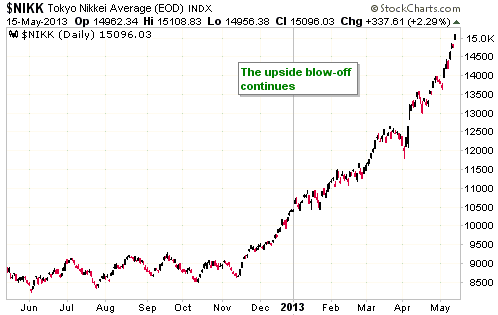
The following daily chart of Japan's Nikkei225 Index illustrates
a story that has played out numerous times over the past 14 years. Central-bank
efforts to 'reflate' an economy or ameliorate a financial-system problem create
an investment bubble, thus sowing the seeds of a collapse and the next major
problem that will 'require' a central-bank solution. We know how the story ends,
we just don't know when.
Gold and the Dollar
Gold
Last Friday's price action left some doubt as to whether or not gold had broken
out to the downside from its 2-week range. This doubt was removed on Monday.
After ending last week in the mid-$1440s, gold traded as low as $1386 on
Wednesday 15th May. As we write it is trading at $1390.
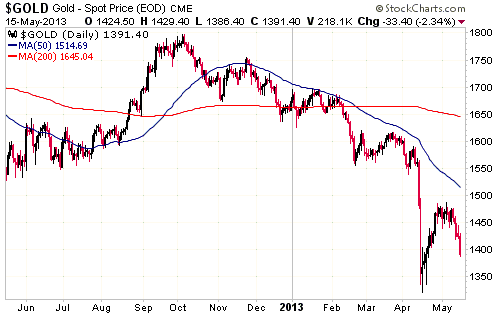
A test of the mid-April low has seemed likely, with the main question being
whether the test would occur sooner (May) or later (October-November). It's
possible that we will get a test of the April low sooner as well as later (that
is, a test within the next few days and another test during the final quarter of
the year), with the two tests of the low separated by a 1-3 month rally.
However, at least one test of the low is highly probable, meaning that if gold
reverses upward over the days immediately ahead without first dropping as far as
the low-to-mid $1300s then a pullback to this price area will probably happen
later in the year.
Gold will probably trade a bit lower, either immediately or a few months from
now, but long-term indicators are screaming that purchases made near the current
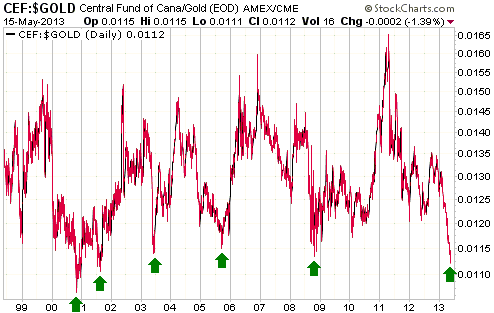
price will end up looking very smart. As evidence we present that following
chart of the CEF/gold ratio (the unit price of the Central Fund of Canada
divided by the gold price). As discussed in the past, CEF/gold is an effective
long-term sentiment indicator because a) CEF holds gold and silver in roughly
equal dollar amounts, b) as a closed-end fund CEF will trade at a premium or
discount depending on the public's level of enthusiasm for precious metals, c)
when the public is very bullish on the PMs the silver/gold ratio will be high
and CEF will likely trade at a sizeable premium to its NAV, leading to a high
CEF/gold ratio, and d) when the public is bearish or disinterested in PMs the
silver/gold ratio will be low and CEF will likely trade at a discount to its NAV,
leading to a low CEF/gold ratio.
Including the current signal, over the past 13 years the CEF/gold ratio has
generated only 6 clear-cut buy signals. The times when the first 5 signals
happened would feature prominently in a list of the best times to buy gold (and
silver). It probably won't be different this time.
Gold Stocks
The HUI has just fallen for five days in a row and made a marginal new low for
the year on Wednesday 15th May. This creates the ideal set-up due to the
tendency for important gold-sector turning points to occur during the month of
May. By the way, the 2012 low was on 15th May, so at this stage the 2013 bottom
has occurred on the anniversary of the 2012 bottom.
Long-term speculators should be buying this weakness provided that they have
sufficient spare financial capacity. Another way of saying this is that
long-term speculators should be buying IF they can do so while maintaining a
comfortable cash cushion. Nobody should be buying gold stocks on margin.
However, for short-term speculators and for long-term speculators who don't like
trying to catch falling knives (most people don't) it would make sense to
postpone any buying until after the HUI has its next significant (>3%) up day.
Positions could then be purchased in liquid gold-stock ETFs such as GDX, GDXJ or
GLDX with risk managed by placing initial sell-stops just below the intra-day
low to date.
We can explain (and have explained) why the long-term bull markets in gold and
gold stocks are almost certainly not over, but right now these bullish long-term
views don't matter. They don't matter because even if gold and gold stocks
commenced long-term bear markets in 2011 there would now be an uncommonly good
opportunity to make money by scaling into the gold-mining sector. Long-term bull
market or long-term bear market, extremes such as we have right now usually lead
to strong multi-month rallies.
Currency Market Update
The Australian Dollar (A$) has been grossly over-valued for years, but prior to
the past two weeks it refused to buckle. It has just buckled, having fallen for
8 days in a row and on 10 of the past 11 days. It is now within spitting
distance of support at 98. Support actually extends from 98 down to 96.
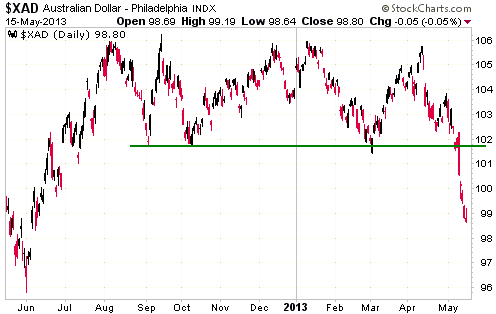
The A$'s recent weakness is consistent with its relative over-valuation, but it
has occurred at a strange time. Our expectation was that the A$ would become
very weak during the next intermediate-term stock market decline, but the A$'s
recent breakdown occurred in parallel with stock market strength.
The A$'s recent divergence from the stock market could be part of a broader
change in the relationship between the stock and currency markets (the US$ has
usually trended in the opposite direction to the stock market over the past
several years), but at this time we aren't prepared to make that call. Until
proven otherwise we are going to assume that the positive correlation of the
past 3.5 months between the stock market and the US$ is a temporary divergence.
The following chart comparison of the euro and the SPX illustrates why we don't
think that a change in the currency-equity relationship has been confirmed at
this time and what would be required to confirm such a change. The chart shows
that although the euro has pulled back quite sharply since early February while
the SPX has continued to trend upward, the euro is still well above its
July-2012 low and hasn't yet breached important support. There is some support
near Wednesday's low (128.5), but the key support lies at 127. A solid break
below 127 in parallel with the combination of continued strength in the stock
market and rising economic optimism would mean that our currency-market outlook
was right for the wrong reason. We expect the euro to eventually break below 127
on its way to a much lower level, but we expect it to do so in response to stock
market weakness and/or the resumption of the euro-zone's debt/banking crisis.

Update
on Stock Selections
Notes: 1) To review the complete list of current TSI stock selections, logon at
http://www.speculative-investor.com/new/market_logon.asp
and then click on "Stock Selections" in the menu. When at the Stock
Selections page, click on a stock's symbol to bring-up an archive of
our comments on the stock in question. 2) The Small Stock Watch List is
located at http://www.speculative-investor.com/new/smallstockwatch.html
 Asanko
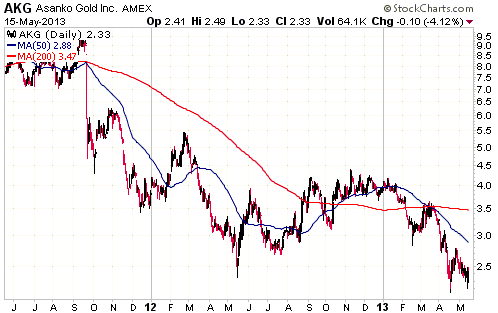
Gold (NYSE & TSX: AKG). Shares: 85M issued, 102M fully diluted. Recent price:
US$2.33 Asanko
Gold (NYSE & TSX: AKG). Shares: 85M issued, 102M fully diluted. Recent price:
US$2.33
AKG reported the results of the PFS for its Esaase project in Ghana. The PFS
indicates good economics, although not quite as good as we expected. The initial
capex was 10% higher than we were expecting and the net present value (NPV) was
less than we thought it would be. However, as discussed below there is scope to
improve the NPV.
The salient PFS details are set out in the following table.
|
|
Asanko Gold (AKG) |
|
Project Name |
Esaase |
|
Location |
Ghana, West Africa |
|
Engineering Study / Date |
PFS |
|
Planned Mine Type |
Open Pit |
|
M&I Resource (oz) |
3.83M |
|
Avg Resource Grade |
1.7 g/t |
|
P&P Reserve (oz) |
2.4M |
|
Metallurgical Recovery |
92% |
|
Strip Ratio |
4.3:1 |
|
Avg Annual Production (oz) |
200K |
|
Cash Cost (per oz) |
$736 |
|
All-In Cost (per oz) |
$990 |
|
Mine Life |
10 years |
|
Initial Capital Cost ($M) |
286 |
|
Assumed Gold Price (US$) |
1400 |
|
Post-Tax NPV(5%) ($M) |
355 |
|
IRR |
23.2% |
|
Project Ownership Percent |
90% |
|
NPV of Company Stake ($M) |
320 |
|
Current Stock Price (US$) |
2.33 |
|
Share Count (M) |
85 |
|
Current Market Cap ($M) |
198 |
|
Net Cash ($M) |
195 |
|
Current Enterprise Value ($M) |
3 |
|
EV/NPV |
1% |
|
Current Discount to NPV |
99% |
|
EV + Capital Cost (EVCC) |
289 |
|
EVCC/NPV |
0.90 |
As discussed in the past, an EVCC/NPV ratio (the
last row of the table) of 1 or lower suggests an economically-robust project
being offered at an attractive price. At AKG's current stock price the ratio is
0.90, so this requirement is met. Furthermore, there is a good chance that the
project's NPV can be significantly increased while leaving the initial capital
cost (CC) the same, thus reducing the EVCC/NPV ratio to an even more attractive
level and providing more scope for share price appreciation.
Lengthening the life of the mine is the key to boosting the NPV, and the key to
lengthening the life of the mine is incorporating more of the M&I resource into
the mine plan. Currently, only 2.4M ounces of the 4.4M-ounce M&I resource are
included in the mine plan. AKG and its consultants believe that there is an
opportunity to include more of the resource. This opportunity will be
investigated as part of the FS, which is scheduled to be completed in Q4-2013.
AKG is one of the top candidates for new buying in the gold sector. It is
currently trading at only slightly more than the value of its cash.
Revamping the
Small Stocks Watch List (SSWL)
The SSWL was created as a way of highlighting stocks that were too
small and/or too illiquid to be included in the TSI Stocks List, but
appeared to have substantial upside potential and could be of
interest to risk-tolerant speculators capable of doing their own
company research. Unfortunately, it was created at the worst
possible time -- in early-2011, at the start of a 2-3 year bear
market in the types of stocks it was designed to contain.
As long as the cyclical bear market in highly speculative resource
stocks continues, most of these stocks that would ordinarily have
speculative merit are going to struggle. We are therefore going to
officially put the SSWL on the backburner (it has unofficially been
on the backburner since October-2012, which is when it was last
updated) until early signs emerge of a new cyclical bull market.
Also, we have scaled down the SSWL from its previous five stocks to
just two stocks, by removing four stocks and adding one stock.
Specifically, we have a) removed First Mexican Gold (FMG.V), Geomega
Resources (GMA.V), Prophecy Coal (PCY.V) and Tigris Uranium (TU.V),
each of which is interesting in its own way but unlikely to do much
until well after the overall market environment improves, b)
retained Frontier Rare Earths (FRO.TO) due to its potential to do
well even if the market environment remains difficult, and c) added
Roxgold (ROG.V) for the same reason.
ROG.V came to our attention two weeks ago due to a mention of the
company by Brent Cook in his
Exploration Insights
newsletter. It has 158M shares outstanding and about $15M of
cash in the bank, giving it an enterprise value of around $67M at
Wednesday's closing price of C$0.52. This is not cheap considering
that the company's flagship Yaramoka project in Burkina Faso has an
Indicated resource of only 680K ounces. What makes ROG an
interesting speculation is the combination of the grade, depth and
metallurgy of the resource. The average grade is very high
(15.7-g/t), metallurgical testing has achieved an excellent gold
recovery of 98% via a conventional gravity/CIL circuit, and the bulk
of the resource is close enough to the surface to be extracted via
an open pit. This means that despite the small size of the resource,
there is a better-than-average chance that it will be developed into
a lucrative mining operation.
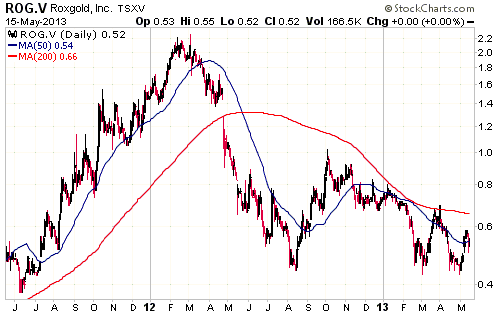
Chart Sources
Charts appearing in today's commentary
are courtesy of:
http://stockcharts.com/index.html

|









