|
- Interim Update 15th September 2010
Copyright
Reminder
The commentaries that appear at TSI
may not be distributed, in full or in part, without our written permission.
In particular, please note that the posting of extracts from TSI commentaries
at other web sites or providing links to TSI commentaries at other web
sites (for example, at discussion boards) without our written permission
is prohibited.
We reserve the right to immediately
terminate the subscription of any TSI subscriber who distributes the TSI
commentaries without our written permission.
The Stock Market
Stock
markets around the world gapped higher on Monday, partly in response to
the new bank capital requirements proposed by a gaggle of central
bankers. The proposed new legislation, known as Basel III, would
increase banks' capital requirements from 2% to 7% of risk-bearing
assets, but the 'kicker' is that the new requirements would be phased
in over nine years. In other words, the agreement just hashed-out by
senior central bankers would effectively ensure that banks had all the
time in the world to boost their capital to the stipulated level (in a
financial world where profits are scalped by robots in fractions of a
second, nine years is like the time from now until the Sun runs out of
fuel). This, naturally, was taken as an excuse to celebrate.
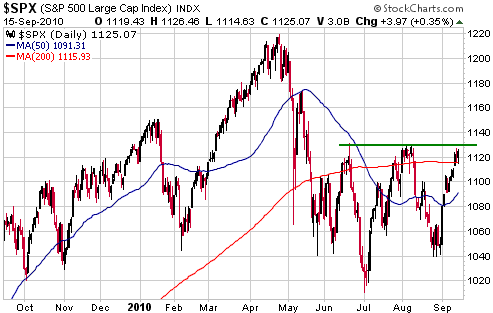
The stock market has reached an interesting juncture. On the positive
side of the ledger, the S&P500 Index has moved up to the vicinity
of its May and August highs, which, because triple tops are rare,
improves its chances of breaking out to the upside and testing its
April high at some point over the next few months.
Also on the positive
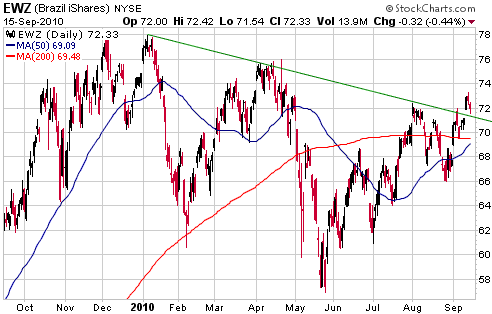
side of the ledger, the Brazil ETF (EWZ) has moved above trend-line
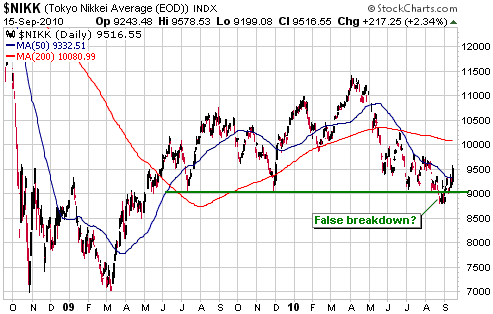
resistance and Japan's Nikkei225 Index has done enough to suggest that
the recent break below support at 9000 was a 'head fake'. Refer to the
following daily charts for details.
However, most stock
markets around the world are now very 'overbought' on a short-term
basis as the US stock market prepares to enter the most bearish 2-week
period of the Presidential Cycle's second year. The following chart
shows where we now are in relation to the Presidential Cycle Model.
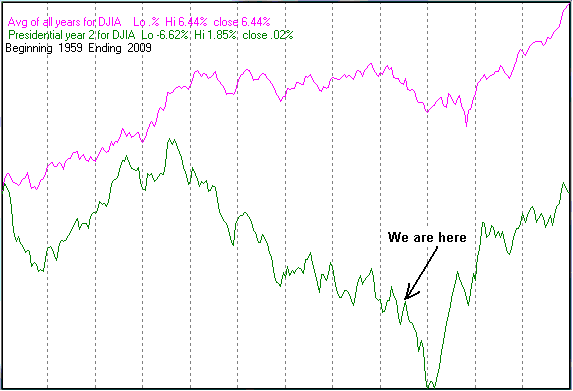
Our guess is that
most stock indices will be higher in three months time than they are
today, but that there will be some interesting downside over the next
2-3 weeks. We aren't inclined to trade the potential downside, but we
will be inclined to 'go long' for a trade in early October if there is
a sizeable pullback between now and then.
Gold and
the Dollar
Gold
'X' reasons to be bullish on gold
Be wary of articles that list the reasons to be bullish, and ONLY the
reasons to be bullish, on any investment. The gold piece linked HERE
is a good example. Articles such as this create the impression that a
valid bearish case doesn't exist, and, therefore, that upward is the
only possible future direction for the price. However, in reality there
is always a valid bearish case. That's why there are smart people on
both sides of the fence.
Before we state the bearish case for gold we'll very briefly address
the nine bullish arguments mentioned in the above-linked article. Of
these arguments, only the first (global fiscal and monetary profligacy)
constitutes an important fundamental driver of the gold price. The
second argument (global imbalances) is not important in its own right
because it is really just an inevitable offshoot of the first. The
fifth argument (the argument that gold is not in a bubble) suggests
that there is a lot of additional upside potential, but the fact that
an investment is not in a bubble is not a good reason, in and of
itself, to be bullish. Argument 7 relates to the change in investment
demand, which is always critical in both bull and bear markets for
gold. However, due to the way this argument is phrased it is clear that
the author doesn't understand the gold supply/demand equation. Gold
supply is the total aboveground stock (about 150,000 tonnes), which
increases by such a small amount each year that it can be considered
constant. For all intents and purposes the change in gold demand is
therefore the sole determinant of the gold price, and investment demand
is at least 50 times more important than any other component of demand.
Moreover, the change in investment demand cannot be quantified except
by reference to the change in price. In particular, if the gold price
rises during a quarter then we know that the investment demand for gold
must have risen during that quarter, and if the gold price falls during
a quarter then we know that the investment demand for gold must have
fallen during that quarter. The other "bullish" arguments mentioned in
the article (excessive FX reserves, CB attitudes to gold, flat mine
supply, the commodity price cycle, the geopolitical environment) are
mostly irrelevant.
So, what are the valid gold-bearish arguments that were omitted from the above-linked article?
There are two that we can think of. We assign a low probability to each of them, but we can't rule either of them out.
The gold-bearish scenario/argument with the lowest probability revolves
around the possibility that a multi-year period of strong REAL economic
growth is about to commence. The investment demand for gold has
increased markedly over the past three years as the weaknesses in the
economic structure have become more apparent, and would almost
certainly decrease if it seemed as if these weaknesses had been
effectively addressed.
The gold-bearish argument with a higher -- although still low, in our
opinion --probability revolves around the possibility that central
banks will be unable or unwilling to prevent a substantial decline in
the money supply in response to continued private sector de-leveraging.
Current Market Situation
The gold market made a new all-time high during the first half of this
week, but this just made it a little more 'overbought' than it already
was. A multi-week pullback is needed to create a relatively low-risk
short-term buying opportunity.
Our impression is that a few weeks ago the financial world began to
discount the next round of "quantitative easing" (QE2). This has led to
additional strength in the gold market, but, of greater significance,
it has led to impressive strength in silver relative to gold and to
some dramatic strength within the ranks of junior gold/silver mining
equities. In a nutshell: it has prompted a shift towards risk.
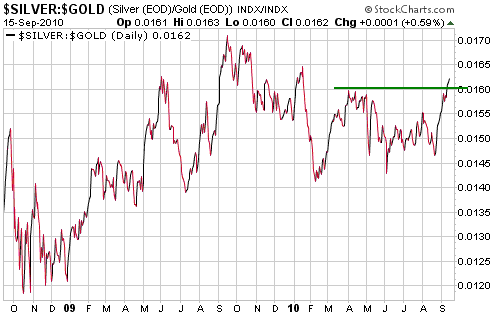
The following chart shows that the general shift towards risk (away
from safety) has been confirmed by an end to the year-long sequence of
declining tops in the silver/gold ratio. This week's upside breakout in
the silver/gold ratio suggests that any stock market decline over the
weeks ahead will be 'contained'.
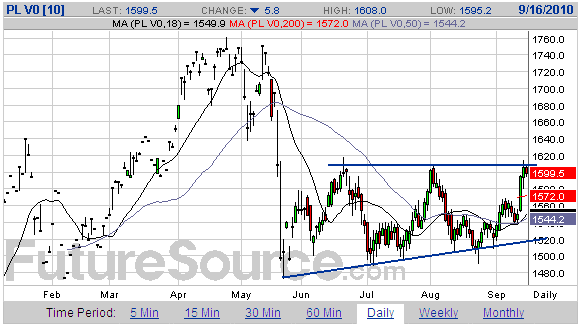
We mentioned during
August that platinum was the 'weak link' in the precious metals sector
due to its precarious chart pattern, and that there wouldn't be much
downside risk in gold or silver until/unless the weak link broke
(through support). The following daily chart shows that October
platinum held support during August and has since rebounded to
resistance.
Platinum's performance since the beginning of this year looks
remarkably like that of the S&P500 over the same period. Both are
likely to experience downward corrections before rising to new
multi-month highs.
Gold Stocks
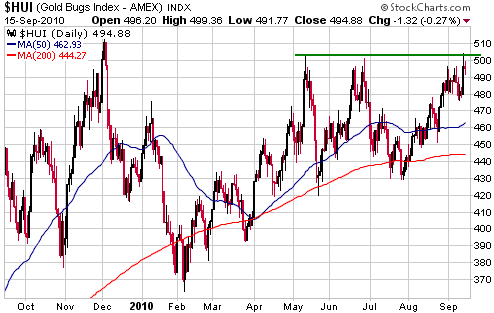
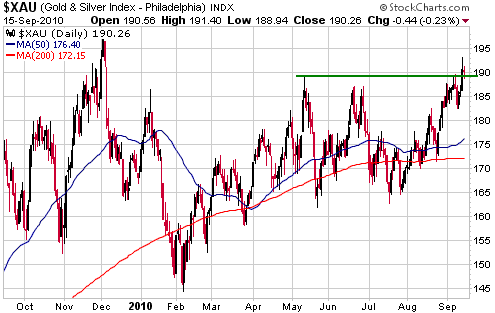
Below are daily charts of the HUI and the XAU. We are including charts
of both of these gold-stock indices because the XAU has broken above
the highs made earlier this year, but the HUI hasn't yet managed to do
so. Ideally, the HUI will follow the XAU to a new high for the year
within the next few days.
If the HUI is able to make a new high for the year within the next few
days it will indicate that the short-term upward trend will likely
persist until November, albeit with a pullback to the vicinity of the
50-day moving average at some point along the way.
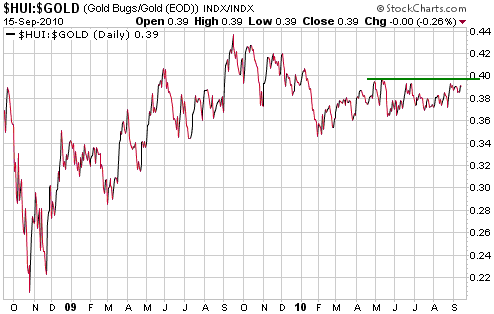
If there is going to
be a multi-month extension to the gold sector's current upward trend,
then as well as breaking to a new high for the year in nominal dollar
terms the HUI should soon also break out to the upside in gold terms
(the HUI/gold ratio should move above the resistance drawn on the
following chart).
The junior
gold/silver stocks have begun to party as if it were 2006. There will
no doubt be sharp corrections from time to time as stocks that have run
up a long way succumb to bouts of profit taking, but in all likelihood
the party has at least a few months to go and, if history is any guide,
will become more riotous before it ends. This is the sort of
environment where a lot of money can be made quickly without taking
additional risk -- by gradually scaling back on stocks that 'go
vertical' and deploying the proceeds of these scaling-back operations
in stocks that haven't yet taken off.
Currency Market Update
Japanese monetary authorities intervened in the currency market on
Wednesday in an effort to halt the Yen's rise. These efforts met with
some initial success in that the Yen fell 3% against the US$ in
response to the intervention. 3% is a rounding error for a junior
resource stock, but a big single-day move for a major currency.
The ability of a central bank to devalue/depreciate its currency should
never be under-estimated, because a central bank has a virtually
unlimited ability to increase the supply of its currency. Therefore, a
commitment to a weaker Yen on the part of the Bank of Japan (BOJ)
should not be taken lightly. However, it's possible that the BOJ's
moves to weaken the Yen will be countermanded by the Fed's moves to
weaken the US$ and the ECB's moves to weaken the euro, especially
considering that the Fed and the ECB have, in the past, proven to be
far more proficient than the BOJ at currency inflation (the main reason
that the Yen has been a persistently strong currency over the past
decade, despite having the lowest nominal interest rate, is that its
rate of supply growth has been relatively slow).
At the moment there are rumours that the Fed will soon act to expand
the supply of dollars, but the Fed hasn't yet acted. If the Fed 'sits
on the fence' for a few more months then the BOJ's actions could be
effective.
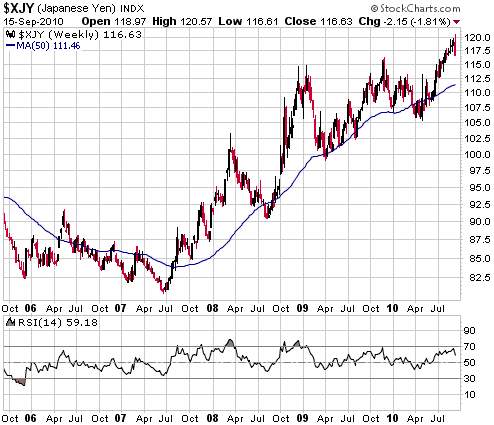
The following weekly chart shows that multi-month Yen corrections over
the past three years have ended at, or just below, the 50-week moving
average. A similar correction over the next three months would take the
Yen down to around 111 and potentially create an opportunity to buy the
Yen for an intermediate-term trade.
Update
on Stock Selections
(Notes: 1) To review the complete list of current TSI stock selections, logon at http://www.speculative-investor.com/new/market_logon.asp
and then click on "Stock Selections" in the menu. When at the Stock
Selections page, click on a stock's symbol to bring-up an archive of
our comments on the stock in question. 2) The Small Stock Watch List is
located at http://www.speculative-investor.com/new/smallstockwatch.html)
 Trading position and core position Trading position and core position
Items 2 to 11 in the article posted HERE
echo what we've been saying for the past 10 years (most recently under
the heading "Profit Taking" in the latest Weekly Update).
If you maintain a substantial core position throughout a secular bull
market then you simply cannot miss a short- or intermediate-term rally,
even if you don't see the rally coming. On the other hand, if you are
always 100% invested -- that is, if your core position is your total
position -- then you will likely oscillate between agony and ecstasy,
and run the risk of 'throwing in the towel' during a severe correction.
Also, having not become attuned to scaling in and out in response to
shorter-term shifts in the financial winds, you probably won't be
prepared to exit when the secular bullish trend eventually ends.
By the way, we disagree with many of the comments in the second half of the above-linked article.
As per the email
sent to subscribers early this week, Endeavour Mining (TSX: EDV) and
Crew Gold have been removed from the TSI Stocks List at profits of 62%
and 5%, respectively.
First Majestic Silver (TSX: FR). Shares: 93M issued, 108M fully diluted. Recent price: C$5.86
We noted last month that FR's break above resistance at C$4.50 would
create a short-term chart-based target of C$6.00, and that a stock
price of C$6.00 would represent full value for the company assuming a
silver price of $18-$20. FR closed at C$5.86 on Wednesday and has
therefore almost reached our estimate of full value. We are therefore
going to remove this long-term position from the TSI Stocks List at a
profit of 313% (based on our 2004 entry price of C$1.42).
We will consider returning FR to the Stocks List if it pulls back to
the mid-C$4 area within the next few weeks, although if it does return
it will more likely be as a short-term trade than as a long-term
holding.
Current gold/silver candidates for buying and profit-taking
The following TSI gold/silver stocks are candidates for new buying near current prices:
CFO.V, DOM.AX, GOZ.TO, JAG, NXG, PEZ.TO
Note: For speculators who don't mind dealing in small exploration-stage
mining stocks, near its current price of C$4.25 we think that CFO.V
(Clifton Star) offers the best risk/reward in the market at this time.
The following TSI gold/silver stocks are candidates for partial profit taking at this time:
FVI.TO, GQM.TO, KGN, ORV.TO, SBB.TO
The remaining stocks are neither short-term buys nor short-term sells.
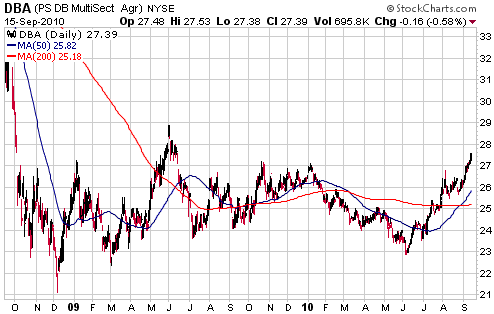
Agriculture ETF (NYSE: DBA). Recent price: US$27.39
We are going to tighten the trailing stop on our DBA trade from 10% to
5%. The stop is based on daily closing prices, meaning that we will
exit if DBA closes more than 5% below its highest trade-to-date closing
price. The current closing high is Tuesday's US$27.55, so the current
stop is a daily close below US$26.17.
Note that although we are treating DBA is a short-term trade, it would
be reasonable to maintain a core position in this ETF. We suspect that
the rally since the June-2010 low will turn out to be the first leg of
a new cyclical bull market.
Chart Sources
Charts appearing in today's commentary
are courtesy of:
http://stockcharts.com/index.html
http://www.futuresource.com/

|