|
- Interim Update
15th October 2014
Copyright
Reminder
The commentaries that appear at TSI
may not be distributed, in full or in part, without our written permission.
In particular, please note that the posting of extracts from TSI commentaries
at other web sites or providing links to TSI commentaries at other web
sites (for example, at discussion boards) without our written permission
is prohibited.
We reserve the right to immediately
terminate the subscription of any TSI subscriber who distributes the TSI
commentaries without our written permission.
Why
leveraged ETFs are only suitable for short-term trades
This is a topic we've covered in the past, but it is worth
revisiting due to the growing popularity of ETFs that are designed
to move each day by 2 or 3 times the amount of a target index. The
point we want to make is that leveraged ETFs should only ever be
used as short-term trading vehicles. The reason is that they tend to
leak value over time. This is not a design flaw; it's just something
that anyone who trades these ETFs should be well aware of.
The critical issue is that leveraged ETFs are designed to move by 2
or 3 times the DAILY percentage changes of the target indexes. They
are NOT designed to move by 2 or 3 times the percentage change of
the target indexes over periods of longer than one day. Due to the
effects of compounding, their percentage changes over periods of
much longer than one day will usually be less -- and sometimes
substantially less -- than 2-times (in the case of a 2X ETF) or
3-times (in the case of a 3X ETF) the percentage changes in the
target indexes. For example, if you believe that the S&P500 Index is
going to fall by 30% over the coming 12 months and to profit from
this expected decline you purchase SDS, an ETF designed to move each
day by 2-times the inverse of the SPX's percentage change, then you
will probably not make a 60% profit on this trade even if you turn
out to be totally correct about the SPX's performance. Instead, the
amount of profit you make will be determined by the path taken by
the SPX on its way to the 30% loss and will probably be a lot less
than 60%.
The easiest way for us to explain how the relationship between the
daily percentage change of an index and the daily percentage change
of an associated leveraged ETF does not translate into a similar
relationship over periods of longer than one day, is via some
hypothetical examples that show how the math works. Here we go.
In the tables presented below, Index A is the target index (the
index for which leveraged exposure is created) and 100 is the
starting (Day 0) value for both the index and the associated
leveraged ETF. We then move the index up on one day and down by the
same amount on the next day, such that by Day 6 it is still at 100.
In our first table, Index A alternately moves up by 10 points and
down by 10 points, ending Day 6 back where it started (at 100). The
final column in this table shows the value of an ETF designed to
move each day by twice the percentage change of Index A. Even though
Index A ended the 6-day period unchanged, the 2X ETF based on Index
A ended the period with a loss of 5.4%.
| |
Index A $ Value |
Index A $ change |
Index A % change |
2X ETF % change |
2X ETF $ Value |
|
Day 0 |
100.0 |
0.0 |
0.0 |
0.0 |
100.0 |
|
Day 1 |
110.0 |
10.0 |
10.0 |
20.0 |
120.0 |
|
Day 2 |
100.0 |
-10.0 |
-9.1 |
-18.2 |
98.2 |
|
Day 3 |
110.0 |
10.0 |
10.0 |
20.0 |
117.8 |
|
Day 4 |
100.0 |
-10.0 |
-9.1 |
-18.2 |
96.4 |
|
Day 5 |
110.0 |
10.0 |
10.0 |
20.0 |
115.7 |
|
Day 6 |
100.0 |
-10.0 |
-9.1 |
-18.2 |
94.6 |
In our second table we ramp up the volatility.
Instead of Index A alternately moving up and down by 10 points it experiences
20-point daily swings, but still ends Day 6 back where it started (at 100). Even
though Index A ended the 6-day period unchanged, in this case the 2X ETF based
on Index A ended the period with a loss of 18.7%.
| |
Index A $ Value |
Index A $ change |
Index A % change |
2X ETF % change |
2X ETF $ Value |
|
Day 0 |
100.0 |
0.0 |
0.0 |
0.0 |
100.0 |
|
Day 1 |
120.0 |
20.0 |
20.0 |
40.0 |
140.0 |
|
Day 2 |
100.0 |
-20.0 |
-16.7 |
-33.3 |
93.3 |
|
Day 3 |
120.0 |
20.0 |
20.0 |
40.0 |
130.7 |
|
Day 4 |
100.0 |
-20.0 |
-16.7 |
-33.3 |
87.1 |
|
Day 5 |
120.0 |
20.0 |
20.0 |
40.0 |
122.0 |
|
Day 6 |
100.0 |
-20.0 |
-16.7 |
-33.3 |
81.3 |
In our third and final table we go back to the
10-point daily swings, but change the leverage to 3-times. In this case, the
unchanged result for the index was accompanied by a loss of 15.5% for the
leveraged ETF.
| |
Index A $ Value |
Index A $ change |
Index A % change |
3X ETF % change |
3X ETF $ Value |
|
Day 0 |
100.0 |
0.0 |
0.0 |
0.0 |
100.0 |
|
Day 1 |
110.0 |
10.0 |
10.0 |
30.0 |
130.0 |
|
Day 2 |
100.0 |
-10.0 |
-9.1 |
-27.3 |
94.5 |
|
Day 3 |
110.0 |
10.0 |
10.0 |
30.0 |
122.9 |
|
Day 4 |
100.0 |
-10.0 |
-9.1 |
-27.3 |
89.4 |
|
Day 5 |
110.0 |
10.0 |
10.0 |
30.0 |
116.2 |
|
Day 6 |
100.0 |
-10.0 |
-9.1 |
-27.3 |
84.5 |
An implication of the above is that the greater
the volatility of an index and the greater the leverage provided by an ETF
linked to the index, the worse the likely performance of the leveraged ETF over
extended periods. The worse, that is, relative to the performance superficially
implied by the daily percentage change relationship between the index and the
leveraged ETF. So, it is fair to say that leveraged ETFs are only suitable for
short-term trades and that a trade should be very short-term if it involves a 3X
ETF and/or a volatile market.
The final point we'll make is that it is possible to take advantage of the value
leakage inherent in the design of leveraged ETFs by shorting them rather than
buying them. For example, if you want to use a leveraged ETF to profit from an
expected decline in the S&P500 Index, you will generally be better served by
going short SSO (ProShares Ultra S&P500 Fund) than by going long SDS (ProShares
Ultra Short S&P500 Fund). For another example, if you want to use a leveraged
ETF to profit from an expected rise in junior gold-mining stocks and you plan to
hold the position for more than a few weeks, you will generally be better served
by going short JDST (Junior Gold Miners Index Bear 3X) than by going long JNUG
(Junior Gold Miners Index Bull 3X).
T-Bond Update
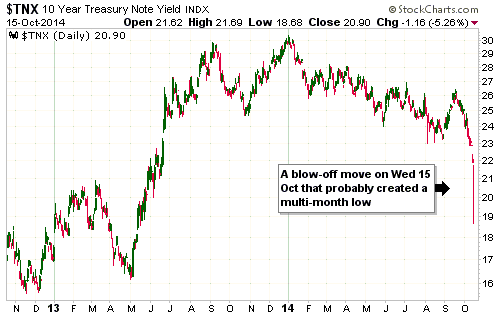
This week's mini-panic in the stock market caused
a surge in demand for US Treasury securities. As illustrated by the following
chart, this led to a big downward spike in the 10-year T-Note yield to an
intra-day low of 1.87% on Wednesday.
We suspect that this price action created a multi-month bottom for the 10-year
T-Note yield and multi-month tops for the 10-year T-Note price and the iShares
20+ Year Treasury Bond ETF (TLT).
 The Stock Market
From the email sent to TSI subscribers after the close of
trading on Monday:
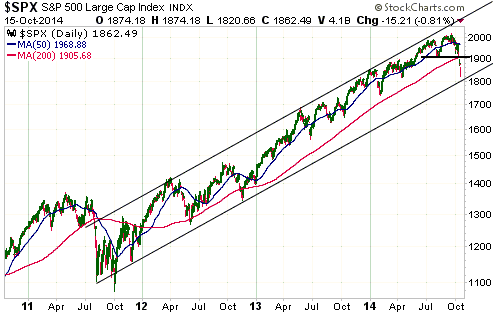
"The S&P500 Index (SPX) broke below short-term support at 1900 on Monday 13th
October and has closed below its 200-day MA for the first time since November of
2012. This brings to an end one of the longest periods ever without an SPX
decline to its 200-day MA.
We think that 1800 (or thereabouts) is a realistic target for a short-term SPX
bottom. We'll explain why in this week's Interim Update. Assuming this target is
valid it could be reached within the coming five trading days, but considering
the extent to which the market is now stretched to the downside it could also be
reached following an intervening 2-4 week rebound or consolidation.
For your information, our own account has a bearish speculation in the form of
SSO (ProShares Ultra S&P500) January-2015 put options. We began averaging into
this position way back in May (horrible timing) and added the final chunk in
early-September. Thanks to Monday's sharp decline in SSO, an above-the-market
sell order was filled on part of our put-option position. Our plan is to exit
the balance if the SPX declines to the low-1800s this week and to purchase
longer-dated put options following a multi-week rebound from whatever low is
made in the near future."
The SPX closed at 1875 on Monday and extended its decline on Wednesday, trading
as low as 1820 before recouping some of its losses. This means that the
"realistic target" for a short-term SPX bottom was almost reached on Wednesday.
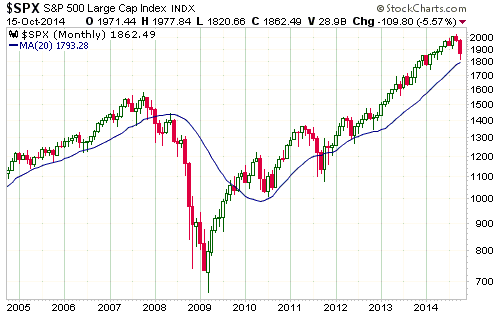
The 1800 (+/- a percent or so) short-term target is suggested by the following
two charts, the first of which is daily and the second of which is monthly. The
daily chart shows that having broken below lateral support and the 200-day MA at
around 1900, the next logical support level was the bottom of a channel dating
back to the 2011 bottom. The bottom of this channel is near 1800. The monthly
chart shows that the 20-month MA is now just below 1800. Over the past 10 years,
correction lows in the SPX have regularly occurred near the 20-month MA. The
reason this MA hasn't been reached since 2012 is that there hasn't, until now,
been a decline worthy of the name "correction" since 2012.
By the way, consecutive monthly closes below the 20-month MA would be a clear
warning that a bear market had begun. If this were to happen it would suggest
that instead of acting as support during a downward correction, the 20-month MA
would become a likely target for the high of a corrective rebound.
The US stock market is now very stretched to the downside on a short-term basis,
with the VIX having hit an intra-day high of 31 on Wednesday 15th October. Also,
having diverged bearishly in a big way prior to this week, the Russell2000
Small-Cap Index (RUT) has diverged bullish over the past three days and has just
reversed upward after making a new 52-week low. This suggests to us that a
multi-week low has either just been put in place or will be put in place within
the next three trading days.
We think that short-term or leveraged bearish speculations should be exited this
week with the aim of re-positioning following a decent rebound. A rebound would
likely retrace at least 50% of the decline from the September peak.
Gold and the Dollar
Gold
Current Market Situation
In the email sent after the close of trading on Monday we wrote that gold had
done enough to confirm that a short-term bottom was put in place at the
beginning of last week, but that it would encounter strong resistance in the
low-$1240s. The gold price managed to trade above this resistance on Wednesday
15th October in reaction to the mini-panic in the stock market, but as the stock
market rebounded the gold price pulled back and ended the day at resistance.
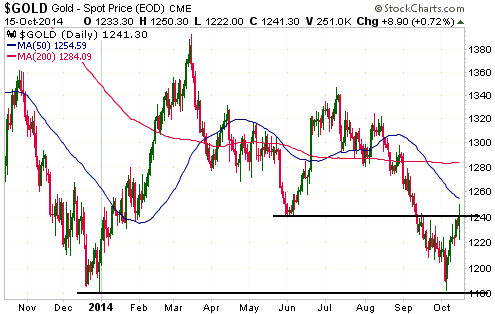
We expect that gold will maintain an upward bias over the next few weeks and at
least make it back to the high-$1200s, but assuming that such a rebound takes
place it will not reduce the probability that gold's 'triple bottom' will be
breached before a multi-year rally gets underway. As far as providing clues
regarding the intermediate-term outlook, silver's near-term price action is
likely to be more informative.
Silver needs to soon get back above $19 to signal that its late-September move
to a new low was the sort of break below obvious support that can mark the end
of a multi-year downward trend.
GLD's Gold Inventory
There has always been an undercurrent of fear, deliberately encouraged in some
quarters, that the SPDR Gold Trust (GLD) does not have all the gold bullion it
is supposed to have. A post earlier this
week at the TSI Blog explains why this fear is unfounded.
Gold Stocks
The gold mining sector, as represented by the HUI, hasn't yet done enough to
signal a short-term bottom, although relative to resistance it is in a similar
position to gold bullion. Since the price lows of early last week, the rebounds
in gold and the HUI have tested resistance defined by the June lows but have
been unable to achieve daily closes above this resistance.
If both gold and the HUI are able to break above the aforementioned resistance
levels, the HUI will be in the stronger position. The reason is that gold's
'triple bottom' will still be pointing to an eventual break to new multi-year
lows, whereas the HUI's chart pattern will entail a potentially more bullish
'double bottom' including a false (quickly reversed) downside breakout as part
of the second bottom. To establish the more bullish pattern the HUI needs to
close above last week's high of 202.2.
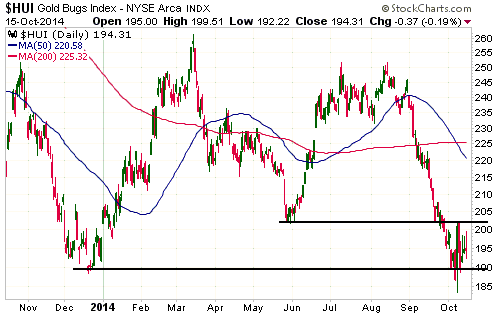
The gold-mining sector hasn't yet signaled a short-term bottom, but, as we noted
in the email sent earlier this week, the increasing 2-way volatility is a sign
that its short-term downward trend is coming to an end.
The Currency Market
Two weeks ago we presented a chart to show that the performance of European
equities relative to US equities explained every important trend in the euro
over the past 10 years. Today we wanted to make the point that relative equity
performance does not work as reliably with other currencies as it works with the
euro. Furthermore, it doesn't work at all with the Yen.
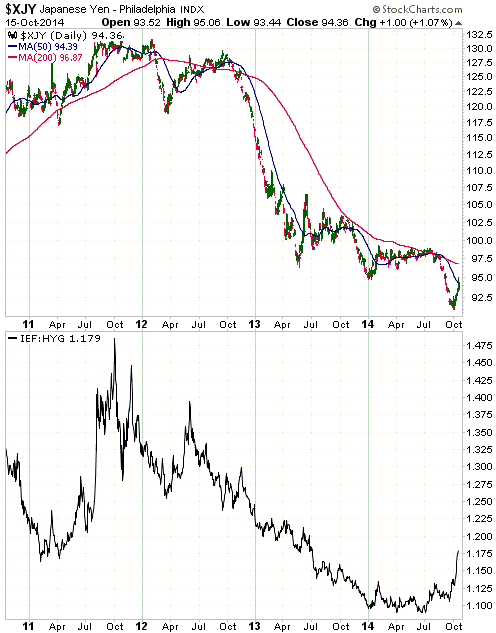
It doesn't seem to matter what Japanese policymakers get up to, in that
regardless of what they do the Yen always seems to trend with global risk
aversion. During periods when risk is 'on', the Yen trends downward. During
periods when risk is 'off', the Yen trends upward.
The Yen's relationship to the general perception of risk is illustrated by the
following chart. In this case we are using the IEF/HYG ratio (7-10 year Treasury
bonds relative to junk bonds) as an indicator of the general perception of risk.
When people become more inclined to take risk, credit spreads become narrower
and the IEF/HYG ratio trends downward. When people become more risk averse,
credit spreads widen and the IEF/HYG ratio trends upward. The Yen therefore
usually trends in the same direction as the IEF/HYG ratio. Most recently, the
sudden increase in risk aversion has been accompanied by an upward reversal in
the Yen.
The Yen will probably be a top-performing currency during the next global equity
bear market.
Updates
on Stock Selections
Notes: 1) To review the complete list of current TSI stock selections, logon at
http://www.speculative-investor.com/new/market_logon.asp
and then click on "Stock Selections" in the menu. When at the Stock
Selections page, click on a stock's symbol to bring-up an archive of
our comments on the stock in question. 2) The Small Stock Watch List is
located at http://www.speculative-investor.com/new/smallstockwatch.html
Chart Sources
Charts appearing in today's commentary
are courtesy of:
http://stockcharts.com/index.html

|









