|
- Interim Update 16th January 2013
Copyright
Reminder
The commentaries that appear at TSI
may not be distributed, in full or in part, without our written permission.
In particular, please note that the posting of extracts from TSI commentaries
at other web sites or providing links to TSI commentaries at other web
sites (for example, at discussion boards) without our written permission
is prohibited.
We reserve the right to immediately
terminate the subscription of any TSI subscriber who distributes the TSI
commentaries without our written permission.
No
Worries
The yield on the 10-year Spanish government bond has been in a
downward trend since last July and is now close to a 52-week low.
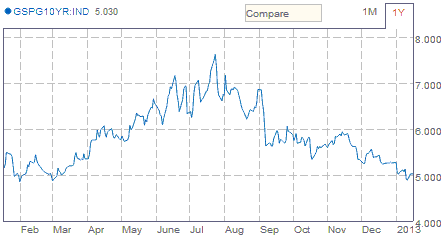
Chart Source: Bloomberg.com
The Expected CPI (the yield on the 10-year T-Note minus the yield on
the 10-year TIPS) moved sharply higher in reaction to the Fed's
"QE3" announcement last September, but it held just below the highs
of the past 5 years and has stabilised since mid-September.
Stabilisation just below the highs suggests a general perception
that the Fed is creating significant "inflation", but not
problematic "inflation".
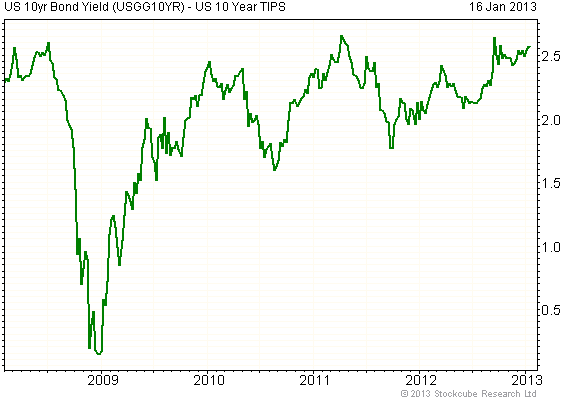
Chart Source: Fullermoney.com
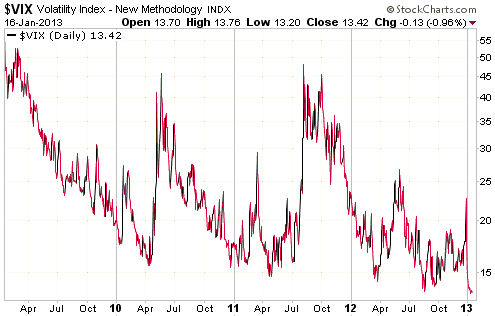
The Volatility Index (VIX) just made a new 4-year low.
Spanish government bond yields at 52-week lows plus inflation
expectations stable at a moderately high level plus the VIX at a
multi-year low equals no worries. The markets are not worried about
debt default in the euro-zone or "inflation" or "deflation" or a
large stock market decline.
The reason that sentiment is a contrary indicator in the financial
markets is that when the crowd becomes convinced that the future is
going to unfold in a particular way and bets accordingly, it changes
the odds such that betting on the popular outlook becomes a losing
proposition.
We don't know what's going to happen over the next few months, but
we do know that inflation expectations are unlikely to remain stable
at a moderately high level. They are far more likely to either break
out to the upside in response to the Fed's money-pumping or fall
sharply in response to fear that economic weakness will push prices
downward despite the Fed's 'best efforts'. Either of these outcomes
would shatter the complacency that currently dominates the financial
landscape. We also know that stock market volatility is unlikely to
remain at such a low level for much longer.
The Stock Market
The earnings outlook
In mid-2012, the average forecast by equity analysts was for S&P500 earnings to
end the year with a 12-month gain of 13%-14%. The final results aren't yet in,
but the actual 2012 earnings growth for the S&P500 will probably be less than
2%. Therefore, it is fair to say that in terms of earnings growth the S&P500 did
much worse during 2012 than it was generally expected to do as recently as 6
months ago. However, the market gained about 5% over the course of the year's
second half.
Anyone who was bullish on the US stock market in mid-2012 or at the beginning of
2012 looks right, but we don't know (or know of) anyone who was bullish on
prices AND predicting a plunge in the rate of earnings growth from double digits
to only slightly above zero. Everyone we know of who was bullish was expecting
at least a moderate rate of earnings growth during 2012.
In the financial markets and in life, dumb luck sometimes beats good analysis.
However, it's dangerous to rely on dumb luck.
Why did the US stock market remain firm during 2012 in the face of the almost
complete evaporation of earnings growth?
We can come up with two plausible answers. First, during the third quarter of
this year it looked like the S&P500 was rolling over into an intermediate-term
decline, but then the anticipation of more money-pumping by the Fed began to
counteract other considerations. The Fed ended up meeting or exceeding the
equity-bulls' expectations, which perhaps created the general impression that
although corporate America was doing much worse than originally expected in 2012
it would do much better during 2013. Second, beginning in the third quarter of
2012 there was a strong rebound in Europe. This rebound also had central bank
money pumping as its primary driver.
In order to keep the S&P500 in an intermediate-term upward trend the monetary
inflation promoted by the world's senior central banks will have to result in
significant earnings growth during 2013. This is not impossible, because
monetary inflation can bring about artificial strength for a while. That's a
large part of why inflation policy remains popular despite its negative
long-term effects. However, it isn't the most likely outcome, because US
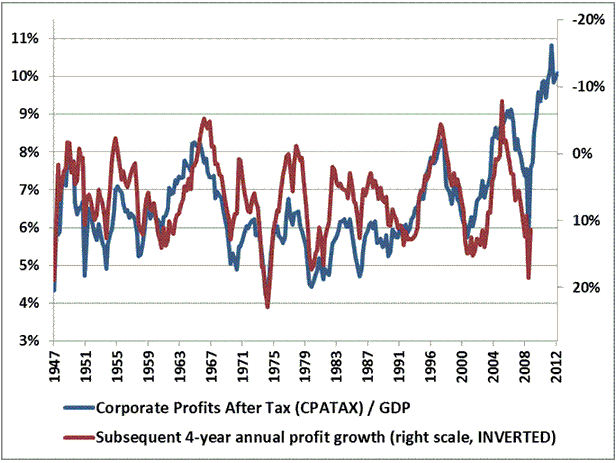
corporate profits are near their highest levels in history as a percentage of
GDP and because the profits/GDP ratio is mean-reverting.
As clearly illustrated by the following chart from John Hussman's latest
Weekly Letter, high
levels of the profits/GDP ratio have always, over the past 65 years, led to a
falling rate of profit growth. The present level of the profits/GDP ratio is
high enough that it points to a significant decline in corporate earnings over
the next few years.
S&P500 profits probably grew by a small single-digit percentage during 2012,
versus the double-digit growth of the preceding year. This is the sort of
slowdown predicted by the historical record.
The historical record suggests that 2013 will have slower earnings growth than
2012. This means that the most likely outcome is for the S&P500's earnings to be
lower during 2013 than they were during 2012. On its own, this isn't necessarily
a reason to be bearish. It's only a reason to be bearish, or at least a reason
to be concerned about substantial downside risk, because the market appears to
be priced for significant earnings growth.
Current Market Situation
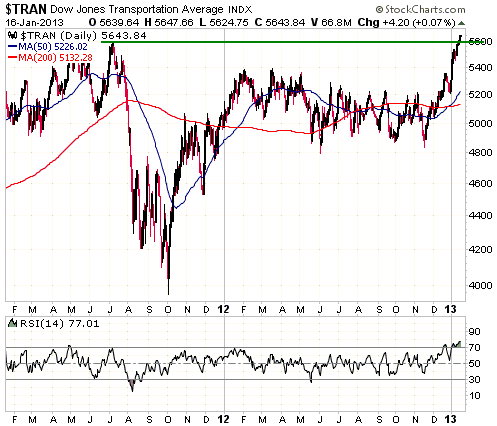
The Dow Transportation Average (TRAN) has just edged above resistance defined by
its 2011 high. This means that TRAN has just made a new all-time high in nominal
dollar terms, although obviously not in real terms.
The TRAN's break to a new all-time high should be viewed as a reward for traders
who were smart enough or lucky enough to turn bullish near the lows of the past
few months, but it isn't a good reason to turn bullish right now. Actually, it
is a good reason to be extra cautious. This is because a) the index is very
'overbought' on a short-term basis, and b) the last three times that the TRAN
broke to a new all-time high (July-2007, May-2008 and July-2011) it was close to
an intermediate-term peak.
Gold and the Dollar
Gold
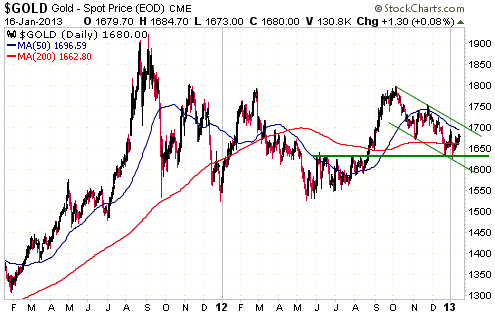
Gold's decline from its September-October high went a little deeper and
continued for longer than we originally thought it would, but the price action
still has the look of a routine correction. Support at around $1630 managed to
hold after being tested twice, and the rate of decline from the early-October
peak of $1800 to the early-January trough of $1626 averages out to only $12
(0.7%) per week. The total peak-to-trough decline was slightly less than 10%.
When considering the future we are always dealing with probabilities,
possibilities and guesses. That is, when considering what will happen there is
always uncertainty. We therefore can't rule out the possibility that support at
$1630 will be breached and that the decline will transmogrify into something of
greater substance. The point is that as things stand today, there doesn't appear
to be anything to suggest that the gold market is experiencing anything more
than a normal correction, albeit a correction that resulted in the market
becoming more 'oversold' than originally seemed likely.
The angst, frustration and disappointment currently evident within the ranks of
gold bulls probably has more to do with gold's failure to react in a very
positive way to the Fed's actions than with gold's price action in isolation. A
slow corrective decline would be easier to handle if not for the increasingly
bullish monetary backdrop.
For an explanation of gold's lacklustre performance in the face of the Fed's
increasingly absurd attempts to stimulate the US economy by raising the supply
of the medium of exchange, look no further than the charts included in the
section of today's report entitled "No Worries". The average market participant
seems to believe that things are under control.
We don't believe that things are under control.
Gold Stocks
Current Market Situation
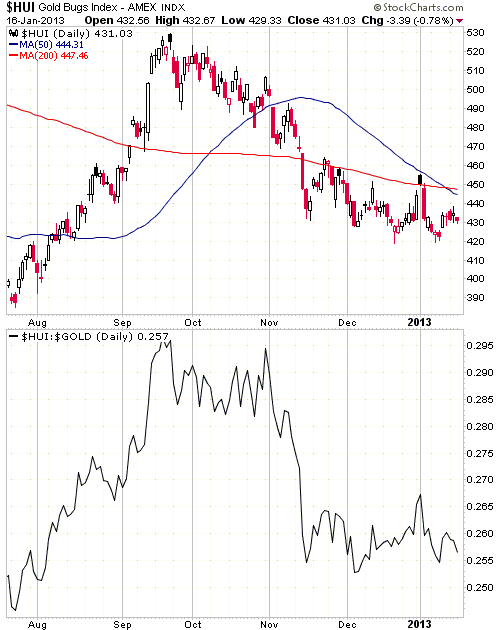
The HUI bottomed at 431 on 16th November. It has since had a slight downward
bias in that it has made two marginal new lows, but it closed at 431 on
Wednesday 16th January. Therefore, if it feels to you as if the gold sector has
been going nowhere, it's because the gold sector has gone nowhere.
Something will have to give in the near future. Probably in the next few days.
The price action should soon tell us whether the sideways trading of both the
HUI and the HUI/gold ratio is a consolidation within a short-term downward trend
or a short-term bottoming pattern. Our guess is that it will turn out to be the
latter, but we are financially and emotionally prepared for the former.
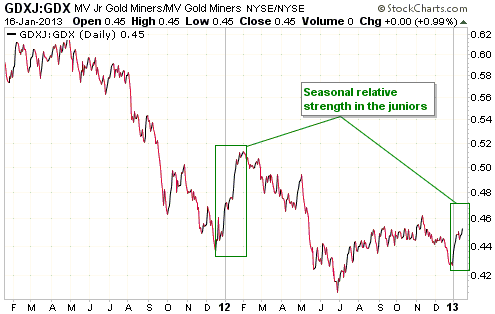
The following chart of the GDXJ/GDX ratio shows how junior gold mining stocks
have performed relative to senior gold mining stocks.
A period of relative strength in the juniors typically begins in late December.
This relative strength tends to extend into the second quarter of the year if
the overall market is strong and come to an end by early February if the overall
market is weak.
The juniors have outperformed over the past few weeks as per the seasonal
pattern. Some additional relative strength is likely.
The all-in cost metric adopted by Goldcorp
Last week Goldcorp (GG) announced that from now on it would be reporting an
"all-in" per-ounce cost for its gold production. As per the practice of almost
all other listed gold miners, GG previously only reported the per-ounce "cash
cost" of its gold production. Although it has become an industry standard over
the past decade, the popular "cash cost" calculation paints an unrealistic
picture of what it costs to mine an ounce of gold. This is because it leaves out
some important contributors to the overall cost of production. For example,
"cash cost" doesn't include sustaining capital (capital expenditures at existing
mines), exploration expenses and G&A expenses.
The difference between the "cash cost" and the "all-in" cost will usually be
substantial. Goldcorp, for example, has estimated that for 2013 its by-product
"cash cost" will be $525-$575 per ounce and its "all-in" cost will be
$1000-$1100 per ounce.
If the new method of cost reporting adopted by Goldcorp is adopted throughout
the gold-mining industry it won't make any difference to informed investors.
Determining the actual, total per-ounce cost of gold production has always been
a straightforward exercise for anyone with basic accounting knowledge and a
willingness to take a few minutes to divide the difference between total revenue
and net profit by the number of ounces produced. It could, however, influence
how government officials think about the taxes imposed on gold-mining companies.
As an example, the parliament of the Ivory Coast, a small West African country
with the potential to experience rapid growth of its gold-mining industry over
the next few years, recently approved a "windfall" profits tax on gold mining.
The plan is for the new tax to be calculated assuming a fixed cost of production
of $615/ounce. Clearly, the government of the Ivory Coast has looked at the huge
difference between the spot price of gold and the "cash costs" reported by most
gold producers and jumped to the conclusion that gold miners are veritable cash
cows that should be milked more aggressively.
If only the average gold producer really was a "cash cow". The reality is that
most of them aren't generating much cash at the current gold price. That's the
main reason the stocks haven't done well.
If reporting an "all-in" cash cost results in some influential politicians
gaining a better understanding of what it really costs to produce an ounce of
gold, it will be a worthwhile thing to do.
Currency Market Update
Market Vane's bullish percentage for the Yen got as low as 17 early this week.
This is one of the lowest readings we have ever seen for a major currency. In
fact, as far as we are aware this is the second-lowest bullish percentage
achieved by any major currency over the past 10 years. The lowest that we know
of was the 13% figure achieved by the US$ near the end of a multi-year decline.
We doubt that the Yen has made or is about to make a major bottom, but a
substantial bear-market rebound is a definite possibility.
There will be some important Yen-related news over the coming four weeks,
starting with the BOJ meeting next week and ending with the appointment of three
new BOJ board members (including a new chairman) on 15th February. The news is
likely to be bearish for the Yen. For example, the odds are in favour of the BOJ
yielding to the government's relentless pressure and announcing a 2% inflation
target at the conclusion of its meeting on 22nd January. The question is: how
much of this bearish news is already 'in' the market? The answer, in our
opinion, is: all of it.
Update
on Stock Selections
Notes: 1) To review the complete list of current TSI stock selections, logon at
http://www.speculative-investor.com/new/market_logon.asp
and then click on "Stock Selections" in the menu. When at the Stock
Selections page, click on a stock's symbol to bring-up an archive of
our comments on the stock in question. 2) The Small Stock Watch List is
located at http://www.speculative-investor.com/new/smallstockwatch.html
 Clifton
Star Resources (TSXV: CFO). Shares: 38M issued, 41M fully diluted. Recent price:
C$0.92 Clifton
Star Resources (TSXV: CFO). Shares: 38M issued, 41M fully diluted. Recent price:
C$0.92
On Tuesday of this week CFO published the results of the
Preliminary Economic Analysis (PEA) for its Duparquet gold project in
Quebec. We've summarised the salient details in table form below.
|
|
Clifton Star (CFO.V) |
|
Project Name |
Duparquet |
|
Location |
Quebec, Canada |
|
Engineering Study / Date |
PEA / Jan-2013 |
|
Planned Mine Type |
Open Pit |
|
M&I Resource (oz) |
2.4M |
|
Avg Resource Grade |
1.62 g/t |
|
P&P Reserve (oz) |
0 |
|
Metallurgical Recovery |
93% |
|
Strip Ratio |
5.5:1 |
|
Avg Annual Production (oz) |
132K |
|
Cash Cost (per oz) |
$726 |
|
Mine Life |
16 years |
|
Initial Capital Cost ($M) |
370 |
|
Assumed Gold Price (US$) |
1472 |
|
NPV ($M) |
382 |
|
IRR |
20% |
|
Project Ownership Percent |
100% |
|
NPV of Company Stake ($M) |
382 |
|
Current Stock Price (US$) |
0.92 |
|
Share Count (M) |
40 |
|
Current Market Cap ($M) |
37 |
|
Net Cash ($M) |
-43 |
|
Current Enterprise Value ($M) |
80 |
|
EV/NPV |
21% |
|
Current Discount to NPV |
79% |
|
EV + Capital Cost (EVCC) |
450 |
|
EVCC/NPV |
1.18 |
So, the project has a PRE-tax NPV(5%) (net
present value using a discount rate of 5%) of $382M at a gold price of $1472/oz.
The pre-tax NPV(5%) rises to $546M at a gold price of $1619/oz, but it makes
sense to use the more conservative gold price assumption -- even though we don't
expect that gold will ever again trade below $1500/oz -- in our analysis due to
the pre-tax nature of the NPV calculation. Unfortunately, no post-tax NPV
figures were provided by CFO.
Our favourite way of quantifying the economic viability of an exploration-stage
gold project is the EVCC/NPV ratio shown at the bottom of the above table. The
projects that we prefer to invest in have an EVCC/NPV ratio of less than one. At
this stage CFO's ratio is therefore higher than we'd like, but CFO remains an
interesting speculation for the reasons outlined below.
The main concern we have after going through the PEA is the magnitude of the
project's initial capex. $370M is simply too big an obstacle in the current
market environment for a project with average annual production of only 132K
ounces and a pre-tax NPV of $382M. We doubt that anyone would be keen to finance
such a mine development. However, there was a note in the PEA that a substantial
reduction in capex and rise in profitability could potentially be achieved by
producing a saleable concentrate that was sold to smelters, thereby eliminating
the POX (pressure oxidation) part of the milling. Additional testing over the
next few months will determine if this is feasible. In other words, it may be
possible to substantially reduce the initial capex and improve the EVCC/NPV
ratio.
Other points of relevance are:
1) The PEA confirmed a sizeable increase in the Duparquet project's M&I gold
resource. The project now has 2.4M ounces in the M&I category and 1.5M ounces in
the Inferred category. Of the 3.9M-ounce total resource, 2.9M ounces are 'in
pit'.
2) Only the in-pit resources were considered in the PEA, meaning that the
project's underground mining potential has not been factored into the estimated
economics at this stage.
3) The next major milestone will be the completion of a PFS. The plan is for
this to happen in Q1-2014. As for short-term market-moving news, there will
hopefully be some resolution within the next few weeks regarding the $22.5M
Osisko loan commitment, and we expect to get confirmation during the second
quarter of this year regarding the feasibility of the capex-reducing strategy
mentioned above.
4) The permitting and construction of the proposed mine is expected to take
three years, with permitting beginning in 2014.
5) The Duparquet project's Quebec location increases its attractiveness to large
and mid-tier North Amercian gold miners.
6) CFO estimates that it will need $6.7M to fund its operations in 2013. By our
calculations, it currently has about $8M in its treasury. It should therefore
have enough money to get through the next 12 months without doing an equity
financing, although we suspect that a small equity financing will be done at
some point during the year.
All things considered, CFO is heading in the right direction. We have some
concerns about the size of the initial capex, but there appears to be scope to
eliminate this obstacle. And even if the capex can't be meaningfully reduced,
this will only be an obstacle for as long as the mine-financing environment
remains tough.
CFO is in a similar position to many exploration-stage gold mining stocks.
Although it has rebounded from its December-2012 low, it is still a long way
below where it was trading 18 months ago. It is definitely a worthwhile
speculation near its current price in the low-C$0.90s, but only for the patient
and risk-tolerant.
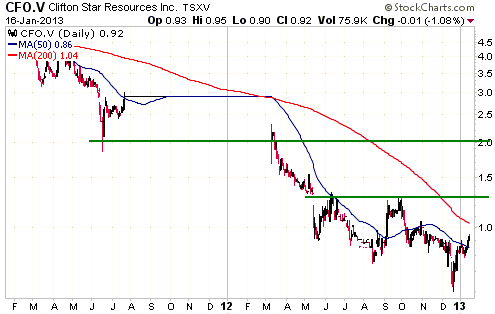
Chart Sources
Charts appearing in today's commentary
are courtesy of:
http://stockcharts.com/index.html
http://www.fullermoney.com/

|









