- Interim Update 16th January 2019
Copyright
Reminder
The commentaries that appear at TSI
may not be distributed, in full or in part, without our written permission.
In particular, please note that the posting of extracts from TSI commentaries
at other web sites or providing links to TSI commentaries at other web
sites (for example, at discussion boards) without our written permission
is prohibited.
We reserve the right to immediately
terminate the subscription of any TSI subscriber who distributes the TSI
commentaries without our written permission.
Commodities
Oil and the Stock Market
The oil price and the US stock market (as represented by the SPX) have
been positively correlated for the past three years and recently the
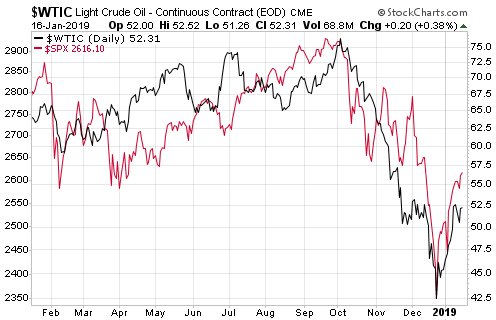
relationship has become stronger. This is illustrated by the following
chart. The chart shows that the oil price (the black line) and the SPX
(the red line) had a loose positive relationship until around mid-August
of last year, at which point the relationship became tight. In particular,
notice that the two peaked together in early-October, plunged together
during October-December, bottomed on the same day in late-December and
then rebounded strongly together.
There's no good reason to expect the strong positive correlation
between the oil price and the broad US stock market to continue
indefinitely. However, the two markets probably will continue to move in
lock-step for at least a few more months, with sizable pullbacks within
the coming 1-2 months followed by rallies to new highs for the year during
the second quarter. Also, it's reasonable to expect that additional upside
in the stock market prior to the start of a sizable pullback would go with
additional upside in the oil price.
Palladium and the Stock
Market
For the second time in 20 years there has been a
bubble in the palladium market in parallel with a bubble in large-cap
technology stocks (as represented by the NASDAQ100 Index - NDX).
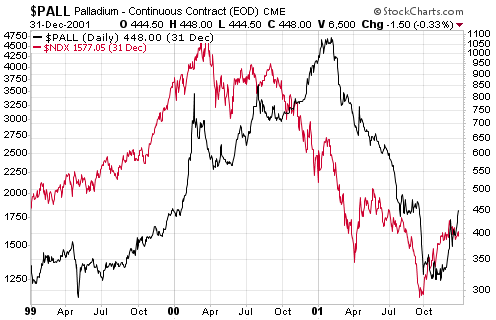
Here's a chart showing what happened during 1999-2001. The black line is
the US$ palladium price and the red line is the NDX.
And here's the same comparison for 2017-2019.
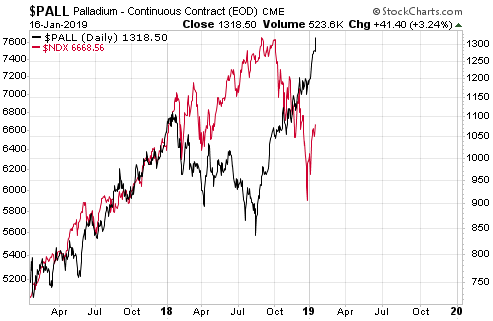
Notice that in 2000 the palladium price continued to rocket upward for
months after the NASDAQ bubble burst, but that in 2001 the two prices
moved back into line with each other via a spectacular collapse in the
palladium price.
There's a decent chance that something similar
will take place within the coming 18 months. Too bad that there aren't any
long-dated put options on the Physical Palladium ETF (PALL).
The Stock Market
Current US Stock Market
Situation
Assessing the US stock market's short-term
risk/reward was made more difficult last week by the fact that we
simultaneously got a reliable warning of downside risk and a reliable sign
of strength. The warning of downside risk was from our put/call indicator,
which came within a whisker of generating a sell signal. Sell signals from
this indicator have an extremely good record if they happen when the
market is stretched to the upside on a short-term basis, which is the case
right now. The caveat is that although the market came very close to a
put/call sell signal, such a signal did not actually occur. The sign of
strength was the McClellan Oscillator (MO) surge to near a 20-year high.
MO surges of this magnitude usually are followed by only minor setbacks
over the ensuing few weeks.
Near the start of the stock market's
recovery from its 24th December low we had in mind resistance at 2550 as a
likely upside target and resistance at 2600 as a maximum upside target for
the SPX's initial rebound. On Wednesday 16th January the SPX traded as
high as 2626 and closed at 2616, so the initial rebound has gone further
than expected.
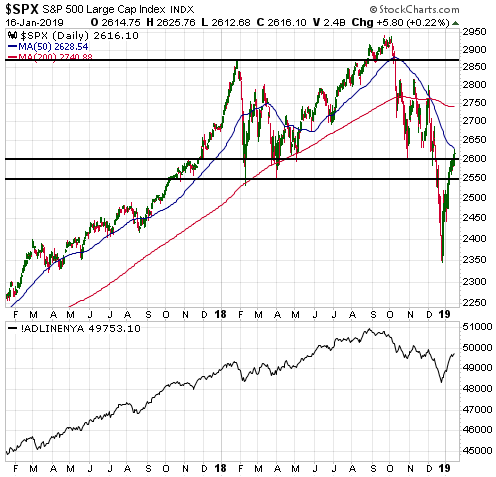
As illustrated by the following daily chart,
Wednesday's high was a test of the 50-day MA. Now that lateral resistance
at 2600 has been exceeded, the 50-day MA (or thereabouts) is the most
likely place for a multi-week top.
The US government shutdown could be at least partly responsible for
the stock market's ability to move higher than expected during its initial
rebound. The government shutdown is not a problem for the economy, but it
will reduce the GDP calculation (GDP is a very poor measure of economic
performance) and the GDP calculation exerts considerable influence on the
Fed.
To further explain, if the government shutdown continues for
a few more weeks then the GDP growth number for Q1-2019 could well be
negative. While this wouldn't indicate much about the real situation of
the economy, it would scare the senior members of the Fed and could prompt
the immediate cessation of the QT program. The market might be in the
process of discounting this possibility.
Summing up, the initial
rebound has done better than expected, but all things considered there's
still a decent chance of the December low being tested as part of a
multi-month reaction to the 'oversold' extreme reached last month.
Therefore, we continue to like the idea of accumulating SPY put options
expiring in March or April. At the same time, the MO surge causes us to be
less aggressive with short-term bearish speculations than otherwise would
be the case.
Gold and the Dollar
Gold
2019 Forecast for the Gold Market
There were hits and misses in our 2018 gold market forecast. We were right
that during the first half of 2018 gold would lose ground relative to
commodities in general. We were also right to mention the potential for
gold to be boosted during the second half of 2018 in both nominal dollar
terms and relative to commodities by serious stock market weakness and a
strong rebound in the T-Bond. However, we were wrong to expect gold to
make a significant first-half gain in US$ terms.
We usually find it
easier to come up with a prediction for what gold will do relative to
commodities (as represented by a broad commodity index such as GNX) than
to predict what gold will do in US$ terms. The main reason is that whereas
there are several strong influences on the US$ gold price, the
gold/commodity ratio consistently trends in the same direction as the
30-year T-Bond.
The strong positive correlation between the T-Bond
and the gold/commodity ratio (gold/GNX) is depicted below.
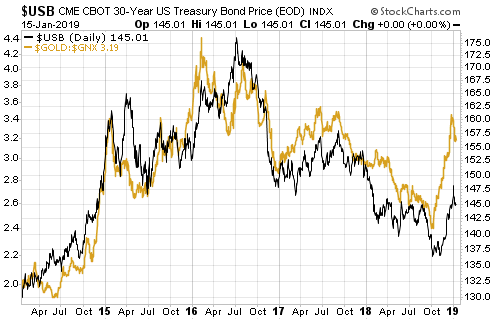
Our 2019 T-Bond forecast is for a price top during the first three
months of the year at not far above the early-January high, followed by a
1-2 quarter decline to new multi-year lows and then a rebound in response
to stock market weakness. This leads us to expect that the gold/commodity
ratio will top-out during the first quarter of this year (if it didn't
already peak near the end of last year), trend downwards for 1-2 quarters
and then rebound strongly into year-end.
What happens to the US$
gold price will depend to a large extent on what happens to the Dollar
Index (DX). In this regard it is significant that the fundamental backdrop
has begun to shift in the euro's favour. If this shift continues then the
US$ gold price will be boosted by US$ weakness over the next several
months. In fact, this is the most likely outcome.
We expect that
the US$ gold price will rise during the first 3-6 months of 2019, but that
the advance will be 'choppy' for two reasons. The first reason is that the
market began the year in an 'overbought' condition. The second reason is
that a continuing recovery in the stock market during the first half of
the year will reduce the demand for 'safe havens'.
During the
second half of the year, a downside breakout in the stock market could
lead to substantial strength in the US$ gold price. Our guess is that gold
will trade near US$1500/oz before year-end.
Turning to the
gold-mining sector, if the stock market was always rational then
gold-mining stocks would always trend with the gold/commodity ratio. This
is because the trend of the gold/commodity ratio indicates the trend of
gold-mining profit margins. On a long-term basis the gold/commodity ratio
does exert considerable influence on the gold-mining indices, but in the
short-term the US$ gold price tends to dominate.
Therefore, we
expect that the gold-mining indices will do something similar to the US$
gold price in 2019. This means that we are anticipating a 'choppy' advance
during the first 3-6 months and a substantial multi-month rally at some
point during the second half. The difference is that the gold-mining
indices likely will be much more volatile than the bullion price. In
particular, gold-mining stocks could be pulled down by a large
stock-market decline and then rebound ferociously after the Fed makes a
rescue attempt.
There's the potential for the gold-mining sector to
make a big catch-up move this year, that is, to greatly outperform gold in
2019. However, at the time of writing there is no evidence that such a
catch-up move has begun.
Current Market
Situation
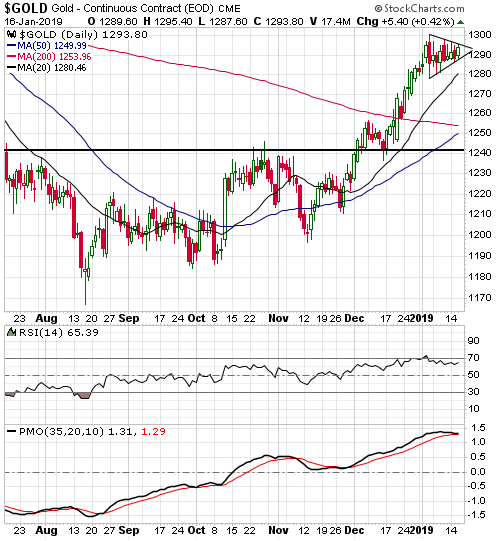
Nine trading days ago (on Friday 4th January) the
gold price spiked up to $1300 and then dropped to around $1280. It was an
'outside down' day and we stated at the time that the reversal could have
created a multi-week top.
The gold price subsequently hasn't traded
outside its 4th January range. Also, its trading range has been getting
smaller by the day. As illustrated on the following daily chart, this
price action has formed a contracting triangle.
As noted in the
latest Weekly Update, a multi-week top won't be confirmed until there is a
daily close below the 20-day MA. This MA is still rising and has reached
lateral support at $1280.
We suspect that if the gold price
breaches the 20-day MA then it will drop quickly to around $1250.
Gold Stocks
Regarding the near-term outlook
for the HUI, in the latest Weekly Update we wrote:
"We have no
opinion regarding the most likely direction of the next 10-point move. A
quick decline to around 150 appears to be just as likely as a quick rise
to around 170.
A daily close below the 20-day MA would warn that a
decline to at least as low as the 50-day MA is on the cards."
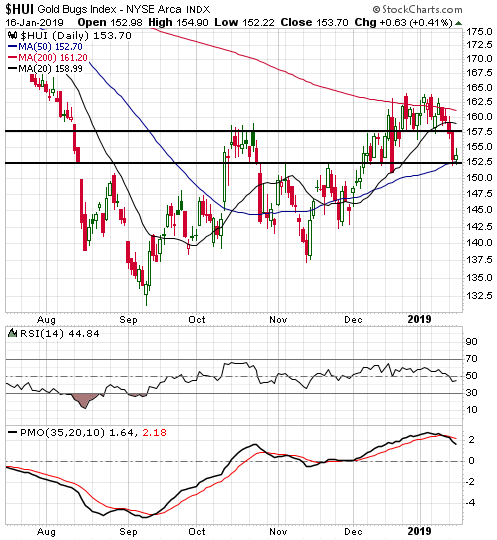
The HUI closed below its 20-day MA on Monday 14th January and followed
through with a quick decline to its 50-day MA on Tuesday. The next support
lies at 142.5 and nearby resistance lies at 157.
The gold/silver sector of the stock market traded poorly over the
first three days of this week, and we aren't only referring to the HUI's
break below its 20-day MA. It also caught our attention that the stocks of
a few high-profile silver miners plunged 5%-10% on Tuesday and that the
IAMGOLD (IAG) stock price plunged 10% on Wednesday. These large declines
were reactions to weaker-than-expected Q4-2018 production results and/or
2019 production guidance, so in each case there was a company-specific
justification. However, bad news tends to be taken in stride when the
underlying price trend is bullish. This week's big negative reactions to
disappointing company news suggest that the sector is still basing.
If you have substantial unhedged exposure to the gold-mining sector
and some options-trading experience, you should consider buying some
insurance in the form of GDX or GLD put options with March or April expiry
dates. A rebound within the coming few days that takes the HUI up to
around 157 would create a good opportunity to hedge.
The
Currency Market
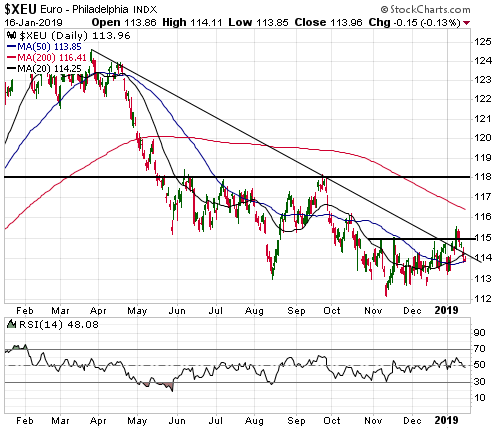
In the latest Weekly Update we noted that
the euro had failed to confirm last week's downside breakout in the Dollar
Index (DX). The euro weakened a little more over the first three days of
this week and like the gold-mining sector still appears to be in basing
mode.
If the 'true fundamentals' extend their recent shift in the
euro's favour then the euro should rise to at least 118 and could make it
to the 120s during the first half of this year, but due to the way the
currency has traded over the past week we won't be surprised if a test of
the November-2018 low (112) precedes the start of a tradable upward trend.
As expected by pretty much everyone, the Brexit deal negotiated by
British Prime Minister Theresa May and her team was rejected in a very
one-sided vote by the UK parliament on 15th January. Unsurprisingly, the
big margin of defeat prompted the leader of the opposition Labour Party to
table a motion of non-confidence in the government, which -- again
unsurprisingly -- the government won, albeit by a fairly narrow margin.
This leaves the Brexit situation 'up in the air', although there is now a
high probability that the UK will not leave the EU as originally scheduled
on 29th March 2019. It's now likely that the exit date will be pushed out
or a new referendum will be held. What a 'dog's breakfast' Theresa May has
made of Britain's attempted escape from the world's largest bureaucracy.
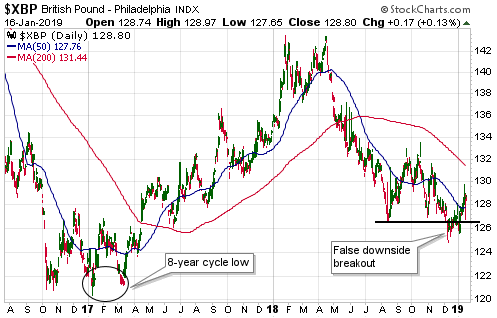
This week's news naturally caused some larger-than-usual swings in the
British Pound. What's interesting is that despite the on-going uncertainty
stemming from the Brexit mess, there are signs in the price action that
the Pound made an important bottom last month.
Updates on Stock Selections
Notes: 1) To review the complete list of current TSI stock selections, logon at
http://www.speculative-investor.com/new/market_logon.asp
and then click on "Stock Selections" in the menu. When at the Stock
Selections page, click on a stock's symbol to bring-up an archive of
our comments on the stock in question. 2) The Small Stock Watch List is
located at http://www.speculative-investor.com/new/smallstockwatch.html
Chart Sources
Charts appearing in today's commentary
are courtesy of:
https://stockcharts.com/