|
- Interim Update 16th February 2011
Copyright
Reminder
The commentaries that appear at TSI
may not be distributed, in full or in part, without our written permission.
In particular, please note that the posting of extracts from TSI commentaries
at other web sites or providing links to TSI commentaries at other web
sites (for example, at discussion boards) without our written permission
is prohibited.
We reserve the right to immediately
terminate the subscription of any TSI subscriber who distributes the TSI
commentaries without our written permission.
Is there a speculative opportunity in "geothermal"?
We
think that "alternative energy" will be one of this decade's most
lucrative investment themes, where "alternative" means
non-fossil-fuel-generated. Geothermal energy fits into the
"alternative" category, and is clean (environmentally friendly) and
renewable. It can also be economically viable without government
subsidy. The question is: do the stocks of geothermal companies
(companies that use geothermal-heated ground water to drive turbines
and produce electricity) represent an attractive speculative and/or
investment opportunity at this time?
Some of these stocks could turn out to be good long-term investments if
they are purchased when their valuations are reasonable, but they don't
have sufficient speculative merit for our taste. This is primarily
because the geothermal business involves high initial capital costs,
just like the metals mining and oil/gas drilling businesses, but
doesn't offer the potential for exceptional profits in response to
exploration success or large increases in commodity prices. That is,
with the geothermal business you don't get the leverage that tends to
go hand-in-hand with the traditional mining and drilling businesses.
An advantage is that unlike a mine or an oil/gas well, a geothermal
reservoir doesn't deplete (water gets cycled between the underground
reservoir and the electricity generation plant). Another advantage is
that leverage is a two-edged sword, so while geothermal operations
don't offer the potential for windfall profits due to helpful changes
in commodity prices, they also don't run the risk of suffering
substantial losses due to adverse changes in commodity prices. In other
words, an established geothermal operation has relatively low risk as
well as relatively modest upside potential. The companies that own such
operations could therefore produce steady returns over time, regardless
of swings in commodity prices. Hence our comment that the associated
stocks could turn out to be good long-term investments IF purchased at
reasonable valuations.
Considering that geothermal stocks have generally performed poorly over
the past 12 months we expected to find that valuations within the
sector were attractive; however, if the three stocks that we quickly
reviewed (Magma Energy, Nevada Geothermal and Ram Power) are
indicative, that's not the case. Each of the companies we checked was
heavily loaded with debt and had a high enterprise value (market
capitalisation plus net debt) compared to the size of the underlying
business.
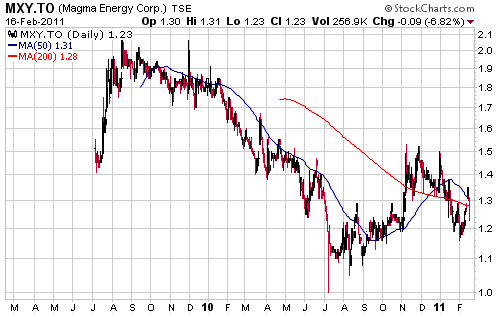
Of the three companies mentioned above, the only one that we would
seriously consider investing in at this time is Magma Energy (TSX: MXY
- see chart below); and that's only because Ross Beatty is the CEO. Mr.
Beatty has a terrific track record when it comes to creating
shareholder wealth, so it's a good bet that MXY will evolve into a very
profitable operation over the years ahead. Our concern is that near the
current share price the company has an enterprise value of about $690M,
even though it is losing money and has a revenue run-rate of only
$80M/year. In other words, this is a loss-making company trading at a
very high 8.6-times its present annual revenue. It is also trading at
almost 2-times its net asset value. It could be that we just don't
understand how to value young and growing geothermal companies, but it
seems to us that MXY's valuation is a long way from being "attractive".
The upshot is that the geothermal sector doesn't appeal to us at this time as either a speculation or an investment.
The Stock Market
The
US stock market has been climbing steadily, with minimal volatility,
for the past 2.5 months. With the exception of the quick 2% decline
caused by the Egypt scare in late January, on a daily closing basis the
S&P500 Index has not experienced a downward correction exceeding
1.2% since November.
The US market continues to be at risk of at least a 10% pullback, but
as at the close of trading on Wednesday the short-term upward trend was
obviously still intact. Additionally, there were no significant bearish
divergences between the various US stock indices. The only divergences
of note are between the US stock market and some of the world's other
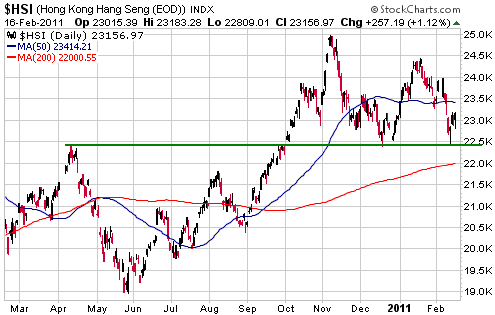
important stock markets. For example, the sequence of new 52-week highs
achieved by the S&P500 Index over the past 2.5 months has not been
confirmed by Hong Kong's Hang Seng Index (HSI). As illustrated by the
following chart, the HSI has just begun to rebound after dropping back
to its low of the past four months.
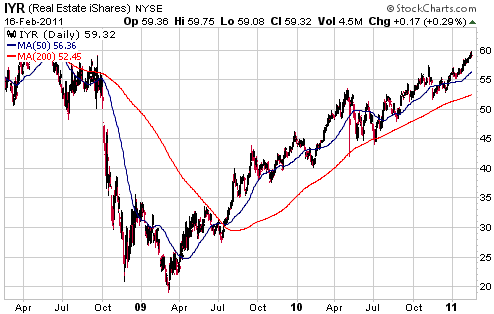
One of the most
remarkable stock-market performances of the past two years has been
that of the US Real Estate Investment Trusts (REITs). The US commercial
real estate sector appeared to be in dire straits in 2009, but the
following chart shows that Real Estate iShares (IYR) has gained 200%
since its 2009 bottom and has now recovered all the ground it lost
during the 2008 crash.
The Fed can be
thanked for the extraordinary recovery in the market value of
commercial real estate. However, there is a high cost associated with
propping up the prices of bad investments. Of greatest importance, the
act of elevating prices to prevent some investors from incurring losses
siphons wealth from other parts of the economy (TANSTAAFL - there ain't
no such thing as a free lunch). These other parts of the economy would
likely have used the wealth more productively, thus allowing the entire
economy to achieve greater progress and to create real (sustainable,
non-government) jobs.
The high cost of the Fed's price-supporting activities is evidenced by
the US economy's 'mysterious' inability to generate employment. The
official US unemployment rate has pulled back from 10% to 9%, but the
pullback is mostly due to people giving up and leaving the workforce.
We think it is both interesting and telling that if the labour
participation rate had remained where it was 10 years ago, the official
US unemployment rate would now be 13% (the unofficial, or actual, rate
would be much higher).
US policy-makers can face up to reality and acknowledge the damage that
has been wrought by their attempts to prop-up prices and protect
poorly-run, capital-consuming enterprises, or they can refuse to let
the facts get in the way of a good story and point the finger of blame
at China.
Gold and
the Dollar
Gold
Gold's Real Trend
Since April of 2007 we have, from time to time, published a table
containing what we consider to be the most important drivers and
indicators of gold's REAL trend (its trend in purchasing power terms,
as opposed to nominal currency terms). We have been following most of
these gold-related factors at TSI for the past decade, but the Trend
Table originally published on 2nd April 2007 was our first attempt to
determine a single number that represented their combination.
An updated version of our Trend Table is displayed below. Notice that
three of the four trend drivers included in the Table relate to
interest rates. These trend drivers were discussed under "Gold and
Interest Rates" in the latest Weekly Update. Also notice that mine
supply changes, jewellery demand changes and central bank gold-market
operations aren't included amongst the trend drivers. They aren't
included because they aren't important enough.
Table Notes:
1. A score of
1, 0.5 or 0 has been allocated to each factor for each year.
Specifically, a factor scored '1' if it was generally bullish for gold
during the course of the year in question, '0.5' if it was neutral (not
decisively bullish or bearish), or '0' if it was bearish.
2. The
individual factor scores were summed to yield a total for each year at
the bottom of the table. Since there are eight factors included in the
table the maximum score (representing maximum bullishness) would be 8
while the minimum score (representing maximum bearishness) would be 0.
A total score of less than 3.5 would be considered bearish, a total
score of 3.5-4.5 would be considered neutral, and a total score of more
than 4.5 would be considered bullish.
| Factor
Description |
2000 |
2001 |
2002 |
2003 |
2004 |
2005 |
2006 |
2007 |
2008 |
2009 |
2010 |
2011 |
| Trend
Drivers: |
|
|
|
|
|
|
|
|
|
|
|
|
| 1.
US$
Exchange Rate |
0 |
0 |
1 |
1 |
1 |
0 |
1 |
1 |
0 |
1 |
0.5 |
0 |
| 2.
Yield-Spread |
0 |
1 |
1 |
1 |
0 |
0 |
0 |
1 |
1 |
1 |
1 |
0.5 |
| 3.
Real
US Interest Rate |
0 |
1 |
1 |
1 |
0 |
0 |
0 |
1 |
0.5 |
1 |
1 |
1 |
| 4.
Credit
Spreads |
0.5 |
1 |
1 |
0 |
0 |
0 |
0 |
0.5 |
1 |
0 |
0 |
1 |
| Trend
Indicators: |
|
|
|
|
|
|
|
|
|
|
|
|
| 1.
HUI/Gold
Ratio |
0 |
1 |
1 |
1 |
0 |
1 |
0 |
0.5 |
0 |
1 |
0.5 |
0.5 |
| 2.
Gold/Euro (euro gold price) |
1 |
1 |
1 |
0.5 |
0.5 |
1 |
1 |
1 |
1 |
1 |
1 |
1 |
| 3.
Gold
vs Indust. Commodities |
0 |
1 |
0.5 |
0.5 |
0 |
0.5 |
0.5 |
0.5 |
1 |
0 |
0.5 |
1 |
| 4.
S&P500/Gold |
0.5 |
1 |
1 |
0.5 |
0.5 |
1 |
0.5 |
1 |
1 |
0 |
0.5 |
1 |
| TOTAL |
2.0 |
7.0 |
7.5 |
5.5 |
2.0 |
3.5 |
3.0 |
6.5 |
5.5 |
5.0 |
5.0 |
6.0 |
When we updated the
Table in January of last year we arrived at a score of 7.0, but based
on the way the various factors actually behaved last year the score
turned out to be 5.0. In other words, we were a bit too bullish on the
12-month prospects for gold's real price (gold's price relative to
other assets and commodities) in early 2010. This was a consequence of
being too pessimistic about the chances of governments and central
banks keeping the 'recovery trade' going for as long as they have. If
our 2011 outlook proves to be 'off the mark', it will probably be for
the same reason. This is because our overarching assumption is that the
global growth/recovery theme will begin to falter within the next few
months.
Once the markets sense that real economic growth will likely be weaker
in the future than it is in the present, credit spreads will embark on
a new widening trend and gold should start to out-perform equities and
industrial commodities. However, the shift away from growth-oriented
investments could initially be accompanied by a decline in the US$ gold
price in a much less dramatic version of what transpired in 2008 (the
accommodative monetary backdrop all but guarantees that there will not
be a 2008-style market collapse this year).
Current Market Situation
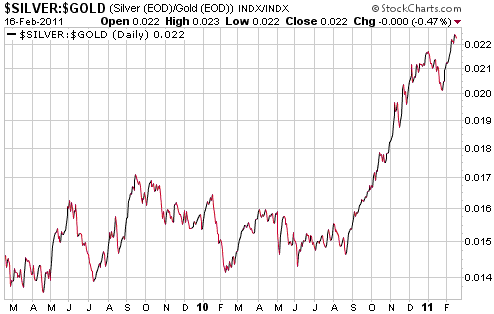
A daily chart of the silver/gold ratio is displayed below.
As noted last week, the silver/gold ratio's move to a new multi-year
high increases the probability of both silver and gold making new
multi-year highs within the next few weeks.
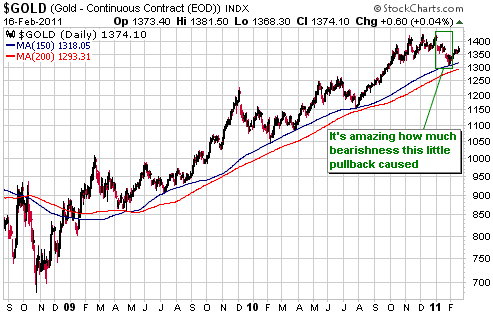
At no stage since
gold's December peak has the price action deviated from what would be
expected from a routine short-term correction within a continuing
intermediate-term advance. The future is never certain, so there
remains a possibility that the correction will morph into the
intermediate-term variety. However, the parameters are clear. As we
mentioned a couple of weeks ago, every short-term pullback in the US$
gold price over the past two years has ended immediately after a touch
of the 150-day moving average. The recent price action has therefore
followed the short-term correction pattern "to a T" up until now, which
means that a future decline to below the 150-day moving average could
be used as a timely warning that something more than a routine
short-term correction was in progress.
The 150-day moving average is now at $1318 and will soon be above
$1320. This means that if we are right to assume that a move to new
highs will soon occur then any decline in the gold price over the next
fortnight should end at, or above, $1320.
Gold Stocks
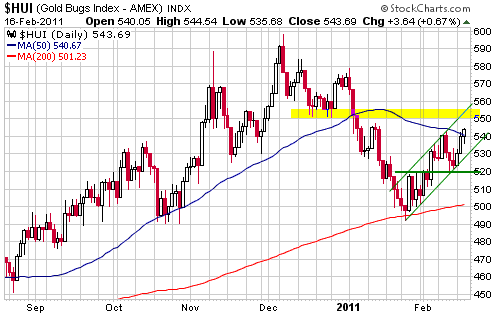
Next resistance of significance for the HUI is in the 550s, while a
near-term pullback is likely to find good support at around 520.
If gold and silver
move to new highs over the next 1-2 months, the HUI should do the same.
In our opinion, there is short-term upside potential to 650-700.
Currency Market Update
The currency market is superficially stable at the moment. It seems
that downward pressure on the Dollar Index caused by strength in
equities is presently being offset by re-emerging fears of sovereign
debt problems in Europe.
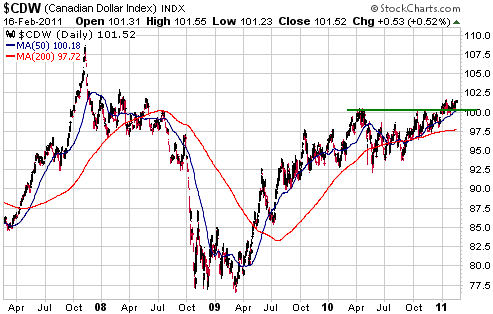
Of the major currencies, the Canadian Dollar (C$) continues to be the
one with the most bullish-looking chart pattern. The C$'s price action
suggests an upcoming test of the 2007 peak, or short-term upside
potential of about 7%.
Update
on Stock Selections
(Notes: 1) To review the complete list of current TSI stock selections, logon at http://www.speculative-investor.com/new/market_logon.asp
and then click on "Stock Selections" in the menu. When at the Stock
Selections page, click on a stock's symbol to bring-up an archive of
our comments on the stock in question. 2) The Small Stock Watch List is
located at http://www.speculative-investor.com/new/smallstockwatch.html)
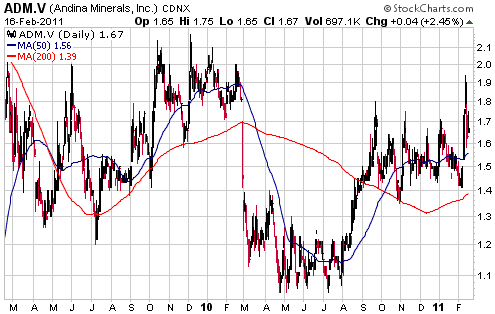
 Andina Minerals (TSXV: ADM). Shares: 108M issued, 129M fully diluted. Recent price: C$1.67 Andina Minerals (TSXV: ADM). Shares: 108M issued, 129M fully diluted. Recent price: C$1.67
ADM announced the results of the long-awaited Pre-Feasibility Study
(PFS) on its large, low-grade Volcan gold project prior to the start of
trading on Monday. The stock price ran up last week in anticipation of
these results, but the market obviously didn't like what it saw and
quickly gave back about three-quarters of last week's gain.
We never really know what the market expects until we see the reaction
to news. In ADM's case, we are left to wonder why anyone would have
expected a lot more from the PFS than was actually delivered. The PFS
confirmed that the Volcan project is marginal at this time, but has the
potential to be developed into a profitable mining operation and offers
substantial leverage to the gold price. It's beyond us why anyone would
have expected much more.
Here are some of the PFS's most important estimates and conclusions:
1. Measured and Indicated (M&I) resources of 8.9M ounces, including 6.6M ounces of Proven and Probable (P&P) reserves.
2. Average annual production of 283K ounces over a mine life of 15 years.
3. Life-of-mine cash cost of $615/oz.
4. Initial capex of $550M.
5. Production to start in 2015 following an 18-24 month construction period.
6. There are several opportunities to improve the project economics,
all of which will be considered as part of the Feasibility Study (FS)
currently scheduled for completion in mid-2012.
The Net Present Value (NPV) figures calculated as part of the PFS
underline the great extent to which the project's viability is levered
to changes in the gold price. For example: assuming a discount rate of
7.5% and a share count of 120M, the NPV is $107M ($0.89/share) at a
gold price of $1000/oz, $441M ($3.67/share) at a gold price of
$1200/oz, and $768M ($6.40/share) at a gold price of $1400/oz. That is,
a 40% increase in the gold price -- from $1000/oz to $1400/oz --
increases the project's NPV by 640%.
It's the leverage that keeps us interested in ADM despite its issues.
If the gold price does what we expect it to do over the next two years
then the Volcan project will become very valuable.
The leverage is a big plus for ADM assuming the gold price stays in a
long-term upward trend. It's also a plus that the company has $30M in
the bank, which should be enough to fund its activities over the coming
12 months. On the negative side of the ledger, ADM's extreme leverage
makes it more vulnerable than many other junior gold stocks to an
intermediate-term correction in the gold market (an intermediate-term
gold correction will likely occur some time this year). Another
negative is that there isn't much chance of ADM becoming a takeover
target anytime soon. The managements of large mining companies
typically like to buy when the numbers look good, which means that they
usually end up 'buying high' and ignoring the most under-valued assets.
ADM is a reasonable candidate for new buying near the current price of
C$1.67, but the C$1.40s is the optimum realistic area for new buying.
Fairborne Energy (TSX: FEL). Shares: 102M issued, 112M fully diluted. Recent price: C$5.24
One of the most remarkable divergences we've ever seen in the financial
markets is the one that developed over the past two years between
natural gas (the commodity) and the stocks of natural gas
producers/drillers. The commodity has languished, but the associated
equities have done extremely well.
Mid-tier natgas producer FEL has been a laggard, perhaps because it
offers substantial leverage to changes in the natgas price (leverage is
a bad thing to have when the price is moving against you). However,
despite the fact that the natgas price has just dropped back to near
the lows of the past 12 months, FEL has finally broken out to the
upside from a 21-month consolidation. As per our previous comments on
this stock, C$7.50-$8.00 is the chart-based target created by the
breakout.
Traders who are 'long' should consider placing a protective stop at around C$4.70.
Northgate Minerals (AMEX: NXG, TSX: NGX). Shares: 290M issued, 297M fully diluted. Recent price: US$2.90
On 15th February NXG announced a resource upgrade for the Kemess
Underground project, which is part of what was formerly known as the
Kemess North project. The resource has gone from 1.4M ounces in the
"Inferred" category to 2.6M ounces in the "Indicated" category.
Although the stock market pretty much ignored it, this news is
significant. The main reason is that NXG's growth prospects will get a
hefty boost if it can be shown that the Kemess Underground project has
the economic potential to be developed into a mine that produces, say,
100K ounces of gold per year. The next step in verifying this potential
will be the Preliminary Economic Assessment due to be completed in the
third quarter of this year.
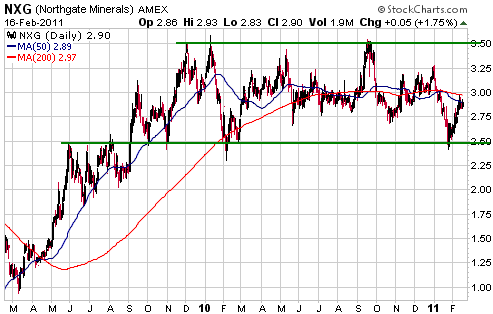
NXG has moved up to near the mid point of its 18-month range. New
buying would be appropriate following a pullback to around $2.75.
Chart Sources
Charts appearing in today's commentary
are courtesy of:
http://stockcharts.com/index.html

|