|
- Interim Update 16th March 2011
Copyright
Reminder
The commentaries that appear at TSI
may not be distributed, in full or in part, without our written permission.
In particular, please note that the posting of extracts from TSI commentaries
at other web sites or providing links to TSI commentaries at other web
sites (for example, at discussion boards) without our written permission
is prohibited.
We reserve the right to immediately
terminate the subscription of any TSI subscriber who distributes the TSI
commentaries without our written permission.
Uranium Update
Uncertainty and Opportunity
Although we know more about nuclear power generation than the average
person, we are a long way from being experts on the topic. Also, the
situation on the ground in Japan is changing almost hourly and can best
be followed via news services that specialise in constant updates. We
therefore won't devote TSI space to the specific details of Japan's
"nuclear emergency". Instead, and at the risk of appearing to be
callously ignoring the human tragedy, we'll focus on the speculative
opportunity stemming from the disaster.
In the likely event that the containment structures perform their roles
and prevent anyone outside Japan's damaged nuclear plants from being
seriously harmed by excessive radiation, there could still be
significant adverse long-term consequences for uranium demand.
Economics logic dictates that there shouldn't be, but the deadly
combination of ignorance and political pragmatism suggests that there
could be. After all, the Three Mile Island accident in 1979 halted the
progress of the nuclear power industry in the US even though nobody was
killed and the containment system worked as it was supposed to.
In the unlikely event that a major (Chernobyl-style) radiation leakage
results from the damage sustained by Japan's power plants, there will
almost certainly be significant adverse long-term consequences for
uranium demand in some parts of the world. However, it wouldn't
completely derail the uranium-mining investment theme if China, India
and Russia continued to push ahead with their plans to greatly expand
their respective nuclear industries, as they would probably do.
In other words, considerable uncertainty about future uranium demand
will remain almost regardless of what happens in Japan over the next
few weeks.
Certainty about the future is not, however, a prerequisite for
financial speculation or investment. In fact, if it were a prerequisite
then no speculation or investment would ever occur, because the future
is always uncertain. Moreover, some of the best investing and
speculating opportunities are born out of considerable uncertainty. It
all depends on what is discounted by the current market price. For
example, it can be a very good idea to buy in the face of considerable
uncertainty if something approaching the worst-case scenario has
already been factored into the market price.
There is no question in our minds that the uncertainty stemming from
the potential worldwide political reaction to Japan's nuclear accident
has created a clear-cut speculative opportunity in uranium mining
shares. It is, unequivocally, a buying opportunity.
Things to consider when deciding what, and how much, to buy
One of the main reasons that most investors don't fare well in the
financial markets over the long haul is that they do most of their
buying when it feels most comfortable to buy, which is when the future
looks brightest. But when there is widespread belief that the future is
bright, valuations are likely to be high and high valuations all but
guarantee sub-par long-term returns. It should also be noted that some
"contrarians" also perform poorly over the long-term because they buy
too much too soon during bearish trends and sell too much too soon
during bullish trends. In the current example of the uranium mining
stocks, a buying opportunity is at hand but there could be an even
better buying opportunity within the next few days (the present
situation is similar to the multi-day collapse that followed the 9/11
terrorist attacks, but focused on one small part of the stock market
rather than on the overall market). Fortunately, the risk that prices
will continue to fall can be mitigated by simply scaling into positions
over time.
EFR.TO, HAT.V and UEX.TO are the three uranium stocks in the TSI List.
Of these, we think that EFR presently has the greatest reward potential
and also the greatest risk.
The company-specific risk with EFR is three-fold: First, EFR's cost of
uranium production is likely to be relatively high, which wouldn't be a
problem with the uranium price above $65/pound but could be a problem
if the uranium price drops back to the $40s and stays there. Second, if
EFR is going to build its uranium mill as currently scheduled then it
will have to raise money within the next few months, but due to the
decline in the stock price it doesn't make sense for the company to
issue new equity at this time. Third, there is the weak (but not
totally irrelevant) legal challenge to EFR's mill licence. On the plus
side, EFR will be producing vanadium in addition to uranium and the
demand for vanadium could potentially rise as a result of what's
happening in Japan.
HAT probably has the lowest risk of our three stocks. This is because
the company has enough cash in the bank to finance its exploration
activities for more than 12 months and because the grade of the
in-ground resource at its flagship project is so high that the project
could be economic at a low uranium price.
Speculators could take advantage of the current situation and at the
same time avoid the need to pick individual uranium-mining stocks by
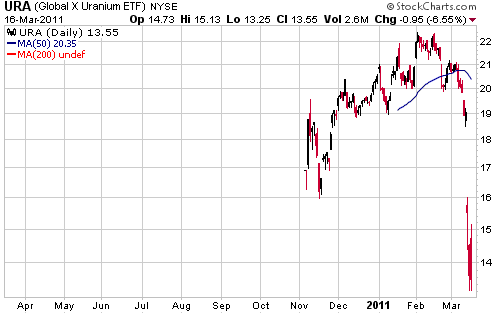
scaling into the Global X Uranium ETF (NYSE: URA), a fund that holds a
basket of more than twenty uranium stocks. As illustrated by the
following daily chart, URA had pulled back from $22 to $19 ahead of
Japan's earthquake in what appeared to be a routine correction, but
then crashed over the past three trading days as the nuclear-related
consequences of the disaster 'hit home'.
We aren't going to add URA to the TSI List at this time, but we began
accumulating it for our own account in the $13.30s on Tuesday and will
probably buy more over the days ahead if the sell-off continues.
Lastly, speculators
could take advantage of the current situation and avoid uranium-mining
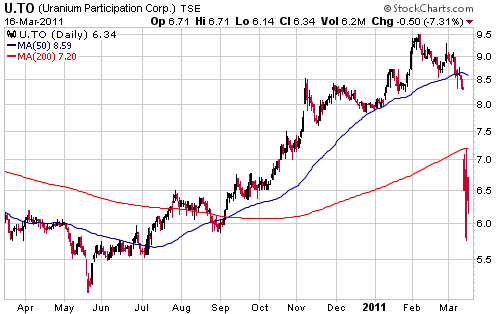
stocks altogether by scaling into Uranium Participation Corp. (TSX: U),
a fund that holds physical uranium. U's performance reveals that the
market is anticipating a large decline in the uranium price.
Perpetual QE?
In
the latest Weekly Update we outlined why we thought that "QE"
(Quantitative Easing) had become a semi-permanent part of the Fed's
monetary policy. This prompted emails from a few of our readers
pointing out that Jim Rickards had come to the same conclusion, as
discussed in his article posted HERE,
but with an interesting twist: Rickards argues that the Fed will
continue its QE policy without expanding its balance sheet. To be more
specific, he argues that the Fed will channel the proceeds of maturing
debt securities into newly issued treasury securities, thus helping to
finance a substantial chunk of the Federal government's deficit and
maintaining "QE" indefinitely. Much of the Rickards article 'rings
true', but there is a basic flaw in his logic. Before we discuss the
basic flaw we'll cover some other aspects of the article.
First, we are in general agreement with the following excerpt from the
article (we made similar comments in the latest Weekly Update):
"The Fed said last
November that QE2 would last until June 30, 2011 but reserved the right
to "adjust the program as needed" in light of "incoming information."
So they have laid a foundation to continue QE2 if they wish. The
negative impact of rising oil prices on the economy might give the FOMC
a reason to continue QE2. However, there is not much time to decide.
There are only three FOMC meetings before the end of June. These are
March 15th, April 26th and June 21st. The Fed might make a formal
announcement on June 21st, however, they will want to make a firm
decision and leak it sooner in order to guide the market in advance and
avoid surprise. Recall that when QE2 was decided the Fed made a formal
announcement in November but began leaking their intentions in August,
three months earlier. So it seems likely the Fed will reach a tentative
decision on March 15th, begin leaking the announcement immediately and
confirm this with a formal announcement in June."
As it turned out, the Fed didn't drop any hints about the imminent end
of "QE2" in its 15th March Policy Statement. Perhaps it was dissuaded
from doing so by the large earthquake-related hit that will be taken by
Japan's economy and by the recent stock market swoon.
Second, we agree with the following comment from the article: "For
political reasons, more so than economic, the Fed will end QE2 in June
and will make its intentions known. But is this the end of QE? The
answer is no."
Third, we agree with Rickards' conclusion that the Fed will continue to
use the proceeds that it receives from interest and principal payments
on Mortgage-Backed and Agency securities to purchase US Treasury
securities, although he has probably over-estimated the amount of money
involved because he has failed to account for the fact that the total
value of these securities will shrink over time. Due to this shrinkage,
it will not be possible for the Fed to continue rolling Mortgage-Backed
debt payments into Treasury debt at the current rate of $500B/year (the
total combined value of the Fed's holdings of Mortgage-Backed and
Agency securities is presently about $1.1 trillion).
We'll now deal with the article's basic logical error. As discussed
above, Rickards is very likely correct when he argues that the Fed will
re-cycle any money it receives from debt repayment; however, the
re-cycling of existing money does not constitute Quantitative Easing.
QE is, by definition, a central-bank engineered expansion of the
monetary base, which can only happen via an expansion of the central
bank's balance sheet. In other words, if the Fed's balance sheet
doesn't grow then there is no "QE".
By way of further explanation, first consider the hypothetical case
where the Fed holds $50B of T-Notes that are just about to mature. The
Fed plans to send the $50B payment of principal to the US Treasury, but
before it can do so it must first receive $50B from the Treasury. Upon
completion of the transaction, nothing will have changed. There will
have been no additional "easing" and the US Treasury will not have made
any progress towards financing its current deficit. Next consider the
hypothetical case where the Fed holds $50B of Mortgage-Backed
Securities (MBS) that are just about to mature. The Fed plans to send
the $50B payment of principal to the US Treasury, but before it can do
so it must receive $50B from the issuers of the MBS. Upon completion of
the transaction, there will have been no additional "easing" but the US
Treasury will have made $50B of progress towards financing its current
deficit.
The bottom line is that Quantitative Easing involves an increase in the
total QUANTITY of money (hence, the name). Consequently, Fed policy
that does not cause the total quantity of money to increase does not
constitute "QE". The Fed can help finance the government's deficit by
channeling MBS interest and principal payments into Treasury
securities, and this can have a significant adverse effect on the
economy by enabling the government to become a larger part of the
economy. However, it is not "QE".
When we say that "QE" will probably continue -- in fits and starts --
until inflation is widely perceived as a major problem we are referring
to Fed-engineered INCREASES in the total supply of money (in parallel
with a near-zero interest rate target), as opposed to the re-cycling of
existing money. The re-cycling of existing money doesn't cause a
permanent loss in money purchasing power, whereas "QE" does.
The Stock Market
Apart
from the stock markets and the individual stocks that are directly
affected by Japan's disaster, equities around the world held up quite
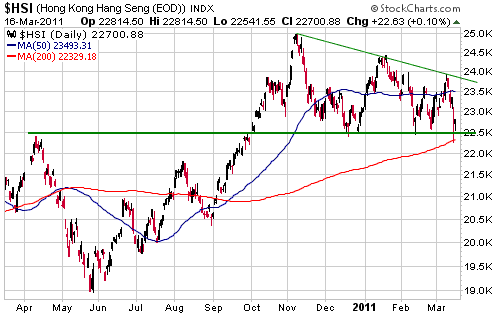
well over the first three days of this week. Hong Kong's Hang Seng
Index (HSI), for example, momentarily broke below important support at
22,500 on Tuesday, but managed to hold above support on a daily closing
basis. We were beginning to wonder what it would take to get the HSI
below 22,500, given that the support had held in the face of rising
interest rates, widespread unrest in the Middle East, a big hit to
Japan's economy and a "nuclear emergency". However, as we write this,
with about an hour left in the Hong Kong trading session, the HSI is
down 400 points at around 22300, so it looks like the support is about
to finally give way.
A daily close below 22,500 would create a short-term chart-based target
for the HSI of 20,000. Barring new dramatic events with substantial
economic ramifications somewhere in the world, the aforementioned
chart-based target probably defines the HSI's maximum downside risk as
far as the coming two months are concerned.
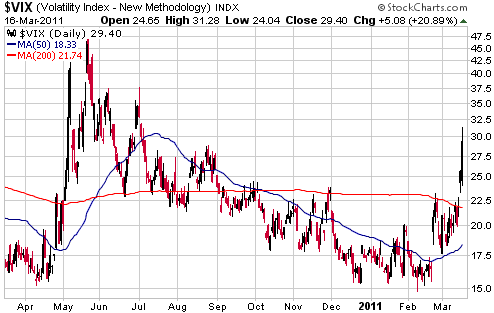
This week's action in
the US stock market has caused the Volatility Index (VIX) to move up to
around 30. If there is an additional increase in fear over the days
ahead then the VIX will move even higher, but the market is now very
'oversold' by some measures and will probably reach a short-term bottom
within the next couple of weeks. Therefore, we think that the traders
who -- as per our suggestion -- accumulated VIX June call options
earlier this year when volatility was very low should now be looking
for opportunities to exit the position.
Gold and
the Dollar
Gold and Silver
Over the past two weeks the April gold futures contract has experienced
a peak-to-trough decline of about $60. This could be nothing more than
another routine pullback, especially considering that Tuesday's
intra-day low (the low to date) coincided with the 50-day moving
average.
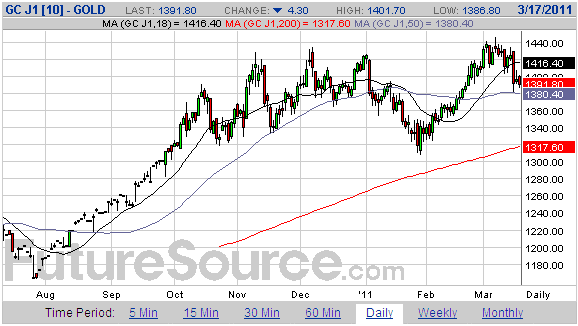
When we look at the
gold market in isolation it does not appear to have much downside risk,
in that sentiment is constructive (Market Vane's bullish percentage has
dropped back to the low-70s) and the price is not extended to the
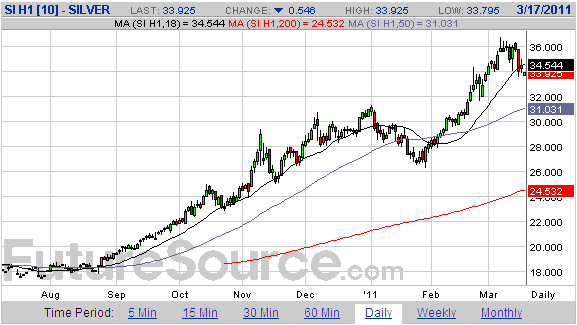
upside. Our concern is with silver. The end of silver's current advance
will very likely be followed by a massive downward correction, and we
can't envisage the silver price falling 35%-45% while gold remains
within its $1320-$1440 range.
Silver's extraordinarily 'overbought' condition constitutes the main
risk for gold, but as things currently stand there is no evidence that
silver has peaked. There was a sharp drop in the silver price on
Tuesday, but there was no follow-through to the downside. Furthermore,
the silver/gold ratio experienced only a minor pullback over the first
three days of this week.
It is possible that silver peaked in the $36-$37 range earlier this
month, but it is equally possible that there will be yet another surge
prior to the final peak of this incredible rally. In our words and in
our money management, we are hedging.
Gold Stocks
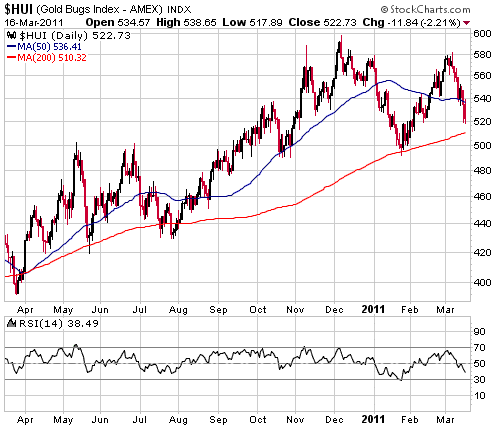
The HUI appears to be on its way back to support in the low-500s. It
would be normal if former support at around 540 now acted as resistance
and capped any rebound over the next few days.
Currency Market Update
All eyes are on the Yen.
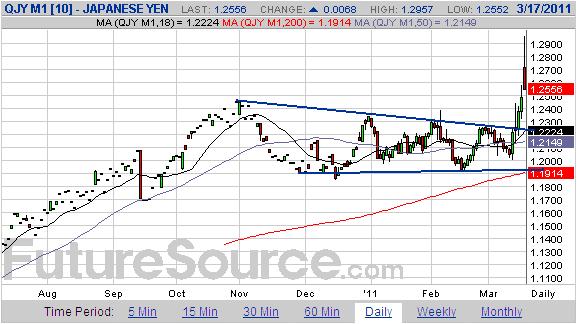
In the latest Weekly Update we wrote:
"[Japan's] natural
disaster pushed the Yen up to trend-line resistance on Friday and could
soon bring about an upside breakout as the currency market discounts
the possibility that the huge clean-up, repair and reconstruction
efforts associated with the disaster will prompt a large flow of
capital into Japan. Note that the Yen rose 20% during the three
month-period following the January-1995 Kobe earthquake."
The following daily chart of the June Yen futures contract shows that an upside breakout has happened.
This week's rise in
the Yen occurred despite herculean efforts on the part of the Bank of
Japan (BOJ) to weaken the Japanese currency. The BOJ 'injected' 23
trillion Yen (the equivalent of 280 billion US dollars) into money
markets during the first two days of this week, and probably injected a
lot more over the ensuing two days, in its attempts to halt the Yen's
rise, but at this stage Japan's central bank is being overwhelmed by
the market. If the BOJ continues to create new Yen at this pace then
its currency-weakening efforts will eventually be successful, but
hopefully the BOJ's decision-makers will come to their senses before
they do a lot more damage.
To the average central banker, monetary inflation is a hammer and
almost every economic problem looks like a nail. Unfortunately,
monetary inflation (or counterfeiting, as it would be called if an
entity other than a bank did it) is never the solution. Flooding the
economy with money is only going to add an inflation problem to all the
other problems and will ultimately increase the cost of the materials
that Japan imports to carry out its reconstruction.
Assuming that the BOJ doesn't go totally overboard with its injections
of new money, the Yen will probably continue to strengthen over the
next 1-2 months. However, once currency traders have finished
discounting the coming Japanese capital repatriation we suspect that
the Yen will embark on a long-term bearish trend.
Update
on Stock Selections
(Notes: 1) To review the complete list of current TSI stock selections, logon at http://www.speculative-investor.com/new/market_logon.asp
and then click on "Stock Selections" in the menu. When at the Stock
Selections page, click on a stock's symbol to bring-up an archive of
our comments on the stock in question. 2) The Small Stock Watch List is
located at http://www.speculative-investor.com/new/smallstockwatch.html)
Chart Sources
Charts appearing in today's commentary
are courtesy of:
http://stockcharts.com/index.html
http://www.futuresource.com/

|