|
- Interim Update
16th April 2014
Copyright
Reminder
The commentaries that appear at TSI
may not be distributed, in full or in part, without our written permission.
In particular, please note that the posting of extracts from TSI commentaries
at other web sites or providing links to TSI commentaries at other web
sites (for example, at discussion boards) without our written permission
is prohibited.
We reserve the right to immediately
terminate the subscription of any TSI subscriber who distributes the TSI
commentaries without our written permission.
The Stock Market
Stock market strength doesn't indicate economic strength
The Zimbabwe stock market rose by millions of percent during 2005-2008. If stock
market strength were an indicator of economic strength then Zimbabwe would have
had the best economy in the world during this period, but it actually had the
worst (or very close to it). Clearly, then, the astronomical gain in Zimbabwe's
stock market was a sign of weakness rather than strength. However, we continue
to see market analysts and commentators citing rises in broad-based stock
indices as evidence of a strong economy. This prompts the question: how fast is
too fast for a stock market to rise? That is, at what rate of ascent does a
rising stock market become indicative of an economic problem rather than
economic strength?
That's actually a trick question, because a rising stock market is NEVER a sign
of genuine economic strength. It is, instead, a sign of monetary inflation. In a
healthy economy with no monetary inflation an index representing the overall
stock market would tend to oscillate around a horizontal line over the long
term. In such an economy, long-term investors in a broad-based stock index would
achieve no nominal capital gain. These investors would, however, achieve a
significant real return due to dividends and the rise in the purchasing power of
money.
In general terms it is therefore fair to say that the faster the rise in the
stock market the greater the amount of monetary inflation. Furthermore, good
economic theory tells us that the greater the amount of monetary inflation the
more severe the coming economic downturn (since monetary inflation causes
mal-investment). That's why the biggest economic busts have often followed the
most spectacular stock-market advances. In such cases it wasn't the eventual
stock market collapse that caused the severe economic downturn; the economic
downturn was caused by the inflation-fueled boom, a symptom of which was a
spectacular rise in the stock market.
It doesn't always work, but when trying to identify the countries that are going
to have the weakest economies over the next 5 years a good place to start is to
identify the countries that had the strongest stock markets over the preceding 5
years.
Current Market Situation
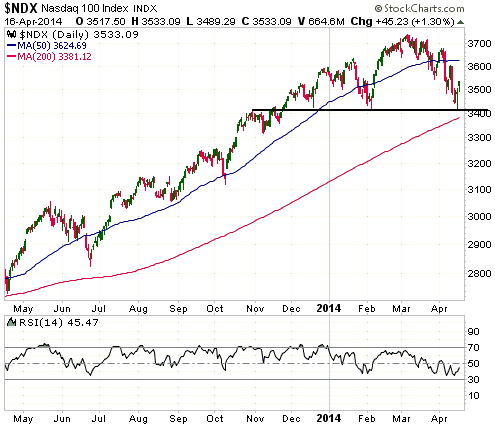
From the latest TSI Weekly Update: "In the US market, last week's downside
breakout by the RUT/SPX ratio is evidence of an intermediate-term trend reversal
from up to down, but this evidence has come with prices stretched to the
downside. Furthermore, the NASDAQ100 Index (NDX), the senior stock index that
has led to the downside, is now close to important lateral support at 3400. This
makes it likely that a 1-3 week rebound will begin within the next two trading
days."
The following daily chart shows that the NDX tested important lateral support at
3400 early this week and then reversed upward. It looks like a 1-3 week rebound
has begun.
We are now entering the short time-window when the Presidential Cycle Model
predicts a seasonal peak for the US stock market. The same model predicts a
September-October seasonal bottom at a much lower level. Moreover, the fact that
the market is entering the aforementioned topping window with high valuations,
complacent sentiment, price extended to the upside and significant bearish
divergences increases the probability that 'seasonality' will work this year.
Consequently, the next three weeks should be a good time for speculators to
average into bearish US equity positions. At this stage we aren't going to make
any formal recommendations, but for our own account we will consider put options
on QQQ (the NASDAQ100 ETF), IWM (the Russell2000 ETF), and SSO (the ProShares
UltraS&P500 ETF).
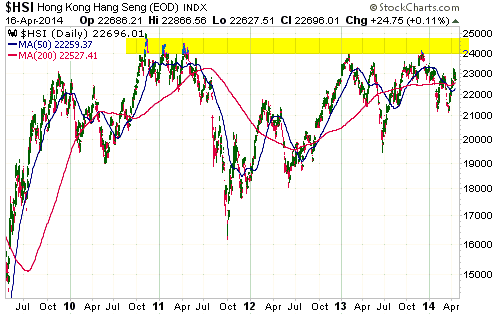
While the US stock market appears to be dangerously extended to the upside, the
same cannot be said for many other stock markets around the world. For example,
the following chart shows that Hong Kong's stock market has essentially moved
sideways over the past four years. The Hong Kong market could still be dragged
downward over the coming 6 months by substantial weakness in US equities, but it
doesn't merit a bearish speculation.
Gold and the Dollar
Gold
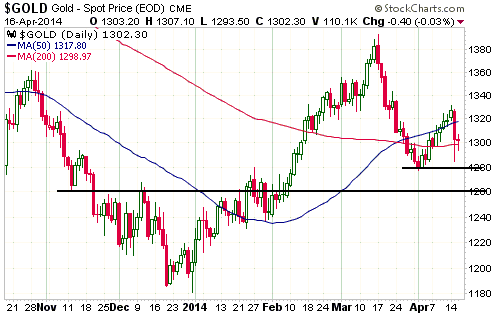
Gold dropped back to test its correction low of $1280 during the first half of
this week. There is no way of knowing at this time if the test is complete or
even if it will be successful. Note that a successful test of the low could
involve a spike below $1280, but ideally won't entail multiple daily closes
below $1280 and definitely should not entail a weekly close below $1260.
Since a test of the correction low was a likely outcome and in line with our
expectations, there is no need for us to look for a news event to explain the
price action. Having said that, the catalyst for at least part of Tuesday's
sharp decline in the gold price could have been the reiteration by Goldman Sachs
(GS) of a
forecast for gold to end this year at $1050/oz.
GS's gold market analyses and forecasts have generally not been 'on the mark'
over the past ten years, but last April they got lucky (or suddenly became far
more prescient than they had been in the past) and issued a 'sell'
recommendation just prior to a large decline in the gold price. Due to this one
success their gold forecasts now have credibility in the eyes of many market
participants.
We obviously disagree with the GS gold-market outlook. We will be surprised if
gold ends this year below $1400/oz, and if we had to make a guess at the
year-end price we would choose $1500/oz. However, GS's analysis is superior to
that of many gold bulls because it is focused on a genuine fundamental driver.
While many gold-bullish analysts kid themselves that they can measure changes in
demand and predict prices by adding up trading volumes and comparing one volume
(e.g. the amount of gold being imported by China) to another volume (e.g. the
amount of gold being sold by the mining industry), the GS analysts are
considering the likely future performance of the US economy.
The GS bearish argument goes like this: Real US economic growth will accelerate
over the next few quarters, while interest rates rise and inflation expectations
remain low. If this happens, gold's bear market will continue.
The logic in the above paragraph is flawless. If real US economic growth
actually does accelerate over the next few quarters then a bearish view on the
US$ gold price will turn out to be correct, almost regardless of what happens
elsewhere in the world. The reason the GS outlook is probably going to be wrong
is that the premise is wrong. Specifically, the US economy is more likely to be
moribund than strong over the next few quarters. It's a good bet that inflation
expectations will remain low throughout this year, but real yields offered by US
Treasuries are more likely to decline than rise due to signs of economic
weakness and an increase in the popularity of 'safe havens' as the stock market
trends downward.
A note in a World Gold Council (WGC) report about gold being used in China as
part of financing deals might also have put some downward pressure on the gold
price earlier this week, the concern being that the unwinding of these deals
could result in up to 1,000 tonnes of physical gold being dumped onto the
market. We plan to discuss this issue in the coming Weekly Update, but suffice
to say right now that it is completely irrelevant.
Silver
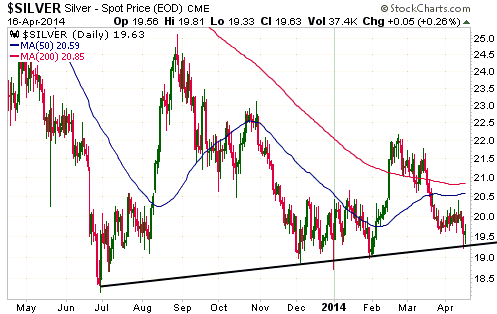
Last week we mentioned that silver could test support at $19.00-$19.30 before
its correction came to an end. The top of this support range was tested during
the first half of this week. As is the case with gold, there is no way of
knowing at this time if the test is complete or if it will be successful.
A daily close above $20.25 would indicate that a successful test of support had
occurred, whereas a weekly close below $19.00 would be a downside breakout.
Gold Stocks
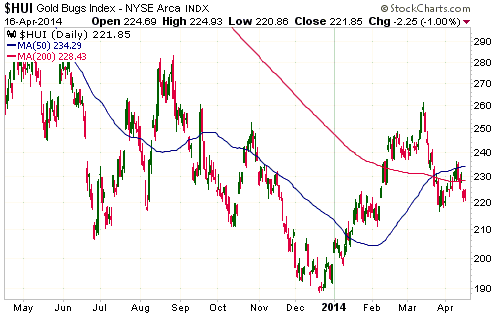
As expected, the HUI has dropped back to test its late-March low. This
lacklustre price action is, we think, setting the stage for the next tradable
rally and is creating buying opportunities in the present.
We are picking away at junior gold stocks via under-the-market buy orders. We
were frustrated prior to this week in that only one of our buy orders had been
filled, but the weakness of the past two days enabled two more orders to get
filled. To buy low and sell high, you first have to buy low.
As noted in a previous commentary, at this early stage of what we think is a new
cyclical bull market in gold-mining stocks it makes sense to direct almost all
new buying towards the stocks of producers that are profitable at $1300/oz and
explorers that own projects that would likely be economically viable at
$1300/oz.
The Currency Market
The Dollar Index rebounded from support at 79.5 over the past few days, thus
prolonging the narrow range-trading of the past 6 months (the Dollar Index has
now spent about 6 months oscillating between 79.5 and 81.5). Such a drawn-out
absence of volatility is unusual and probably won't persist for much longer.
The direction of the eventual breakout from the narrow multi-month trading range
is more likely to be down than up.
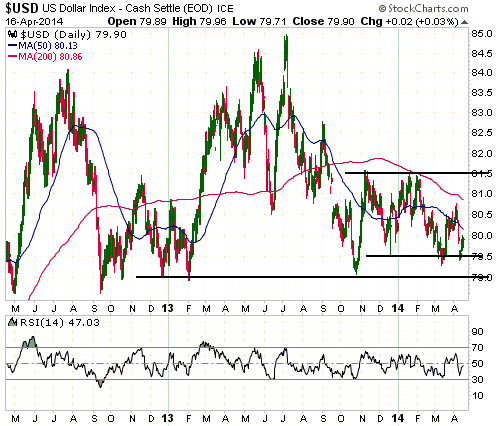
With the recent rebound having eliminated the dollar's 'oversold' condition and
in expectation that a downside breakout will occur sooner rather than later, our
short-term US$ outlook has shifted to bearish.
Updates
on Stock Selections
Notes: 1) To review the complete list of current TSI stock selections, logon at
http://www.speculative-investor.com/new/market_logon.asp
and then click on "Stock Selections" in the menu. When at the Stock
Selections page, click on a stock's symbol to bring-up an archive of
our comments on the stock in question. 2) The Small Stock Watch List is
located at http://www.speculative-investor.com/new/smallstockwatch.html
Chart Sources
Charts appearing in today's commentary
are courtesy of:
http://stockcharts.com/index.html

|









