|
- Interim Update 16th June 2010
Copyright
Reminder
The commentaries that appear at TSI
may not be distributed, in full or in part, without our written permission.
In particular, please note that the posting of extracts from TSI commentaries
at other web sites or providing links to TSI commentaries at other web
sites (for example, at discussion boards) without our written permission
is prohibited.
We reserve the right to immediately
terminate the subscription of any TSI subscriber who distributes the TSI
commentaries without our written permission.
Fitting the pieces of the inter-market puzzle together
The
pieces of the inter-market puzzle often don't fit neatly together, one
reason being that 'well established' inter-market relationships
periodically change. We've recently seen a great example of this with
respect to the well-known relationship between the gold and currency
markets. More often than not gold performs well when the euro is strong
and the US$ is weak, and yet since early February the gold market has
strengthened on the back of euro weakness (and resultant US$ strength).
We pay close attention to the relationships between different markets,
but due to the fact that these relationships regularly vary and
sometimes break down altogether we always place more emphasis on
individual market analysis. In a perfect world the conclusions based on
inter-market analysis will mesh with, and support, the conclusions that
stem from individual market analysis, but in the real world there is
regularly a conflict. When a conflict occurs we give priority to the
individual market analysis. Gold, for instance, is much more of a play
on a general decline in monetary confidence than a play on US$
weakness, so it really wasn't surprising that major concerns about
euro-zone stability led to the gold price rising in US$ terms while the
US$ moved sharply higher against the euro.
Currently, the pieces of the inter-market puzzle do fit together quite
neatly. At least, it seems to us that they do. For example, a
counter-trend rebound in the stock market would be expected to go
hand-in-hand with counter-trend rebounds in industrial commodities, the
euro, and the commodity currencies, along with some consolidation in
the gold market, which is exactly what is happening. The rebounds could
continue for a few more weeks, following which the overarching trend --
a trend that involves a shift away from growth-oriented investments
towards 'safe havens' -- should resume.
Chasing Performance
Warren
Buffett has likened the relationship between an investor and the stock
market to that of a batter and a pitcher. The market is continually
pitching, but the investor is under no obligation to swing at any
pitch. Rather, the investor is entitled to wait...and wait...and wait
until he gets exactly the right pitch.
For an investor that waits around for the 'right pitch' there will
naturally be periods of inactivity. These periods can be tedious and
frustrating, but they are essential because there will always be times
when the market does not pitch anything worth swinging at. This is even
the case within the market sectors where the best long-term
money-making opportunities lie, meaning the gold sector at this time.
Unfortunately, some investors feel that they should always be actively
doing something to increase their wealth, so they quickly jump from one
perceived opportunity to the next in a frenetic chase for short-term
performance. The result is that they have a more interesting time
losing money.
We'll take the market action as it comes, but at this stage we expect to see a lot of 'juicy pitches' in October-November.
The Stock Market
Noteworthy comments from the latest Barrons Roundtable
Barrons Magazine has just published the mid-year edition of its
"Roundtable" discussion. For the uninitiated, the Roundtable comprises
10 well-known analysts/investors who opine on the markets and give
suggestions on how to profit from the financial environment that they
anticipate. Here are some of the most interesting and sensible comments
from the latest installment:
Felix Zulauf (Owner and president, Zulauf Asset Management, Zug, Switzerland) said:
"European and U.S.
policymakers believe China eventually will bail us out, but China is
tightening. Its real-estate sector will get hit badly. All the leading
indicators are topping around the world. Commodity prices are heading
lower. The stock market probably will make its low for the year in late
summer or fall. The upside is probably 5%, the downside 20%. If there
is a big break in the fall and the Federal Reserve starts printing
money again, stocks could rally."
And:
"In commodities, I would
short aluminum and the DJ Stoxx 600 Optimised Basic Resources ETF, as
well as the iShares MSCI Brazil Index and the iShares MSCI Australia
Index. I expect base-metals prices to decline due to softening demand
and record inventories. The U.S. dollar rise that started against the
euro will spread to almost all other currencies. Resource currencies
like the Australian dollar and Brazilian real are in the early stages
of a cyclical decline. By shorting these ETFs, investors can catch
declining equity prices as well as falling currencies."
And:
"It would be best if the
weaker members left the EU. If they don't leave, the devaluation of the
euro will continue. Eventually it will have to decline to a level at
which even the weakest member can compete in the world economy. At the
end of the day, the EU will break up, because its other members are
using Germany as the payer of last resort for their sins. German
citizens will revolt and vote in a new government with a different
attitude."
We totally agree with the above, although we aren't in agreement with
all of Zulauf's views. For one example of disagreement, he thinks that
US Treasury bonds will be a good investment for the next 6-9 months,
but the T-bond currently doesn't appeal to us as either a 'long' or a
'short'. For another example, in a recent interview with Eric King
he said that he expected central banks to allow deflationary forces to
build over the next few years and to then suddenly engineer a massive
inflation of the money supply to effectively wipe out all bank debt,
destroying the currency in the process. This forecast makes no sense to
us. Central bankers such as Ben Bernanke believe in 'fighting'
deflation -- or what they perceive to be deflation -- every step of the
way, but at the same time they are mindful of the need to maintain the
illusion that the official currency is sound. Consequently, there is
likely to be a gradual build-up of an inflation problem until a
'tipping point' is finally reached where "the masses wake up".
Fred Hickey (Editor, The High-Tech Strategist, Nashua, N.H.) said:
"The "exit strategy" talk
of earlier this year now has gone by the wayside. All exit strategies
have been put away. That is why I continue to be heavily invested in
gold. The stock market is dangerous as valuations aren't where they
were at the lows last year. I expect stock prices to keep falling
unless and until the Fed starts printing again. If that happens, stocks
can go up. It is hard to say where the market will be at the end of the
year. That also makes it a dangerous market to short.
The alternative to
printing money would be to let the market clear the excesses in the
system. But that becomes more difficult the longer it is postponed.
Ultimately that is what will happen. As Ludwig von Mises said, the
final outcome of a credit expansion is general impoverishment."
We agree. The "exit strategy" talk of the past 9 months was pure
propaganda. Central bankers can't withdraw their monetary support
because they never permitted the necessary liquidation of the
mal-investments fostered by the preceding inflation-fueled boom.
Instead, with plenty of help from politicians they fueled additional
mal-investments. This means that any genuine attempt to 'tighten the
monetary reins' WILL lead to another financial crisis. So, rather than
shifting away from the inflationary stance of the past 20 months,
additional weakness in the stock market and the re-emergence of
deflation fear over the months ahead will very likely prompt another
round of monetary largesse. In today's world there are few things as
predictable as the reaction of the central banking community to rising
fear of deflation.
Marc Faber (Managing director, Marc Faber Ltd., Hong Kong) said:
"The S&P might drop
to around 950. I am bearish about the world. In the second half of the
year, data on economic growth and corporate profits will disappoint. At
the same time the Federal Reserve is run by a money printer, and a
prospective vice chairman, Janet Yellen, who said she would implement
negative interest rates if she could. Interest rates, in real terms,
will stay at zero forever."
And:
"The European economy is
rolling over, the U.S. economy could roll over, and there is evidence
of a slowdown in China. As soon as economies around the world weaken
again, central banks will have another excuse to ease and keep interest
rates artificially low. The global economy could deteriorate but the
markets might not go down, because there is more money-printing and
more stimulus packages. But the market could get more selective. From
March 2009 through April 2010, equities and commodities went up, in
particular industrial commodities. In the future, industrial
commodities might not perform well, because of a global economic
slowdown, but some equities could do well."
And:
"I...recommend shorting
the Australian dollar as a way of playing the slowdown in China, which
will lead to reduced demand for industrial commodities. Australia, a
major commodities producer, is like a warrant on China. I would rather
short the Australian dollar because the Chinese market already has
fallen 30% from its August 2009 high."
Our views are most closely aligned with those of Marc Faber.
Current Market Situation
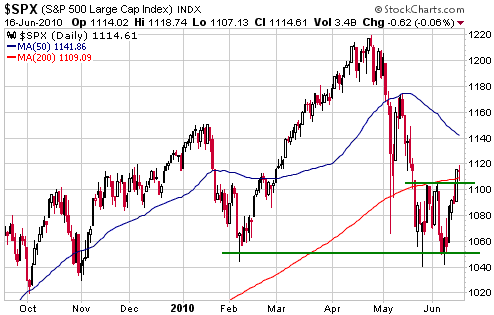
The following daily chart shows that the S&P500 Index broke above
short-term resistance in the low-1100s earlier this week. The breakout
creates a measured objective of 1160, a rise to which would put in
place the "right shoulder" of the "head and shoulders" topping pattern
that many pundits think is unfolding.
The main problem with
the "head and shoulders" idea is that it's a little too popular amongst
the bearish contingent. Here are two other possible short-term outcomes
that are just as likely:
1. The S&P500 moves back up to around 1200 over the next four weeks
in what will prove to be a successful test of its April high. This
scenario has the advantage of being consistent with our short-term
currency market outlook.
2. The S&P500 tops near its current level and soon begins its next downward leg.
Regardless of whether it ends at 1120 or 1160 or 1200, we believe that
the current rally will turn out to be the counter-trend variety and
will be followed by a decline to new lows for the year. Also, we have
previously said that we would downgrade our short-term stock market
outlook to "bearish" if the S&P500 moved up to within 2% of its
50-day moving average. It traded within 2.1% of this moving average on
Wednesday, which is close enough.
Our short-term bearish outlook is based on the opinion that the
S&P500 has maximum upside potential to around 1200 and downside
risk to the mid-900s over the next few months.
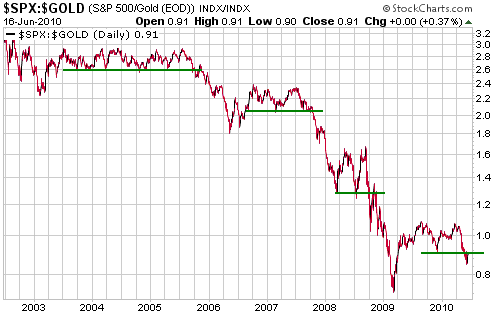
Looking at the US stock market from a different perspective, the
following chart shows how the S&P500 has performed in gold terms
over the past 8 years. Notice that the S&P500/gold ratio recently
broke below lateral support and that similar breaks of support have
been followed by substantial declines.
The break below support would be confirmed by a move below the early-June low of 0.84.
Gold and
the Dollar
Gold
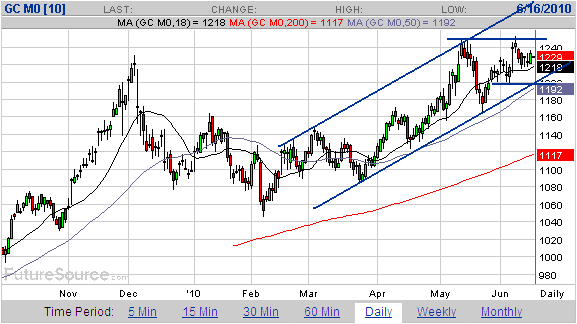
The gold market has recently been 'marking time', which is common for
this time of the year. The following daily chart shows that resistance
lies at $1250 and support lies just below $1200.
A daily close below the aforementioned support would suggest that a pullback to the low-$1100s was underway.
Gold Stocks
There are certain cases where the level of trading volume is a
meaningful indicator. For example, when a small-cap stock begins to
rise in price on unusually high volume with no news it probably means
that a positive development is in the works. In most cases, though,
volume isn't important. For example, if we were 'long' a stock that
fell by 50%, the fact that it happened to fall on declining volume
would be of no consolation. Taking a specific example, the entire
rebound in the US stock market from the March-2009 bottom occurred on
low volume, but it was still the best post-crash rebound ever and
caused short-sellers to lose just as much money as they would have lost
if the trading volume had been 'healthy'.
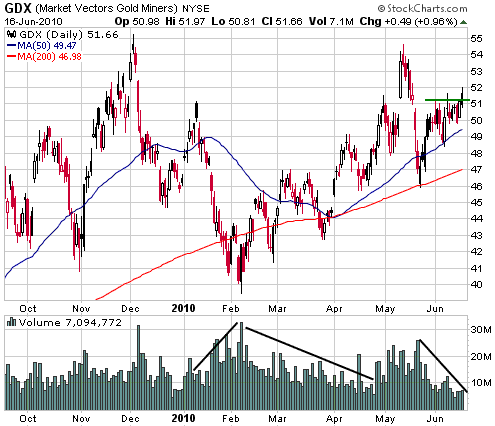
That being said, the gold sector's volume pattern is moderately
interesting. What's interesting is that since the beginning of this
year the trading volume has generally trended in the opposite direction
to the price, meaning that volume has risen during the price declines
and fallen during the price advances. The only exception to this
pattern occurred during the first half of May, when there was a spurt
in the demand for gold-related investments amidst a market-wide
mini-panic. This volume pattern is clearly evident on the daily GDX
(Gold Miners ETF) chart displayed below.
We don't want to make a big deal of the gold sector's volume pattern,
mainly because we don't think it is a big deal. However, it is
consistent with the idea that all of this year's price action has
occurred within the context of an intermediate-term correction.
Another point worth mentioning is that GDX and the gold-stock indices
broke above the tops of their recent trading ranges on Wednesday. These
breakouts don't say much about the future, but they do help with risk
management. The reason is that if these breakouts are 'real' then the
lows of the past week will not be breached. This means that 'stops' on
long trading positions can now be raised to just below the lows of the
past week (452 for the HUI, $49.80 for GDX).
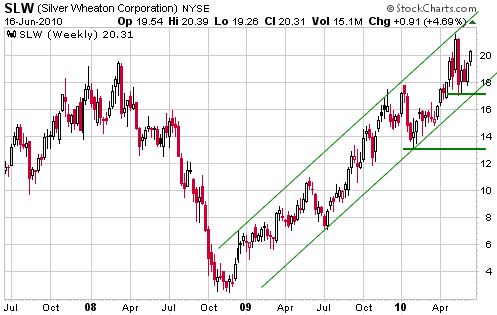
The following weekly
chart of Silver Wheaton (SLW) shows that a combination of channel and
lateral support lies at around US$17. A break below $17 would probably
bring the lower support at $13 into play.
In the 2nd June Interim Update we wrote: "Speculators
looking for ways to hedge long-term exposure to gold and silver stocks
could consider purchasing December-2009 put options on Silver Wheaton
(SLW) with the stock in the US$19-$20 range." SLW ended Wednesday's session just above the top of this range and within a few percent of its May high.
If you need to hedge then the optimum time to do so is when prices are
high, not after they have broken out to the downside. SLW is a good
candidate for a put-option hedge, not because there is anything wrong
with the underlying company but because: a) it is extended to the
upside on an intermediate-term basis, b) it often performs like a
high-beta play on the gold-stock indices, c) it could be completing the
counter-trend rebound that invariably follows the initial decline from
an intermediate-term peak, and d) it has a lot of downside potential.
Currency Market Update
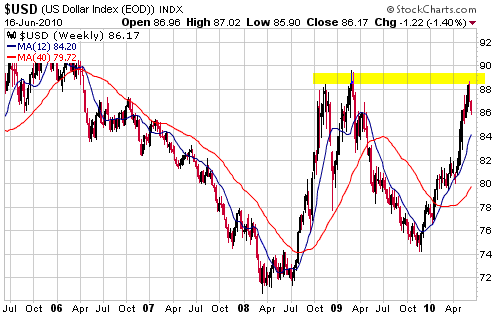
The following weekly chart shows that the Dollar Index has reversed
lower after testing major support at around 89. The correction will
probably last a few more weeks and could encompass a test of the recent
peak. Our best guess at this time is that it will end somewhere between
the moving average lines shown on the chart.
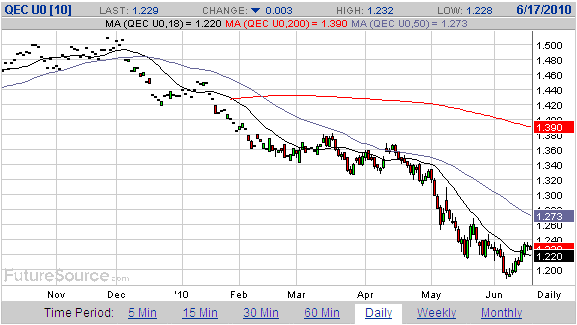
A daily chart of June
euro futures is displayed below. A likely target for the current
rebound is the 50-day moving average, which is at 1.273 and falling.
The biggest threat to
the forecast for a continuing euro rebound is the potential for an
immediate resumption of Europe's debt crisis. Fear about the solvency
of European governments and banks has abated over the past couple of
weeks, but it lies just beneath the surface and could re-emerge as the
dominant financial-market influence at any time.
The highest-profile concern right now is the freezing-up of Spain's
inter-bank money market. The capital markets are essentially closed to
most Spanish banks, so the government of Spain -- via the Bank of Spain
-- has decided to carry out and publish the results of bank "stress
tests". The hope is that such a gesture will remove uncertainty and
stimulate the flow of credit.
Stimulating the flow of credit within the banking industry could buy
some time, but it wouldn't even touch on the main issue. The main issue
is that there is too much debt. The banks have too much debt and most
governments have too much debt.
Update
on Stock Selections
(Notes: 1) To review the complete list of current TSI stock selections, logon at http://www.speculative-investor.com/new/market_logon.asp
and then click on "Stock Selections" in the menu. When at the Stock
Selections page, click on a stock's symbol to bring-up an archive of
our comments on the stock in question. 2) The Small Stock Watch List is
located at http://www.speculative-investor.com/new/smallstockwatch.html)
 Clifton Star Resources (TSXV: CFO). Shares: 28M issued, 38M fully diluted. Recent price: C$4.18 Clifton Star Resources (TSXV: CFO). Shares: 28M issued, 38M fully diluted. Recent price: C$4.18
CFO is an exploration-stage junior gold mining stock that generally
moves to the beat of its own drummer rather than to the beat of the
gold market. For example, even though CFO has a lot of unhedged
in-ground gold in a secure location (Quebec), and therefore stands to
benefit greatly from gains in the gold price, it regularly rises on
days when most gold stocks are down and falls on days when most gold
stocks are up.
When CFO rocketed up to C$7-$8 in late February we thought it was a
good candidate for partial profit taking. Shortly after it began a
downward trend, and in the 19th April Weekly Update we speculated that
the maximum realistic downside potential was defined by support at
C$3.80-C$4.00. At that time we said: "If
CFO dropped to near this support and there were no company-specific
negative developments in the mean time then it would be appropriate for
speculators to 'back up the truck'."
CFO has just dropped to the C$3.80-$4.00 support area (see chart below for details), so is it now time to 'back up the truck'?
We believe that this is an excellent buying opportunity and that the
stock is close to its ultimate correction low, but we do have one
concern. The concern is the lack of drilling results over the past few
months. A massive drilling campaign got underway early this year and we
expected that this campaign would yield a steady stream of drilling
results throughout the year, but apart from one uninspiring press
release in April there has been no drilling news from CFO since
February.
The lack of news is not a management failure on CFO's part and does
not, as far as we know, indicate a problem with the project. It is
important to understand that CFO's Duparquet gold project in Quebec is
a 50/50 JV between CFO and Osisko (OSK), with OSK being the operator
and therefore having the primary responsibility for generating and
publishing the drilling results. The issue, we suspect, revolves around
the fact that while the Duparquet project is everything for little CFO,
it is only the third most important project for the much larger OSK.
The unexpected lack of drilling news opens up the possibility that CFO
will drop to the mid-C$3 area before bottoming out, but the C$13/share
target mentioned in our 22nd February commentary remains valid. This
target is based on the JV proving up a 10M-ounce gold resource at
Duparquet.
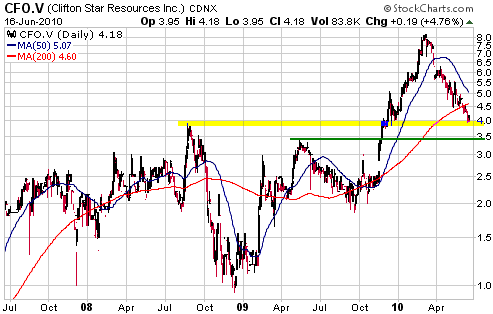
Chart Sources
Charts appearing in today's commentary
are courtesy of:
http://stockcharts.com/index.html
http://www.futuresource.com/

|