- Interim Update 16th November 2016
Copyright
Reminder
The commentaries that appear at TSI
may not be distributed, in full or in part, without our written permission.
In particular, please note that the posting of extracts from TSI commentaries
at other web sites or providing links to TSI commentaries at other web
sites (for example, at discussion boards) without our written permission
is prohibited.
We reserve the right to immediately
terminate the subscription of any TSI subscriber who distributes the TSI
commentaries without our written permission.
Trump's first 100 days
At the end of October Donald
Trump released
a list of things that he would do within his first 100 days in office
if elected President. Many of the items on the list are either not
realistic or not important. For example, the first item on the list is: "Propose
a Constitutional Amendment to impose term limits on all members of
Congress." He can certainly propose such a change, but there is no
way that a majority of incumbent politicians will vote in favour of it.
There are, however, items on Trump's "things to do list" that are both
achievable and important. We will now single-out some of the ones that
stand a good chance of happening and would have a significant effect on
the financial markets.
1) "I will direct my Secretary of the
Treasury to label China a currency manipulator".
This is
wrongheaded thinking in three ways. First, every currency is being
manipulated. For example, if China deserves to be labeled a currency
manipulator then so does the US Federal Reserve. Second, the "currency
manipulator" charge would stem from the belief that China's government was
trying to weaken the Yuan in order to obtain a trade advantage, but the
fact that China has reduced its holdings of US government bonds by
hundreds of billions of dollars over the past two years means that China's
government has actually been trying to STRENGTHEN the Yuan. The reality is
that the Yuan has been falling under the weight of its own over-valuation
and China's government has been trying to slow the decline. Third, it's
nonsense that China's economy would gain a trade advantage over the US
economy via an artificially-low Yuan.
Based on wrongheaded thinking
it certainly is, but this is something that Trump seems determined to push
ahead with. The potential effects are reduced trade, higher costs for US
consumers, an increase in the pace at which China's government sells off
its US Treasury bonds and higher US interest rates.
2) "I will
direct the Secretary of Commerce and U.S. Trade Representative to identify
all foreign trading abuses that unfairly impact American workers and
direct them to use every tool under American and international law to end
those abuses immediately".
This implies that the US government
will implement tariffs and put other obstacles in the way of international
trade. Did nobody in US politics learn anything from
Smoot-Hawley?
3) "Middle Class Tax Relief And
Simplification Act. An economic plan designed to grow the economy 4% per
year and create at least 25 million new jobs through massive tax reduction
and simplification, in combination with trade reform, regulatory relief,
and lifting the restrictions on American energy. The largest tax
reductions are for the middle class. A middle-class family with 2 children
will get a 35% tax cut. The current number of brackets will be reduced
from 7 to 3, and tax forms will likewise be greatly simplified. The
business rate will be lowered from 35 to 15 percent, and the trillions of
dollars of American corporate money overseas can now be brought back at a
10 percent rate."
As discussed in the latest Weekly Update,
Trump's proposed tax cuts aren't being funded by reduced government
spending and therefore aren't genuine tax cuts. The private sector will
end up paying, one way or another.
What the tax cuts constitute is
a Keynesian stimulus program, and in this regard they could be effective.
In other words, they could give the economy a significant boost over the
coming year or two at the cost of slower long-term progress. They could
also give equity prices a significant intermediate-term boost (especially
when it is considered that more than 70% of the tax cut will go to the top
5% of taxable-income earners) and add to the upward pressure on interest
rates.
The proposal to lure trillions of dollars of American
corporate money from outside to inside the US will give the Dollar Index
and the US stock market a boost if it is effective, but we don't see why
it would be effective. Why pay 10% to the US government just for the
'privilege' of bringing home money that has already been subject to
foreign tax requirements?
As an aside, the money-supply figures
reveal that there has been a substantial transfer of US dollars from
outside to inside the US over the past 12 months. That is, the
international money flow that Trump's tax proposal is designed to
incentivise has already happened for other reasons. The other reasons are
probably fear of the ECB's profit-crushing Negative Interest Rate Policy
(NIRP), the risk of a European banking crisis, "Brexit"-related
uncertainty, and the range of social, political and economic problems
infesting Europe.
4) "End The Offshoring Act. Establishes
tariffs to discourage companies from laying off their workers in order to
relocate in other countries and ship their products back to the U.S.
tax-free."
This would hinder international trade, lower
corporate profits and increase costs for US consumers.
5) "Repeal
and Replace Obamacare Act. Fully repeals Obamacare and replaces it with
Health Savings Accounts, the ability to purchase health insurance across
state lines, and lets states manage Medicaid funds. Reforms will also
include cutting the red tape at the FDA: there are over 4,000 drugs
awaiting approval, and we especially want to speed the approval of
life-saving medications."
This could be a big step in the
right direction. It could boost the economy, pave the way for more
full-time jobs and save a lot of lives, but it isn't something that's
going to happen in the first 100 days.
6) "Restoring National
Security Act. Rebuilds our military by eliminating the defense sequester
and expanding military investment".
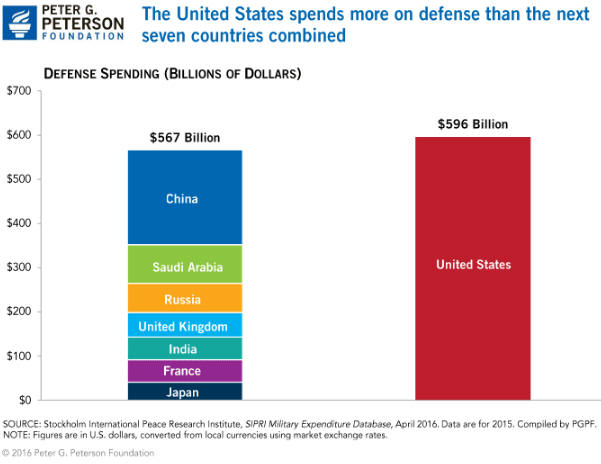
The idea that the US is
not spending enough on its military is absurd, as made clear by the
following chart.
The problem is that policing the world and being constantly involved
in regime change in multiple countries* is both very expensive and
counter-productive. US foreign policy under Trump is likely to be
less-interventionist that it would have been under Clinton, but funding
the military is still going to place a large burden on the US economy over
the next few years. Moreover, no matter how excessive the size of the
military, war-mongers in the government will always find ways to make full
use of it.
7) Dismantle the
Dodd-Frank Wall Street Reform and Protection Act that was passed in
2010 as part of a typical "closing the stable door after the horse has
bolted" response to the 2007-2009 financial crisis. This wasn't on the
first-100-days list linked above, but Trump has said that it is a top
priority.
It should first be understood that if fractional reserve
banking were recognised under the law as the fraudulent practice that it
is, then there would be no need for any special laws to 'regulate' the
banks. To put it another way, an entity that has been granted the power to
create new legal tender out of nothing has the ability to disrupt the
entire economy and therefore needs a special set of laws/regulations.
Unfortunately, Dodd-Frank is not a useful set of laws/regulations. The
big banks are currently engaged in the same sort of activities that
contributed to the 2007-2009 crisis, so the legislation hasn't achieved
its touted purpose. The legislation has, however, caused the banks to
employ an army of lawyers and compliance officers that produces reams of
paperwork and adds no value. Actually, the 'compliance army' that must now
be employed by every financial institution adds negative value, because
from a customer's perspective it makes dealing with banks, brokers and
other financial firms far more difficult than it should be.
In
effect, Dodd-Frank makes the economy less efficient and its elimination
should be an important plus, although much will depend on what replaces
it.
Summing up, the various proposals aimed at making international
trade 'fairer' will be costly to the US economy. The tax cuts could be
very effective as a short-to-medium-term stimulus program, with
substantially-higher interest rates being the most obvious ramification.
The elimination of some unwieldy legislation, most notably Obamacare and
Dodd-Frank, will help, while growing the already-bloated military will
waste resources.
*Rarely does a week go by
when the US is not involved in the bombing of at least three countries,
and in September it actually managed to
bomb six countries in a single weekend.
Copper breaks the bear
market pattern
The middle section of the
following chart illustrates the Commitments of Traders (COT) situation for
Comex copper futures. It reveals a spectacular rise in the speculative
net-long position (the red bars) during the one-week period ending Tuesday
8th November, which is the date of the latest available data.
At
8th November the speculative net-long position in copper futures was
actually higher than at any time since early-2004. In other words, it hit
a 12-year high last week. Furthermore, the 8th November numbers don't
include the effects of the post-election price surge.
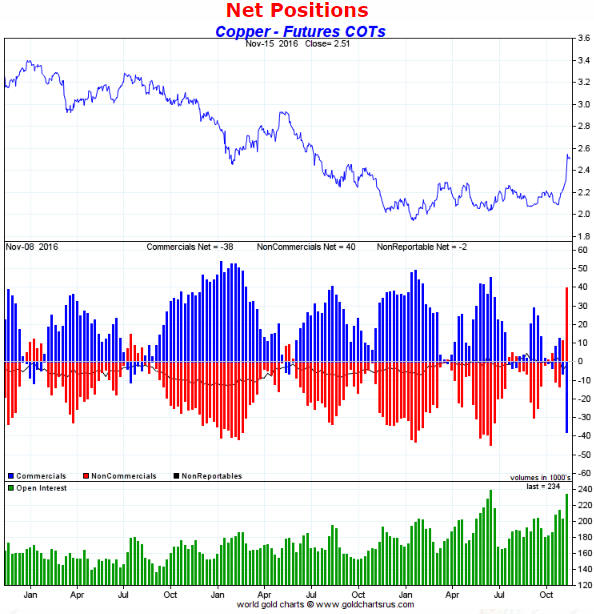
The dramatic increase in the speculative net-long position in copper
futures has smashed the bear-market pattern that dominated over the
preceding three years. Prior to the past two weeks, whenever the
speculative net-long position in copper futures moved above the zero line
the price was near a short-term peak. The price would then decline until
speculators, as a group, had become net-short to the tune of 30,000-40,000
contracts.
Putting it in simpler terms, the change in copper's COT
situation suggests that copper has commenced a cyclical bull market.
At the same time, the ramp-up in speculation has created short-term
downside risk. In this regard, the copper-futures speculation in China
discussed in the article posted
HERE is of greater concern than the goings-on at the Comex. It seems
that speculators in China will buy any futures contract that happens to be
in a steep upward trend.
The T-Bond is close to a
short-term bottom
Here is a chart of the 20+ Year
Treasury ETF (TLT), a proxy for the prices of long-dated US government
bonds. The bottom section of the chart shows the daily RSI(14), a
short-term momentum indicator.
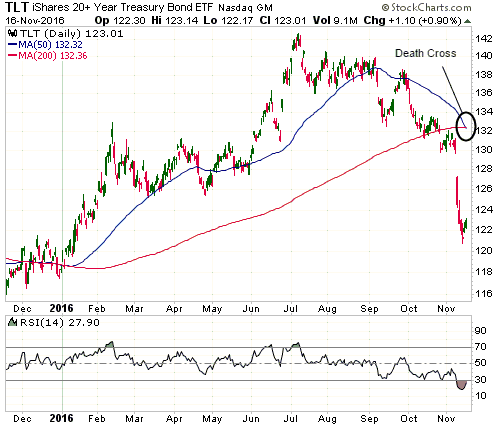
On Monday of this week, TLT's daily RSI hit its lowest level since the
second quarter of 2007. This means that by one measure, the T-Bond market
is now more 'oversold' than at any time over the past 9 years.
Also
worth noting is that TLT has just experienced a "death cross", meaning
that its 50-day MA has just crossed its 200-day MA from above. Despite the
name, "death crosses" are reliable short-term BULLISH signals, the reason
being that they tend to occur near short-term price bottoms. Specifically,
a "death cross" will often occur near the end of a multi-month correction
within a bull market or around the first short-term bottom within a
long-term decline.
The combination of the 'oversold' extreme in the
daily RSI and the "death cross" suggests that the Treasury market is very
close to a short-term bottom in terms of both price and time.
The Stock Market
The US
In the latest Weekly Update we listed "market internals" as one of three
reasons that there could be a 6-12 month extension to the US stock
market's long-term bullish trend. Here's what we wrote:
"...at
no time over the past several months has there been a meaningful bearish
divergence between the senior US stock indices and the 'market internals'.
Furthermore, during last week's rally the 'internals' were stronger than
most of the indices. For example, whereas the S&P500 Index (SPX) rebounded
to a lower high last week, the UWSPX/SPX ratio (the Unweighted SPX divided
by the capitalisation-weighted SPX, a measure of breadth within the
S&P500) made a new high. This is a bullish divergence."
Today
we wanted to make it clear that the upside breakout by the UWSPX/SPX ratio
was not the only bullish divergence over the past week between the indices
and the 'internals'. Of perhaps greater significance is that there have
been more individual common stocks making new 52-week highs on both the
NYSE and the NASDAQ than at any time over the past few years.
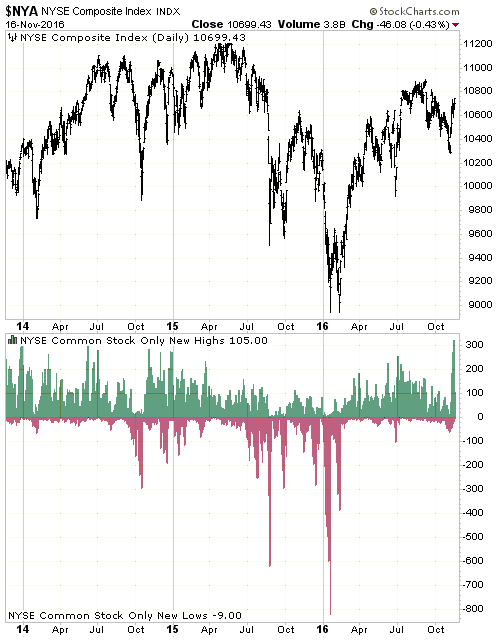
Here's a chart showing the NYSE situation. Within the past few days the
number of individual common stocks making new 52-week highs (the green
bars on the lower section of the chart) hit its highest level of the past
three years even though the NYSE Composite Index was below its
September-2016 peak and well below its 2015 peak.
We hasten to point out that while this is evidence of a continuing
bull market, it does not imply a bullish short-term outcome. There were
many cases over the past 15 years when the number of individual stocks
making new 52-week highs became relatively large just prior to the start
of a significant short-term market decline.
Gold and the Dollar
Gold
Current Market Situation
The US$
gold price almost touched important lateral support in the low-$1200s on
Monday. Also, Monday's intra-day low might have defined the bottom of a
price channel.
The rebound following the test of support has been
weak up until now, so we won't be surprised if there are additional tests
over the days ahead. An intra-day spike below support wouldn't be a
problem, but a weekly close below $1200 would be a problem for the
intermediate-term bullish case.
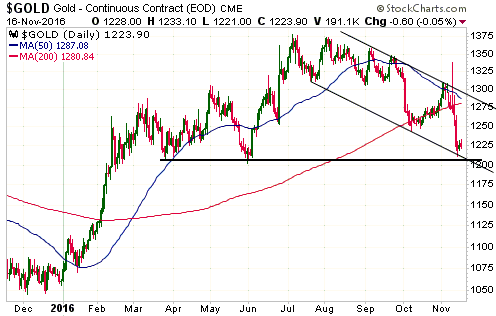
At this stage the decline from the July peak looks like a routine
correction, but with the 'new bull market scenario' having not yet been
confirmed we shouldn't blindly assume that this is necessarily the case.
In the financial markets, blind assumptions that turn out to be wrong are
often very costly.
We are looking forward to seeing the next set of
COT data as it will show the extent to which speculators liquidated their
collective net-long position during the post-election rout. It will be a
positive development if the total speculative net-long position in Comex
gold futures has fallen to 150K contracts or less.
India's Gold Market
In last week's
Interim Update we linked to an article by Jayant Bhandari dealing with the
general panic, and the panic-buying of gold, that was set in motion by an
incredibly ill-conceived and poorly-planned decision on the part of
India's government to ban the most popular currency notes. A follow-up
article by the same author has been posted at
http://www.acting-man.com/?p=47842. It is a must read.
The
situation in India appears to have gone from very bad to much worse over
the past week. Economic collapse appears to be an imminent risk, all
because of the gross stupidity and arrogance of Narendra Modi, India's
Prime Minister.
Gold Stocks
In the latest
Weekly Update we mentioned that the HUI didn't have any remaining nearby
lateral support of significance, but that the bottom of a price channel
was situated a few points below Friday's low. As illustrated by the
following chart, the channel bottom was reached on Monday.
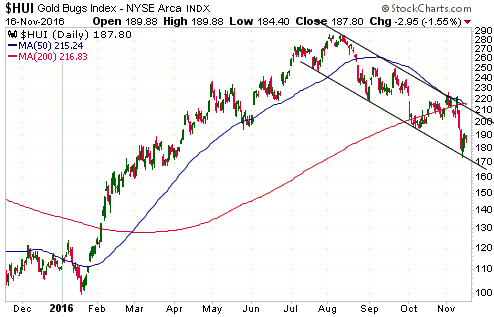
The rebound from the channel bottom has not done enough, yet, to
indicate that a short-term low or even just a multi-week low is in place.
Conclusive evidence of a reversal would require a solid break above the
channel top, but a daily close above 196 would be an early warning of a
bullish turnaround.
Interestingly, one of the same signs that the
T-Bond market is close to a short-term bottom also applies to the HUI. We
are referring to the fact that the HUI has just experienced a "death
cross". Even if we are dealing with a far more bearish intermediate-term
scenario than we currently have in mind, the "death cross" increases the
probability that a short-term bottom will soon be put in place if it isn't
already in place.
The Currency Market
The Dollar Index
In the latest
Weekly Update we wrote that major resistance at 100.0-100.5 for the Dollar
Index would probably be tested within the next two weeks. As illustrated
below, the resistance is now being tested.
There is a good chance
that this resistance will be breached within the coming few months.
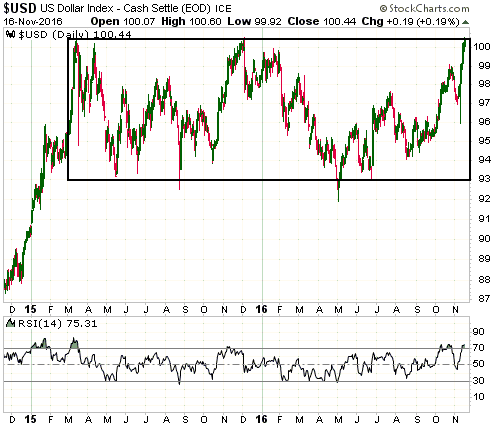
On a short-term basis, the Dollar Index is 'overbought'. This could
result in a few weeks of consolidation in the 98-101 range prior to a
breakout.
The likelihood of an upside breakout in the Dollar Index
within the coming few months represents a threat to gold-related and
commodity-related investments. It is a good reason to be cautious. More
specifically, it is a good reason to maintain a hefty cash reserve and to
look for opportunities to hedge long-term positions.
The Australian Dollar (A$)
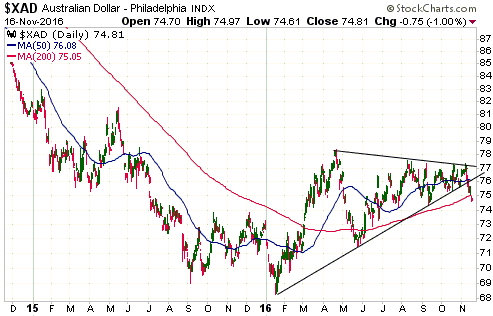
The A$
is beginning to confirm the C$'s bearish performance.
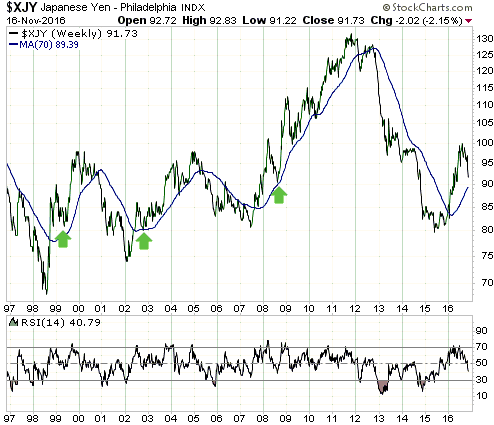
The Yen
Our expectation has
been that the Yen's July-August 'double top' near 100 would be followed by
a roughly 10% decline to the vicinity of the 70-week MA, after which there
would probably be a rally to new multi-year highs. This expectation was
based on what happened in the past after rallies from multi-year lows to
above the 200-week MA, and is unchanged.
As illustrated by the
weekly chart displayed below, the 70-week MA is in the 89-90 range and the
current price is 91.7. This should mean that the Yen is now within 2
points of a correction low and in roughly the same position as it was at
the times indicated on the chart by the green arrows.
Updates on Stock Selections
Notes: 1) To review the complete list of current TSI stock selections, logon at
http://www.speculative-investor.com/new/market_logon.asp
and then click on "Stock Selections" in the menu. When at the Stock
Selections page, click on a stock's symbol to bring-up an archive of
our comments on the stock in question. 2) The Small Stock Watch List is
located at http://www.speculative-investor.com/new/smallstockwatch.html
 Premier
Gold (PG.TO) published the long-awaited results of the FS for the
Hardrock (Trans-Canada) gold project after the close of trading on
Wednesday 16th November. The results can be summed up in one word:
lacklustre.
Premier
Gold (PG.TO) published the long-awaited results of the FS for the
Hardrock (Trans-Canada) gold project after the close of trading on
Wednesday 16th November. The results can be summed up in one word:
lacklustre.
The results are lacklustre because they reveal that
the project is economically unattractive near the current gold price. The
project has significant option value, but there is little chance of it
being shifted into the construction phase with the gold price at or below
US$1250/oz. If all else remains the same, a gold price of at least
US$1400/oz will probably be required.
Although the results are
unimpressive, they aren't surprising. We were hoping for better, but the
delays in completing the FS and PG's efforts to de-emphasise the Hardrock
project by making investments elsewhere were warnings that Hardrock's
economics would not justify mine development anytime soon.
If the
stock market were an unemotional weighing machine then the FS results
wouldn't lead to additional weakness in PG's stock price. This is because
PG offers good value at its current price even if a value of zero is
assigned to Hardrock. However, the stock market is a highly emotional
voting machine.
There will be additional comments on Hardrock's FS
in the Weekly Update.
Chart Sources
Charts appearing in today's commentary
are courtesy of:
http://stockcharts.com/index.html
http://www.goldchartsrus.com/