|
- Interim Update 17th March 2010
Copyright
Reminder
The commentaries that appear at TSI
may not be distributed, in full or in part, without our written permission.
In particular, please note that the posting of extracts from TSI commentaries
at other web sites or providing links to TSI commentaries at other web
sites (for example, at discussion boards) without our written permission
is prohibited.
We reserve the right to immediately
terminate the subscription of any TSI subscriber who distributes the TSI
commentaries without our written permission.
Inflating away the debt
Under
the current monetary system almost all money gets borrowed into
existence. For example, commercial banks generally make loans by
creating new money out of nothing, not by transferring part of the
existing money supply to the borrower. Also, when the Fed purchases the
Government's bonds it does so with newly created money. Consequently,
adding a dollar to the money supply usually entails adding a dollar of
debt. How, then, can the total debt burden ever be 'inflated away'?
If the central bank follows its traditional procedures then the total
debt burden can't be inflated away, but monetary inflation can help
alter the distribution of debt. For example, in the US over the past 18
months there has been a significant reduction in private-sector debt
alongside a huge increase in government debt*. Also, central banks in
general and the Fed in particular have recently demonstrated a
willingness to deviate from their traditional modus operandi in order
to pump more money into their respective economies. The Fed, for
example, has chosen to monetise existing debt securities, thus adding
new money without adding new debt. Furthermore, there is no good reason
to believe that the Fed's monetisation will stop at debt securities (if
the Fed is willing to monetise mortgage-backed bonds then at some point
in the future it may be willing to monetise shares and houses).
The deflationists argue that monetary inflation can't help, to which we
respond: yes, we know; we've been explaining in our commentaries for
the past 10 years that monetary inflation can only make things worse.
By distorting relative prices and sending false signals regarding the
amount of savings within the economy, monetary inflation leads to
widespread mal-investment and the destruction of wealth. As a result,
most debtors don't benefit in the long run from the currency
depreciation that always, eventually, stems from a large increase in
the money supply. Instead, they either become unemployed or suffer
substantial declines in their REAL incomes.
That inflation doesn't "work" or "help" goes without saying as far as
we are concerned. The problem is that the 'ignorami' that populate the
upper echelons of most central banks and governments either don't know
that, or believe that they can use monetary inflation to buy some time.
It therefore remains a good bet that the weaker the economy gets, the
more inflation there will be.
*As mentioned in
previous commentaries, hyperinflationary episodes of the past century
have generally been set in motion by a rapid expansion of government
debt combined with the monetisation of the government debt by the
central bank. In other words, hyperinflation has generally occurred via
explosions in the quantities of money AND debt. Deflation forecasters
who believe that the current high debt levels preclude the evolution of
a major inflation problem therefore don't have a sufficient
appreciation of monetary history. We reiterate, though, that while we
think hyperinflation is almost inevitable on a long-term basis, we do
not believe there is a significant risk of it occurring within the next
two years.
The Stock Market
In the latest Weekly Update we said: "The
market's 'overbought' condition points to a near-term pullback, but
it's very likely that a move to new 52-week highs will follow the next
pullback. The reason is that most indicators and market internals have
confirmed the recent strength."
A pullback hasn't yet occurred. Instead, the market has become more
'overbought', with the VIX moving to its lowest level since May of 2008
and the 10-day moving average of the equity put/call ratio reaching its
lowest level since July of 2005. This means that a pullback remains
likely. Most indicators and market internals have again confirmed the
latest strength, so it also remains likely that a move to new 52-week
highs will follow the next pullback.
The one important indicator that continues to diverge bearishly is the
HYG/TLT ratio (a measure of credit spreads). This bearish divergence
and other considerations (the Presidential Cycle, for example) suggest
that the stock market will peak on an intermediate-term basis by mid
April.
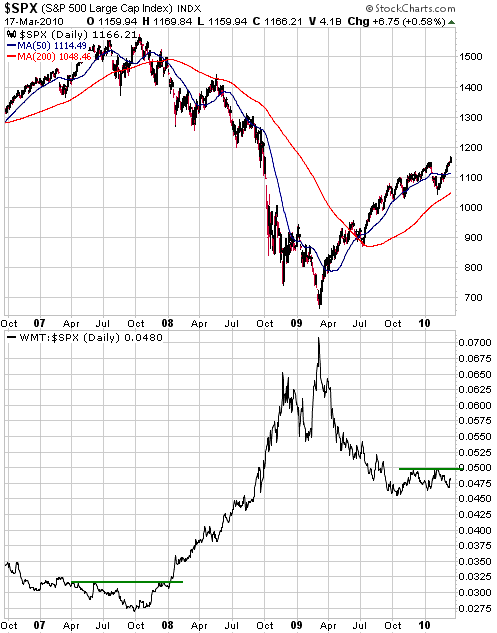
In the hope of gaining an advantage we try to look at things that every
man and his dog are NOT looking at. The following chart comparison of
the S&P500 Index (SPX) and the WMT/SPX ratio (the stock price of
Wal-Mart relative to the broad stock market) is an example. The idea
behind this chart is that 'investors' gravitate towards relatively safe
stocks such as WMT during periods when risk is generally perceived to
be increasing, resulting in WMT/SPX trending inversely to the SPX.
The WMT/SPX ratio could provide timely confirmation that an
intermediate-term decline has begun. The confirmation would be in the
form of a solid break above 0.05.
Gold and
the Dollar
Gold
Long-term speculators, people who use gold as a long-term store of
value and people who hold gold for insurance purposes shouldn't care
whether the next $50 move in the gold price is to the upside or the
downside. Regardless of whether gold's next $50 move is to the upside
or the downside, the gold price will still be within the consolidation
range bounded by its December-2009 high and its February-2010 low.
Oscillations within the consolidation range can create trading
opportunities, but the biggest and easiest money will be made by
maintaining substantial exposure to gold-related investments until gold
becomes over-valued. And how will we know when gold has become
over-valued? The answer is that we won't know for certain, but one
thing to keep in mind is that the last two secular bear markets in US
equities didn't end until after the gold price had traded at roughly
the same level as the Dow Industrials Index.
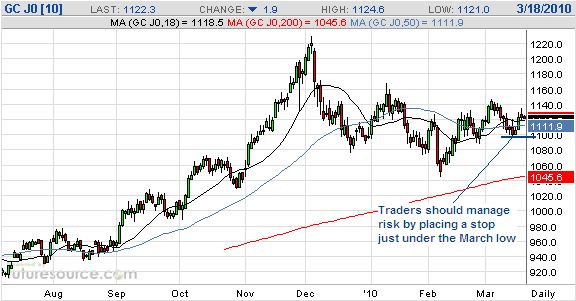
As noted in the email alert sent earlier this week, the Fed confirmed
on Tuesday that it is planning to keep the real short-term interest
rate in negative territory for many more months and that it is prepared
to resume "quantitative easing" at a moment's notice if deemed
necessary. The Fed is therefore committing to do what it can to keep
the monetary backdrop gold-bullish. As also noted in the email alert,
it would be reasonable for short-term holders of gold futures to manage
risk by placing a stop just below last week's low ($1097 in the April
contract).
Gold Stocks
Current Market Situation
In the email alert sent in response to Tuesday's market action, we wrote:
"After peaking on 3rd
March the HUI completed a picture-perfect pullback. What we mean is
that pullbacks within continuing short-term upward trends typically
last 5-8 trading days, and the pullback from the 3rd March peak
bottomed on the 8th trading day (Monday 15th March) after retracing
only half of the preceding 5-day surge. Furthermore, the low on the 8th
trading day was immediately followed by a definitive upward reversal.
This doesn't guarantee
any particular future outcome, but it does mean that the
risk-management parameters are now clearly defined. Specifically,
traders could operate under the assumption that short-term upward
trends have resumed for the gold-stock indices and gold bullion unless
the lows of the past three trading days are breached on a daily closing
basis. The relevant lows are 409 for the HUI and $1097 for April gold."
And in the latest Weekly Update, we wrote:
"As far as the coming
three weeks are concerned, we think two very different potential
outcomes have roughly equal chances of occurring. One possibility is
that the gold sector is consolidating in bullish fashion and will soon
resume its short-term advance, with the XAU and the HUI moving quickly
up to around 185 and 470, respectively. The other possibility is that
the gold-stock indices are now headed back to test their February lows."
The action during the first half of this week clearly shifted the odds
in favour of the first potential outcome; that is, it appears that we
are more likely to get a rise to resistance at 470 than a return to the
February low over the next 2-3 weeks.
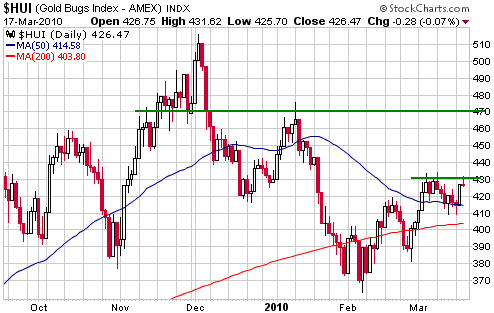
Unless something
unexpected happened, we would view a rise to 470 (or thereabouts) by
early April as a short-term selling opportunity. An example of
"something unexpected" would be a break below 78 by the Dollar Index.
The Juniors
Almost all junior gold/silver stocks rebounded strongly from their
Q4-2008 lows, but only a select few are now well above their levels of
2 years ago. Most are either flat or down on a 2-year basis, despite
gold bullion having made considerable headway in the mean time. The
juniors that have provided the best returns on a 2-year and a 1-year
basis generally have profitable production of more than 100K
ounces/year, or, in the case of exploration-stage companies, have at
least one of the following:
1) A mineral deposit that will likely be the target of a mid-tier or major mining company within the next 12 months
2) A financially-strong partner
3) A high-quality mineral deposit in a secure location AND access to
sufficient financing to take the project through to production
Of the exploration-stage stocks in the TSI List, CKG.V and KGN are in
category 1); CFO.V fits into categories 1) and 2); and FVI.TO and
ORV.TO have some current production but can be put into category 3)
because their main projects are under development.
Something we haven't seen since 2006-2007 (the last two years of the
inflation-fueled boom) is broad-based speculation at the junior end of
the gold/silver universe. The reality is that with a few exceptions,
the stock market is not giving exploration-stage stocks any credit for
their upside potential. To put it another way, there is almost no
option value being factored into the current prices of these stocks.
That it is still easy to find in-ground gold resources on sale for less
than $30/ounce is evidence of this.
Now, the future is not a simple extrapolation of the past so the fact
that the market has fixated on a certain type of stock and ignored
other types of stock over the past 12 months doesn't mean it will do
the same over the next 12 months. Cycles change, if for no other reason
than strong demand for a particular investment will increase the
valuation of that investment relative to the alternatives.
We expect to see a dramatic upward revaluation of in-ground gold and
silver resources over the next two years, but we can't confidently
predict when this revaluation will begin in earnest. As noted in
previous TSI commentaries, in the interim it will be important to
spread one's junior gold-stock exposure across the gamut -- from
companies with >200K ounces of current profitable production to
companies that are years away from having any production. Also, with
regard to the explorers we would be inclined to steer clear of
companies that haven't yet proven-up a resource of at least 1M gold
ounces.
Currency Market Update
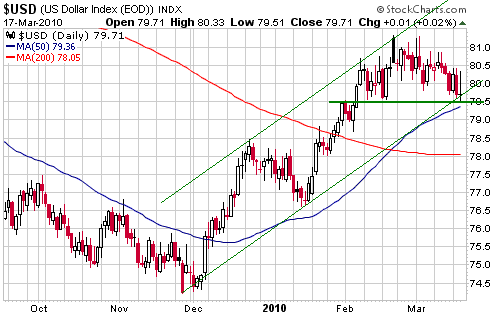
The following daily chart shows that the Dollar Index touched support
at 79.5 on Wednesday. It has therefore achieved what we have thought to
be the minimum objective for its downward correction. The maximum
objective is 78.0.
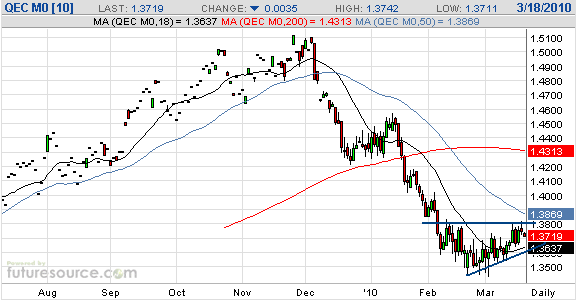
Not surprisingly, the
euro's daily chart (see below) looks like the inverse of the dollar's
chart. Support for the Dollar Index at 79.5 corresponds with resistance
for the June euro at 1.38.
The present
association between the currency market and the general perception of
the financial world can be expressed as follows:
1) The Dollar Index between 78.5 and 80.5 signifies that most things
are perceived to be right with the world (the proverbial "Goldilocks"
scenario).
2) The Dollar Index dropping below 78 would signify the general
perception of an increasing US inflation problem and would likely be
associated with the US$ gold price surging to a new all-time high.
3) The Dollar Index moving above 81 would signify the general
perception that deflation was again becoming a clear and present danger
and would likely be associated with pronounced weakness in stocks and
commodities.
We expect the Dollar Index to break out of its "Goldilocks" range to the upside, but not over the next few weeks.
Update
on Stock Selections
(Note: To review the complete list of current TSI stock selections, logon at http://www.speculative-investor.com/new/market_logon.asp
and then click on "Stock Selections" in the menu. When at the Stock
Selections page, click on a stock's symbol to bring-up an archive of our comments on the stock in question)
 Catalpa Resource (ASX: CAH). Shares: 161M issued, 171M fully diluted. Recent price: A$1.50 Catalpa Resource (ASX: CAH). Shares: 161M issued, 171M fully diluted. Recent price: A$1.50
CAH announced on Tuesday 16th March that it is raising A$20M -- A$10M
by issuing new shares at A$1.32/share to a couple of large investors
and an additional A$10M via a rights issue. Under the rights issue,
eligible CAH shareholders (those with registered addresses in Australia
or New Zealand) will be able to purchase 1 new CAH share at A$1.25 for
every 19 shares they own. Shareholders with registered addresses
outside Aust/NZ will have their rights sold on their behalf by a
nominee company and will have the proceeds of the sale sent to them
(assuming that there is a viable market in the rights and a premium
over the expenses of sale can be obtained).
Associated with the above-mentioned equity financing, CAH's debt is
being restructured to slightly reduce the interest rate and 6M options
held by Macquarie Bank are being cancelled.
All things considered, the financing/debt-restructuring is a minor plus
in that the company's fully diluted share count will only increase by
10M (16M new shares less the 6M cancelled options) and its balance
sheet will be strengthened.
We suggest that eligible shareholders participate in the rights issue.
Our intermediate-term valuation-based price target for CAH is A$2.50/share.
Chart Sources
Charts appearing in today's commentary
are courtesy of:
http://stockcharts.com/index.html
http://www.futuresource.com/

|









