|
- Interim Update 17th October 2012
Copyright
Reminder
The commentaries that appear at TSI
may not be distributed, in full or in part, without our written permission.
In particular, please note that the posting of extracts from TSI commentaries
at other web sites or providing links to TSI commentaries at other web
sites (for example, at discussion boards) without our written permission
is prohibited.
We reserve the right to immediately
terminate the subscription of any TSI subscriber who distributes the TSI
commentaries without our written permission.
More
thoughts on "getting it backwards"
In the latest Weekly Update we stated that Keynesians invariably
see "aggregate demand" as the driver of the economy and economic
downturns as the result of insufficient aggregate demand. This is
why they believe that it is a good idea to artificially stimulate
demand during periods of economic weakness. We explained that this
fixation on demand as the driver was a case of "getting it
backwards", and that a sustainable increase in demand must be
preceded by an increase in production. We also explained that what
they call an "insufficient aggregate demand" problem is almost
always a structural production problem caused by earlier attempts to
artificially stimulate demand. This prompted one of our readers to
comment that businesses won't increase production unless there is
demand for the additional products, which means that we could be
dealing with a "chicken and the egg" situation: Increased demand
requires increased production, but more production isn't going to
happen unless there is more demand. For example, a baker is not
going to invest in additional production capacity unless he
perceives demand for the additional bread that will end up being
baked. Is this correct, and, therefore, could it make sense under
certain circumstances to bring about an artificial boost to demand
in order to 'kick-start' the economic growth process?
It's a good question, to which the answer is an unequivocal no; this
isn't a "chicken and the egg" situation. It is correct that a baker
won't invest in expanded production capacity unless he perceives
sustainable demand for the additional bread. However, assuming that
his perception is correct and that we aren't dealing with one baker
taking business away from another baker, the additional demand would
have to come from an increase in production somewhere else in the
economy or a shift in consumer preferences (a desire to consume more
bread and less of something else) or a reduction in the exchange
rate (price) of bread. So, in order for bread demand to increase
without a corresponding reduction in the demand for something else,
there would have to be increased production elsewhere in the economy
(to enable more bread to be consumed at the same price) or a fall in
the price of bread.
In a free (or relatively free) economy what often happens is that
people figure out ways to generate a higher output for less input,
which leads to greater supply at a reduced selling price. Turning
again to our hypothetical bread-baking example, bakers figure out
how to produce more bread at a reduced cost per loaf. Prior to the
improvement in baking technology or the investment in baking
equipment that led to the production increase, there were plenty of
people who would have liked to consume more bread but couldn't
afford to do so. With the increased supply and reduced price, higher
bread consumption occurs. The economy has grown in that it now
produces more bread than it did before.
Looking at the economy-wide situation, until we reach the point
where everyone has everything they want (a point that will never be
reached in the real world), there will always be unsatisfied demand
for some products. The question is which products. Price signals
(including profits and losses) tell the market which products to
produce more of and which ones to produce less of. Also, smart
businessman will figure out which products the public is going to
want before the public knows it wants them. For example, nobody knew
they wanted an iPhone before Apple made the first iPhone and nobody
knew they wanted to drive around in a car before the first cars were
produced. As Henry Ford is reported to have said: "If I'd asked
people what they wanted, they would have said faster horses."
There has never been insufficient aggregate demand and there never
will be, because most people will always want more than they
currently have. Demand (meaning the desire to consume more) is
therefore never a limiting factor. The limiting factor is the
ability to exercise demand, which, in turn, is determined by the
ability to supply the right products.
That being said, when an inflation-fueled boom turns to bust many
businesses will complain about lack of demand for their products,
which is why a superficial analysis will conclude that something
should be done to boost demand. The hard reality, here, is that
after an economy's production structure gets distorted by the
large-scale creation of money and credit out of nothing, it takes
time to re-align production with sustainable consumption trends and
this re-alignment period will be tough. It takes time for the failed
investments of the boom years to be liquidated and for new
investments to be made, but the quicker the liquidation happens the
quicker resources can be freed-up to be used in more productive
endeavours. Two of the worst things that can happen at this stage
are 1) the central bank promotes the creation of more money and
credit out of nothing, and 2) the government increases its spending.
Both of these policy responses get in the way of a genuine recovery.
The first leads to more false price signals and undeserved transfers
of wealth (more of what set the stage for the current bust), and the
second takes resources away from the private sector (the government
can only spend more by taking more from the private sector). Both
policy responses temporarily stimulate economic activity, but at the
same time they destroy wealth because the activity is inefficient.
In conclusion, when boom turns to bust the typical Keynesian mistake
is to think that insufficient aggregate demand is the root cause of
the weakness and, therefore, that the solution is to create more
demand via increased government spending and/or central bank
money-printing. This 'solution' can appear to work for a while, but
it is based on a false premise and inevitably leads to
distorted/deceptive price signals, wasted resources, and a further
mismatch between production and sustainable consumption. That is, it
hampers the economy's ability to make real progress and sows the
seeds of another painful bust.
The Stock Market
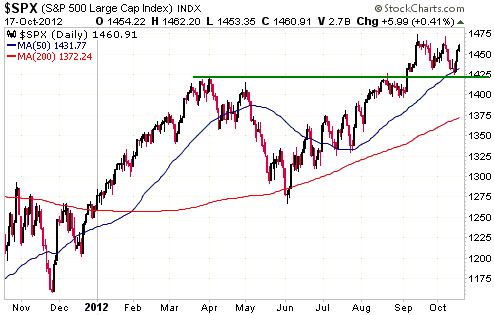
In last week's Interim Update we wrote that the S&P500 Index
(SPX) had pulled back to just above important support in the 1420s and that this
support would have to hold to keep open the possibility of another -- likely
final -- move to a new high for the year. Support held, so the odds are in
favour of a new 52-week high being achieved within the next couple of weeks.
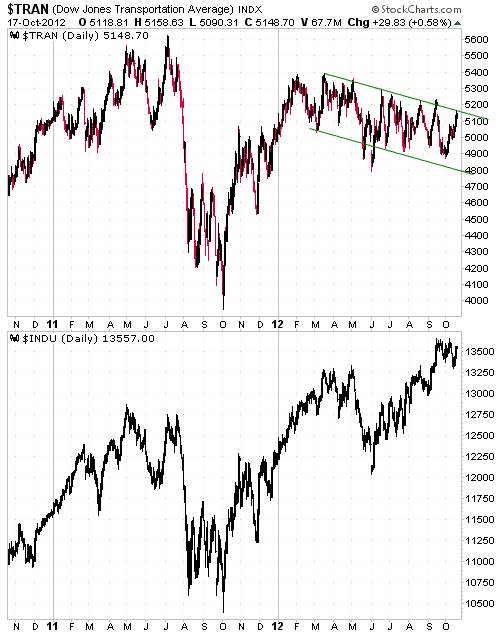
The uncommonly large and lengthy divergence between the Dow Transportation
Average (TRAN) and the Dow Industrials Index continues to develop. The top
section of the following daily chart shows that TRAN has been oscillating within
a downward-sloping range since March. It has rallied over the past two weeks,
but remains within this trading range. The bottom section of the same chart
shows the contrasting performance of the Dow Industrials.
There's a good chance that the Dow will make a new multi-year high in the near
future. If it does, it will be interesting to see what the TRAN is doing at the
same time.
Our best guess is that the US stock market (as represented by the SPX) will make
an important peak just before or just after the 6th November Presidential
election. Our next-best guess is that the market will maintain a slight upward
bias into January and then roll over. However, we have no desire to place any
short-term bets on the broad US stock market doing anything in particular.
Instead, we would view any additional upside from here as an opportunity to add
to our cash reserve.
Gold and the Dollar
Gold
It could turn out that the US$ gold price made a correction low when it dropped
to $1730 early this week. At this stage there's no way of knowing. The chart
(see below) doesn't provide us with any clues as to whether or not Monday's
decline to within $20 of the 50-day moving average was the bottom.

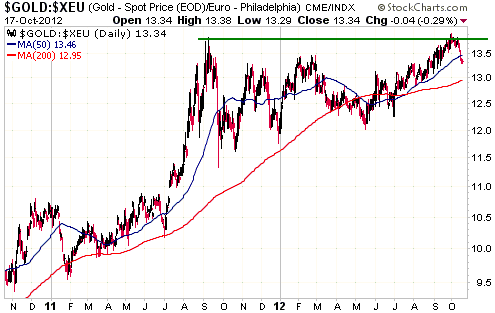
The 2-year chart of the euro-denominated gold price (gold/euro) displayed below
contains more clues than the 1-year chart of the US$ gold price displayed above.
Gold/euro tested its all-time high last month and has since pulled back to just
below its 50-day moving average. It is now short-term 'oversold' by some
measures, but when it has previously been in a similar position it has more
often than not continued to decline until reaching its 200-day moving average.
This implies additional downside potential of 3%, which isn't much.
Our short-term gold outlook has shifted from "neutral" to "bullish".
Gold Stocks
Current Market Situation
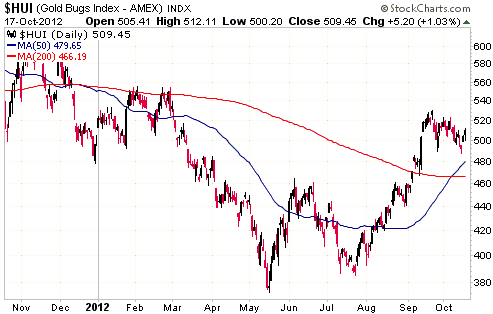
It's possible that the HUI made its correction low on Monday 15th October when
it spiked down to 487. At this point the HUI was within 2% of its 50-day moving
average and the correction had been in progress for about 4 weeks, which is a
normal duration for a mid-trend consolidation in this market.
However, the price action hasn't definitively signaled a bottom, which means
that this week's low could be breached within the next couple of weeks.
Clear-cut evidence of a top or a bottom usually only arrives well after the
fact, which is why it's generally a bad idea to wait for such evidence before
buying or selling.
This is a reasonable time to be averaging into selected gold stocks and/or
gold-stock ETFs such as GLDX.
The Strikes Continue
Production at the majority of South Africa's gold mines is still being stopped
or constrained by "illegal" strikes. Moreover, it's not just the SA mining
industry that is being affected by labour unrest. The strikes have spread
through the economy and are probably responsible for the recent decline to a
3-year low in the foreign exchange value of the South African Rand (ZAR).

Although the labour unrest was probably the catalyst for its recent weakness,
the Rand was clearly in a downward trend well before the strikes became a major
problem. This suggests to us that the Rand supply has been rapidly inflated.
Upon checking the data at the web site of South Africa's Reserve Bank we find
that both M1 and M2 money supply grew at average rates of around 20% per year
from mid-2005 through to mid-2008. The monetary inflation rate fell sharply
during 2008-2009, but then rebounded. Over the past two years the year-over-year
M1 growth rate has oscillated between 7% and 11% and the year-over-year M2
growth rate has oscillated between 5% and 9%.
There's a good chance that rapid inflation of the Rand supply is part of the
reason for the strikes. A high MS growth rate eventually leads to a high rate of
increase in the cost of living. If mine-workers have been getting squeezed due
to their living expenses rising at a faster pace than their wages it would go a
long way towards explaining the desperate measures that are now being taken.
This doesn't mean that the strikers have right or good sense on their side, only
that they can be added to the long list of unknowing victims of central bank and
government stupidity (unknowing because they have no idea why they have a
problem). We would argue that their actions are neither right nor sensible,
because their work stoppages are causing damage to the mines and will probably
make some mines uneconomic, leading to the loss of jobs and even greater
financial hardship. However, it is not uncommon for desperate people to take
desperate, ill-conceived actions.
The recent weakness in the Rand pushed the Rand-denominated gold price (gold/ZAR)
to a new all-time high and added to the weirdness of the following chart
comparison. The chart compares gold/ZAR (the gold price that matters the most as
far as gold miners operating in South Africa are concerned) with the stock price
of Harmony Gold (HMY), a major gold miner that produces all of its gold in South
Africa. HMY is trading a little lower today than it was at the beginning of
2005. Over the same period gold/ZAR has gained about 500%.
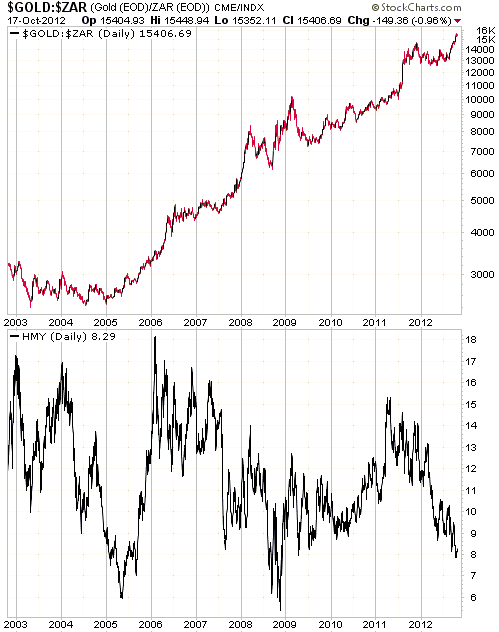
There are good reasons for HMY's poor performance relative to gold/ZAR,
including the current strikes. The size of the disparity between the performance
of HMY and the performance of gold/ZAR still doesn't make sense, though. That's
why we said in the 8th October Weekly Update that long-dated HMY call options
were an interesting speculation.
Currency Market Update
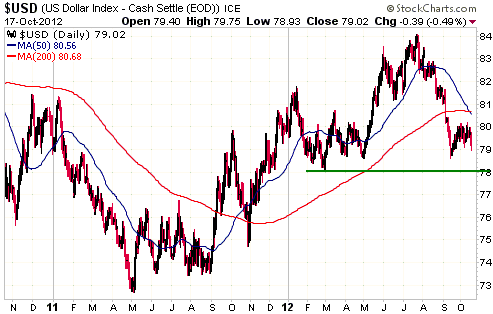
The Dollar Index reached an 'oversold' extreme in mid-September and then began
to rebound. The rebound looked like a counter-trend move that would run its
course after a few weeks and be followed by a decline to a new multi-month low.
This week's price action suggests that the rebound has ended and that a decline
to a new multi-month low, or perhaps even a new low for the year, has begun.
Support at 78 is a logical near-term target.
Update
on Stock Selections
Notes: 1) To review the complete list of current TSI stock selections, logon at
http://www.speculative-investor.com/new/market_logon.asp
and then click on "Stock Selections" in the menu. When at the Stock
Selections page, click on a stock's symbol to bring-up an archive of
our comments on the stock in question. 2) The Small Stock Watch List is
located at http://www.speculative-investor.com/new/smallstockwatch.html
 As
originally notified in the email that was broadcast to subscribers early this
week, Prodigy Gold (PDG.TO) has been removed from the TSI Stocks List in
response to Argonaut Gold's takeover bid for the company. As
originally notified in the email that was broadcast to subscribers early this
week, Prodigy Gold (PDG.TO) has been removed from the TSI Stocks List in
response to Argonaut Gold's takeover bid for the company.
New short-term trading position: Rye Patch Gold (TSXV: RPM).
Shares: 146M issued, 155M fully diluted. Recent price: C$0.49
In the 8th October Weekly Update we said that RPM would be added to
the TSI List as a short-term trade if it became available at C$0.52
within the ensuing two weeks. The stock traded at C$0.52 on Tuesday
of this week and has therefore been added to the List.
As previously discussed, this is solely a play on the outcome of a
court case. The trial was originally scheduled to happen in
November, but at the request of RPM's opponent (Coeur d'Alene Mines)
it has been postponed. A new trial date will apparently be set
within the next week or so. The postponement of the trial date
prompted selling of RPM shares as traders lost patience, which is
why the stock has dropped to C$0.49. Near this price we think the
risk/reward is very attractive, but due to the trial delay the
duration of this trade is not going to be as short as we originally
expected.
Tax Loss Selling
"Tax-loss harvesting, also commonly known as tax selling, is one
of the ways to avoid taxes on some of your portfolio gains. Tax-loss
harvesting is the selling of securities, usually at year-end, to
realize portfolio losses, which an investor can use to offset
capital gains and therefore lower personal tax liability."
- From
http://www.investopedia.com/articles/04/122704.asp#axzz29XIEs374
In terms of stock market performance, the stocks that are most
affected by tax selling are those that have small market
capitalisations and have fallen a long way since the end of the
preceding year. 2012 has been an unusually bad year for junior
resource stocks in general and junior gold/silver stocks in
particular, which means that an unusually large number of these
stocks will be sold for tax purposes during this year's US/Canadian
tax-selling season (November-December). Given that the TSI Stocks
List is packed with junior resource (mostly gold) stocks, this also
means that an unusually large number of TSI stock selections could
be affected by tax-loss sales over the coming 10 weeks.
The following table shows the Canadian and US stocks in the TSI List
(the Australian stocks aren't shown because Australia's tax year
ends in June), the year-to-date percentage change in the stock
price, and a comment as to whether the stock is vulnerable to
tax-loss selling. The table is in order of YTD performance, with the
worst performers (generally, the most likely targets for tax-related
selling) at the top. Note that not all of the stocks have been in
the TSI List since the beginning of the year, but in this case it's
the YTD performance, not the performance since joining the TSI List,
that counts.
|
Symbol |
Market |
Company Name |
Price @ 31-Dec-11 |
Price now (19-Oct-12) |
YTD % Change |
Tax Loss Candidate? |
|
JAG |
NYSE |
Jaguar Mining |
6.38 |
1.19 |
-81.3 |
YES |
|
BAT |
TSXV |
Batero Gold |
1.83 |
0.43 |
-76.5 |
YES |
|
RN |
TSX |
Rio Novo Gold |
0.55 |
0.18 |
-67.3 |
YES |
|
CFO |
TSXV |
Clifton Star Resources |
2.9 |
0.95 |
-67.2 |
YES |
|
SSP |
TSXV |
Sandspring Resources |
1.24 |
0.52 |
-58.1 |
YES |
|
FEL |
TSX |
Fairborne Energy |
2.96 |
1.69 |
-42.9 |
YES |
|
EFR |
TSX |
Energy Fuels |
0.28 |
0.16 |
-42.9 |
YES |
|
VTR |
TSX |
Volta Resources |
0.97 |
0.58 |
-40.2 |
YES |
|
THM |
NYSE |
International Tower Hill |
4.36 |
2.7 |
-38.1 |
YES |
|
GPD |
TSX |
Golden Predator |
0.58 |
0.36 |
-37.9 |
YES |
|
ELG |
TSX |
Elgin Mining |
0.98 |
0.65 |
-33.7 |
YES |
|
CPN |
TSX |
Carpathian Gold |
0.44 |
0.32 |
-27.3 |
YES |
|
SBB |
TSX |
Sabina Gold & Silver |
3.84 |
2.89 |
-24.7 |
YES |
|
ORV |
TSX |
Orvana Minerals |
1.08 |
0.91 |
-15.7 |
MAYBE |
|
UEX |
TSX |
UEX Corp. |
0.66 |
0.6 |
-9.1 |
MAYBE |
|
EDV |
TSX |
Endeavour Mining |
2.43 |
2.5 |
2.9 |
NO |
|
PVG |
TSX |
Pretium Resources |
12.51 |
12.94 |
3.4 |
NO |
|
KGN |
TSX |
Keegan Resources |
3.89 |
4.05 |
4.1 |
NO |
|
GSS |
NYSE |
Golden Star Resources |
1.65 |
2.07 |
25.5 |
NO |
We plan to update the above table in early
December, which is when tax-selling season gets into full swing. The situation
could change between now and then, especially if gold breaks out to the upside.
On a related matter, the stocks that are most affected by tax-selling become
likely candidates for a strong January rebound. For our own money management
this is the most important aspect of the phenomenon. We usually don't take any
action in preparation for the December selling, but towards the end of December
we sometimes buy stocks that have been beaten down by tax-loss selling in
anticipation of the ensuing rebound.
Chart Sources
Charts appearing in today's commentary
are courtesy of:
http://stockcharts.com/index.html

|









