|
- Interim Update 17th November 2010
Copyright
Reminder
The commentaries that appear at TSI
may not be distributed, in full or in part, without our written permission.
In particular, please note that the posting of extracts from TSI commentaries
at other web sites or providing links to TSI commentaries at other web
sites (for example, at discussion boards) without our written permission
is prohibited.
We reserve the right to immediately
terminate the subscription of any TSI subscriber who distributes the TSI
commentaries without our written permission.
Printing money to help the economy
Just
for fun, we created the following cartoon video in which a toothpick
salesman explains that he is taking a leaf out of Ben Bernanke's book.
http://www.xtranormal.com/watch/7697223/
Inflating the debt away
In
many economies the total quantity of debt has become so high that
repayment is no longer possible using the current supply of money. This
means that default on a grand scale is inevitable, the only unknown
being the nature of the default. One possibility is that most debt
defaults will be the direct kind, while the only other possibility is
that enough new money will be created to enable most debts to be repaid
using substantially depreciated currency units. The second possibility
is often described as "inflating away the debt".
The idea that there will be an attempt to "inflate away the debt" has
become popular, partly due to the way the US Federal Reserve has
reacted to financial crises and economic weakness to date. We wish to
point out, however, that the economy-wide debt burden cannot possibly
be reduced via monetary inflation unless the central bank makes a major
change to the way it operates. The reason is that the way the monetary
system currently works, almost all money is borrowed into existence
(new money is accompanied by new debt). In other words, unless the
central bank's modus operandi changes, it will not be possible to
"inflate away the debt"; rather, faster money-supply growth and a
resultant acceleration in the rate of currency depreciation will
require a more rapid expansion in the total quantity of debt. Or, to
put it simply: more inflation requires more debt.
Our impression is that most commentators who predict that the central
bank and/or the government will try to "inflate the debt away" either
don't have a good understanding of the process by which money is
created or haven't thought through the mechanics of the inflation
process in sufficient detail.
As long as new money is borrowed into existence, the economy's overall
debt can't be "inflated away". However, under the current monetary
system this doesn't restrict the amount of money-supply growth. The
reason, to use Greenspan's terminology, is that a government with a
captive central bank cannot become insolvent with respect to
obligations in its own currency. A government can actually take on new
debt ad infinitum provided that its central bank is prepared to
purchase the debt.
An implication of the above is that if the central bank and the
government want to bring about a rapid expansion of the money supply at
a time when the private sector is reducing its collective indebtedness,
they can do so by ensuring that government indebtedness grows at a much
faster pace than private indebtedness shrinks. The overall debt burden
expands, but the private sector becomes responsible for a lesser
proportion of it.
So, if the Fed stuck to its standard operating procedures* it wouldn't
be possible to "inflate away" the US economy's overall debt burden, but
it certainly would be possible to substantially devalue the US dollar
via a large increase in government indebtedness. This means that if all
else remained the same, a large increase in government indebtedness and
the monetary inflation associated with it could provide the private
sector with a net benefit by reducing the REAL value of its debt.
However, all else never remains the same. Although private-sector
debtors could benefit from having their debts denominated in
depreciated dollars, the market economy would be devastated by the
extra costs and uncertainty caused by rapid currency depreciation,
distortions of relative prices, and the expansion of government. In
such an environment, people with significant real savings to invest
would be inclined to either get their savings out of the country or
protect their wealth by hoarding commodities. They would be disinclined
to invest their savings in ways that create employment. That's why the
historical record is unblemished by examples of the general public
benefiting from a large inflation-fueled depreciation of the currency.
*Over the past two
years the Fed has begun to deviate from its standard operating
procedures in that it has begun to monetise assets, which means that
the creation of new money no longer relies on the creation of new debt
to the extent it once did. It is unknown how far the Fed will proceed
down this new path.
Possible China and commodity reversals
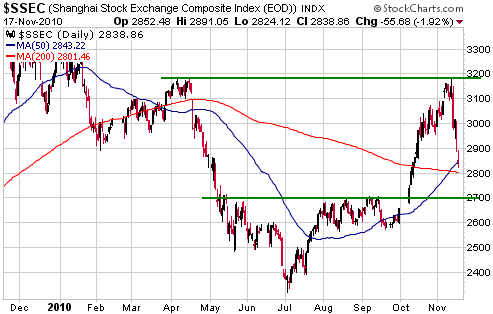
China's stock market,
as represented on the following daily chart by the Shanghai Stock
Exchange Composite Index (SSEC), built on last week's downward reversal
over the first three days of this week. This week's price action
increases the probability that an intermediate-term peak is in place,
although the price action is not definitive (as is often the case).
Also, regardless of whether or not an intermediate-term peak is now in
place, the SSEC has fallen to a price range (the area around its 50-
and 200-day moving averages) from which a rebound is likely to occur.
This means that the price action is unlikely to become more definitive
in the near future.
Evidence that food prices in China are rising at a dangerously rapid
rate has emerged (last week the Chinese government admitted to a
year-over-year increase in food prices of about 10%, but the actual
rate is probably closer to 20%), which has prompted the government to
take action. Based on the fact that the policy moves being considered
include price controls and food subsidies it is clear that China's
much-admired central planners are in the same league as Hugo Chavez
when it comes to solving an inflation problem, but the point is that
the political elite in China are beginning to feel the need to take
drastic action to stop the current price trends. This could/should lead
to tighter monetary conditions and slower nominal growth.
What happens in China has a big effect on what happens to the prices of
most commodities. In particular, an end to the China boom, or even just
a prolonged slowdown in China's economy as tighter monetary policy
takes its toll, would end the rallies in most industrial commodities.
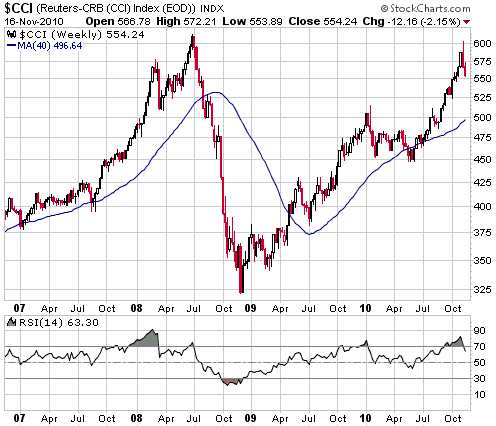
Not surprisingly, then, last week's downward reversal in China's stock
market coincided with a downward reversal in the Continuous Commodity
Index (CCI).
The CCI's recent reversal, which is clearly evident on the following
weekly chart, does not necessarily indicate that a lasting peak is in
place. In fact, there were a few similar downward reversals during the
rally of the past two years that led to nothing more serious than
routine short-term corrections. However, the latest reversal looks more
ominous because a) it began in the vicinity of the 2008 major peak, b)
it began after the CCI became 'overbought' on a weekly basis, and c) it
occurred in parallel with a potentially important fundamental change in
China.
The Stock Market
The
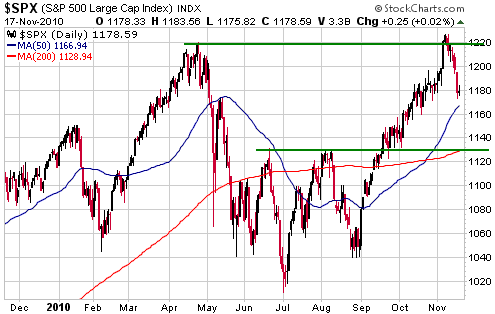
first of the following daily charts shows that the S&P500 Index
broke above its April high near the start of this month and then almost
immediately reversed downward. This is bearish price action, but taken
in isolation it doesn't mean very much. It means more when considered
alongside the reversals in China and commodities discussed above, and
the plunge in municipal bonds illustrated by the second of the
following daily charts (the second chart shows that the Nuveen
Municipal Total Return Index (NMUNI) recently gave back 10 months of
gains within the space of only 5 days).
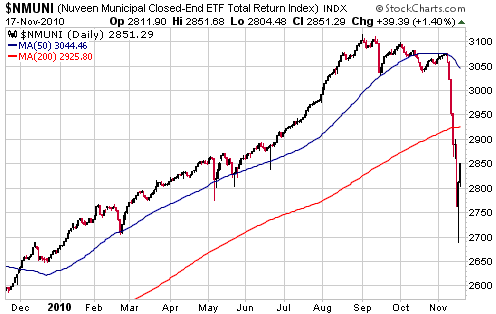
NMUNI is now
rebounding after bottoming during Tuesday's trading session, but an
intermediate-term peak is clearly in place. Perhaps this will prompt
the Fed to switch the focus of its QE from treasury debt to municipal
debt.
It is not yet known (or knowable) if the S&P500 Index has made an
intermediate-term peak, or even a short-term peak. But regardless of
whether or not a peak is in place, the market is a little 'oversold'
and could soon begin to rebound.
Gold and
the Dollar
Gold and the other PMs
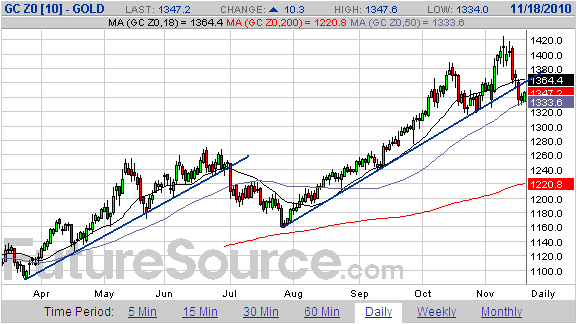
The following daily chart shows that December gold broke below
trend-line support on Tuesday and then fell to its 50-day moving
average in the low-$1330s. We could unequivocally state that this
decline to the 50-day moving average completed the correction and we
could turn out to be right, but only by chance. In our opinion, it is
roughly an even-money bet as to whether the correction will continue or
has just ended. It could have just ended, but notice on the chart that
a break below a similar trend-line in early July was followed by three
weeks of additional corrective activity.
Gold has support in the $1320s, but the most important short-term support is defined by the June high at around $1270.
We mentioned during
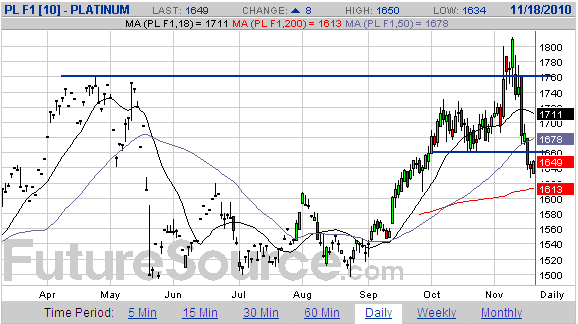
August-September that of the three most important precious metals
markets (gold, silver and platinum), the weakest link was platinum.
Consequently, we said that downside risk in gold and silver would not
be worrisome as long as the platinum market was holding up. That's why
it is of some concern to us that the platinum price plunged by almost
$200 from its 9th November intra-day high to its 17th November
intra-day low, breaking through short-term support in the process.
Intermediate-term support lies at $1600.
It looks like an intermediate-term peak is in place in the platinum
market, but the plunge that began last Tuesday, which might not be
complete yet, should be partially retraced. Gold and silver could make
new highs as platinum retraces.
The China, CCI,
municipal-bond and platinum reversals should all be considered warnings
that a very important trend change could be in progress.
Gold Stocks
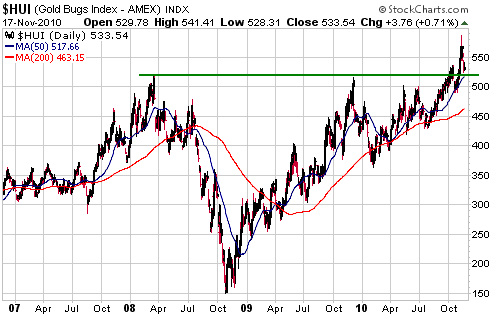
The HUI broke out from a multi-year base a few weeks ago. Once a
correction got underway, the top of the former base (520) became a
reasonable downside target. This target was essentially reached on
Tuesday 16th November.
Some additional 'corrective' action is possible, but the HUI shouldn't
move much lower than 520 on a daily closing basis. At least, it
shouldn't IF we are right to assume that this is a pullback within an
upward trend.
The S&P/TSX
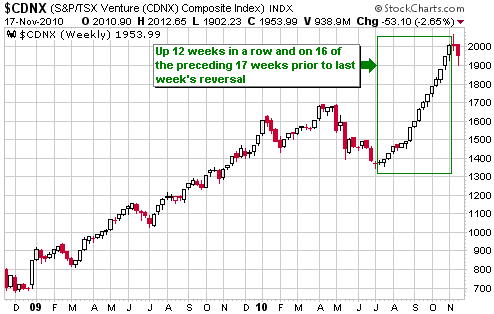
Venture Composite Index (CDNX) is a proxy for junior resource stocks.
The following chart therefore illustrates the relentless nature of the
rise in junior resource stocks that occurred prior to last week's
reversal.
A similar rise ended in January of 2006. The CDNX's January-2006 peak
was followed by a 2-week correction and then another relentless 3-month
advance to a very important top in May of 2006.
Currency Market Update
When the Dollar Index began to rebound in early November it was most
likely a reaction to being extremely 'oversold', but a more solid basis
for a US$ rally has since emerged in the form of another euro-zone debt
crisis (just Ireland at the moment, but more euro-zone governments are
likely to become involved later) and downward reversals in the
growth-oriented markets.
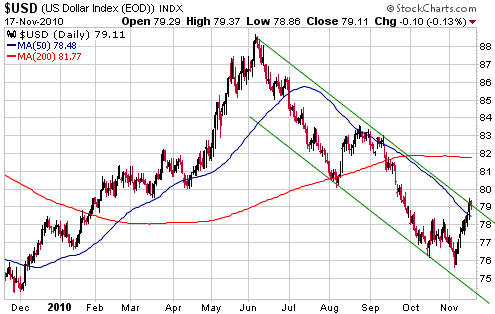
The following chart shows that the Dollar Index has moved a little
above its 50-day moving average and to the top of its downward-sloping
channel. If this is just a counter-trend rebound then a downward
reversal should occur almost immediately, while a decisive break above
80 would be a clear sign that an intermediate-term bottom is in place.
Update
on Stock Selections
(Notes: 1) To review the complete list of current TSI stock selections, logon at http://www.speculative-investor.com/new/market_logon.asp
and then click on "Stock Selections" in the menu. When at the Stock
Selections page, click on a stock's symbol to bring-up an archive of
our comments on the stock in question. 2) The Small Stock Watch List is
located at http://www.speculative-investor.com/new/smallstockwatch.html)
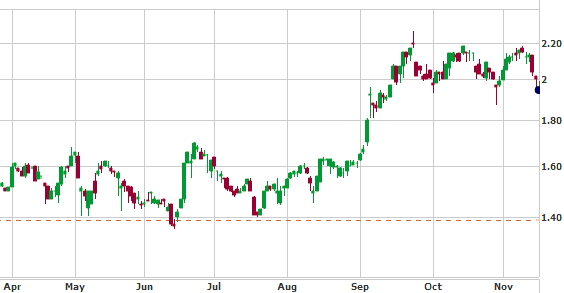
 Catalpa Resource (ASX: CAH). Shares: 163M issued, 169M fully diluted. Recent price: A$1.91 Catalpa Resource (ASX: CAH). Shares: 163M issued, 169M fully diluted. Recent price: A$1.91
CAH is a 130K-oz/yr Australia-based gold producer with a relatively low
valuation. In September we said that it was suitable for partial profit
taking in the A$2.20s. The following chart shows that it has since
consolidated within a horizontal range and is now near the bottom of
this range.
CAH is a good candidate for new buying near its current price of A$1.91.
Other gold/silver
stocks that are suitable for new buying near current prices include
ADM.V, CFO.V, CRK.TO, JAG, MFN, NXG, RSG.AX, and THM.
Duoyuan Global Water (NYSE: DGW). Shares: 25M. Recent price: US$13.00
The quarterly results announced by DGW prior to the start of trading on
Wednesday confirmed that the company continues to grow strongly and
profitably, prompting a bounce of about $1 in the stock price. If we
annualise the US$0.55/share Q3 earnings we find that DGW is presently
trading at a P/E ratio of 5.9, meaning that there is a lot of
valuation-related upside potential in this stock.
The market is obviously still worrying about a possible problem with
the accounting (hence, the low valuation), and these worries could
persist until the completion of the third party audit being carried out
by a large US law firm. We don't know when this audit will be complete.
We doubt that DGW's managers would have arranged for the
above-mentioned audit to take place if they had anything to hide, so
the probability is low that there are important accounting
irregularities waiting to be uncovered. In any case, based on what has
happened over the past week we are now more concerned with general
market risk than with any company-specific DGW risk.
Chart Sources
Charts appearing in today's commentary
are courtesy of:
http://stockcharts.com/index.html
http://www.futuresource.com/

|