|
- Interim Update
18th March 2015
Copyright
Reminder
The commentaries that appear at TSI
may not be distributed, in full or in part, without our written permission.
In particular, please note that the posting of extracts from TSI commentaries
at other web sites or providing links to TSI commentaries at other web
sites (for example, at discussion boards) without our written permission
is prohibited.
We reserve the right to immediately
terminate the subscription of any TSI subscriber who distributes the TSI
commentaries without our written permission.
Fed
Speak
The Fed removed the word "patient"
from its post-FOMC Meeting statement, thus opening the door for a
rate hike as soon as June.
Just to be clear, based on the way 'Fed speak' is believed to work
it takes a minimum of two FOMC meetings to go from "patient" to the
start of a rate-hiking program, in that the removal of "patient" is
supposed to be followed in a subsequent meeting by words to the
effect that a "measured" move towards policy normalisation will soon
begin. These words would then pave the way for a rate hike at the
ensuing meeting. Therefore, removing the word "patient" is part of a
process that makes a rate hike at the June FOMC meeting (there's an
intervening meeting in April) possible, but far from certain. Had
the Fed left the word "patient" in its statement, a June rate hike
would have been off the table.
A rate hike as soon as (but no earlier than) June has been confirmed
as possible, but in addition to removing "patient" the Fed also
downgraded its economic and interest rate forecasts. Therefore, at
the same time as the Fed gave itself the flexibility to begin a
rate-hiking program at the June FOMC Meeting, it also sent signals
that a) the first rate hike will probably happen later than June and
b) there will be no more than two rate hikes this year.
Our view at the beginning of the year was that there would be no
more than one Fed rate hike this year. Our view is unchanged.
In reaction to the Fed's signals that "policy normalisation" will
begin later and take longer than many people were expecting, almost
everything rallied. General equities, bonds, commodities, gold and
gold stocks all rose in price. This means that the financial world
bid up both risk assets and safe havens in reaction to the Fed news,
which makes no sense. This will probably get sorted out over the
days ahead, with the risk assets turning back down as the safe
havens continue to rally or the other way around.
Trade gaps and currency exchange
rates
Is the strong dollar a problem for the US
economy? The short answer is no. A strong currency is never a problem for any
economy; it is always a net benefit. A weak currency, on the other hand, is
usually a problem (or reflective of a problem), and instability (meaning large
swings) in exchange rates can dampen growth by making international trade more
difficult/costly.
Today we aren't going to get into the theory-based argument as to why a strong
currency will never be a net disadvantage for an economy, because it was
indirectly covered in our 2014 article titled "Currency
devaluation: The most destructive policy of all". For the same reasons that
policies aimed at creating a relentlessly weak currency are destructive,
policies that promote long-term currency strength are constructive. Today,
instead, we will take a simple numbers-based approach, using the US and Japan as
our case studies, in an effort to bust one of the most popular myths about
currency strength -- the myth that a relatively strong currency creates an
economic headwind by making a country's manufacturing sector less competitive on
the world stage.
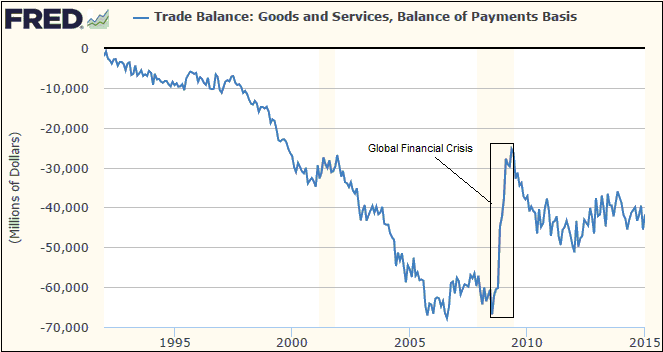
The US has run a "trade deficit" every month for the past 20 years, meaning that
it has consistently imported more goods than it has exported. The deficit is
currently running at $40B-$45B per month, or about $500B per year.
The first point we'll make is that $500B equates to about 1.6% of the total US
economy*, so it would take a massive change in the trade deficit to generate a
tiny change in the economy. This is one numbers-based reason that it would make
no sense to devalue the currency for the purpose of reducing the trade deficit,
even if it were not true that currency devaluation is economically destructive.
However, it's not the only or even the main reason. The main numbers-based
reason is that when a country has a consistent trade deficit to begin with,
basic math informs us that weakening the currency will tend to INCREASE, not
decrease, the deficit.
To understand why this is so, first assume that a country has annual exports of
$1000B and annual imports of $1500B, resulting in an annual trade deficit of
$500B. Not coincidentally, the numbers we have chosen resemble the current US
situation. Next, assume that the currency's exchange rate falls by 10%, that is,
assume that the currency becomes 10% cheaper relative to other currencies.
Now, it's actually not possible to know in advance how this exchange-rate
adjustment will affect the trade deficit and it's also not possible to know in
advance how domestic prices will be pushed around by the actions taken to bring
about the devaluation on the FX market, which is one of the problems that
interventionists always face. They plough ahead with no clue as to the
disruptions they will cause to the millions of individual connections that
comprise a modern economy. However, for argument's sake we'll assume that there
are no economy-weakening domestic price distortions and that the change in the
exchange rate affects exports and imports equally.
In our simplistic hypothetical example, the 10% currency devaluation causes the
quantity of exports to rise by 10% and the cost of imports to rise by 10%. The
country now has annual exports of $1100B, annual imports of $1650B, and an
annual trade deficit of $550B. That is, the 10% currency devaluation increased
the trade deficit by 10%.
In the same way it can be shown that when a country is running a consistent
trade deficit, an increase in the currency's relative value will decrease the
trade deficit.
The real world doesn't work like our hypothetical example, because there are
many other variables to contend with. The point is that when a country is
running a trade deficit, there is no good reason to believe that devaluing the
currency will reduce the deficit. In an all-else-remaining-equal scenario,
devaluing the currency will actually increase the trade deficit and upwardly
revaluing the currency will actually decrease the trade deficit.
In a real world scenario, where all else is never equal, the effects on the
trade balance of a change in the exchange rate will usually be unpredictable.
That's why, over the past 20 years, there hasn't been a consistent relationship
between the US trade gap and the Dollar Index. Instead, there was a multi-year
period when the trade deficit increased in parallel with a strengthening dollar,
a multi-year period when the trade deficit increased in parallel with a
weakening dollar, and a multi-year period when the trade deficit shrank in
parallel with a strengthening dollar. Note that only the first of these periods
matched the conventional wisdom.
In the above hypothetical example we used some basic math to show that for a
country running a trade deficit, the expected result of currency devaluation is
a greater trade deficit if all else remains equal. Those who are sceptical of
our numbers and logic should turn their attention to Japan for a real-world
example.
The following chart shows Japan's monthly trade gap. A powerful bearish trend in
the Yen's exchange rate occurred during the period within the red box
(October-2012 to the present).
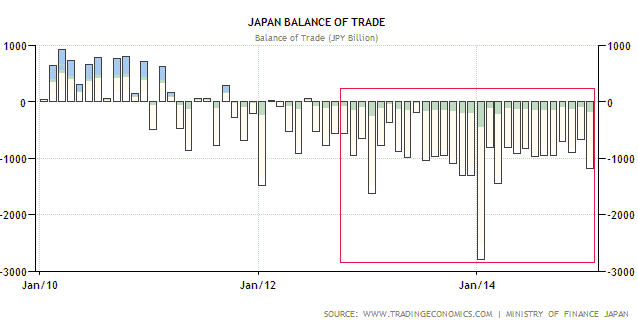
Clearly, Japan's trade situation went further into deficit during the Yen's bear
market. This happened because the weakening Yen increased the total cost of
imports by more than it stimulated exports, which, from our perspective, is
hardly a surprising result.
By the way, the profits of some Japanese manufacturers have been boosted by the
weak Yen, but this is generally not because of increasing international sales
volumes. By way of explanation, take the example of the Japanese car
manufacturers that sell a lot of cars in the US. Most of the Japanese cars that
are sold in the US are made in the US, meaning that if you buy a new Japanese
car in the US then you are probably buying a car that was made in a US factory
employing US workers and using mostly US-sourced materials. Therefore, how could
a weaker Yen possibly help the Japanese car manufacturer sell more of these
cars? The answer is that it couldn't. What it does, though, is lead to a higher
Yen-denominated profit when a conversion of dollars to Yen is done in the
preparation of the company's accounts. That is, the increased profits are a type
of monetary illusion.
Despite the currency-conversion boost to profits being enjoyed by some large
Japanese manufacturers, a
recent survey indicates that Japan's corporate sector now views Yen weakness
as a problem. Thanks to the downward trend in the Yen, costs have been rising
faster than sales at many Japanese companies.
Returning to the US, the final point we'll make is that many US multi-national
corporations will probably blame US$ strength for missing their earnings targets
over the months ahead, but the problem that these companies face isn't the
rising dollar. The problem is declining global growth, as, one after another,
the national economies of the world shift from inflation-fueled boom to bust. US
policy-makers can now look outside the US for a preview of what is to come in
their country, but, of course, that won't prevent them from being shocked when
their own inflation-fueled boom inevitably goes the same way.
*The annualised
Gross Output of all US industries was $31.3T in Q3-2014 and is probably
about $32T today.The Stock Market
The US
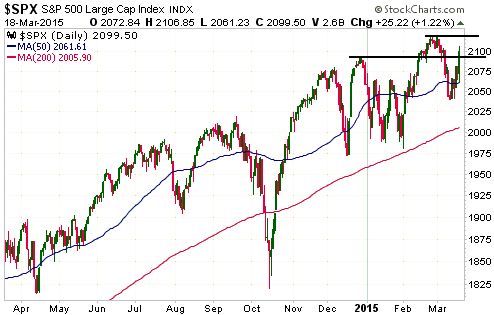
If you are so inclined, the US stock market is now at the optimum place for a
bearish speculation. That's because the S&P500 Index (SPX) and the other senior
US stock indices have declined and then rebounded to just below their
late-February highs.
There's the potential for a sizable decline to begin from near the current
level. More importantly, with the SPX now only 1% below its peak, risk can be
limited to a small amount by placing a mental stop just above the February peak.
Specifically, bearish speculations could be entered near the current level with
a plan to exit with a small loss if the SPX achieves a daily (for short-term
trades) or weekly (for intermediate-term trades) close above 2120.
The lowest-risk way to bet against the US stock market is to buy unleveraged,
actively-managed bear funds such as BEARX and HDGE. These funds can be
averaged-into on strength and held for years if need be.
Put options and leveraged inverse index funds are riskier, but provide more
'bang for the buck'. Put options can be used for short-term or intermediate-term
speculations by selecting the appropriate expiry date (the expiry date should be
2-3 months into the future for a short-term trade and at least 10 months into
the future for an intermediate-term trade), but, as we've previously explained,
leveraged funds are only suitable for short-term trades due to their value
leakage over time. There is also value leakage over time with options, but the
amount of money risked in an option trade would typically be a lot less than the
amount of money risked in the purchase of a leveraged index fund.
As noted in the latest Weekly Update, a long position in the Yen should also
benefit from a sizable decline in the US stock market.
Europe
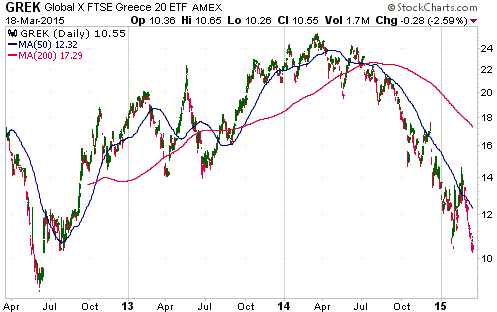
GREK, the Global X Greece 20 ETF, is a proxy for Greece's stock market in US$
terms. As illustrated below, GREK has just dropped back to its late-January low.
Apart from a brief period in 2012, this is a level it has never traded below.
When GREK was near its low in late-January, we wrote:
"We don't know enough about the situation in Greece or the Greek stock market
to take a position, but given the steep price decline of the past 10 months and
the fact that Greece's stock market had the world's lowest Cyclically-Adjusted
P/E ratio (CAPE) prior to the start of this decline it occurs to us that it
could now make sense to buy GREK for an intermediate-term trade. We get the
impression that Greece's stock market has factored-in the worst-case scenario
and then some."
Our opinion is unchanged. For the reasons mentioned above and because we have
neither the time nor the financial resources to pursue every opportunity that
comes along, we aren't going to take a position. However, our superficial
impression is that GREK's risk/reward is very attractive right now.
Gold and the Dollar
Gold
This is how we concluded the discussion on the US$ gold price in the latest
Weekly Update:
"A multi-week rally in the US$ gold price from at or above last year's low
remains a likely short-term outcome, but the first-quarter test of last year's
low combined with the unhelpful fundamental backdrop means that an eventual
decisive breach of last year's low is now likely."
A decline in the real US interest rate and relative weakness in bank stocks
resulted in a small improvement in gold's true fundamentals on Wednesday 18th
March, but the above excerpt from the Weekly Update still reflects our
expectations with regard to the next few months.
Did the anticipated multi-week rally get underway on Wednesday in reaction to
the Fed news?
It probably did, but at this stage there's no way of knowing. That's because the
gold price hasn't yet rebounded by enough to overcome any resistance of
significance.
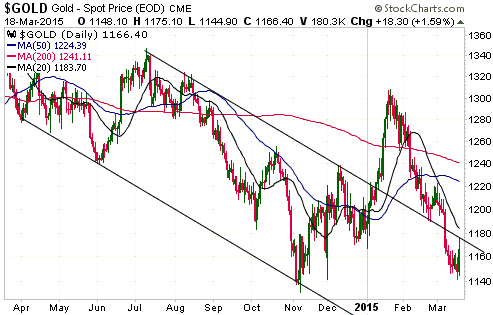
Wednesday's rebound took gold to channel resistance at $1175 (refer to the
following daily chart for details). There is also lateral resistance to contend
with in the mid-$1170s. A daily close above this resistance would generate the
first price-related evidence of a short-term reversal.
Gold Stocks
The gold-mining sector's position as we write today's report is similar to its
position at the same time last week.
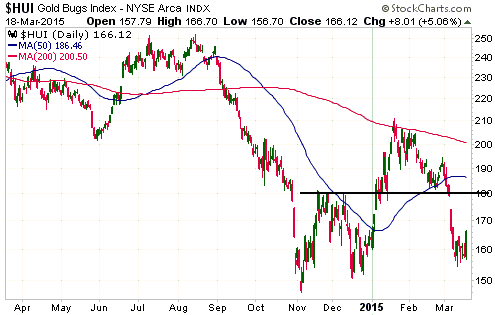
At this time last week the gold sector had just reversed upward from the
vicinity of its 2014 bottom after seven consecutive down-days, and in doing so
had suggested that a multi-week bottom was in place. However, it needed some
follow-through to the upside to confirm that a short-term trend reversal from
down to up had indeed taken place. This follow-through to the upside never
happened, but neither was there a decline to new lows (the 11th March low is
currently the low for the year).
After spending four days retracing the gain made on Wednesday 11th March, the
gold-mining sector has again reversed upward from the vicinity of its 2014
bottom. It must now follow-through to the upside over the final two trading days
of this week to confirm that a short-term trend reversal from down to up has
taken place.
The Currency Market
Here are the most popular reasons put forward by US$ bulls for additional gains
in the dollar:
1. The US economy's strength relative to the economies of the euro-zone and
Japan
2. The monetary policy divergence, with the Fed having ended its QE program and
having begun to take tentative steps towards "policy normalisation" while the
ECB and the BOJ become increasingly profligate
3. The trite statement that the US$ is "the cleanest dirty shirt in the
laundry". We wish we had an ounce of gold for every time we heard/read this
justification for additional US$ strength.
4. The massive US$-denominated debt outside the US, which is effectively a
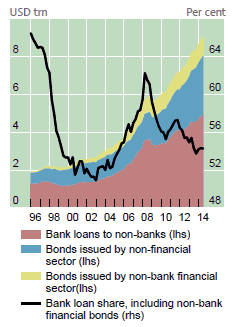
global short position in the US$. To further explain, according to a
report put out by the BIS in
January this effective short position amounts to almost $9 trillion. The
following chart from the BIS report has been doing the rounds on the internet
over the past couple of weeks and shows the debt build-up over the past 20
years. Another chart in the same report shows that "emerging markets" are
responsible for about $3.5T of this debt.
The one thing that the above US$-bullish arguments have in common is that they
were all just as valid a year ago when the Dollar Index was at 80 as they were
early this week when the Dollar Index was at 100. Therefore, the relevant
question is: at what level for the Dollar Index are these bullish arguments more
than fully discounted?
Sentiment can usually provide clues as to when the bullish or bearish case has
been factored into the current price, but, based on sentiment indicators, we
thought that the bullish arguments had been more than fully discounted on at
least a short-term basis when the Dollar Index was in the high-80s, and then
again when the Dollar Index was in the mid-90s. Obviously, sentiment indicators
have their limitations. They never constitute more than just one piece of a big
puzzle.
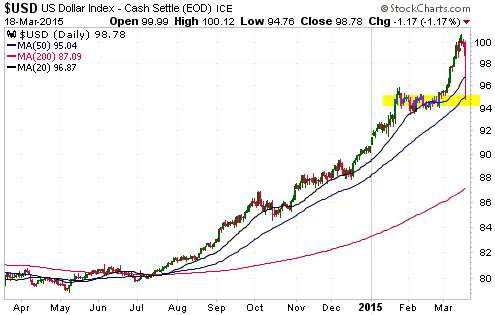
Perhaps the quick rise from 94 to 100 was the final surge, with the Fed news on
Wednesday 18th March acting as the catalyst for the start of the first
meaningful correction since last July.
The Dollar's most recent 3-week surge was fully retraced within the space of an
hour on Wednesday. Although the bulk of the losses were subsequently recouped,
at this early stage we view Wednesday's extreme (Bitcoin-like) volatility in the
world's premier currency measure as a signal that a multi-month top is finally
in place. The top will probably be tested over the days ahead, but we take
Wednesday's plunge to the 50-day MA as preliminary evidence that the Dollar
Index will decline to the vicinity of its 200-day MA (at 87 and rising) within
the coming two months.
Updates
on Stock Selections
Notes: 1) To review the complete list of current TSI stock selections, logon at
http://www.speculative-investor.com/new/market_logon.asp
and then click on "Stock Selections" in the menu. When at the Stock
Selections page, click on a stock's symbol to bring-up an archive of
our comments on the stock in question. 2) The Small Stock Watch List is
located at http://www.speculative-investor.com/new/smallstockwatch.html
Chart Sources
Charts appearing in today's commentary
are courtesy of:
http://stockcharts.com/index.html
http://www.tradingeconomics.com/
http://research.stlouisfed.org/

|









