- Interim Update 18th March 2020
Copyright
Reminder
The commentaries that appear at TSI
may not be distributed, in full or in part, without our written permission.
In particular, please note that the posting of extracts from TSI commentaries
at other web sites or providing links to TSI commentaries at other web
sites (for example, at discussion boards) without our written permission
is prohibited.
We reserve the right to immediately
terminate the subscription of any TSI subscriber who distributes the TSI
commentaries without our written permission.
When something doesn't
work, do more of it!
The Fed didn't wait for this
week's FOMC meeting* to act. Instead, it 'upped the ante' on Sunday when
it announced additional and aggressive monetary stimulus.
Specifically, in its Sunday 15th March announcement the Fed stated that it
would lower the target range for the federal funds rate (FFR) by 1 percent
to 0 to 1/4 percent. According to the Fed: "This action will help
support economic activity, strong labor market conditions, and inflation
returning to the Committee's symmetric 2 percent objective."
The Fed doesn't explain how a rate cut will do what it claims (support
economic activity, etc.). The reality is that banks will expand their loan
books if, and only if, a) there is a growing pool of borrowers who are
both willing and qualified, and b) the banks' balance sheets are strong
enough to support additional leverage. If a) or b) is not in place, how
can cutting the FFR bring about an increase in bank lending to the
economy? Hasn't the European experience already proved that it can't?
In its announcement the Fed also stated that over the coming months it
would buy, using money conjured out of nothing, at least $500B of Treasury
securities and $200B of Mortgage Backed Securities (MBS). In other words,
it announced the resumption of official QE (as opposed to doing QE but
calling it something else, which is what has been happening over the past
five months). According to the Fed, this will "support the smooth
functioning of markets for Treasury securities and agency mortgage-backed
securities" and "support the flow of credit to households and
businesses."
Again, the Fed doesn't explain how the action
achieves the stated objective. How, for example, will increasing the
demand for Treasury securities support the smooth functioning of the
Treasury market when said securities are already in the midst of an epic
upside blow-off? And how will reducing the supply of the credit market's
most useful collateral (Treasury securities) help increase the flow of
credit to the economy? It is easy to see how Primary Dealers will be
helped, but how could this action possibly increase the availability of
credit to households and businesses?
A glut of questions, a dearth
of answers.
We obviously weren't the only ones to have questions
following the Fed's 15th March missive, because on 17th March the Fed
introduced two new programs.
First, the Fed announced that it will
establish a Commercial Paper Funding Facility (CPFF). As noted by the Fed
in its press release: "Commercial paper markets directly finance a
wide range of economic activity, supplying credit and funding for auto
loans and mortgages as well as liquidity to meet the operational needs of
a range of companies." Commercial paper was one of the credit markets
that froze-up during the 2007-2009 financial crisis. The Fed is going to
make sure that doesn't happen again.
Second, the Fed announced that
it will establish a Primary Dealer Credit Facility (PDCF). According to
the Fed's press release: "The PDCF will offer overnight and term
funding [to Primary Dealers] with maturities up to 90 days and will be
available on March 20, 2020. It will be in place for at least six months
and may be extended as conditions warrant. Credit extended to primary
dealers under this facility may be collateralized by a broad range of
investment grade debt securities, including commercial paper and municipal
bonds, and a broad range of equity securities." In other words, the
Fed isn't going to buy corporate bonds, municipal bonds, commercial paper
and equities directly, but it will provide near-zero-cost credit to
Primary Dealers to finance the purchases of such assets.
The
programs announced over the past four days will result in a massive
expansion of the Fed's balance sheet and a large increase in the US money
supply (it's possible that the US monetary inflation rate will move into
double digits within the next two months), but will this unprecedented
monetary easing put a floor under the stock market? Not immediately,
obviously, because the market has continued to decline since the
announcements, but eventually it should and if it doesn't the Fed will do
more. The Fed will keep throwing stuff at the wall until something sticks.
*The FOMC meeting ended up being cancelled.
The Stock Market
Current Market Situation
From the email sent to subscribers after the close of US trading on
Monday:
"Although the US stock market suffered one of its worst
single-day percentage declines in history on Monday 16th March, last
Thursday still stands as the US stock market's internal extreme. This is
because the NYSE and NASDAQ McClellan Oscillators were higher at the close
of trading on Monday than they were last Thursday and because on both the
NYSE and the NASDAQ a smaller number of individual stocks made new 52-week
lows on Monday than they did last Thursday."
The SPX and most
other stock indices made new price extremes on both Tuesday and Wednesday,
but last Thursday still stands as the US stock market's internal extreme.
The two charts displayed below highlight the carnage of the past few
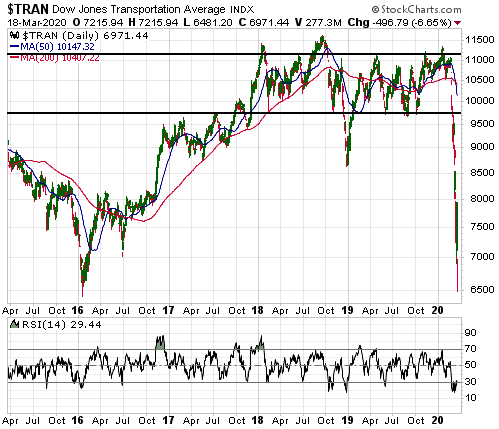
weeks. The first chart shows that the Dow Transportation Average (TRAN)
has fallen so far that on Wednesday of this week it tested its early-2016
low. To say that we exited our Transportation ETF put options too soon
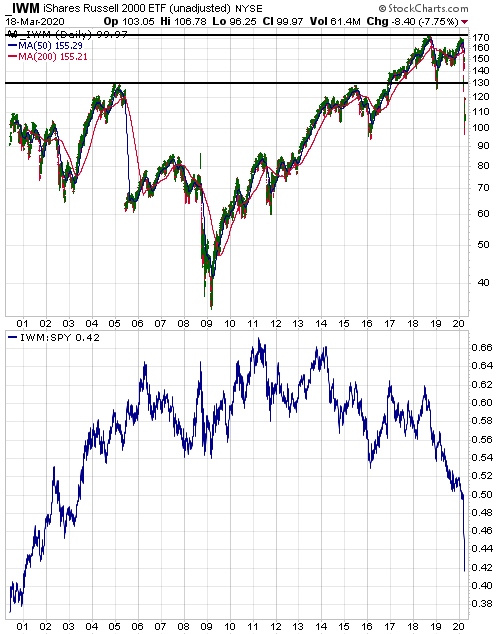
would be a huge understatement. The second chart is longer-term and shows
that the Russell2000 ETF (IWM) is nearing its early-2016 low in nominal
terms and has plunged to its lowest level since 2001 relative to the
S&P500 ETF.
Once a short-term bottom is in place a rebound that retraces about
half the decline from the February peak has a very high probability of
happening, regardless of the market's long-term prospects. For example, if
this Wednesday's intra-day SPX low of around 2300 turns out to be the
crash low, then the retracement target would be around 2850.
We
continue to think that the fear associated with the coronavirus is totally
out of proportion to the actual threat to the vast majority of people. It
is smart for people who are in the high-risk category to take precautions,
which could involve self-quarantining. However, the widespread
shutting-down of commerce and the other draconian measures being taken by
governments to prevent the virus from spreading make no sense, because
they potentially will do a lot more damage than would be done by the virus
itself.
The Chinese Communist Party (CCP) is claiming great success
with the draconian measures that it took to prevent the spread of the
virus, but it's more likely that the CCP simply gave up trying to control
the virus when it realised that the cost of shutting everything down was
far greater than the cost of letting the virus take its natural course.
The numbers of new COVID-19 cases and deaths being reported by China's
government each day have dwindled to almost nothing, but that's only
because they stopped counting. Currently, China's government only counts
the new COVID-19 cases coming into China from other countries.
What to do?
It may seem as if the extreme
financial-market volatility is heaven for short-term traders, but we think
it is better for long-term investors. The reason is that the volatility
has become so great that it is impossible for short-term traders to manage
risk effectively. Long-term investors, however, can slowly average into
positions at bargain-basement prices. This will work well as long as the
positions are "investment grade".
We are doing some short-term
trading, such as getting into gold-mining ETF positions on Monday and
getting out on Tuesday of this week (as discussed in the emails sent to
subscribers). Our primary focus, however, is to gradually build up
long-term positions. For example, we are long-term bulls on agricultural
commodities and think that the best way to gain exposure is to accumulate
the shares of the major fertiliser producers. In this vein, prior to this
week we had established a position in Mosaic (MOS).
MOS has been
clobbered in the stock market over the past few weeks and is now trading a
long way below the replacement value of its assets, which means that it is
now a potential takeover target*. Rather than add to our MOS position,
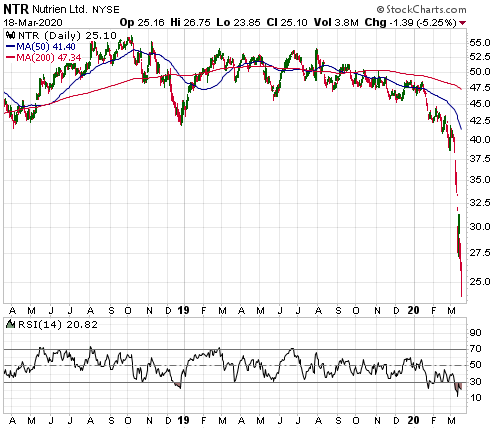
however, on Wednesday we took an initial position in Nutrien (NTR), the
world's premier listed fertiliser producer. The following chart shows that
as recently as three weeks ago NTR was trading in the low-US$40s, which is
about the same as its book value, but on Wednesday 18th March it traded as
low US$23.85 and closed at US$25.10. Its book value won't have changed
over the past three weeks.
The reason we chose NTR over MOS for new
buying on Wednesday is that NTR is the financially stronger company with
the better-quality assets. When all assets are dumped regardless of
quality, it's best to direct most new buying towards the highest quality
assets.
As well as scaling into the stocks of relatively high-quality
companies that have been crushed in price, we think it makes sense to
scale into physical metals (indirectly via ETFs or directly) that are
trading near historic lows relative to gold. We are, of course, referring
to silver and platinum.
*BHP is the most
likely acquirer.
Gold and the Dollar
Gold
On
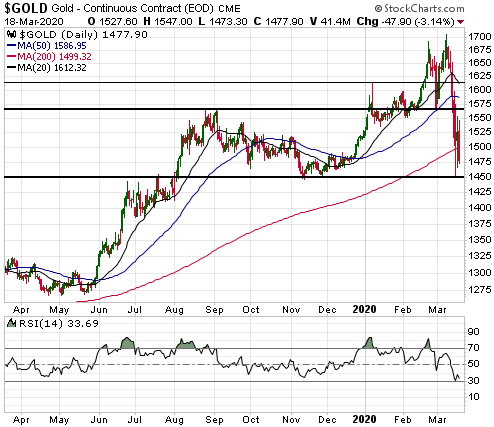
Monday of this week the gold price plunged to the support ($1450) that we
have mentioned as a likely target. The support held, but it might not
continue to hold. What started off as a mini stock market panic has turned
into a general financial-market rout, with speculators and investors
selling everything in an effort to raise cash. Consequently, it will be
difficult for gold to commence a new upward trend until the stock market
has dropped to a level where the buying of value investors finally begins
to overwhelm the fear-motivated selling of the herd.
Silver
There was outright panic by speculators
in silver futures over the past four trading days. As a result of this
panic, the price collapsed from US$16.00 to as low as US$11.64. This is
the lowest price since early-2009. Moreover, the gold/silver ratio soared
to a high of 133, which is the highest level in history for this ratio.
Here are the relevant charts.
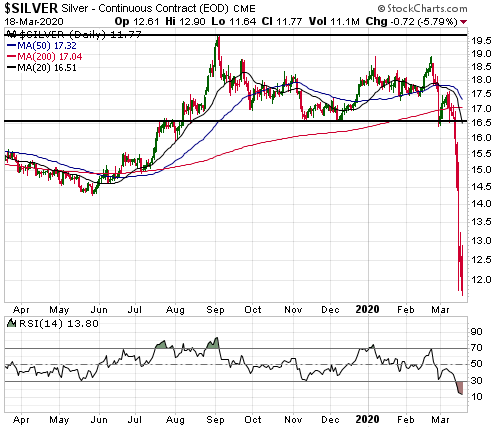
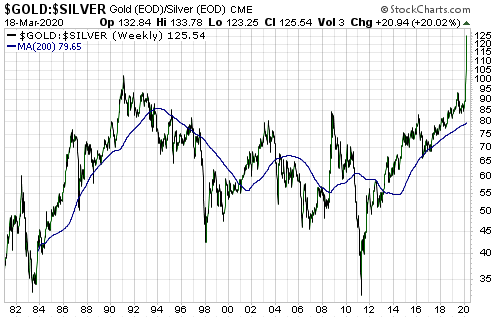
We won't know the extent of speculator long liquidation in silver
futures until the COT report is published on Friday, but we do know that
the open interest (OI) in silver futures has fallen to around 164K
contracts. This is approximately the OI that coincided with an important
low in the silver price in early-2016.
Silver's risk/reward is very
attractive right now, but that doesn't mean you should mortgage the back
forty and put all the proceeds into silver. That would be reckless.
However, if you have a sizable cash reserve then it would make sense to
buy some silver now with a plan to average in over time. Also, short-term
traders could attempt to profit from the rebound that follows every crash.
Gold Stocks
From the email sent to subscribers
after the close of US trading on Tuesday 17th March:
"In just
two days the HUI has retraced about half of its preceding crash. If we are
dealing with a routine countertrend rebound, then it won't go much higher
before pulling back to test the crash low.
It will be reasonable to
assume that we are dealing with a countertrend rebound in the gold sector
and that a test of Monday's low is coming unless the HUI achieves
consecutive daily closes above its 200-day MA (currently at 214)."
The following daily chart shows that the HUI traded slightly below
support in the high-140s on Monday before reversing course and surging to
resistance near 200 (resistance for a countertrend rebound extends from
around 200 up to the 200-day MA near 214). It then pulled back sharply on
Wednesday 18th March.
The volatility is breathtaking. We expected a
strong rebound from Monday's low that retraced about half of the preceding
crash, but we didn't expect it to happen within two days.
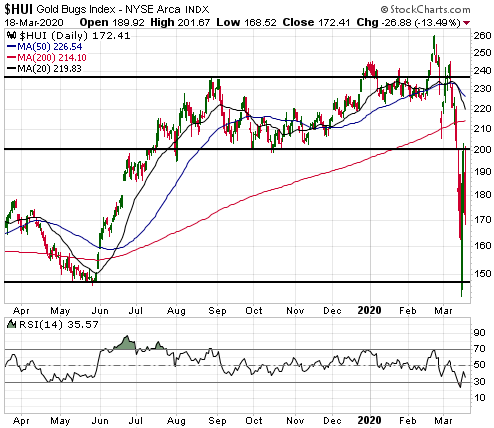
The HUI probably will test Monday's crash low, but the timing is
impossible to pin down. It could happen before the end of this week, or it
could follow a few weeks of back-and-forth trading.
The market
price relative to the NAV of the popular gold mining ETFs could help
identify the next short-term trading opportunity. For example, at the end
of last week GDXJ was priced at a 14% discount to its NAV, which indicated
that weakness near the open on Monday 16th March should be bought. At the
close of trading on Tuesday 17th March the ETF was trading at a 5% PREMIUM
to its NAV, which indicated that the "get me out" mentality that prevailed
during the final few hours of trading last Friday and the first hour of
trading on Monday had been replaced by a "get me in" mentality. At the
close of trading on Wednesday 18th March GDXJ was priced at an 8% discount
to NAV, so we are already back to a "get me out" mentality. This is crazy!
Note that a few hours after the close of trading each day, GDXJ's
NAV is reported
HERE.
By the way, the collapse in industrial commodity prices
relative to the gold price should lead to a large increase in the
profitability of gold mining over the coming year. As a result, a 1-2 year
upward trend in the gold mining sector could begin after the 'dust
settles'. First of all, however, we have to navigate through the market
chaos caused not by the coronavirus itself but by the over-the-top
reactions to the coronavirus.
The Currency Market
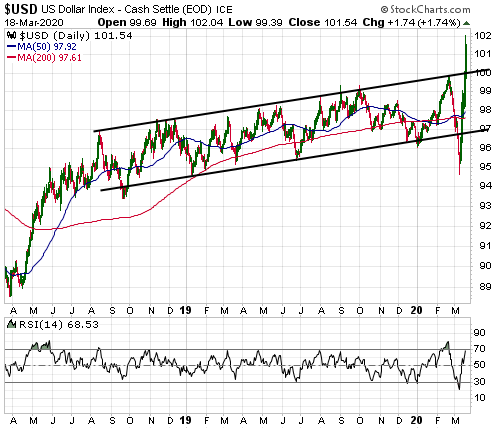
Initially during the virus-inspired financial-market chaos there was a
rush to cover euro short positions associated with carry trades, but now
we are getting the traditional panic into the US$. This has driven the
Dollar Index (DX) from well below its channel bottom to well above its
channel top within the space of only seven trading days. This potentially
is a major upside breakout, but the absurd volatility throughout the
financial world makes breakouts even less reliable (as indicators of the
future) than is normally the case.
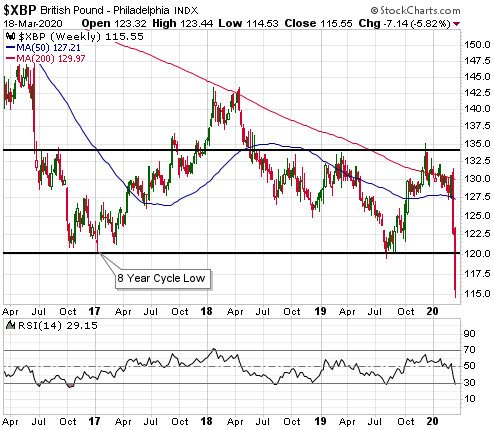
The extreme volatility has encompassed a spectacular decline in the
British Pound. As illustrated by the weekly chart displayed below, the
Pound has plunged from 1.31 to 1.15 and in doing so has breached its
8-year cycle low. This could be a false downside breakout, but it would be
prudent to assume that it is genuine until proven otherwise. Therefore,
short-term traders who 'went long' near support in the low-1.20s should
exit for risk management purposes. Long-term traders could average down,
but be aware that the breakout implies risk to around 1.00.
Updates on Stock Selections
Notes: 1) To review the complete list of current TSI stock selections, logon at
http://www.speculative-investor.com/new/market_logon.asp
and then click on "Stock Selections" in the menu. When at the Stock
Selections page, click on a stock's symbol to bring-up an archive of
our comments on the stock in question. 2) The Small Stock Watch List is
located at http://www.speculative-investor.com/new/smallstockwatch.html
 Recent
changes to TSI Stocks List
Recent
changes to TSI Stocks List
As advised in the emails sent
to subscribers on 16th and 17th March, the following changes to the TSI
Stocks List were implemented during the first two days of this trading
week:
- GDXJ was added at $19.80 on Monday and exited at
$31.00 the next day.
- The GDX May-2020 $23 call option was
added at $0.80 on Monday and exited at $3.50 the next day.
-
The Physical Platinum ETF (PPLT) was added at Monday's closing price of
US$62.06.
- The SLV May-2020 $14 call option was added at
$0.43 on Tuesday.
Chart Sources
Charts appearing in today's commentary
are courtesy of:
https://stockcharts.com/