|
- Interim Update 18th May 2011
Copyright
Reminder
The commentaries that appear at TSI
may not be distributed, in full or in part, without our written permission.
In particular, please note that the posting of extracts from TSI commentaries
at other web sites or providing links to TSI commentaries at other web
sites (for example, at discussion boards) without our written permission
is prohibited.
We reserve the right to immediately
terminate the subscription of any TSI subscriber who distributes the TSI
commentaries without our written permission.
The financial markets and the end of QE2
As
everyone knows, the Fed has been aggressively buying Treasury
securities since last November under the program affectionately known
as "QE2". One of the touted justifications for this program was the
perceived need to support the housing market by making mortgages more
affordable, the idea being that the Fed's buying of Treasurys would
help to lower Treasury yields and, due to the link between Treasury
yields and other yields, mortgage interest rates. However, the
following chart shows that the 10-year T-Note yield has risen since the
introduction of QE2.
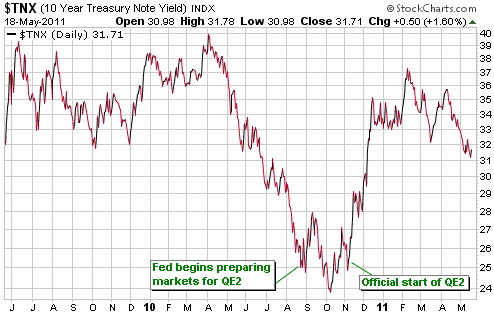
The increase in the
10-year interest rate since the beginning of QE2 is not as anomalous as
it may superficially appear. Yes, the Fed's buying of Treasurys
constituted a significant additional source of demand for government
debt, but it also led to a significant increase in inflation
expectations by pushing up the prices of commodities and equities. In
general, if the lowering of interest rates is the primary goal then the
monetisation of debt will be counterproductive -- even from the
jaundiced perspective of a central banker -- when the additional money
causes inflation expectations to rise.
It should be understood, though, that while the lowering of long-term
interest rates was a publicly stated goal of QE2, it probably wasn't
the actual goal (there is often a big difference between the stated and
actual reasons for a policy). It's more likely that the large-scale
debt monetisation was undertaken with the aim of boosting prices and
strengthening the balance sheets of poorly managed banks. In this case
it achieved its short-term objectives, in that: a) it effected the
surreptitious transfer of wealth from the rest of the economy to the
banking industry, b) the cost of living is now much higher, and c)
stock prices have risen to the point where the broad stock market's
future long-term performance is almost guaranteed to be sub-par. A very
successful policy, indeed!
A point we wanted to make today is that while many analysts appear to
be operating under the assumption that the end of QE2 will quickly lead
to a rise in bond yields, it could actually bring about the opposite by
causing inflation expectations to fall. Think of it this way: if the
QE2-related boost to monetary inflation put irresistible upward
pressure on long-term interest rates by causing commodity prices and
inflation expectations to rise, why wouldn't the reduction in monetary
inflation associated with the termination of QE put irresistible
downward pressure on long-term interest rates by causing commodity
prices and inflation expectations to fall?
At this stage there are a lot of unknowns. We don't know, for instance,
if the Fed will end its QE program in June as currently scheduled. Our
best guess is that it will, but will phrase any announcements in such a
way that the door is kept open to the immediate resumption of the
policy if deemed necessary. We also don't know what will happen to the
banks' excess reserves, which is an important consideration because the
banking industry now has sufficient reserves to rapidly expand the
money supply without any assistance from the Fed.
What we do know is that if the Fed announces the end of QE and the
markets take the announcement seriously, the result could be
substantial downturns in the commodity and equity markets and a
multi-month extension to the recent T-Bond rally in response to falling
inflation expectations. We also know, or at least can be confident,
that a substantial decline in the stock market would prompt the Fed to
resume QE, although there would likely be a 2-4 month period between
the end of "QE2" and the start of "QE3" during which the markets
discounted slower monetary inflation. Lastly, we are confident that a
bond market decline of sufficient magnitude to push the 10-year T-Note
yield above 4% would prompt a large decline in the stock market, with
or without additional QE.
The bottom line, then, is that as far as the next few months are
concerned there is a lot more downside risk in the stock market than
the bond market. There is also probably less upside potential in the
stock market than the bond market.
Oil Update
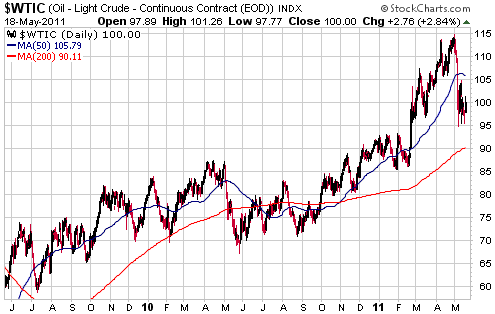
Chart-wise,
the oil market is in a similar position to the gold market in that it
dropped sharply after peaking at the beginning of May but hasn't yet
provided solid evidence that an intermediate-term peak is in place.
Having said that, oil's chart pattern looks a little more bearish than
gold's in that oil's decline from its early-May peak took the price
well below its 50-day moving average.
Our guess is that an intermediate-term correction has begun in the oil
market and that any rebound over the next couple of weeks will end near
the 50-day moving average.
The market's attention has since shifted away from political
instability in MENA and the potential for this instability to restrict
the flow of oil, but there's a good chance that the upheaval seen to
date -- with a few long-serving dictators being overthrown via popular
movements -- is just the first phase of a major new trend. From our
perspective, this means that the geopolitical risk factor will
eventually return to centre stage and that the oil market's downside
potential resulting from economic and stock market weakness will
continue to be balanced by the potential for a supply shock.
The Stock Market
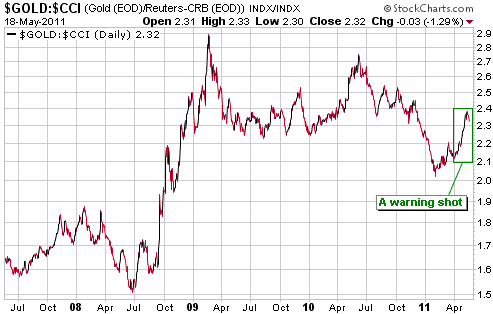
The
following chart shows the gold/CCI ratio (gold relative to a basket of
commodities). We'll now explain why we have included this chart in the
stock market section of today's report, rather than in the gold section.
Gold/CCI is an indicator of economic confidence, in that it trends
higher when confidence trends downward. Also, it tends to rise in
response to an increasing desire to save, and, by extension, a
decreasing desire to consume. The reason it behaves in this way is that
even though gold is no longer money in the true meaning of the word
(gold is not the general medium of exchange), in many respects it
performs as if it were money.
The Fed and other central banks unwittingly support gold's monetary
performance. They do this by ensuring that anyone who tries to save in
terms of the official money will end up with a negative real return and
a loss of purchasing power. In effect, central bankers are constantly
shouting: "If you try to save in dollars (or euros or Yen or pesos), we
will punish you!" This forces some large investors -- and some small
investors, but the large investors have more influence -- to save in
terms of a money-like asset that can't be depreciated by central banks.
Consequently, an increase in the propensity to save is generally
indicated by a rise in the price of gold relative to the prices of
commodities that are consumed.
A rise in the propensity to save is a short- and intermediate-term
negative for an over-valued stock market that relies on increasing risk
aversion to maintain its elevated valuation. The recent rebound in the
gold/CCI ratio should therefore be considered a warning shot that the
stock market's upward trend is about to end.
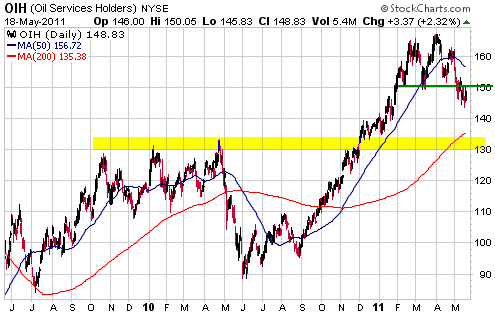
Within the Oil and
Gas sector, the drilling services companies generally have the most
bullish earnings outlooks over every timeframe. However, evidence is
emerging that the stocks of these companies peaked on an
intermediate-term basis in early April. For example, the Oil Services
Holders ETF (OIH) appears to have just completed a rounded topping
pattern.
Ideally, the drilling services stocks will fall far enough to set up
excellent buying opportunities by the final quarter of this year.
Gold and
the Dollar
Gold and Silver
Current Market Situation
Market Vane's bullish consensus for silver peaked at an extraordinary
97% during the final week of April, which doesn't guarantee anything
but is consistent with the idea that silver's late-April peak will hold
for a long time (more than a year). The sentiment situation has since
changed dramatically, with Market Vane's bullish consensus reaching 61%
on Tuesday 17th May. Tuesday's bullish percentage was the lowest since
August of last year, and is consistent with the idea that a meaningful
rebound has either begun or will soon do so.
There is little chance that silver has made its ultimate correction
low, but a counter-trend rebound to the low-$40s is a realistic
possibility.
Unlike silver, there is no decisive evidence yet that gold has made a
peak of intermediate-term significance. A daily close below the
early-May low would constitute such evidence.
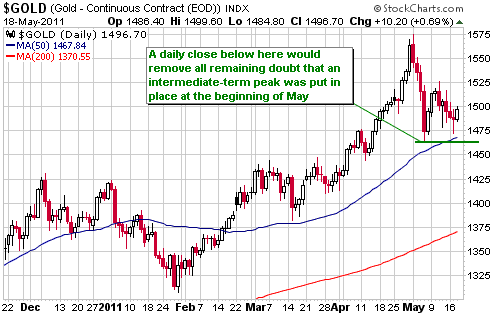
With regard to the
next 2-3 weeks, one plausible scenario is that gold will rally to a new
high for the year while silver rebounds to a lower high. If this
scenario played out it would create an excellent short-term selling
opportunity.
Incorporating silver into Mexico's monetary system
Jeff Berwick of The Dollar Vigilante did an interview earlier this week
with Mexican billionaire Hugo Salinas-Price (HSP) about the latter's
plan to "monetise" the one-ounce silver Libertad coin. The interview
can be read HERE.
Prior to Jeff's interview we weren't clear on what HSP had in mind. It
seemed as if there were moves afoot to provide silver backing to the
Mexican Peso, but that's not actually the case. As explained in the
interview, if HSP's proposal were adopted it would not provide the Peso
with any silver backing and would not in any way limit the ability of
Mexico's central bank to inflate the Peso supply. The proposal, in a
nutshell, is for Mexico's central bank to quote a value for the 1-ounce
Libertad coin that would always be above the current market value of
the contained silver.
We are certain that HSP has good intentions, but his current plan does not appear to offer any benefits.
Gold Stocks
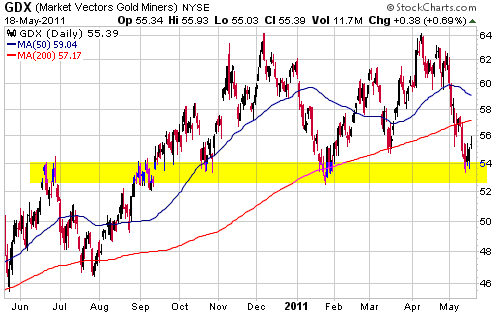
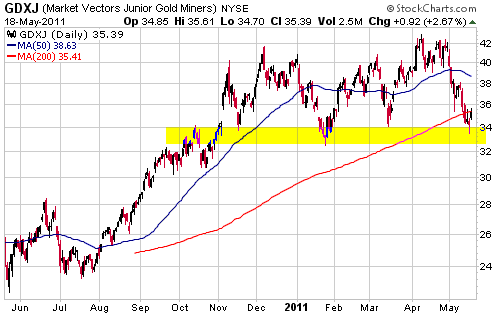
The following charts show that GDX (a proxy for large-cap gold mining
stocks) recently tested intermediate-term support at $52.50-$54.00 and
that GDXJ (a proxy for junior gold mining stocks) recently tested
intermediate-term support at $33.00-$34.00. These support ranges will
probably be breached before the gold sector's correction comes to an
end, but we suspect that GDX and GDXJ will consolidate/rebound for a
couple of weeks before resuming their declines. $57-$59 and $37-$38 are
reasonable upside targets for near-term rebounds in GDX and GDXJ,
respectively.
This week's modest
strength in the major gold stocks relative to gold bullion probably
means that our HUI/Gold Oscillator (HGO) will not generate a buy
signal. At this stage it looks like HUI/gold's decline reached its
momentum extreme last Thursday (12th May).
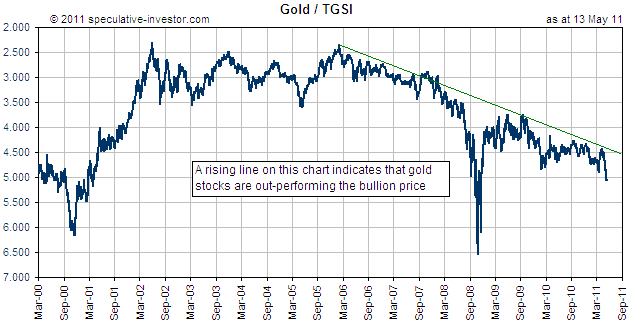
We maintain our own index of major gold stocks, known as the TGSI. The
following chart shows that with the exception of the 2008 panic
(August-October of 2008), at the end of last week the major gold
stocks, as a group, were at their lowest level relative to gold bullion
in more than 10 years.
We don't know what to make of this. It means that the major gold stocks
are relatively cheap, but it doesn't mean that they aren't going to
become a lot cheaper. During the 1970s the major gold stocks became
progressively cheaper in terms of gold until they finally bottomed-out
in January of 1980.
Currency Market Update
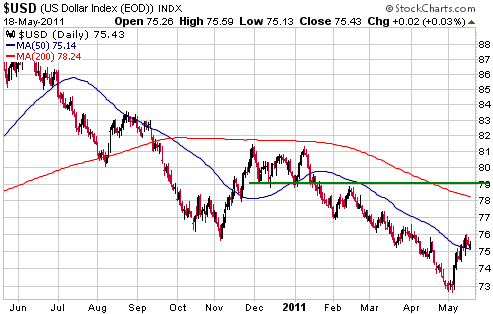
Over the past 25 years, intermediate-term US$ bottoms have usually
involved a multi-week rally followed by a decline to test the low. If
the current bottoming process follows this pattern then the Dollar
Index probably won't do any better, over the next few weeks, than rise
to around 79 before embarking on a decline that eventually takes it
back to the vicinity of its early May low. The area just below the
200-day moving average (77-78) is the most likely place for a
short-term peak.
Update
on Stock Selections
(Notes: 1) To review the complete list of current TSI stock selections, logon at http://www.speculative-investor.com/new/market_logon.asp
and then click on "Stock Selections" in the menu. When at the Stock
Selections page, click on a stock's symbol to bring-up an archive of
our comments on the stock in question. 2) The Small Stock Watch List is
located at http://www.speculative-investor.com/new/smallstockwatch.html)
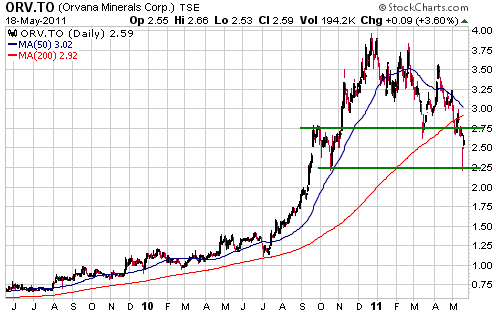
 Orvana Minerals (TSX: ORV). Shares: 117M issued, 120M fully diluted. Recent price: C$2.59 Orvana Minerals (TSX: ORV). Shares: 117M issued, 120M fully diluted. Recent price: C$2.59
We confirmed ORV's addition to the TSI List in Stock Selection Update #65, which was sent to subscribers after Tuesday's trading session.
The following chart shows that ORV has resistance at C$2.70-$2.75 and support at C$2.25.
ORV has the potential
to rise to C$6 within the next 12 months, but there will be significant
execution risk as it brings its two main projects into production.
'Teething problems' during the production ramp-up combined with the
continuation of the sector-wide correction could result in the stock
trading below this week's low before the next intermediate-term advance
gets underway.
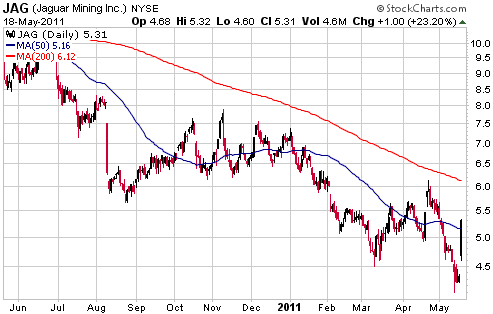
Jaguar Mining (NYSE and TSX: JAG). Shares: 84M issued, 88M fully diluted. Recent price: US$5.31
JAG's price action over the past month has been bizarre. The stock
price surged from $5 to $6 in mid April in response to a press release
confirming that the company's planned operational turnaround was on
track, then dropped relentlessly for about 4 weeks to new multi-year
lows in the $4.10-$4.30 range, and then, on Wednesday of this week,
jumped 23% on heavy volume in response to a press release that
essentially provided the same information as the mid-April press
release. The stock market is many things, but it ain't efficient.
If JAG is able to
achieve its 2011 production and cost forecasts then at the current gold
price the stock would, in our opinion, be fairly valued at around
US$10/share. Given the historical record this is a big "if", but the
mid-April and mid-May press releases indicate that the company was on
track as at the end of Q1.
Chart Sources
Charts appearing in today's commentary
are courtesy of:
http://stockcharts.com/index.html

|