|
- Interim Update
18th June 2014
Copyright
Reminder
The commentaries that appear at TSI
may not be distributed, in full or in part, without our written permission.
In particular, please note that the posting of extracts from TSI commentaries
at other web sites or providing links to TSI commentaries at other web
sites (for example, at discussion boards) without our written permission
is prohibited.
We reserve the right to immediately
terminate the subscription of any TSI subscriber who distributes the TSI
commentaries without our written permission.
Will the
Fed end its money pumping this year?
This week's FOMC meeting was another
non-event, as it came and went with no surprises and minimal effect
on the financial markets. As widely expected, the Fed continued
along the $10B/meeting "tapering" path. Given the absence of signs
that the Fed is about to deviate from this path and the broadening
recognition that QE is not helping, it's time to revisit the
question: Will the Fed follow through on the commitment to end its
money-pumping this year?
Earlier this year we thought that the answer was no. More
specifically, we thought that the Fed's "tapering" would terminate
prematurely during the third quarter. For example, in our 2014
Yearly Forecast, which was published in January, we wrote:
"The economic data will probably be OK during the first few
months of 2014, but if commercial-bank credit growth continues at
its present slow pace then by the third quarter of this year there
will probably be enough stock market weakness and enough signs of
economic deterioration to prompt the Fed to step away from its
"tapering" plan."
And in the 14th April Weekly Update, we wrote:
"The Fed began to reduce the rate at which it creates new dollars
a few months ago and plans to turn off its 'money pump' before the
end of this year. We think that by July-August of this year the Fed
will be sufficiently worried about how the stock market and the
economy are faring to prematurely end its "QE tapering", but in the
meantime there will be a further scaling-down of the Fed's so-called
"monetary accommodation"."
The US economy has been sluggish during the first half of this year;
however, the senior US stock indices have continued to grind upward.
The S&P500 Index is only up by around 6% since the beginning of the
year, but it made a new high as recently as Wednesday 18th June. Its
upward trend is therefore intact. Although a significant (10%+)
decline is likely within the next two months, the fact that it is
taking longer than expected for the stock market to top-out suggests
that equities won't get weak enough soon enough to jolt the Fed from
its "tapering" path.
As an aside, the inability of the economy to 'gain traction' is an
inevitable consequence of the Fed-engineered monetary deluge of the
past several years. This is because the flood of new money prevented
markets from clearing, discouraged saving (the necessary initial
step in the growth process), and caused resources to be wasted on
projects, businesses and other investments that would not have been
viewed as economically viable if not for the central-bank
suppression of interest rates.
The stock market's resilience is undoubtedly due in part to an
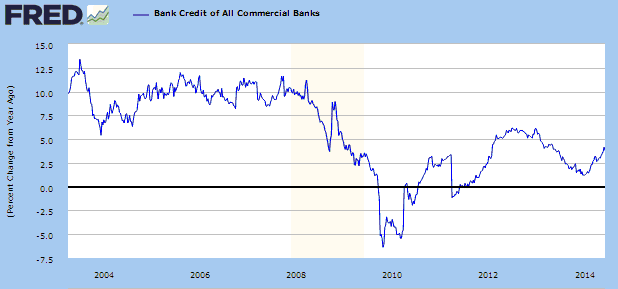
increase in the pace of commercial bank credit creation. The current
3.8% year-over-year (YOY) rate of growth in commercial bank credit
is low by historical standards, but it is up from only 1.2% at the
beginning of this year (note the up-tick on the chart displayed
below). Importantly, in the process of expanding their balance
sheets at a faster pace the commercial banks have, to date, created
enough new money to more than offset the Fed's reduced pace of money
pumping. This has pushed the YOY rate of growth in US True Money
Supply (TMS) up from 7.0% at the end of December-2013 to 8.2% at the
end of May-2014. It is therefore fair to say that monetary
conditions in the US are easier today than when the Fed commenced
its QE "tapering".
So, getting back to the question of whether the Fed will scale down
the current QE program to zero as originally planned, our answer is
now: yes, it probably will. Thanks to the up-tick in commercial-bank
credit growth and the extension of the stock market's upward trend,
the Fed probably won't be pressured by its unwavering devotion to
bad economic theories to provide additional monetary 'support' until
after this year's QE "tapering" has run its planned course.
China's House of Cards
"Shadow Banking System" is the name given to the
combination of all the non-bank companies and institutions that create credit or
facilitate credit creation. In China it has added about $5T of credit since 2007
and therefore played an important role in the inflation of that country's
massive credit bubble (perhaps the greatest credit bubble the world has ever
seen). China's banking system has added about $10T of credit over the same
period, but the Shadow Banking System (SBS) is in a far more precarious position
than the official banking system because in general its cost of funds is far
higher, its investments are much riskier and there is considerable doubt as to
whether it will receive central government support when push comes to shove.
At the heart of China's SBS are local government financing vehicles (LGFVs), of
which there are about 10,000. These were set up by Communist party officials as
a way to get around laws that forbid local governments from running deficits.
Rather than borrow money directly, local governments create LGFVs that sell
high-yielding "investment products" to the public. The money received from the
sale of the investment products is then passed along to the local government.
The plan, in most cases, is for the local government to use the proceeds from
future land sales to make good on its obligations to the LGFV, enabling the LGFV
to make good on its obligations to the purchasers of the investment products.
Until recently the public has been an eager buyer of these products, because by
doing so it could obtain an annual interest rate of at least 9%. Considering
that bank deposit interest rates are capped by the government at around 3% per
year and that China's currency is losing purchasing power at more than 5% per
year, the investment products offered by the SBS looked attractive provided that
the risk of default appeared to lie somewhere between very low and nonexistent.
The popularity and perceived attractiveness of these investment products has
begun to wane, however, as it is becoming clear to Chinese investors that the
risk of default is nowhere near as low as previously believed. This is because
some high-yielding products have already defaulted and because declining
real-estate sales and prices are prompting questions about the abilities of
local governments to raise enough money to make good on their obligations to the
LGFVs. Also, it's probable that many participants are starting to become aware
of the Ponzi-like nature of the system, with continual new investment by local
governments in infra-structure projects -- funded partly by the LGFVs and their
investment products -- needed to create the 'growth' that keeps real estate
prices heading upward, and a never-ending rise in real estate prices needed to
generate the funds to pay-off earlier buyers of the LGFVs' investment products.
China's Shadow Banking System can be thought of as a house of cards that's
propping up a much larger house of cards. When the SBS collapses, which it
inevitably will, it could set in motion a much larger economy-wide collapse.The Stock Market
China
The relationship between stock market performance and economic performance is
weak. This is generally the case throughout the world and is especially the case
in China. Consequently, the economic problems that are bubbling to the surface
in China do not mean that substantial weakness lies in store for China's stock
market.
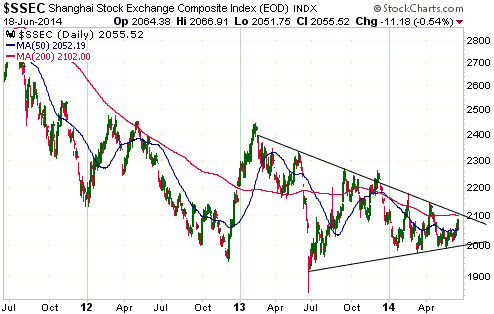
The following daily chart of the Shanghai Stock Exchange Composite Index (SSEC)
shows a neutral pattern over the past year, with declining highs and rising
lows. This pattern is just as likely to end via an upside breakout as a downside
breakout. Actually, considering that the pattern began to form following years
of weakness in both absolute and relative terms and also considering the
incipient strength over the past 6 months in most things commodity-related, we
suspect that the SSEC's next multi-month trend will be to the upside.
The upshot is that despite China's economic distortions and the potential for a
chaotic collapse of its Shadow Banking System, we do not think that China's
stock market is a good candidate for a bearish speculation. The US stock market
is a much better candidate for a bearish speculation, although at the moment it
seems intent on defying gravity.
The US
By maintaining its upward trend, the US stock market continues to be a minor
frustration to us.
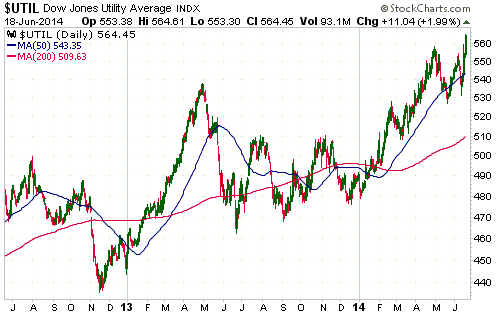
This week, in response to an absence of anything new from the Fed, the Dow
Utility Average (UTIL) negated its recent bearish signal by making a new high
for the year. This increases the probability that the market's major topping
process will extend into the final quarter of this year.
Small-Cap Canadian Stocks
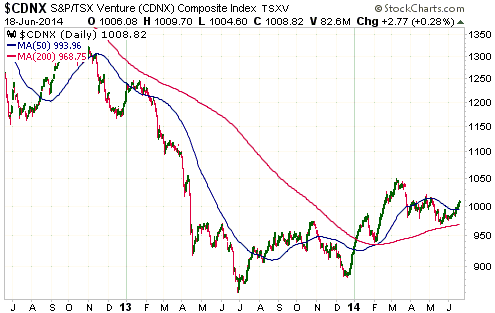
The TSX Venture Exchange Composite Index (CDNX), a proxy for small-cap Canadian
resource stocks, has done enough over the past few days to confirm that a
routine correction ended last month and that a new short-term upward trend is
underway.
Gold and the Dollar
Gold
The article titled "11
facts that explain the escalating crisis in Iraq" is a good primer on the
Iraq situation. Fortunately, the markets appear to have put Iraq on the
'backburner', which means that if gold manages to break out to the upside in the
near future, we will be able to trust the breakout.
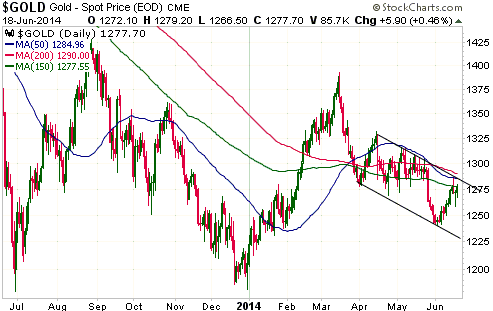
As illustrated below, gold has a confluence of resistance in the $1275-$1290
range. The resistance is defined by three moving averages and the top of a
short-term channel. That similar resistance was first overcome by GDXJ last week
and has just been breached by the senior gold-stock indices tells us that an
upside breakout will probably soon occur in the bullion market.
Gold Stocks
Current Market Situation
The only surprise following Wednesday's Fed news was that gold and gold stocks
strengthened along with the broad stock market. This was only mildly surprising,
however, because the inverse relationship between the broad stock market and
gold-related investments is loose and often doesn't work over short periods.
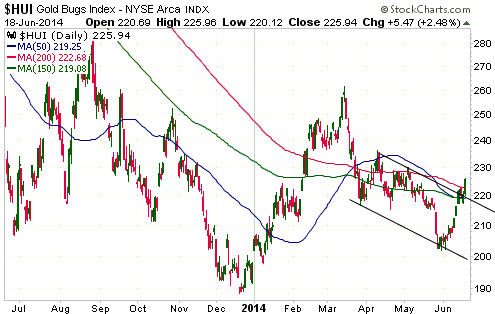
This week's follow-through to the upside has clearly taken the HUI above a
confluence of resistance at around 220. Provided that the HUI is able to end the
week at its current level or higher we will have additional evidence that a
downward correction ended late last month and that a rally to new highs for the
year has begun.
West African Gold Miners
The stocks of exploration/development-stage gold miners with projects in West
Africa are the flavour of the month and stand a good chance of being the flavour
of the year. The catalyst for the most recent increase in the demand for these
stocks was B2Gold's takeover bid for Papillon Resources (PIR.AX), but there were
tentative signs of accumulation prior to the aforementioned takeover news.
The increasing demand for West African junior gold miners is due to the type and
quality of the resources that have been and continue to be discovered in this
part of the world. The region is extremely prospective, and yet it has seen
relatively little exploration to date. The potential is huge, but investors in
the companies that have already discovered or that appear to be on the verge of
discovering an economically-viable gold deposit in West Africa should take into
account the country risk. While country risk does not appear to be a major
concern at this time, the 2012 military coup in Mali shows that when country
risk comes to the fore it can do so with no warning.
The TSI Stocks List has a lot of exposure to West Africa. Specifically, the TSI
List includes six gold stocks that have their most important assets in West
Africa -- three producers (EDV.TO, GSS and RSG.AX) and three
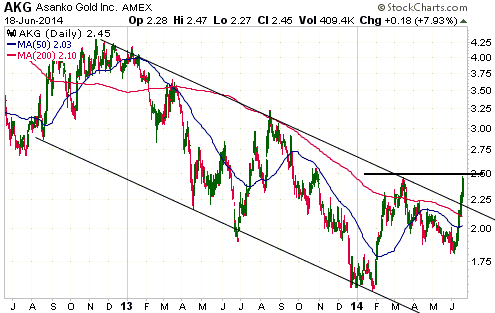
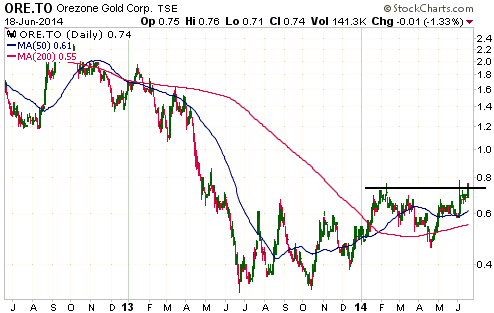
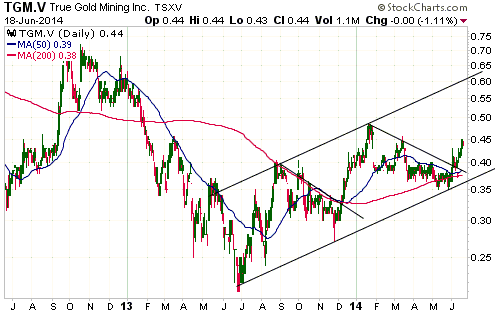
explorers/developers (AKG, ORE.TO and TGM.V). As noted above, the latter (the
explorers/developers) are the flavour of the month. This popularity is evidenced
by the fact that all three are close to 9-month price highs. For details, refer
to the charts displayed below.
Note: AKG was a laggard prior to the past few trading days, but has suddenly
'caught fire'. In addition to the increasing demand for West Africa-based gold
explorers/developers, this is probably due to a small increase in AKG's
weighting within GDXJ. In any case, it is now short-term 'overbought' and just
below intermediate-term resistance at US$2.50, which means that it is currently
not a good candidate for new buying. ORE.TO and TGM.V remain reasonable
candidates for new buying in the low-C$0.70s and low-C$0.40s, respectively.
The stocks of our three West African gold producers aren't yet doing much. In
EDV's case there are two likely reasons. One is a lowering of the stock's
weighting within GDXJ that will take effect at the end of this week. In this
regard EDV.TO is in a similar position to EVN.AX, which is discussed below. The
other is that EDV is perceived to be a potential acquirer rather than a
potential acquiree. This perception is correct, although we doubt that it is on
the acquisition track at this time. We think that the combination of EDV's
extreme under-valuation, profitability and organic growth profile will cause the
stock to be a relatively strong performer over the months ahead.
The Currency Market
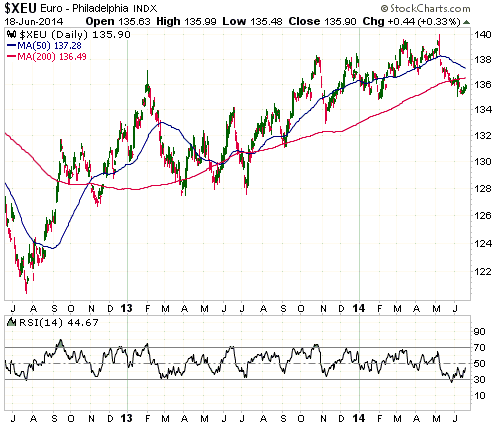
The euro is edging upward. In the process it is working off its 'oversold'
condition without making significant headway and without doing enough to signal
an end to the decline that began last month.
We will have to re-think our short-term bullish view on the euro and associated
short-term bearish view on the Dollar Index if the euro fails to get back above
its 200-day MA over the next few days.
Updates
on Stock Selections
Notes: 1) To review the complete list of current TSI stock selections, logon at
http://www.speculative-investor.com/new/market_logon.asp
and then click on "Stock Selections" in the menu. When at the Stock
Selections page, click on a stock's symbol to bring-up an archive of
our comments on the stock in question. 2) The Small Stock Watch List is
located at http://www.speculative-investor.com/new/smallstockwatch.html
 New
short-term trading position New
short-term trading position
A short-term position in Evolution Mining (EVN.AX) has been added to the TSI
List at A$0.74 (the closing price in Australian trading on Thursday 19th June).
The TSI List also contains a long-term position in this stock.
EVN has a low valuation, a decent balance sheet and more than 400K ounces/year
of profitable gold production across 5 mines in Australia.
This week's decline in EVN's stock price has most likely been caused by the
changes to GDXJ component weightings that will take effect after the close of
trading this Friday. We estimate that the change in EVN's weighting within GDXJ
would necessitate the sale of more than 11M shares. The bulk of this GDXJ-related
selling is probably now complete, but it could continue to put downward pressure
on the stock price until the end of this week. This has led to a short-term
opportunity, because as soon as the ETF/index-related selling ends the stock
should trade more bullishly.
The following chart shows that EVN is drifting lower in what appears to be a
corrective move and is presently near the bottom of its range. Furthermore, the
decline from the March high of around A$1.00 to the low-A$0.70s could be forming
the right shoulder of a major head-and-shoulders basing pattern. A break above
the top of the basing pattern would create a chart-based objective of A$1.50.
We suspect that EVN will quickly rebound to resistance at A$1.00 after the gold
market signals the resumption of its intermediate-term upward trend, but we have
a higher price target in mind.
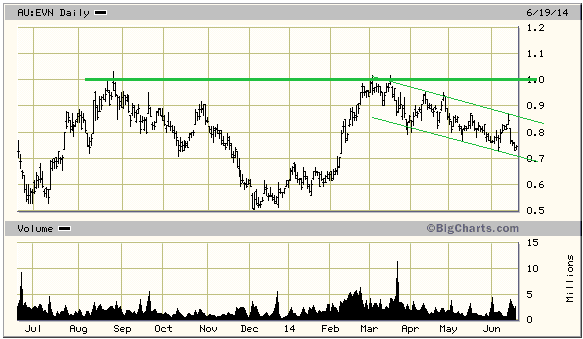
Chart Sources
Charts appearing in today's commentary
are courtesy of:
http://stockcharts.com/index.html
http://bigcharts.marketwatch.com/
http://research.stlouisfed.org/

|









