- Interim Update 18th October 2017
Copyright
Reminder
The commentaries that appear at TSI
may not be distributed, in full or in part, without our written permission.
In particular, please note that the posting of extracts from TSI commentaries
at other web sites or providing links to TSI commentaries at other web
sites (for example, at discussion boards) without our written permission
is prohibited.
We reserve the right to immediately
terminate the subscription of any TSI subscriber who distributes the TSI
commentaries without our written permission.
Email Issues
1) For most of the past week we
weren't able to receive emails sent to steve@speculative-investor.com. The
problem has now been fixed, but if you sent an email to the aforementioned
address during the several days prior to this Wednesday then there's a
good chance we didn't receive it. So, if you emailed us something
important during this period, please re-send.
2) For subscribers
who receive TSI emails in Gmail accounts, be aware that Google categorises
the TSI commentary-notification emails as "promotions". Therefore, if you
have a separate "promotions" tab in your Gmail account then this is
probably where the TSI emails will end up.
Story Stocks
Introduction
In the latest Weekly Update we wrote: "This year has been
difficult for anyone employing a value-oriented approach to selecting
stocks and other assets, because it seems that nothing has mattered except
the story. In general, investors (using the word as loosely as possible)
have flocked to assets with interesting stories regardless of valuation
and have ignored assets that by traditional measures offer good value."
In recognition of the current market environment should we change our
approach and start putting a much greater emphasis on the story than on
the measures of value that have worked well over the long term?
The
answer is a qualified no. In most cases, the market value of a "story
stock" will be based on dreams of what the underlying business could be
worth in the distant future if many things go right and will bear no
resemblance to what the underlying business is worth in the present. There
is no way that we can recommend and follow such stocks at TSI, because in
the absence of a value-linked anchor we can't determine appropriate buy
and sell prices. However, the management of our own portfolio does
encompass story stocks, usually as the result of opportunities to
participate in pre-IPO or pre-RTO (reverse take-over) financings. These
stocks will never be tracked via the TSI service, but occasionally from
now on we'll mention some of the more interesting ones that we are
involved with.
Our occasional notes on story stocks will be similar
to our occasional notes on the stocks included in the SSWL (Small Stocks
Watch List), in that the information will be provided to potentially spark
the interest of readers with enough experience to do their own research.
However, we currently don't intend to maintain a list of story stocks.
Also, story stocks are fundamentally different to the sorts of stocks that
we put in the SSWL. Whereas SSWL stocks look cheap based on a few
reasonable assumptions, story stocks usually look expensive to
rational/impartial observers.
The first of these "story stocks" is
discussed below and two others will be discussed in the coming Weekly
Update.
Chapter 1: Patriot One Technologies (TSXV: PAT,
USOTC: PTOTF). Shares: 76M. Recent price: C$1.52
PAT
listed on the TSXV via the backdoor in October of 2016 by merging with a
defunct mining company and then getting Exchange approval for a COB
(Change of Business) from mining to technology.
PAT's product is
the Patscan CMR (cognitive microwave radar) concealed weapons detection
system. The device scans people as they walk past and generates a warning
on a screen if it detects a weapon.
Unlike the electronic security
measures in common use these days, the PATSCAN system is unobtrusive (it
is a box that will usually be installed behind a wall or barrier) and does
not pose any health threats. Furthermore, unlike a metal detector the
system is designed to generate warnings only when the scanned person is
carrying a weapon. For example, someone walking past a PATSCAN box with a
set of keys or a mobile phone will not generate a warning, but someone
walking past with a knife, a gun or a bomb will generate a warning. And
not just a general warning, but a warning that specifically identifies the
concealed weapon. Consequently, there is no need for the people being
scanned to take any action such as emptying pockets or even be aware that
they are being scanned. Lastly, the PATSCAN system is designed to learn
over time. The more it is used, the better it will get at detecting
legitimate threats and avoiding false alarms.
A demonstration video
and brief description of what the PATSCAN system does can be found at
https://patriot1tech.com/solutions/overview/.
If it works, the
potential market for this product is huge. The potential market is almost
all buildings with public access, including hotels, casinos, cinemas,
convention centres, concert halls, churches, schools, office buildings,
government buildings, museums, shopping malls, banks and train stations.
One of the risks is that it won't work as well as advertised. Another risk
is that competing products will capture most of the market.
The
company has achieved the government approvals it needs for commercial
roll-out of the product across North America. Specifically, over the past
few weeks it has received Industry Canada approval and FCC (the US Federal
Communications Commission) approval.
It's a great story, but
what's it worth?
At this stage there's no way of valuing the
company. The current market cap is C$115M (US$90M), which is extremely
high based on the minimal amount of current revenue and extremely low
based on optimistic projections of what the company will earn if its
product is widely adopted.
PAT is the largest holding in our
account, but that's only because we had the opportunity to make a
medium-sized investment at C$0.15/share in a private placement prior to
last October's backdoor listing and the stock price is now ten times
higher. We don't advise buying at the current price, but we also don't
advise against it because there's a realistic chance of the stock price
rising by another 10-times over the next couple of years.
One way
to deal with this stock would be to track the company's progress and,
provided that the product roll-out doesn't hit any big obstacles, average
into a position during periods when demand is temporarily weak.
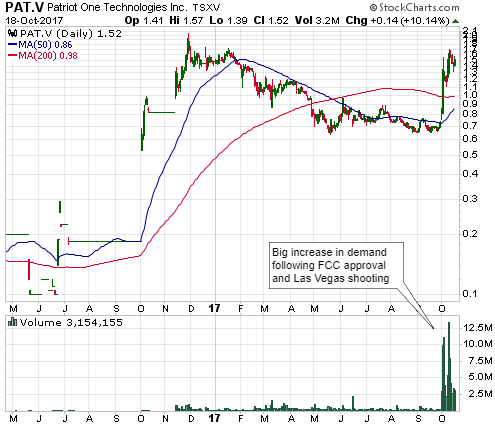
As
evidenced by the following chart, demand has been strong over the past
three weeks. The stock got a boost near the beginning of October from the
announcement of FCC approval, but the recent price surge appears to have
been at least partly a reaction to the mass shooting in Las Vegas.
Bitcoin to "fork"
again?
Bitcoin "forked" in August,
meaning that it split in two. In effect, every "pre-fork" coin was
replaced by two "post-fork" coins, although the new one was called
"Bitcoin Cash". According to the article linked
HERE, it will be "forking" again in November.
How many times
will the supply of this supposedly inflation-proof currency have to double
overnight before a critical mass of people figure out its true nature?
It's going to be interesting to find out.
The Stock Market
With regard to the US stock
market's performance, the big talking point at the moment is the absence
of a talking point, that is, the record-breaking absence of volatility.
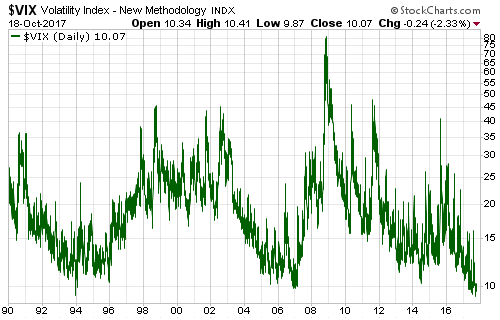
The following chart shows that prior to this year there were a couple of
brief spikes in the VIX to below 10, but 2017 is the first year since at
least 1990 that the VIX spent a lot of time in single-digit territory.
There are four inter-related reasons for 2017's remarkable performance
by the VIX. The first is sentiment, in that there has been a strange
absence of fear. The second is that there has been less day-to-day
volatility than ever before in the S&P500's price action. The third is the
increasing popularity of passive investing via ETFs (the US stock market
now has more ETFs than individual stocks). The fourth is the increasing
number and influence of "quant funds", which are hedge funds that tend to
concentrate on profiting from small price inefficiencies and shy away from
big speculations on market direction.
These four inter-related
reasons have created the situation where being 'short' volatility has paid
steady dividends. That's why being short volatility is now more popular
than ever, as evidenced by the record-high speculative net-short position
in VIX futures.
The decline in volatility is temporary. A dramatic
increase is coming, the only question is the timing. It could happen at
any time with almost no warning, although the fact that it didn't happen
during September-October means that it might not happen until the first
quarter of next year.
Currently we are covered (via VIX call
options) against a volatility surge happening within the next four weeks.
We aren't inclined to place any longer-term bets on rising volatility,
though, because the cost of doing so is too high.
Gold and the Dollar
Gold
The Fundamentals
Gold tends to
perform relatively well during periods when economic confidence is falling
and relatively poorly during periods when economic confidence is rising.
The general trend in credit spreads is one of the best measures of
economic confidence, with widening spreads being indicative of falling
confidence and narrowing spreads being indicative of rising confidence.
That's why the credit-spread trend is one of the inputs to our gold model.
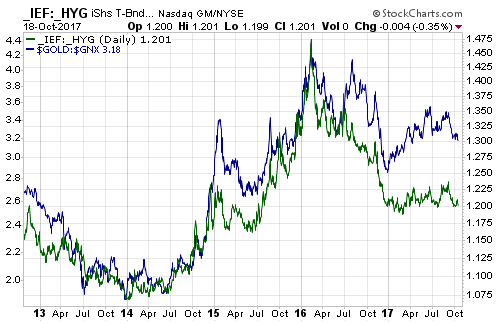
It's also why the following chart reveals a strong positive correlation
between the IEF/HYG ratio, a quantity that moves in the same direction as
credit spreads, and the gold/commodity ratio.
Economic confidence
has been on the rise since early-September, leading to relative weakness
in the gold price.
The Price Action
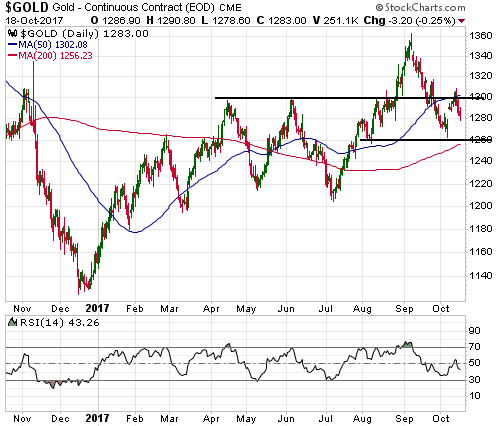
Despite the
US$ gold price having ended last week slightly above both lateral
resistance at $1300 and its 50-day MA, we didn't see a good reason to
expect much from gold in the near future. Here's how we concluded the Gold
section of the latest Weekly Update:
"The fundamental backdrop
is now slightly supportive, but sentiment is still a headwind and the
weakness in the HUI/gold ratio suggests there won't be significant
additional price gains before the rebound from the 6th October low is at
least partially retraced."
A retracing of the rebound from the
6th October low began immediately and over the first three days of this
week the US$ gold price fell from the low-$1300s to the low-$1280s. There
is support near $1260 that should hold if tested over the next few days.
The gold market is presently in a sort of no-man's land where
something will have to change in order for a substantial rally to begin.
That "something" is the sentiment backdrop becoming very supportive or the
fundamental backdrop becoming definitively bullish.
The fundamental
backdrop becoming definitively gold-bullish will require sufficient
weakness in the stock market to disrupt the Fed's 'policy normalisation'
plan, while the sentiment backdrop becoming very supportive will require
sufficient weakness in the gold price to greatly reduce the speculative
net-long position in Comex gold futures.
Gold Stocks
The HUI closed slightly below its 200-day MA on Wednesday 18th
October. This is not exactly a red flag, but it should be viewed as a
warning not to be aggressively bullish.
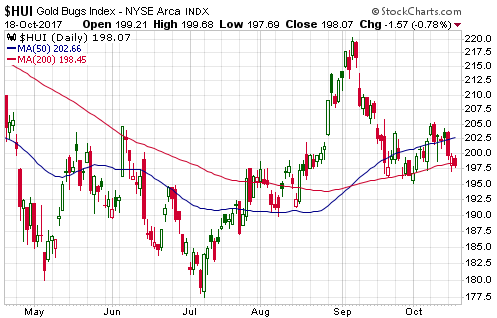
As a result of last week's price action and the price action of the
first three days of this week, the overall rebound from the early-October
low now looks more like a consolidation within a downward trend than the
start of a multi-month rally. If so, we may be in for a sharp decline to
well below the early-October low (195) prior to the start of a rally worth
trading.
This is just guessing, but one possibility is that there
will be at least a few more days of choppy price action in the 195-205
range and then a sharp 1-2 week decline to a sustainable bottom during the
first half of November. If this were to happen it would set the stage for
a strong rally from early-November through to January-February.
The Currency Market
Like the gold-mining indices,
a few major currencies made short-term highs in early-September, declined
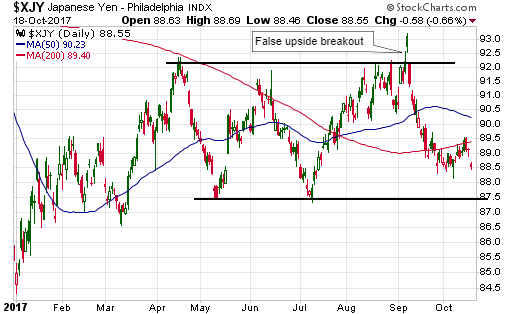
sharply to lows in early-October and then consolidated. One example is the
Yen.
The Yen immediately reversed downward after breaking above
important lateral resistance in early-September. It has substantial
support at 86.5-87.5 that could limit the decline, especially considering
that this currency has a very supportive Commitments of Traders (COT)
situation.
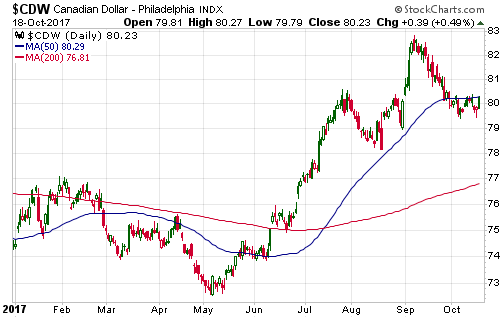
Another example is the Canadian dollar (C$).
Unlike the Yen,
the C$ has a COT situation that greatly adds to the short-term downside
potential. However, the C$ is holding up relatively well at the moment
because speculators in C$ futures are, as a group, refusing to be shaken
out of their extremely large net-long position.
We suspect that
speculators have been encouraged to stick with their long C$ exposure by
the recent strength in the oil price. Should the oil price lose a few
dollars as part of a routine correction, which we think it will do at some
point over the next two months, then the C$ could plunge as speculators
rush for the exit.
Updates on Stock Selections
Notes: 1) To review the complete list of current TSI stock selections, logon at
http://www.speculative-investor.com/new/market_logon.asp
and then click on "Stock Selections" in the menu. When at the Stock
Selections page, click on a stock's symbol to bring-up an archive of
our comments on the stock in question. 2) The Small Stock Watch List is
located at http://www.speculative-investor.com/new/smallstockwatch.html
Chart Sources
Charts appearing in today's commentary
are courtesy of:
http://stockcharts.com/index.html