|
- Interim Update 18th November 2009
Copyright
Reminder
The commentaries that appear at TSI
may not be distributed, in full or in part, without our written permission.
In particular, please note that the posting of extracts from TSI commentaries
at other web sites or providing links to TSI commentaries at other web
sites (for example, at discussion boards) without our written permission
is prohibited.
We reserve the right to immediately
terminate the subscription of any TSI subscriber who distributes the TSI
commentaries without our written permission.
Turning Japanese? We
really don't think so!
In his November commentary, hedge fund manager Hugh Hendry (The Eclectica Fund) argues the case for deflation and the related case for a speculative long position in US Treasury Bonds. While we clearly disagree with some of Hendry's conclusions, our view of the financial world is actually not that different from his.
Hendry discusses the falling productivity of debt and what it suggests about the government's attempts to boost "GDP growth" by ramping up its own leverage. Specifically, he says:
"Over the last decade, each marginal dollar of debt has generated less and less marginal income. We knew that there would be a "zero-hour" for the economy when the creation of new debt would not contribute to GDP growth. The government's reaction to last year's demand shock has been to increase its own leverage. But, with the economy operating at its zero-hour, we believe this incremental leverage will actually have a negative impact. That is to say, the public sector will fail in its attempt to bring the economy back to its previous level of nominal GDP. In this scenario, the outcome will disappoint the market's expectations, which are rampantly bullish as evidenced by this year's dramatic re-pricing of risk assets."
Our view is that increasing government spending -- and the associated indebtedness -- is ALWAYS a negative for the economy; it's just that under some circumstances it will be offset by positives. Under the current set of circumstances the positives appear to be inadequate, so the incremental leverage will, as Hendry suggests, likely have a negative impact. Consequently, there's a very good chance that future growth will be lower than currently expected and that the recent rush towards 'risk' will prove to have been ill-conceived.
We are therefore in agreement with Hendry regarding the outlook for economic growth. However, economic stagnation (or contraction) combined with increasing risk aversion doesn't imply that a period of deflation lies in store. The main problem for the deflation view is that even after it becomes apparent to the average primary-school student that the government's attempts to stimulate are hurting rather than helping, the attempts won't end. Rather, they will very likely become more frenzied! Based on the reality that over the next few years it will be the Obamas of the world who will be designing/implementing government policy and the Krugmans of the world who will be providing the intellectual justification for the policy, we should assume that the weaker the economy becomes, the faster the government will borrow and spend. It is therefore reasonable to say that under the current monetary/political system, economic weakness is not a good argument for deflation. It is, instead, an argument for more inflation. This is a point we've been stressing since at least 2001.
Hendry goes on to cite the Japanese experience to support his thesis that US Government Bonds will do very well despite a large increase in bond supply. For example, he says:
"...it all really comes down to your take on the ratio of total debt-to-GDP. If you believe, like I do, that it peaked in 2007 then the repercussions are enormous. The leverage does not necessarily have to come down (after peaking in 1932 at 300% it troughed 20 years later at 150%). Rather, it may well be that low interest rates allow the mountain of debt to continue to be serviced. This has been the Japanese experience to date. However, everything in our economic life exists at the margin, and the consequences of just maintaining the leverage constant would be a very low delta in nominal GDP growth. Consider that the Japanese, under these very circumstances, have managed to grow nominal GDP at just 1% compound since 1990."
Similarities definitely exist between the current US situation and post-bubble Japan, but as we've discussed in previous TSI commentaries there is also at least one critical difference. We are referring to the all-important difference in the monetary backdrop. Contrary to Hendry's belief and, it seems, the belief of everyone who argues that the US is following in Japan's footsteps, Japan's rate of money-supply growth has been relentlessly slow (by fiat money standards) over the past 19 years. To be more specific, Japan's year-over-year M2 growth rate plunged to 2% during the 12 months following the bursting of its stock market bubble and has averaged 2% ever since. In other words, at no time since 1990 have Japan's monetary authorities done anything remotely similar to what the US Fed and Treasury have done over the past 15 months.
Summing up, we agree with Hendry that there are large risks for equities and industrial commodities with regard to the year ahead, and that the schools of Keynes and Friedman offer no remedies for what ails the global economy. We also agree that the Japanese bond market is an accident waiting to happen. However, we think he is seriously under-estimating the ability and willingness of US (and other) policy-makers to inflate, and is therefore too bullish on Treasury Bonds.
The US
Stock Market
A 180-degree turn is now complete
This Friday (20th November) is the 12-month anniversary of a major turning point in the financial markets. As illustrated by the following chart, 20th November 2008 marked important bottoms for the broad stock market (S&P500) and the gold sector (XAU), and an important top for the Dollar Index. Will the days around 20th November 2009 mark the opposite?
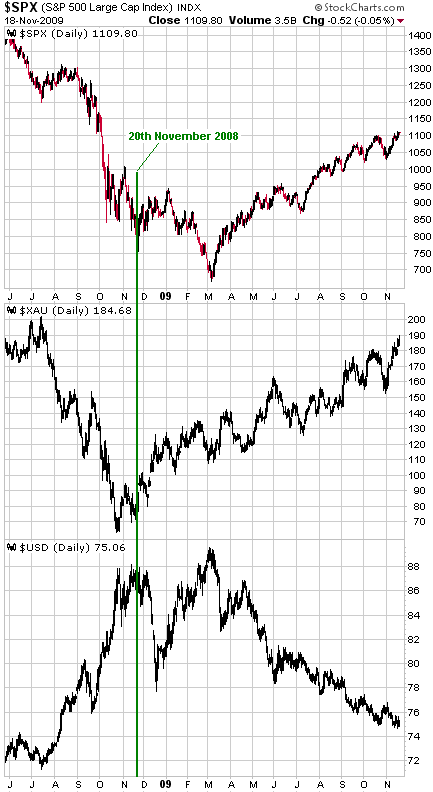
It seems superstitious, but anniversaries of major turning points can sometimes be important in the financial markets. This is just something to keep in mind if reversals occur over the next few days.
Current Market Situation
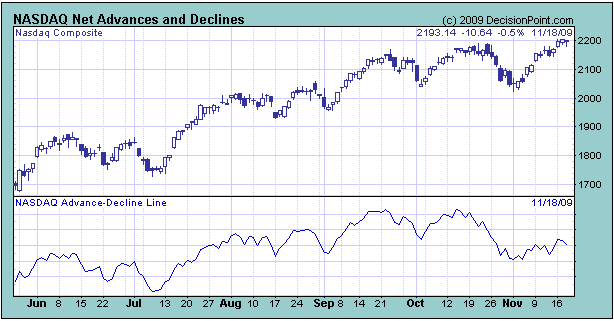
The following chart shows the NASDAQ Composite Index and the NASDAQ's Advance-Decline (A-D) Line. Notice that the A-D Line did not confirm the NASDAQ's latest move to a new high for the year. It is generally the case that measures of the stock market's internal health peaked around mid October.
The relatively poor performance of the stock market's 'internals' over the past month should be treated as a warning sign of trouble ahead.
Governments have a history of downplaying or ignoring genuine major threats and building up minor or non-existent threats into major issues. We are therefore prompted to ask: why is the government building "Swine Flu" into a major issue? Is it being positioned as a potential scapegoat for the next phase of the economic depression? Or, perhaps, as the justification for the additional curtailment of individual freedom?
Gold and
the Dollar
Gold and Silver
Sentiment
Don't mistake the widening recognition of gold's bull market as a sign of an important top. It can't remain a secret forever. Moreover, the most spectacular phase of any bull market can only begin after the general public has embraced the upward trend, and at this stage there is no evidence that the general public has embraced the gold bull. We note, for example, that the premiums on closed-end bullion funds CEF and GTU were 4.9% and 1.6%, respectively, at the end of Wednesday's session. This is a 12-month low for GTU's premium and near a 12-month low for CEF's premium, which tells us that the public's demand for these funds is relatively low right now.
Think back to November of 1999, and how, at that time, every man and his dog were fixating on the daily gyrations of the NASDAQ and ploughing their money into tech stocks. Does anyone seriously believe that the current situation in the gold market is comparable? Is almost everyone you know buying gold and gold stocks? Do most conversations revolve around what's happening in the world of gold? Are taxi drivers and waitresses giving you unsolicited tips on what gold stocks you should be 'investing' in?
We suspect that a multi-week correction will soon get underway, but the idea that gold sentiment has reached a dangerous extreme is, in our opinion, completely wrong.
Current Market Situation
The gold price has risen on 13 of the past 15 days and the gold market is now very 'overbought' on a short-term basis. This means that unless the market has commenced a NASDAQ-style upside blow-off, a downward correction lasting at least a few weeks will soon begin.
The silver market negated a potentially bearish short-term pattern during the first half of this week, but the following daily chart shows that it has quickly moved up to the top of the channel that began to form 13 months ago. This chart is consistent with the idea that the precious metals will soon embark on multi-week corrections.
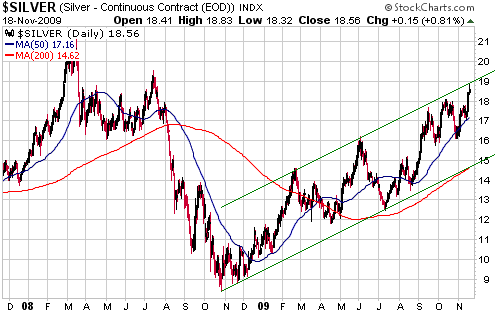
Our best guess, at this stage, is that gold and silver will 'correct' between now and year-end, and then rise to new highs during Q1-2010.
Gold Stocks
Hedging
Prior to Wednesday's small decline the HUI had risen on 11 of the preceding 12 trading days, gaining 23% in the process. It is therefore now appropriate to reproduce the following excerpt from a commentary we wrote in September of 2008, when the gold sector was in the midst of a steep and relentless decline:
"At the moment it seems like the downward correction in the gold sector is never-ending, but there will come a time -- quite likely within the next 12 months -- when gold stocks are so strong that it will seem like they will never go down again. This is the way of the financial world. If you are a contrarian investor then you will do most of your buying when market sentiment is so depressed that it seems as if prices will decline forever and you will do most of your selling when the market's mood is so up-beat that it seems like prices will rise forever. The most successful investors tend to be contrarians."
We can now reverse the above and state that there will likely come a time within the next 12 months when gold stocks will be so weak that it will seem like they will never go up again. It's important to "make hay while the sun shines", but at the same time it's prudent to make some preparations for the next bleak period. In our opinion, the best way to do this is to clip some gains (build up cash) after stocks have made sharp upward moves. There hasn't yet been a broad-based surge at the junior end of the gold sector (where most of our interest lies), but several of our stocks have risen by enough of late to warrant making a PARTIAL exit. This is particularly the case for speculators who averaged-in at much lower levels and now have substantial positions. Examples of TSI gold/silver stocks that have recently moved sharply higher and may be candidates for partial sales are FVI.V, GQM.TO, KGN.TO, NGD, and RSG.AX.
Our primary method of hedging is to scale-up our cash reserve as intermediate-term downside risk increases. We are currently about 40% cash and had to clip some additional gains in gold/silver stocks over the past few days to maintain our cash percentage at this level. We also do some hedging via put options, but people who are inexperienced with options should probably stick to hedging via cash. Put options can obviously provide additional downside protection, but there are no 'one size fits all' guidelines as to how such hedging should be carried out. Furthermore, it's a dynamic process in that it usually won't be appropriate to simply buy some puts and then do nothing. In most cases, the put-option position will have to be adjusted as the underlying prices change and as the options get closer to their expiry dates. Someone using put options to hedge will also have to know the circumstances under which they will realise gains and take losses on the positions.
Current Market Situation
The potentially important bearish divergence between the HUI and the HUI/gold ratio remains in place, but there are signs that the overall advance will continue into the first quarter of 2010. We are referring, in particular, to the new 52-week high just achieved by XGD.TO and the fact that Royal Gold (RGLD) has managed to build on last week's breakout.
If gold and gold stocks are about to enter 'blow-off mode' then pullbacks over the next few months will be very brief, but the most likely short-term outcome -- regardless of whether or not the HUI's intermediate-term upward trend is set to extend into Q1-2010 -- is that a 3-6 week decline will soon begin.
Mine Development Risk
Some mining analysts claim that one of the best times to buy the stocks of junior mining companies is when the companies are about to go into production. We disagree. Based on what we have observed over the past several years, the period immediately following the commencement of production is one of the riskiest times to buy/own such stocks. That's why our
Mine Development Risk Profile
(MDRP) includes a stage (Stage 5) following construction and prior to full production where the risk is shown to remain at a relatively high level.
The months following the start of production are when a mining company discovers whether reality matches the conclusions of its Feasibility Study. It is also when a lot of glitches tend to occur, even in those cases where the actual grades, widths, locations and metallurgy of the in-ground deposit line up extremely well with the assumptions made during the design phase. The bottom line is that the proof of a metal deposit and its associated production facility is in the mining. Until you actually start mining, you don't really know what you have.
Examples of junior gold/silver mining companies that stumbled badly following the commencement of production include Gammon Gold (Ocampo), European Minerals (Varvarinskoye), ATW Ventures (Burnakura), and NovaGold Resources (Rock Creek). Gold-Ore Resources and First Majestic Silver did much better, but still had to overcome issues that weighed on the stocks for a long time and are still, to some extent, weighing on them. Minefinders doesn't appear to be encountering major problems in ramping its project up to full production, but it is still experiencing enough of the normal 'teething problems' to reduce demand for the stock at a time when it should be benefiting in a big way from surging metal prices. Outside the gold/silver sector we've seen junior nickel miner Crowflight Minerals run into one obstacle after another during its first year as a producer. There are numerous other examples.
The lesson we have learned is to steer clear of junior mining companies that have their main asset in either Stage 4 (mine construction) or Stage 5 (initial production, with mine economics not yet proven). There will be exceptions, such as when the stock market seems to have already factored in every conceivable risk or when the company has a track record of successfully taking projects from exploration through to production, but as much as possible we'll stick with companies that are in Stage 2 (post-discovery exploration / pre-feasibility), Stage 3 (feasibility), or Stage 6 (commercial production with design parameters achieved). Stage 3 is generally less desirable than Stage 2 or Stage 6, but it is still of interest to us because it is the part of the development process where a junior miner is most likely to receive a takeover bid.
Update
on Stock Selections
 Clifton Star Resources (TSXV: CFO). Shares: 25M issued, 38M fully diluted. Recent price: C$3.25 Clifton Star Resources (TSXV: CFO). Shares: 25M issued, 38M fully diluted. Recent price: C$3.25
When we added CFO to the Stocks List last month we noted, under company-specific risks, that the company would soon have to do a sizeable equity financing. What we had in mind was a C$15-$20M financing, which would be a substantial sum for a company with a market cap (at the time) of around C$50M. We said that an equity financing could limit the short-term upside, but that the downward pressure exerted by the financing could be more than offset by positive news.
Details of CFO's new equity financing were announced on Monday 16th November. As it turned out, the financing was much bigger than we were expecting in that CFO has essentially diluted the stakes of existing shareholders by 50% in order to raise C$70M. The market's response to the financing news was to increase CFO's stock price by 30%.
We think the market's response to the financing news was rational. A large equity financing will generally reduce a company's per-share value if the financing is done when the shares are under-valued, but in this case the large equity financing substantially reduced risk and, we think, INCREASED the per-share value, even though CFO's shares were under-valued at the time of the financing. The reason lies in the details of the financing.
In our initial CFO write-up on 21st October, we said: "...there appear to be important geological similarities between CFO's properties and the nearby Canadian Malartic deposit owned by Osisko (TSX: OSK). Specifically, it appears that lower-grade zones amenable to low-cost open-pit mining surround the high-grade vein structures that almost all of the historical work at CFO's properties has focused on. Extended core sampling is being undertaken to confirm these similarities, and initial results have been encouraging. Note that OSK's resource is presently being valued by the stock market at more than $150/ounce, compared to only $45/ounce for CFO's resource. This is not an apples-to-apples comparison given that OSK's project is far more advanced, but it does highlight a source of considerable upside potential."
The market interpreted this particular financing as a big plus because all the money is being provided by Osisko. Specifically, OSK, a company with a market cap in excess of $2B, will provide C$70M over a 4-year period to fund the development of CFO's projects. In exchange, OSK will earn a 50% interest in the projects. Also, OSK will become the operator of the projects and, to enable CFO to meet its corporate expenses and its obligations to the projects' optionors, will advance to CFO an additional C$37M under various terms as discussed in the 16th Nov press release.
If there's anyone outside Clifton who should appreciate the potential value of Clifton's projects, it's the CEO of Osisko. Therefore, this financing is a vote of confidence by the 'smartest money'.
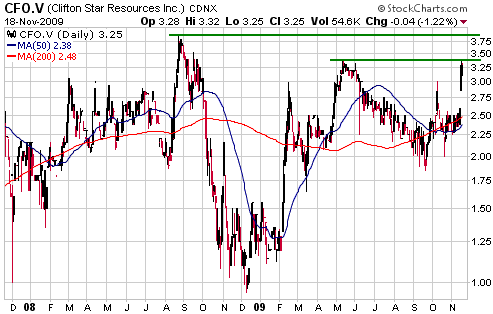
The following chart shows that this week's news took CFO up to the intermediate-term resistance that extends from C$3.38 to C$3.90. A pullback to C$2.80-C$3.00 would create a buying opportunity in anticipation of a move up to at least C$6.00 (our new intermediate-term upside target).
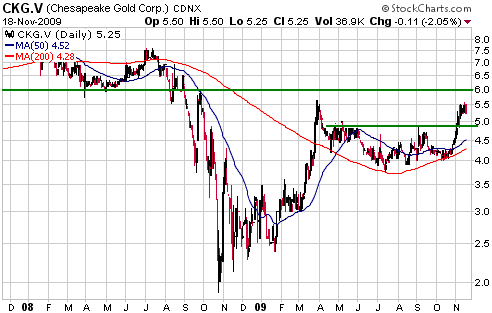
Chesapeake Gold (TSXV: CKG). Shares: 38M issued, 45M fully diluted. Recent price: C$5.25
A few days ago it was announced that Goldcorp (GG) was buying Mexico-based exploration-stage gold miner Canplats Resources (TSXV: CPQ) in a deal that values CPQ's total (measured + indicated + inferred) in-ground gold resource at around $60/ounce. Applying a similar valuation to the in-ground gold at CKG's Metates project, but only counting the 14.7M-ounce measured-and-indicated portion of the gold resource and ignoring the substantial silver portion of the resource, yields a value of $882M for Metates. This equates to about $20 per CKG share.
CPQ is slightly more advanced than CKG in that it recently completed a preliminary economic assessment (PEA) for its project. However, CKG is well on the way to having a PEA of its own (the current schedule is for the Metates PEA to be complete in early 2010), and the metallurgical tests carried out to date by CKG have been very positive. If the PEA suggests robust economics then a $60/oz valuation could well be appropriate for CKG.
The following chart shows that CKG has intermediate-term resistance at C$6.00 and short-term support at C$4.80. We think it is a speculative buy ahead of the PEA, ideally at around C$4.80-C$5.00.
Crowflight Minerals (TSX: CML). Shares: 509M issued, 618M fully diluted. Recent price: C$0.18
The troubles continue at the Bucko nickel mine, which was brought into production by CML earlier this year and has never come close to achieving its design parameters. CML reported after the close of trading on Monday that it was suspending mining at Bucko for three months to "complete ramp development, accelerate mine development and upgrade the backfill plant." The plan is that with production temporarily stopped, the company will be able to focus all of its resources on rectifying the issues that have hampered the project up until now.
The stock price plunged in the aftermath of the shutdown news, but then recouped the bulk of its losses. The temporary shutdown is a reasonable step, but there is no reason to be confident that the problems will be resolved. We therefore wouldn't be buyers of CML at this time.
Two junior gold stocks worth considering
We will continue to highlight buying opportunities amongst the juniors, even though the gold-stock indices look over-extended to the upside and vulnerable to sharp multi-week corrections. This is because we expect the junior end of the gold sector to do very well during Q1-2010, and because not all of our readers have as much exposure to gold stocks as they would like.
Two junior gold miners that are reasonable candidates for new buying near their current prices are Orvana Minerals (TSX: ORV) and Pediment Gold (TSX: PEZ). A daily chart of each stock is displayed below.
ORV has been steadily working its way upward over the past year in a two-steps-forward-and-then-one-step-backward process. It has been consolidating (taking the one step backward) since mid September and may be about to resume its advance. Our 12-month valuation-based target for the stock is C$2.30.
PEZ recently tested the top of its lengthy basing pattern (C$1.20-$1.25) and has since pulled back to support at around C$1.00. A break above C$1.25 would create a measured (chart-based) objective of C$2.00.
Over the past few months there has been a conspicuous lack of news regarding PEZ's San Antonio gold project in Mexico, which probably means that the company has still not been able to finalise an agreement with local landowners regarding long-term surface access rights at this project. This, we think, is the main company-specific risk at this time and the reason the stock has been unable to break out to date.
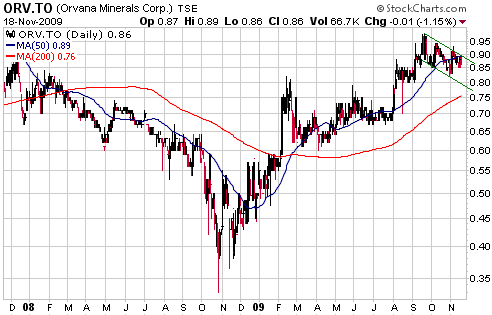
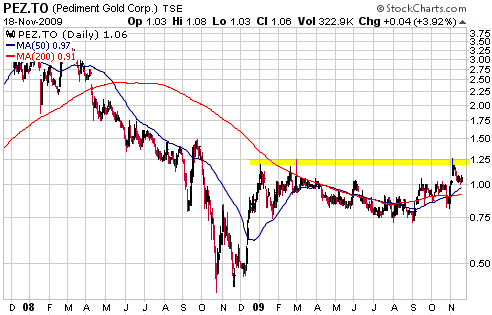
Chart Sources
Charts appearing in today's commentary
are courtesy of:
http://stockcharts.com/index.html
http://www.decisionpoint.com/

|









