|
- Interim Update 19th January 2011
Copyright
Reminder
The commentaries that appear at TSI
may not be distributed, in full or in part, without our written permission.
In particular, please note that the posting of extracts from TSI commentaries
at other web sites or providing links to TSI commentaries at other web
sites (for example, at discussion boards) without our written permission
is prohibited.
We reserve the right to immediately
terminate the subscription of any TSI subscriber who distributes the TSI
commentaries without our written permission.
Oil
The
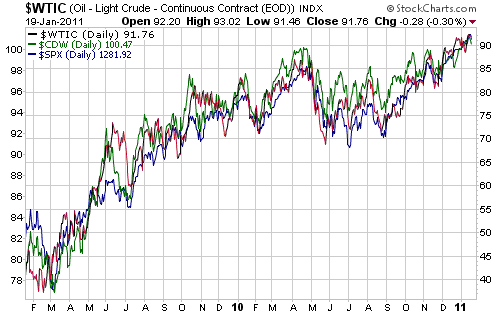
following picture may not be worth a thousand words, but it is worth at
least a few hundred. It clearly illustrates that over the past two
years the price charts of oil, the S&P500 Index and the Canadian
Dollar have been very much alike. Almost every squiggle in one matches
a squiggle in each of the other two.
An implication is that unless you expect war to break out in the Middle
East (a Middle-East war would cause a large rise in the oil price and a
concurrent large decline in the S&P500 Index), your outlook for oil
should be the same as your outlook for the broad US stock market. To
put it another way, it makes no sense to be bullish on oil and bearish
on the stock market, or bullish on the stock market and bearish on oil.
We are bearish on the stock market. Therefore, we are bearish on oil.
The Stock Market
The Barrons Roundtable
At the beginning of every year Barrons Magazine puts together a "panel
of Wall Street luminaries" to discuss the likely course of the
financial world over the year ahead and to offer suggestions on how to
profit from the expected performances of the markets. This week's issue
of the magazine had the first installment of the 2011 Roundtable.
The Roundtable discussion is worth reading to get a general feel for
the sentiment of investment professionals. Although it has only 10
members, the group assembled for the Roundtable is a good cross-section
of the professional investing community in that it includes contrarians
and out-of-the-box thinkers as well as mainstream/conventional thinkers.
Here are some of the more interesting comments contained within the first Roundtable installment:
Marc Faber: "Janet Yellen, vice chair
of the Federal Reserve, said about a year ago that if it were possible
to push interest rates into negative territory, she would vote for
that. This is a very important statement because it implies that the
Fed will keep real interest rates negative as far as the eye can see.
Negative real rates amount to expropriation and destroy one function of
money: to be a store of value and a unit of account. If you measure the
stock market not in dollars but gold, it is down 80% since 1999. I no
longer regard the U.S. dollar as a valid unit of account. People
shouldn't value their wealth in dollars because one day, in dollars,
everyone will be a billionaire."
Felix Zulauf: "In the late 1970s and
early 1980s, Paul Volcker [then the chairman of the Federal Reserve]
crunched inflation by applying very high real interest rates for
several years. Now we are getting the same process, just in reverse.
Just as it took several years for the market to see that Volcker's
policies would lead to declines in inflation and interest rates, it
will take several years for the market to realize the Fed's current
policies are highly inflationary. They will lead to a debasing of the
currency, which is happening to varying degrees in most of the
industrialized countries."
Fred Hickey: "A year ago people were
talking about an exit strategy. I knew there wasn't going to be one,
ever. The economy has structural problems and we aren't dealing with
them. Money-printing won't work, yet that's the prescription we
continue to give the patient. If the Fed keeps printing after June,
we'll have higher gasoline and food prices and more imbalances until
this ends. And at some point it will end, because the dollar will fall
apart. What we are doing now makes everything appear rosy. But it is a
devastatingly terrible policy for the long term."
As far as the stock market's likely 2011 performance is concerned, our
impression is that the sentiment of the Roundtable crew matches the
overall sentiment situation. Specifically: Bulls on the economy are
bullish on the stock market because, well, because they are bullish on
the economy. Bears on the economy are generally also bullish on the
stock market because they expect that economic weakness will perpetuate
the Fed's easy money policies, prompting stock prices to rise in
nominal terms. Hardly anyone is bearish on the stock market (none of
the Roundtable members expect the stock market to have a bad year).
The outlooks of the more astute economic bears are encapsulated by the following two quotes from the Barrons Roundtable:
Hickey: "If the Fed continues
printing, the market will go higher. It will continue printing, because
the economy probably would collapse if it didn't. The stock market
could go up 10% this year."
Faber: "The U.S. market has almost
doubled since March 6, 2009. Some emerging markets have gone up much
more than that. A correction is overdue. Then we'll have the second leg
of the bull market. In the third year of the presidential cycle, you
want to be in the most speculative stocks. As we approach the 2012
election, the Fed is going to print like hell. I am bearish about
everything, but in my bearishness I'll be better off in stocks than
government bonds."
Current Market Situation
The US stock market pulled back a little over the first two trading
days of this holiday-shortened week, but remains in a precarious
position. It is 'overbought' on an intermediate-term basis and
sentiment is almost as complacent as it ever gets.
The risk is currently high, in our opinion. This means that investors
should proceed with great caution, but it doesn't mean that
equity-related long positions should be avoided altogether. In a world
where central banks and governments are "hell bent" on depreciating
their currencies, some 'long' exposure to the stock market will
generally be appropriate.
Aside from the gold sector, which is counter-cyclical (gold stocks are
quite capable of trending up while the broad stock market trends down),
we are intermediate-term bullish on the uranium and agriculture
sectors. Most uranium and agriculture stocks are 'overbought' on a
short-term basis, but would likely be pushed down to attractive levels
for new buying by a sharp pullback in the broad stock market.
Gold and
the Dollar
Gold and Silver
Silver and the silver/gold ratio recently became sufficiently extended
to the upside to create tops of at least intermediate-term
significance, but in each case the price decline since the peak has not
been as fast as it would typically be if the peak were the
intermediate-term variety. To put it another way, we are yet to see the
sort of rapid price decline that usually follows an intermediate-term
peak.
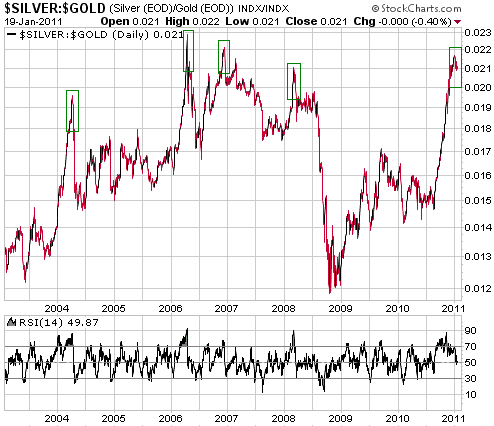
The following daily charts help explain what we are talking about.
The first chart shows that the silver/gold ratio hit extremes in
April-2004, April-2006, December-2006 and March-2008, and that a sharp
decline occurred in the immediate aftermath of each of these price
tops. A similar extreme was hit during November-December of last year,
but the price decline since the latest peak has been far less dramatic
than the declines that followed the earlier intermediate-term peaks.
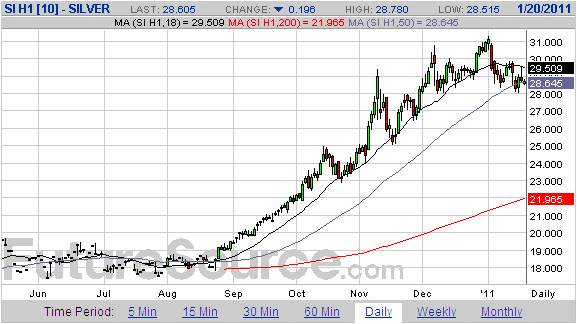
The second chart
shows that the recent price decline in the March silver futures
contract looks like a routine pullback to the vicinity of the 50-day
moving average. It also shows that the 200-day moving average is a long
way below the current price, which suggests that the downside risk is
quite high even if the current pullback proves to be the short-term
variety (even if the pullback that began three weeks ago is followed by
a rise to a new multi-year high, there's a very good chance that silver
will trade at or below its 200-day moving average at some point over
the next 6 months).
The upshot is that
neither silver nor the silver/gold ratio has yet fallen far enough to
confirm that anything more serious than a routine short-term correction
is underway.
Platinum's performance lends some weight to the possibility that silver
and gold are experiencing routine short-term corrections. It appeared
as though platinum had reached an intermediate-term peak in November
and would do no better than partially retrace its November decline
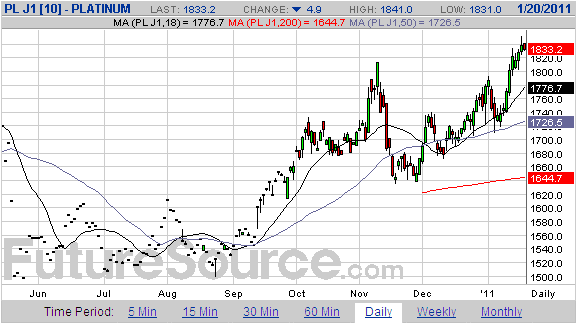
during December-January, but the following chart shows that platinum
has made it to a new 52-week high.
Gold Stocks
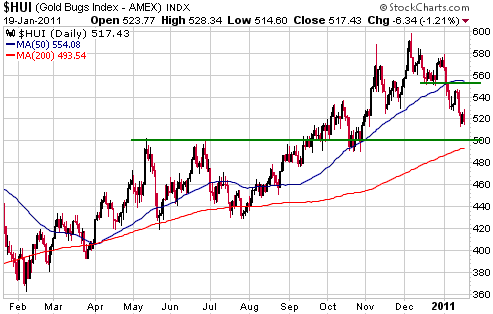
The gold sector, which is represented on the following daily chart by
the HUI, is 'oversold' on a short-term basis and within a few percent
of good support. We continue to expect that some sort of low -- either
a correction low or a low that holds for at least a few weeks -- will
be put in place over the coming fortnight.
Short-term resistance lies in the low-550s.
The gold sector
remains our favourite sector of the stock market for the long haul. It
is the one sector of the market that benefits from economic weakness,
and sub-par economic performance is all but guaranteed by the policies
being followed by many of the world's most important governments,
including the governments of the US, most European countries, Japan and
China.
Currency Market Update
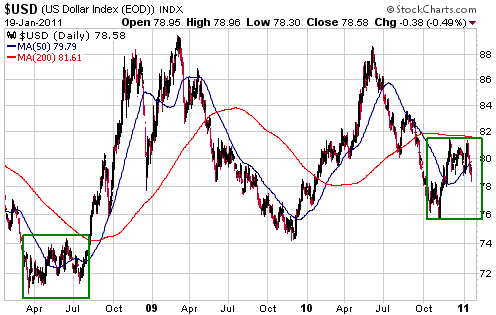
Displayed below is a daily chart of the Dollar Index covering the past
three years. We've drawn boxes around 2008's bottoming pattern and the
price action of the past few months.
The Dollar Index has broken decisively below its 50-day moving average,
which clearly isn't bullish. However, notice that it fell below its
50-day moving average twice during the 2008 bottoming process. In 2008
it wasn't until the Dollar Index broke above its 50-day moving average
for the third time that a substantial upward trend got underway.
Confirmation of the new trend was provided by a solid break above the
200-day moving average.
Our best guess is that something similar to the 2008 bottoming process
is happening now. Obviously, for this interpretation to remain valid
the Dollar Index must hold above last year's low during any further
weakness.
On the basis that the Dollar Index's recent pullback has reduced its
short-term downside risk to about 2 points, we have decided to upgrade
our short-term US$ outlook to "bullish".
Update
on Stock Selections
(Notes: 1) To review the complete list of current TSI stock selections, logon at http://www.speculative-investor.com/new/market_logon.asp
and then click on "Stock Selections" in the menu. When at the Stock
Selections page, click on a stock's symbol to bring-up an archive of
our comments on the stock in question. 2) The Small Stock Watch List is
located at http://www.speculative-investor.com/new/smallstockwatch.html)
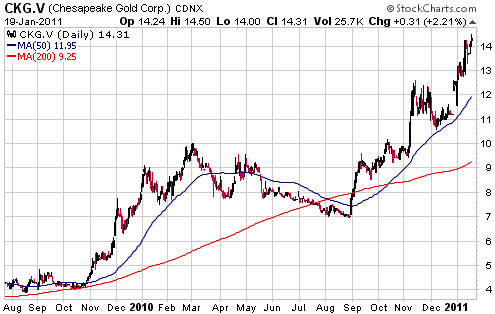
 Chesapeake Gold (TSXV: CKG). Shares: 38M issued, 45M fully diluted. Recent price: C$14.31 Chesapeake Gold (TSXV: CKG). Shares: 38M issued, 45M fully diluted. Recent price: C$14.31
Investment bank Dahlman Rose recently issued a very detailed report on
CKG that included a $91/share estimate of the company's net asset value
(NAV). This NAV is Dahlman's long-term price target for the stock.
The $91/share NAV assumes that CKG's huge Metates gold/silver/zinc
project is developed into a mine that performs in accordance with the
parameters outlined in the Preliminary Economic Assessment (PEA)
completed in mid-2010. There are obviously risks associated with these
assumptions, especially given that the project is almost certainly more
than 4 years from production. These risks can be accounted for by
discounting the calculated NAV. For example, Dahlman suggests a
12-month target of $25/share by applying a substantial discount to
factor-in the many uncertainties that exist at this early stage of
development. This 12-month target looks reasonable to us.
So, would we be buyers of CKG at the current price?
The answer is no, because at current prices we think there are more
attractive alternatives. One of them (Pretium Resources) is discussed
below.
New TSI stock selection: Pretium Resources (TSX: PVG). Shares: 81M issued, 84M fully diluted. Recent price: C$6.40
PVG is a new company (it IPO'd last month) under the stewardship of Bob
Quartermain, the former CEO of -- and the person largely responsible
for the past decade's strong growth of -- Silver Standard Resources
(SSRI). It was formed for the purpose of taking over SSRI's Snowfield
and Brucejack projects -- two adjacent gold projects in northern B.C.
(Canada) that, when combined, constitute one of the world's largest
undeveloped gold deposits.
The current estimate for the gold resource at Snowfield/Brucejack (SB)
is 26.0M ounces in the M&I category plus 15.9M ounces in the
Inferred category, or a total gold resource of 34M ounces assuming that
the total resource equals 100% of the M&I gold plus 50% of the
Inferred gold. This means that the SB project contains almost twice as
much gold as CKG's Metates project, and yet PVG presently has a lower
enterprise value (market cap plus debt minus cash, or market cap minus
net cash) than CKG. Therefore, if CKG is very under-valued at its
current price (as discussed above), then what does that make PVG?
As is the case with CKG's Metates project, a PEA was completed for
PVG's SB project last year. The 'headline' results of the two PEA's
were actually quite similar. The SB project is expected to be a bit
bigger (700K oz/yr versus 550K oz/yr LOM avg gold production and $3.5B
versus $3.2B initial capex), but the 'guesstimated' net present values
and internal rates of return are in the same ballpark.
For the SB project, the PEA came up with a pre-tax net present value
(@5%) of $6B assuming a gold price of $1235/oz. This equates to
$74/share, a figure that would have to be substantially discounted to
arrive at a reasonable 12-month price target. By applying the same
discount that Dahlman Rose used when determining a 12-month price
target for CKG, we end up with a target of $18 for PVG.
Other points of interest:
- SSRI owns about 40% of PVG
- PVG has about $50M of cash in the bank
- PVG's news-flow should be OK, in that a resource update (to
reflect the results of last year's drilling) will be completed during
the first half of this year and new drilling results should be
available during the second half of this year
- There exists the potential for PVG's SB project to be combined
with Seabridge's KSM project to form the world's largest undeveloped
gold project
There's no point showing a chart of PVG because the stock has only been
trading since mid December. During its brief trading history it has
spent most of its time in the C$6.20-C$6.50 range. The IPO price was
C$6.00.
We have added PVG to the TSI Stocks List at Wednesday's closing price of C$6.40.
Fairborne Energy (TSX: FEL). Shares: 102M issued, 112M fully diluted. Recent price: C$4.77
Natural gas stocks have generally fared well over the past 12 months,
but mid-tier natgas producer FEL has unfortunately been an exception.
We can't be sure why, but it's possibly because FEL's current
production is leveraged to the natgas price (the best-performing natgas
stocks have tended to be those of companies that are focused on
drilling services, or have no (or very little) current production, or
have very low production costs).
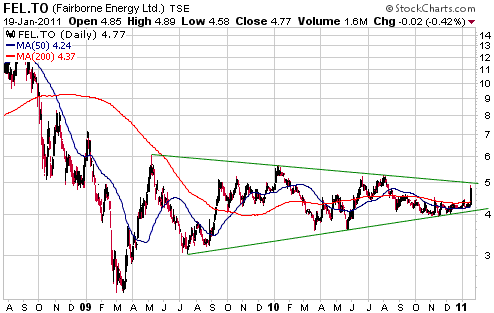
Our most recent FEL write-up was in the 8th November Weekly Update,
when we noted that the stock had dropped back to the bottom of an
18-month triangular consolidation pattern. Our suggestion at the time
was that traders buying near the current price (around C$4.00) manage
risk by placing a 'sell stop' just below the 2010 low.
The stock didn't do much until Tuesday of this week, when it gained 12%
in response to production guidance that obviously impressed the market.
It remains within the consolidation pattern that has defined its
progress for more than 18 months, but this week's action is perhaps a
sign that an upside breakout will soon occur. A breakout would create a
chart-based objective of C$7.50-$8.00.
In our opinion, traders using 'stops' should move them up to around C$4.20.
Keegan
Resources (TSX: KGN, AMEX: KGN). Shares: 71M issued, 75M fully diluted
(including the latest financing). Recent price: US$7.55
KGN announced a "bought deal" financing prior to the start of trading
on Tuesday. The company is raising at least $185M by issuing at least
24.7M new shares at C$7.50/share. The amount of money raised and the
number of new shares issued will rise to $213M and 28.4M, respectively,
if the underwriters exercise their over-allotment option. As is normal
in these cases, the stock price quickly dropped back to near the $7.50
financing price.
Relative to company size, this is a huge financing (KGN's market cap
was only $360M prior to the new issue of shares). It is also a
surprising financing in that KGN, a company that is only at the
pre-feasibility stage of project development, now appears to be fully
funded through to production (assuming the over-allotment option is
exercised, KGN will have about $250M in the bank upon completion of the
financing). Adding to the surprising nature of the financing is that
KGN will very likely be purchased by a larger mining company well
before it commences mine construction.
When a company with a lot of valuation-related upside does a large
equity financing, some of the upside potential is given away. Such is
the case with KGN. Due to the financing announced on Tuesday we are
reducing our valuation-based upside target for this stock from
$15/share to $13/share. On the positive side of the ledger, the risk
has also been reduced.
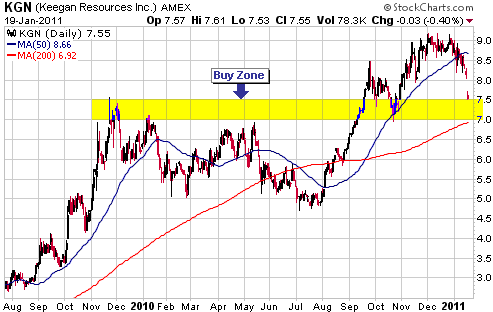
KGN is a reasonable candidate for new buying at around $7.50 and would
be a strong candidate for new buying at around $7.00. We doubt that it
will trade significantly lower than $7.00.
As an aside, that a
small company such as KGN was able to do such a large "bought deal"
financing, with no warrants attached, is evidence of two things. First,
it confirms that there is a lot of money sloshing around the markets.
Second, it tells us that there is strong demand from serious investors
for the shares of high-quality junior gold stocks.
Chart Sources
Charts appearing in today's commentary
are courtesy of:
http://stockcharts.com/index.html
http://www.futuresource.com/

|