|
- Interim Update 19th March 2003
Money Management
Sound money management is one of the
keys to long-term success in stock market speculation. If you don't understand
and rigorously apply the principles of sound money management then the
probability that you will consistently achieve above-average returns in
the stock market is extremely low, regardless of how accurate your opinions
on the market prove to be.
Your money management methodology should
encompass such things as:
1. How to determine how much money
to commit to a particular trade/investment.
2. How to determine your total commitment
to the market or any sector of the market (see below for more on the level
of commitment).
3. Once you've determined how much
to invest in a particular stock or a particular sector of the market, how
to go about accumulating your position (see below under "getting set" for
more on this).
4. How to go about limiting draw-downs
in the value of your portfolio. Using protective stops is one way of doing
this, but it is not the only way (see below under "risk management" for
more on this).
5. How to go about exiting a position
when price has moved in your favour.
The importance of not being over-committed
When you over-commit yourself to an
investment/trading position you will find it impossible to remain objective,
regardless of how compelling the logic of your position appears to be.
In fact, it often seems as though the mission of the stock market is to
'weed out' those speculators who are over-committed. It is almost as if
the market knows when you are over-committed and moves against you in a
brazen act of mean-spiritedness for just long enough to force you out at
a loss before doing exactly what you expected it to do in the first place.
Getting set
When you have decided to take a position
in a particular stock or a particular stock-market sector it is usually
not a good idea to buy your entire position in one fell swoop. A better
approach is to scale into a position, that is, to plan to make multiple
purchases and to know, in advance, the approximate price levels at which
these purchases will be made. The process of "averaging down" is often
ridiculed, but there is a huge difference between a) averaging down as
part of a deliberate strategy, and b) buying what you thought was going
to be your total position in a stock and then 'doubling your bet' simply
because the stock takes an unexpected dive.
We will usually plan to scale into
a stock via 2 or 3 purchases. Sometimes, of course, the stock price will
rocket higher after the first purchase, but so be it.
Risk management
What happens when the market moves
against you? Are you just going to grit your teeth, close your eyes and
hold on until you (or your spouse) can't take it any more? Or do you have
a plan in place to limit your losses and maximise your sleep?
Not allowing yourself to become over-committed
to a particular stock, stock sector, or view of the market is a good first
step. You might be absolutely convinced that the market is going to move
in one direction, but if it instead moves sharply in the opposite direction
this would obviously be a much bigger problem for you if you happened to
be 100% invested than if you were only 30% invested.
A necessary second step is to have
a plan in place to limit the draw-downs in the invested (non-cash) portion
of your portfolio. One way to do this is by putting protective stops at
carefully-chosen price levels. Note, though, that just as it is usually
not wise to buy an entire position at one time, it might not be prudent
to exit an entire position at one time even when the exit is via a 'stop
loss' order.
In one of his recent commentaries Robert
Prechter warns against using stops. In his opinion people lose more
money on stops than anything else. A better alternative, according to Prechter,
is real-time analysis. This is because the question isn't so much whether
a level is broken but what the analysis indicates as it breaks. To a certain
extent we agree with Prechter and, in fact, almost never use stops in our
own trading. However, using stops to mitigate downside risk is much better
than doing nothing. Also, because a 'stop' removes emotion from the equation
it can be an effective tool when used in the right way.
The US
Stock Market
Quick review
The war against Iraq has begun, which
means that the stock market and all the other financial markets are going
to be tossed back and forth over the next few weeks in response to war
or terrorist-related news. Every piece of good news for the US-led coalition
(the coalition apparently consists of 35 countries) will cause the stock
market to bounce, while every sign that things might not be going as well
as expected or that a terrorist attack might be imminent will cause the
market to spike lower.
Notwithstanding the sharp reactions
to war news that are likely to occur over the next few weeks, our view
remains the same as that outlined in the latest Weekly Update, that is,
that a short-term bottom was put in place last week and that the market
will work its way higher over the next 1-2 months. In fact, our short-term
stock market view has been essentially unchanged over the past month. Over
that time we've been forecasting a low for the market before the end of
March that would not be substantially below last October's bottom.
In the latest Weekly Update we included
a chart showing how the markets behaved during March-May of 2001 because
our analysis suggests that a similar pattern is unfolding this year. In
2001 the stock market (including gold stocks) bottomed and the bond market
peaked during the second half of March, after which stocks moved higher
for about 7 weeks while bond prices moved lower. The major trends (down
for the overall stock market, up for bonds) then resumed.
1991 all over again?
The outbreak of war against Iraq in
early-1991 ushered in a new bull market. For this reason many analysts
have eagerly anticipated this year's commencement of military action against
Iraq. However, the probability of the US stock market embarking on a cyclical
bull market at this time is close to zero because the market is presently
at least twice as expensive as it was at the beginning of 1991. In fact,
because sentiment during the lead-up to this year's war never became extremely
bearish the probability of even a substantial bear market rally (one lasting
3-6 months and taking the Dow at least 20% higher) is low. As discussed,
what we probably will get is a rally lasting 2 months at most.
How high is high?
The much anticipated war rally actually
began on 12th March (the day the S&P500 Index spiked below 800 and
reversed higher) and, in our view, is already more than half over in terms
of the total eventual point gain. We say this for two reasons. First, sentiment
indicators have already begun to show a sharp increase in optimism. For
example, the results of the latest Investors' Intelligence survey showed
a jump in the bullish percentage from 39% to 46% and the equity put/call
ratio has moved sharply lower. Second, there isn't a substantial distance
between yesterday's closing levels and important overhead resistance.
With regard to this second point, take
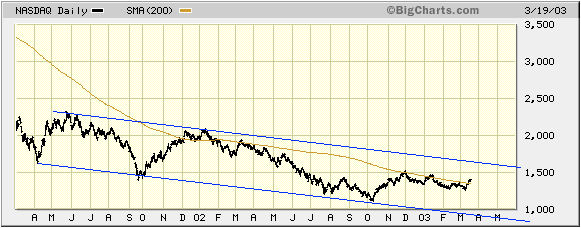
a look at the following charts. The first chart shows the NASDAQ Composite
Index since the beginning of March, 2001. Over the past 2 years the NASDAQ
has been moving within a downward-sloping channel. Since there is no reason
to think that the long-term trend has changed it is reasonable to assume
that the current rally will fail at, or below, the channel top. If this
is the case then the NASDAD has maximum upside potential of about 10%,
from its current level, over the next 2 months. It is, however, likely
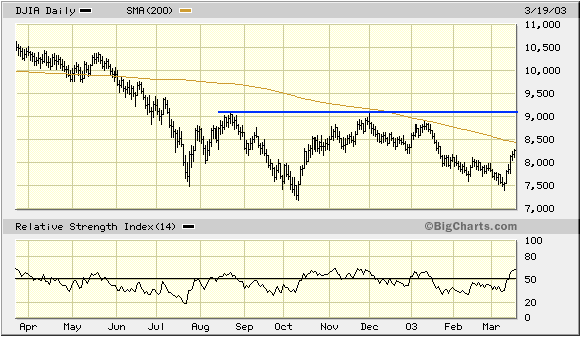
to exceed its December-2002 peak. The second chart shows the Dow Industrials
Index over the past 12 months. The Dow has substantial resistance just
above the 9,000 level. Given the valuation and sentiment backdrop this
resistance will probably hold, meaning that the Dow also has maximum upside
potential of about 10% from its current level.
Current Market Situation
We have no idea how the US market will
react when it opens today. It is possible that the removal of the war uncertainty
has already been fully factored into all the markets over the past
week and that the 'good news' (as far as the stock market is concerned,
that is) will be sold. It is also possible that the war news will result
in one final surge in the stock market. Either way, it is likely that the
initial leg of the rally off the March low will be complete by the end
of this week.
Clearly, we don't expect this week's
peak to be the ultimate peak of this rally. In the coming Weekly Update
we'll discuss some of the things we expect to see near the ultimate rally
top.
Gold and
the Dollar
Gold Stock Valuation Comparison
Below is an updated version of the
table that last appeared in the 13th November 2002 Interim Update.
It is a rough valuation comparison of thirteen (previously twelve, but
we've now added IAG) large and mid-sized gold producers, ranked in order
of PE ratio (lowest to highest). The figures assume a gold price of about
US$320 and have been updated, wherever applicable, based on the latest
information issued by all the companies.
Note that:
a) The annual production, revenue and
earnings figures shown in the below table are estimates for 2003 and are
either based on forecasts provided by the companies or have been calculated
by annualising the results from the December quarterly reports. Where we've
come up with earnings estimates for 2003 by extrapolating the earnings
reported for the December-2002 quarter we've excluded any abnormal gains
and losses. For example, we excluded, from our calculations, the large
unrealised profit reported by Durban Deep (in its December quarterly report)
as a result of a change in the marked-to-market value of financial instruments.
b) The earnings and cost figures for
the 'new' Kinross Gold (Kinross following the takeovers of TVX, TVX Newmont
and Echo Bay) are very rough due to the absence of any operating history
for the new company. Due to its recently completed takeover of Repadre,
the earnings and cost figures shown below for IAMGOLD are possibly also
less accurate than would otherwise be the case. However, we think the figures
used are good enough for our purpose (our purpose is to get a reasonable
idea of relative valuation and relative leverage).
c) We calculate a mining company's
cost to produce an ounce of gold as follows: We subtract reported earnings
from reported revenue to get a total, all-in cost figure. We then divide
this total cost by the number of ounces produced to get a cost per ounce.
This is a much fairer way to do a cost comparison than using the cash costs
or production costs reported by the mining companies.
| Name |
Symbol |
Recent Price (US$) |
Market Cap (US$M) |
Annual Prod (Koz) |
Annual Rev ($M) |
Annual Earnings ($M) |
Cost per oz prod (US$) |
Reserves (M oz) |
Mkt Cap $ per oz reserves |
Price/ Sales |
Price/ Earnings |
| Harmony Gold |
HMY |
12.50 |
2,288 |
3,096 |
1,004 |
152 |
275 |
49 |
47 |
2.3 |
15.0 |
| Anglogold |
AU |
29.82 |
6,650 |
6,196 |
2,008 |
360 |
266 |
68 |
98 |
3.3 |
18.5 |
| Gold Fields |
GFI |
10.62 |
5,013 |
4,360 |
1,480 |
240 |
284 |
79 |
63 |
3.4 |
20.9 |
| Lihir Gold |
LHG |
0.81 |
925 |
672 |
213 |
40 |
257 |
16.7 |
55 |
4.3 |
23.1 |
| Kinross Gold |
KGC |
6.07 |
1,906 |
1,900 |
620 |
80 |
284 |
15 |
127 |
3.1 |
23.8 |
| Goldcorp |
GG |
10.57 |
2,188 |
600 |
189 |
88 |
168 |
5.5 |
398 |
11.6 |
24.9 |
| Meridian Gold |
MDG |
11.32 |
1,121 |
320 |
104 |
43 |
191 |
2.1 |
534 |
10.8 |
26.1 |
| Barrick Gold |
ABX |
15.07 |
8,168 |
5,450 |
2,104 |
272 |
290 |
87 |
94 |
3.9 |
30.0 |
| IAMGOLD |
IAG |
4.35 |
657 |
421 |
137 |
20 |
278 |
3.6 |
182 |
4.8 |
32.8 |
| Durban Deep |
DROOY |
2.86 |
569 |
900 |
264 |
12 |
280 |
16.3 |
35 |
2.2 |
47.4 |
| Newmont |
NEM |
25.98 |
10,444 |
7,500 |
2,438 |
200 |
298 |
87 |
120 |
4.3 |
52.2 |
| Agnico Eagle |
AEM |
12.82 |
1,192 |
375 |
122 |
18 |
277 |
4 |
298 |
9.8 |
66.2 |
| Glamis Gold |
GLG |
10.11 |
1,274 |
268 |
89 |
19 |
261 |
4.9 |
260 |
14.3 |
67.0 |
Here are some of our thoughts on the
information presented in the above table:
1. As was the case when we last did
this comparison in November of 2002, the South African gold stocks (HMY,
GFI, AU, DROOY) offer better value than their North American counterparts.
However, the valuation advantage of the SA gold stocks has narrowed over
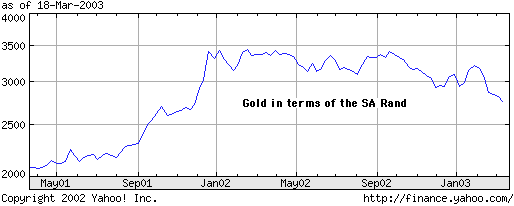
the past 6 months due to the strong Rand. As the following chart shows,
the gold price in terms of the Rand has fallen by around 20% since last
September (the US$ gold price has gained about 5% over the same period).
So, although the major SA gold producers appear to be doing a good job
of controlling costs they have suffered a reduction in operating profit
margins over the past 2 quarters due to Rand strength.
In the 10th February Weekly Update
we discussed SA gold stocks in relation to the SA Rand. Our view was/is
that the Rand has embarked on a long-term uptrend against the US$. This
view, in turn, is based on our expectation that commodity prices are still
in the early stages of a long-term bull market. However, given the sharpness
of the Rand's upward move over the past 15 months a substantial counter-trend
decline in the Rand is likely to occur this year, so Rand strength will
probably soon be removed as a short-term impediment to the SA gold stocks.
The biggest risk for the SA gold stocks
over the next 6 months is probably the up-coming wage negotiations with
the National Union of Mineworkers (NUM). An agreement between the NUM and
the mining companies will eventually be reached, but probably not before
a strike is threatened or actually occurs. Most of our readers would no
doubt still remember the 2001 negotiations during which brinkmanship on
the part of union leaders and company management caused market sentiment
towards the SA gold stocks to be temporarily depressed.
2. Taking into account P/E ratio, price-to-sales
ratio, and the price the market is currently putting on reserve ounces
in the ground, Harmony Gold still offers the best value. Amongst the North
American contingent the 'new' Kinross continues to offer the best value,
although we are yet to see how the combined company performs.
3. The market assigns the lowest value
to the reserves owned by South Africa's Durban Deep (US$35/ounce). There
are good reasons for this, such as the fact that Durban is a marginal producer
(it would barely be breaking even at the current Rand gold price) and the
controversy that constantly seems to surround this company. However, as
outlined below Durban does offer the most leverage to the spot gold price
and should therefore do extremely well if the gold price can sustain a
move up to, or above, $400/ounce.
4. As was the case when we did this
valuation comparison last November, GLG, MDG, AEM and GG remain very expensive.
In November MDG's reserves were being priced by the market at an 'eye-popping'
$818/ounce. Due to a sharp reduction in MDG's stock price the value of
its gold in the ground has fallen to $534, but this is still extraordinarily
high. The stock market is often very slow to bring prices into line with
fundamental value and over-priced stocks can continue to trend higher for
a long time, but as RGLD shareholders recently discovered the inevitable
return to 'fair value' can be swift.
Below is the same comparison, but this
time based on a gold price of $425. The earnings at a gold price of $425
have been calculated by assuming that the cost to produce an ounce of gold
will remain at its current level and that 70% of the increase in revenue
resulting from the higher gold price will drop through to the bottom line.
These assumptions may or may not be valid but for our purposes they are
reasonable because we are trying to assess the relative merits of
these 13 gold stocks, not determine accurate earnings figures. Once again
the companies have been ranked in order of PE ratio.
Note that:
a) We haven't accounted for the adverse
effects that hedging will have on the earnings of ABX, AU, NEM and LHG
if the gold price rises to $425.
b) We haven't accounted for exchange
rate changes (e.g., at a gold price of US$425 the SA Rand would likely
be stronger than it is today).
c) The below table includes an "earnings
increase" column to show our estimate of the approximate percentage increase
in earnings that would occur if the average gold price during 2003 was
about $100 higher than it was during the final quarter of last year. Clearly,
Durban offers the most leveraged exposure to the spot gold price.
| Name |
Symbol |
Recent Price (US$) |
Market Cap (US$M) |
Annual Prod (Koz) |
Annual Rev ($M) |
Annual Earnings ($M) |
earnings increase (%) |
|
|
Price/ Sales |
Price/ Earnings |
| Harmony Gold |
HMY |
12.50 |
2,288 |
3,096 |
1,335 |
384 |
153 |
|
|
1.7 |
6.0 |
| Durban Deep |
DROOY |
2.86 |
569 |
900 |
351 |
73 |
508 |
|
|
1.6 |
7.8 |
| Anglogold |
AU |
29.82 |
6,650 |
6,196 |
2,671 |
824 |
129 |
|
|
2.5 |
8.1 |
| Gold Fields |
GFI |
10.62 |
5,013 |
4,360 |
1,968 |
582 |
142 |
|
|
2.5 |
8.6 |
| Lihir Gold |
LHG |
0.81 |
925 |
672 |
283 |
89 |
123 |
|
|
3.3 |
10.4 |
| Barrick Gold |
ABX |
15.07 |
8,168 |
5,450 |
2,798 |
758 |
179 |
|
|
2.9 |
10.8 |
| Kinross Gold |
KGC |
6.07 |
1,906 |
1,900 |
825 |
223 |
179 |
|
|
2.9 |
11.6 |
| IAMGOLD |
IAG |
4.35 |
657 |
421 |
182 |
52 |
158 |
|
|
3.6 |
12.7 |
| Newmont |
NEM |
25.98 |
10,444 |
7,500 |
3,243 |
763 |
282 |
|
|
3.2 |
13.7 |
| Goldcorp |
GG |
10.57 |
2,188 |
600 |
251 |
132 |
50 |
|
|
8.7 |
16.6 |
| Meridian Gold |
MDG |
11.32 |
1,121 |
320 |
138 |
67 |
56 |
|
|
8.4 |
17.6 |
| Agnico Eagle |
AEM |
12.82 |
1,192 |
375 |
162 |
46 |
157 |
|
|
7.3 |
25.8 |
| Glamis Gold |
GLG |
10.11 |
1,274 |
268 |
118 |
40 |
108 |
|
|
10.8 |
32.2 |
Current Market Situation
In the latest Weekly Update we said
that the gold price had short-term downside risk to the mid-320s, but that
the HUI had probably bottomed. As is the case with the overall stock market
it would not be surprising to see the major gold stocks test their recent
lows over the coming 2 weeks. However, given that the HUI just hit an oversold
extreme and its 3-year uptrend-line there is a good chance that gold stocks
will move higher over the coming 1-2 months. This is particularly so since
the supposed worst case scenario for gold and gold stocks - a removal of
the war uncertainty - has come and gone. Furthermore, most people seem
to be expecting a quick and easy US victory in the war so the probability
of a negative surprise for gold (a positive surprise as far as the consensus
view of the world is concerned) is low. And, now that the war has begun
we are closer to the time when the attention of the markets will move back
to what caused the downtrend in the US$ and the uptrend in the gold price
in the first place.
As discussed earlier in today's commentary,
Harmony Gold appears to offer the best value amongst the major gold stocks.
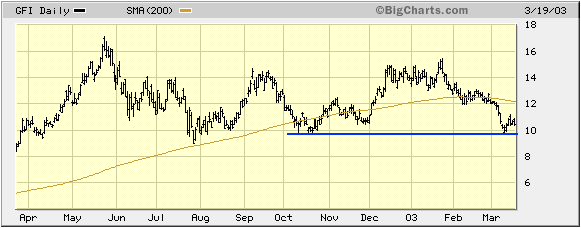
From a technical perspective, though, GFI looks better than HMY. As the
following chart shows, GFI held above its October-2002 low during the recent
sell-off. GFI looks like a good 'trading buy' from its current level down
to $9.70. Also, speculators in options could consider buying, or adding
to existing positions in, GFI October $12.50 call options on weakness over
the next 2 weeks.
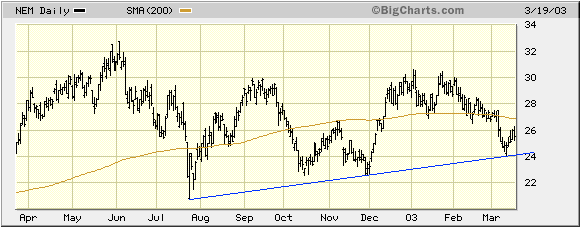
The NEM chart also appeals to us at
this time. NEM fell right to its intermediate-term uptrend-line and then
bounced. NEM would be a good trading buy on a pullback to near the trend-line
shown on the below chart.
As is the case with the stock market
the initial leg of the recovery rally in the Dollar Index is probably close
to being complete, but higher levels will probably be seen over the next
1-2 months before the Dollar resumes its major downtrend trend.
Commodities
In the 3rd March e-mail alert we said
"The
CRB Index is probably in the early stages of a correction, but we expect
the commodity-price trend to remain 'up' for at least the next 12 months."
Time permitting we will update our views on the CRB Index, oil and the
industrial metals in the next Weekly Update.
A lot of attention is presently focused
on the oil market, for obvious reasons. The nearest NYMEX crude oil futures
contract traded as low as $28 today after briefly touching $40 only a few
weeks ago, so the recent drop in the oil price has been spectacular. Oil
equities have, of course, been forecasting a sharp fall in the oil price
for many months.
Update
on Stock Selections
 The
more we find out about Northern Orion (TSX: NNO) the more interesting this
small company with the enormous copper/gold resource appears to be. Unfortunately,
a number of newsletters have recently recommended it (this creates some
downside potential once the buying in response to the recommendations has
subsided), but we certainly think it is worth taking an initial position
in the stock near the current level (C$0.19) with the aim of buying more
if it pulls back to around 0.15. The
more we find out about Northern Orion (TSX: NNO) the more interesting this
small company with the enormous copper/gold resource appears to be. Unfortunately,
a number of newsletters have recently recommended it (this creates some
downside potential once the buying in response to the recommendations has
subsided), but we certainly think it is worth taking an initial position
in the stock near the current level (C$0.19) with the aim of buying more
if it pulls back to around 0.15.
We
neglected to mention, in the latest Weekly Update, that Chesapeake Energy
(NYSE: CHK) closed below our nominated sell stop at the end of last week
and has therefore exited the Stocks List. We expect that CHK will make
a return to the List in the future.
Chart Sources
Charts appearing in today's commentary
are courtesy of:
http://bigcharts.marketwatch.com/
http://finance.yahoo.com/

|









