|
- Interim Update
19th March 2014
Copyright
Reminder
The commentaries that appear at TSI
may not be distributed, in full or in part, without our written permission.
In particular, please note that the posting of extracts from TSI commentaries
at other web sites or providing links to TSI commentaries at other web
sites (for example, at discussion boards) without our written permission
is prohibited.
We reserve the right to immediately
terminate the subscription of any TSI subscriber who distributes the TSI
commentaries without our written permission.
The Stock Market
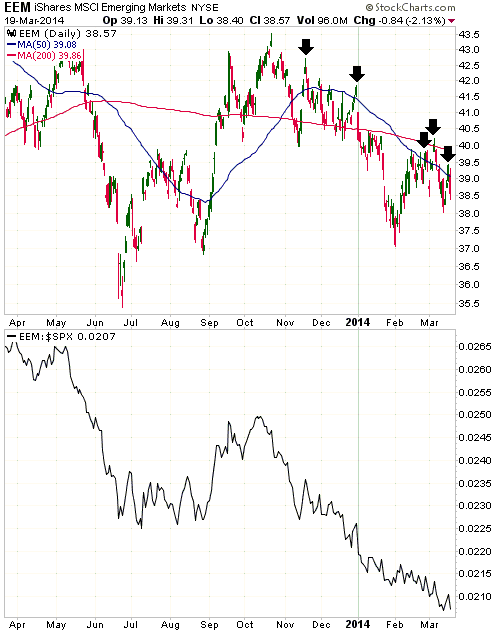
The top section of the following daily chart shows the Emerging
Markets ETF (EEM) and the bottom section shows the EEM/SPX ratio (Emerging
Market equities relative to US equities).
Relative to the US market, EEM continues to drift downward. In doing so it is
extending a trend that began 3.5 years ago. The trend is old, but it is still
alive.
In nominal dollar terms EEM has essentially been trendless for the past few
years, trading back and forth within a wide horizontal range. This creates the
possibility that a big move to the downside still lies ahead, which, in turn,
sparks our interest in having a position that profits from a decline in this ETF.
Fundamentally, a bet against EEM is supported by the need -- due to obvious
inflation problems -- on the part of several Emerging-Market central banks to
bring about tighter monetary conditions. Any tightening by the US Fed could
magnify this need by putting additional downward pressure on the exchange rates
of Emerging Market currencies, which is why EEM was weaker than the SPX
following Wednesday's hint that the Fed will begin a rate-hiking campaign sooner
than previously anticipated.
Although the possibility that EEM is in the process of completing a major
topping pattern would not be negated by a rise to near the upper boundary of its
3-year trading range, it wouldn't be prudent to maintain a bearish position in
the face of such a rise. Instead, the first sign that EEM is not yet ready to
roll over into a large decline should be viewed as a signal to step away from
bearish bets.
This week's price action and the price action over the preceding 5 months
suggests that a daily close above $39.50 would be a sign that EEM wasn't yet
ready to complete its major top. The reason is that EEM reversed lower from this
level on Tuesday-Wednesday of this week, thus continuing the pattern of the past
few months. If it now manages to close above this level it would be an
unexpected (from our perspective) sign of strength.
Gold and the Dollar
Gold
Unfounded Beliefs
In the latest Weekly Update we warned that the Ukraine situation created
near-term downside risk rather than near-term upside potential for gold. Based
on the historical record it was almost inevitable that gold would fully retrace
any gains made in reaction to the heightened threat of military conflict in
Ukraine, with $30/oz being our guess as to the amount of Ukraine premium in the
price as at the end of last week.
When it became apparent at the beginning of this week that the Ukraine conflict
was not going to immediately escalate, the gold price quickly dropped $30.
The Ukraine-related conflict between Russia and the "West" could escalate in the
future, causing the gold price to surge. If it does, the same will apply: any
price gain made by gold on the back of such news would almost certainly be
retraced in full.
The upshot is that contrary to popular belief, international military conflict
or increasing risk of such conflict never creates a short-term buying
opportunity in the gold market. However, it sometimes creates a short-term
selling opportunity.
While on the subject of false beliefs, another one that will soon come into play
in the gold market is the "Golden Cross". A Golden Cross is defined as a move --
in any market -- by the 50-day MA from below to above the 200-day MA. Its
opposite (a move by the 50-day MA from above to below the 200-day MA) is often
referred to as a Death Cross.
There is widespread belief that Death Crosses are bearish and Golden Crosses are
bullish, but nobody who has bothered to check the historical record could hold
this belief. Here are the facts:
1) A sizeable majority of Death Crosses in major financial markets occur near
lows of at least short-term importance. A Death Cross therefore tends to be a
BULLISH signal.
2) On average, a Golden Cross has no predictive value. The historical record
suggests that it is neither reliably bullish nor reliably bearish. However, in
the gold market a particular type of Golden Cross has generally occurred near a
high of at least short-term importance. We are referring to the situation where
the cross occurs after the 50-day MA has risen from a long way below the 200-day
MA. This is the situation we will be dealing with if -- as is very likely -- the
gold market achieves a Golden Cross in the near future.
The 20-year gold-market history of the type of Golden Cross mentioned above (the
type where the cross occurs after the 50-day MA has risen from a long way below
the 200-day MA) contains only five examples. Here they are:
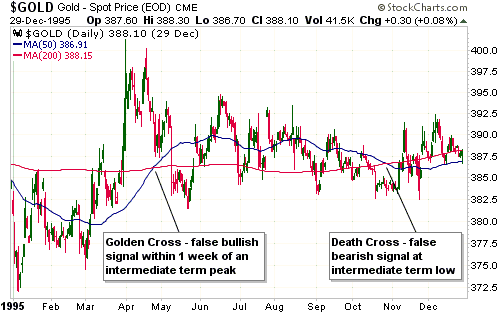
1) In April of 1995, a Golden Cross occurred about one week after an
intermediate-term price high. An intermediate-term price low was then marked by
a Death Cross in October of the same year.
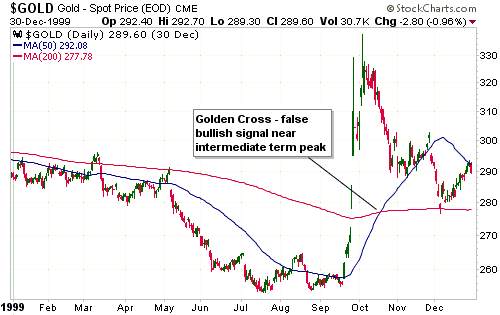
2) In October of 1999, a Golden Cross coincided with an intermediate-term price
peak.
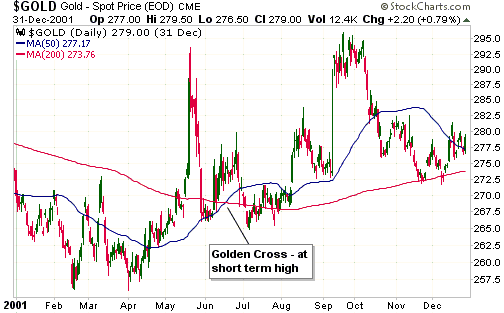
3) In June of 2001, a Golden Cross coincided with a short-term price peak. If
Golden Crosses are supposed to be bullish signals then the June-2001 cross was
the least wrong of our examples.
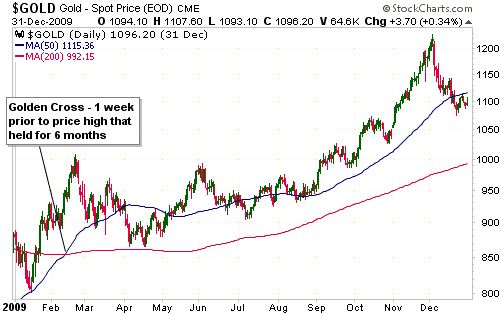
4) In February of 2009, a Golden Cross occurred about one week prior to a price
high that held for 6 months.
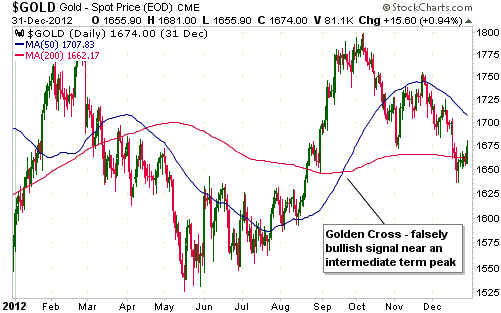
5) In September of 2012, a Golden Cross occurred just prior to an
intermediate-term price high. If Golden Crosses are supposed to be bullish
signals then the September-2012 cross was the biggest failure of the past 20
years due to the fact that it occurred near the beginning of a large 9-month
price decline.
Current Market Situation
Gold shed $30 over the first two days of this week in reaction to the easing of
Ukraine-related tension and then shed an additional $25 on Wednesday in reaction
to the latest words of wisdom from the Fed.
According to the latest words from the Fed, the 'tapering' of bond monetisation
will continue at the rate of $10B per FOMC meeting. This was widely expected.
What wasn't widely expected was the Fed's suggestion that the interest rate it
directly controls will start being raised by March-May of next year.
The gold market's knee-jerk reaction to this news isn't surprising, but it also
isn't rational. First, everybody knows that the Fed will have to allow
short-term interest rates to rise at some point. Second, everybody should know
that the Fed has no clue about when it will commence its next rate-hiking
program.
The reality is that what the Fed does in the future will be a reaction to what
the financial markets and the economic data have already done. For example, the
Fed won't commence a rate-hiking program next Spring if the US stock-market
bubble bursts before the end of this year or if the US economy is in recession
by the time we get to next Spring. In other words, any advice from the Fed as to
what it plans to do next year is completely irrelevant.
This week's pullback in the gold price from a high of around $1390 to a low of
around $1325 is the first significant pullback of the year, but it is perfectly
normal bull-market price action. We noted a couple of weeks ago that a pullback
to around $1300 would be normal given that moving averages were converging
around this level.
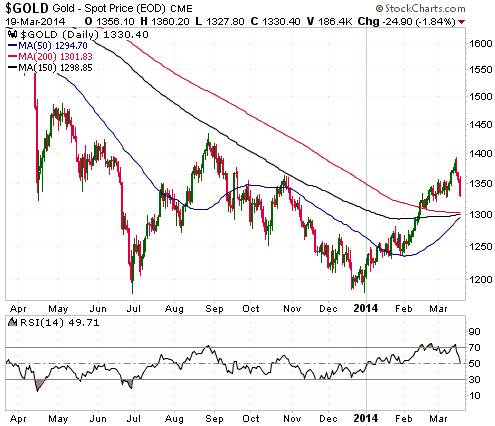
The following daily chart shows the moving-average convergence we are talking
about. The 50-day MA (the blue line on the chart) is rising and should soon
intersect the 150-day and 200-day moving averages near $1300, establishing the
Golden Cross discussed above. This time around it looks like a Golden Cross will
mark (occur just after) a price high that holds for at least a few weeks, but
there is little chance that it will mark an intermediate-term price high. It
will, we think, end up being a lot more like the June-2001 signal than the
September-2012 signal.
The chart also shows that the daily RSI has dropped back to around 50 after
spending a few weeks in 'overbought' territory. A normal correction within a
short-term upward trend will often take the RSI down to 40-50.
Given that we do not expect gold to trade much lower than $1300 before it
resumes its upward trend and that we view resistance in the $1420s as a
high-probability 3-month target, our short-term gold outlook will automatically
shift from "neutral" to "bullish" if the gold price drops below $1320.
Silver
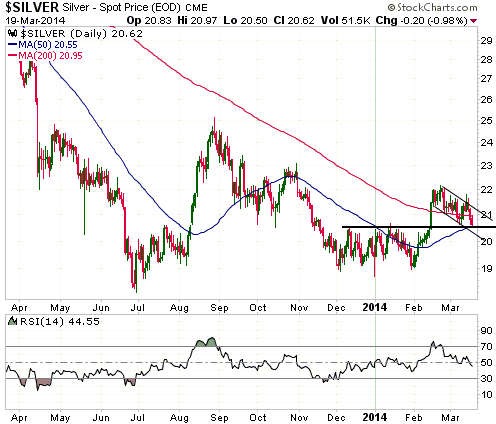
Unlike gold, which made a new multi-month price high at the end of last week and
has therefore just begun to 'correct', silver has been in 'correction mode' for
about one month. It is now slightly 'oversold' in nominal dollars and moderately
'oversold' relative to gold, and is near support at $20.50.
As well as being slightly 'oversold' in momentum terms, sentiment in the silver
market is at a level that suggests minimal additional downside potential. As
evidence we point out that Market Vane's bullish percentage for silver is in the
mid-30s. Gold's current bullish percentage is around 50.
The bottom line is that silver looks attractive as either a short-term or a
long-term buy at $20.00-$20.60.
Gold Stocks
This week's performance by the HUI is another example of why it is often a good
idea NOT to buy immediately following an upside breakout and/or obvious
confirmation of strength. The breakout could be false, but even when it proves
to be a genuine signal there will be many occasions when it will be followed by
a 'testing' pullback. Consequently, it usually makes more sense to buy a
pullback to support than to buy an upside breakout.
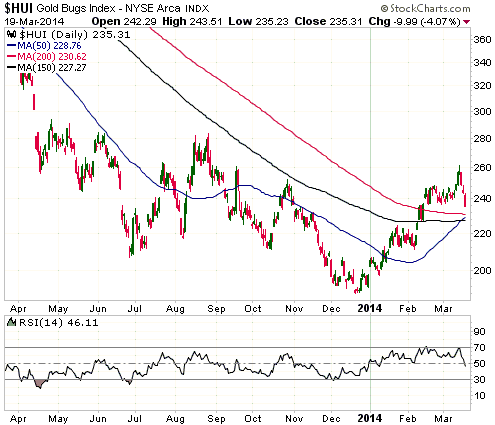
We think that last week's upside breakout was a genuine signal, but it looks
like a decline to support at 225-230 will precede the start of a rally to new
highs for the year. The 225-230 range should be strong support because, as
illustrated by the following chart, the 50-day, 150-day and 200-day moving
averages are converging in this range.
The rally in the gold-mining sector that began last December has been
characterised by strength in the juniors relative to the seniors. With the
benefit of hindsight it is therefore clear that GDXJ's inability to confirm last
week's upside breakout in the HUI was a warning that a pullback was about to
begin.
Currency Market Update
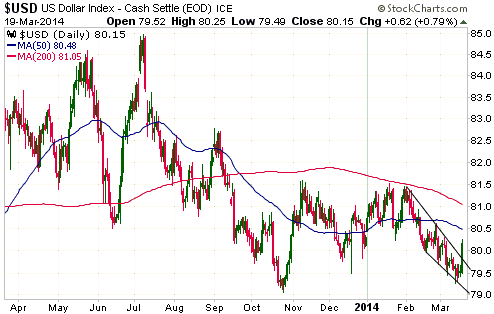
The Dollar Index bounced on Wednesday in reaction to the Fed news. The bounce
wasn't significant in the grand scheme of things, but it broke the Dollar out of
its recent range.
The Dollar Index has resistance at 80.5 and at 81.5. The former is likely to be
tested this week, while a weekly close above the latter is needed to confirm a
trend reversal of multi-month significance.
It will be interesting to see what happens next week after the Fed news has been
fully absorbed.
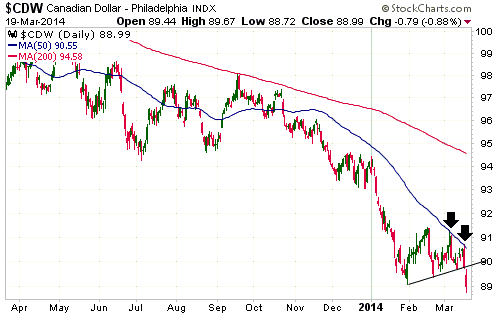
The C$ has been the weakest major currency over the past few days. As
illustrated by the following chart, the C$ completed another successful test of
its 50-day MA early this week and then plunged to a new multi-year low.
Our view is unchanged. We think that the C$ is a buy below 90 and will be a
strong buy if it falls to around 85.
Updates
on Stock Selections
Notes: 1) To review the complete list of current TSI stock selections, logon at
http://www.speculative-investor.com/new/market_logon.asp
and then click on "Stock Selections" in the menu. When at the Stock
Selections page, click on a stock's symbol to bring-up an archive of
our comments on the stock in question. 2) The Small Stock Watch List is
located at http://www.speculative-investor.com/new/smallstockwatch.html
 A
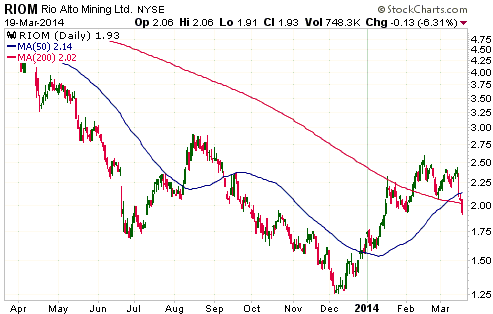
benefit of this week's sharp pullback in most things gold-related is that it has
led to a new opportunity to buy Rio Alto (RIOM), a profitable
relatively-low-risk junior gold producer operating in Peru. A
benefit of this week's sharp pullback in most things gold-related is that it has
led to a new opportunity to buy Rio Alto (RIOM), a profitable
relatively-low-risk junior gold producer operating in Peru.
RIOM has dropped to the low-US$1.90s, where there is good support (not shown on
the following chart). The worst-case realistic short-term scenario entails a
further decline to around US$1.75, but if we didn't already have a full position
we would have no hesitation in buying near the current price.
Further to the discussion in the "Stock Market" section of today's
report, we are reducing the 'stop' on our bearish Emerging Markets
position. The EEV (UltraShort Emerging Markets) trading position in
the TSI List will now automatically be exited if EEM (Emerging
Markets ETF) closes above $39.50.
Chart Sources
Charts appearing in today's commentary
are courtesy of:
http://stockcharts.com/index.html

|









