- Interim Update 19th August 2020
Copyright
Reminder
The commentaries that appear at TSI
may not be distributed, in full or in part, without our written permission.
In particular, please note that the posting of extracts from TSI commentaries
at other web sites or providing links to TSI commentaries at other web
sites (for example, at discussion boards) without our written permission
is prohibited.
We reserve the right to immediately
terminate the subscription of any TSI subscriber who distributes the TSI
commentaries without our written permission.
No Weekly Update for
the coming week
We will be taking a short break
and therefore won't be publishing a Weekly Update for the week commencing
Monday 24th August. Normal programming will resume with next week's
Interim Update.
We will send out a Market Alert email if something
unexpectedly dramatic or dramatically unexpected happens in the financial
markets during the period between these commentaries.
The Fed's
footprints are all over the financial markets
Many analysts downplay the Fed's
influence on bond yields, but we don't think it's possible to explain the
following chart without reference to the massive yield-supressing boot of
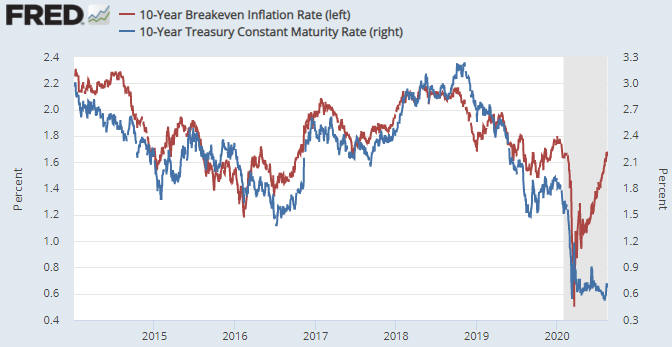
the Fed. The chart compares the 10-year T-Note yield with the 10-Year
Breakeven Rate, a measure of the market's inflation (CPI) expectations.
The Breakeven Rate is calculated by subtracting the Treasury Inflation
Protected Security (TIPS) yield from the associated nominal yield.
The chart reveals that the 10-year T-Note yield generally moves in the
same direction as the 10-Year Breakeven Rate. This is hardly surprising,
given that the expected "inflation" rate is usually the most important
determinant of the long-term interest rate. In particular, a higher
expected "inflation" rate usually will result in a higher long-term
interest rate. However, something very strange has happened since March of
2020. Since that time there has been a large rise in the expected CPI
while the nominal 10-year yield has drifted sideways near its all-time
low.
As far as we can tell, there are only two ways that the sort of
divergence witnessed over the past five months between inflation
expectations and nominal bond yields could come about.
One way is
capital flight from outside the US to the perceived safety of the US
Treasury market that overrides other effects on bond prices/yields. This
is what happened during 2011-2012, which is the only other time that a
substantial rise in inflation expectations coincided with flat or
declining nominal US bond yields. In 2011-2012, capital flight to the US
was prompted by the euro-zone's sovereign debt crisis.
Manipulation
by the Fed is the other way that the divergence could arise.
Over
the past five months there has been no evidence of capital flight to the
US. Therefore, it's clear that the Fed has maintained sufficient pressure
to prevent the nominal 10-year bond yield from responding in the normal
way to a large rise in the bond market's inflation expectations. Not
without ramifications, though.
A large rise in the expected
"inflation" rate in parallel with a flat nominal interest rate equates to
a large decline in the 'real' interest rate. In this case, it equates to
the 'real' US 10-year interest rate moving well into negative territory.
This has put irresistible downward pressure on the US$ and irresistible
upward pressure on the prices of most things that are priced in dollars,
including gold, equities, commodities and houses. It has even put upward
pressure on the price of labour, despite the highest unemployment rate
since the 1930s.
At the moment the Fed undoubtedly is pleased with
its handiwork. The rise in the gold price to new all-time highs could be
viewed as a rebuke, but these days no-one in the world of central banking
cares about the gold price. Central bankers do, however, care about the
stock market, and the Fed's governors will be patting themselves on the
back for having helped the S&P500 Index fully retrace its February-March
crash. They also will be pleased that the CPI is rising in spite of the
deflationary pressures resulting from the lockdowns. After all, the
concerns they have expressed over the years about insufficient "inflation"
make it clear that the last thing they want is for your cost of living to
go down*.
However, the Fed is 'playing with fire'. Putting aside
the long-term negative economic consequences of the mal-investment caused
by the Fed's money pumping and interest-rate suppression, if the Fed
continues to prevent bond yields from reflecting rising inflation
expectations then the steady shift currently underway towards hard assets
and anything else that offers protection against currency depreciation
will become a stampede. And once that happens, the sort of central-bank
action that would be required to restore confidence would crash both the
stock market and the economy.
If the Fed continues along its
current path then an out-of-control rise in prices won't be an issue to be
dealt with in the distant future. It possibly will become an issue before
the end of this year and very likely will become an issue by the middle of
next year.
*Nobody with common-sense can
figure out why.
Commodities
Lumber Extreme
In the midst of a recession and in parallel with double-digit
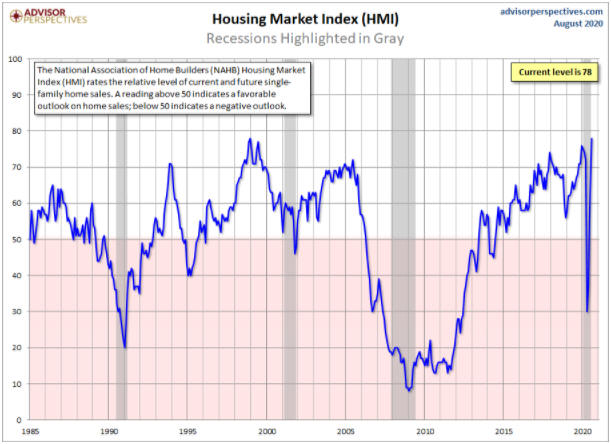
unemployment, the NAHB Housing Market Index just hit an all-time high.
Refer to the following chart for the details. This means that US
homebuilders have never been more optimistic than they are today.
Source:
Advisor Perspectives
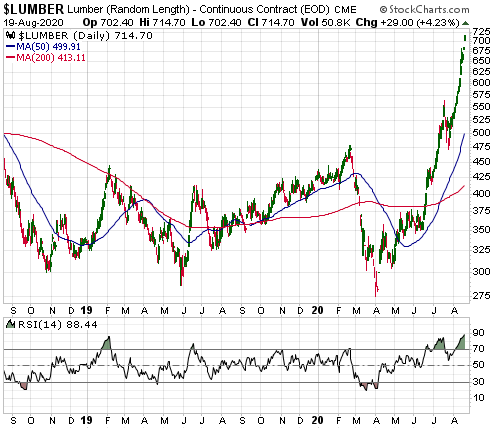
The above chart helps to explain the
following chart, which shows that the lumber price has more than doubled
over the past few months and is now much higher than it was at the
pre-COVID peak in February-2020.
This could be almost as good as it gets for the lumber price and for
homebuilder optimism. However, don't be surprised if the sort of price
action seen in the lumber market over the past few months occurs in many
other commodity markets within the next 12 months.
Is the
copper correction over?
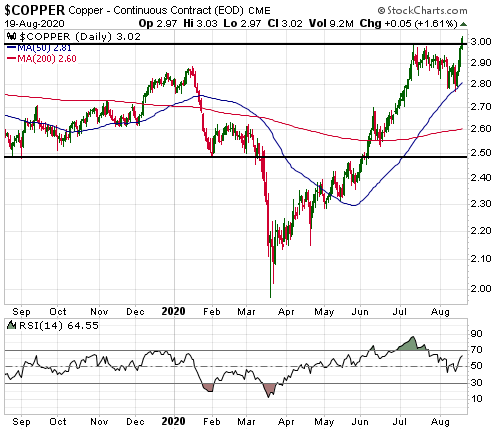
We expected a significant
pre-election (July-October) correction in the copper market as part of a
1-2 year cyclical advance from the March-2020 low. The copper price pulled
back from an early-July high near resistance at US$3.00 to a low late last
week near its 50-day MA in the high-$2.70s, before reversing course and
returning to $3.00 over the past three days. So, was that it? Has the
correction come and gone?
Possibly. The latest COT data show that the total speculator net-long
position in copper futures is well below where it was at important price
tops during 2016-2018 (the most recent multi-year bullish period for
copper), so there is scope for additional speculative buying. However,
whether or not there is additional speculative buying of copper in the
short-term will be mostly determined by the currency market. This is
because US$ weakness is the primary driver of the current upward trend in
the copper price.
If the Dollar Index (DX) extends its downward
trend over the weeks immediately ahead then the copper price probably will
test its 6-year high in the $3.30s during September. This could happen,
but it would be risky to bet on further short-term weakness in the US$.
Because the probability of a short-term US$ rebound is high, copper's
short-term risk/reward is neutral at best.
The Stock Market
A risk at the moment is that
there will be too much US$ weakness and, as a result, too much "inflation"
in the stock and commodity markets too soon. This could lead to upside
blow-off moves in many markets over the coming three months, as opposed to
the corrective action we've been expecting. Don't get us wrong, a US$
rebound and resultant sizable pullbacks in stocks, gold and commodities
still describes the most likely short-term scenario, but it's possible
that enough traders now understand the intermediate-to-long-term
consequences of the 'stimulus' measures of the past six months that price
changes that would have occurred over the next 9-12 months will be
compressed into 2-4 months. This risk can be managed by maintaining core
exposure in line with the cyclical rising-inflation trend.
At the
moment, the stock market is signalling neither an acceleration to the
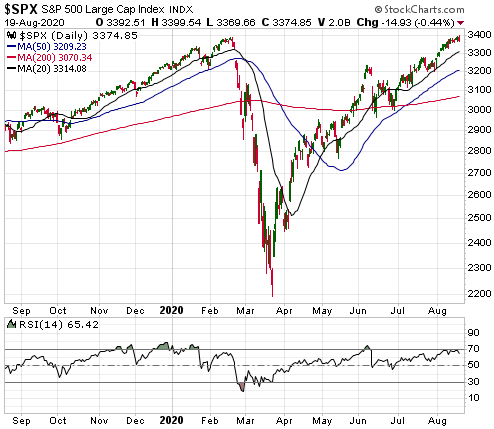
upside nor a reversal. Instead, the S&P500 Index (SPX) is trading quietly
near its February-2020 all-time high.
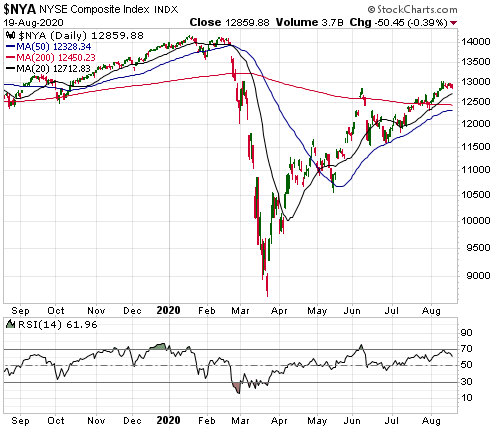
The NYSE Composite Index (NYA) remains well below its early-2020
all-time high, but it, too, is trading quietly.
The fact that the stock market is complacent doesn't mean that the
short-term upward trend will continue, because the stock market is usually
complacent immediately prior to the start of a sizable downward move.
However, complacency by itself is not a reason to be concerned about
downside risk.
We are concerned about short-term downside risk for
a number of reasons, one being the extent to which a number of
inter-related markets are stretched in one direction or the other right
now. This suggests to us that the stage is set for countertrend moves
lasting 1-2 months.
Another concern stems from comparisons between
this year's price action and historical periods with similar price action.
The best example is the following chart-based comparison of the NYA's
performance in 2020 and the Dow's performance during 1929-1930.
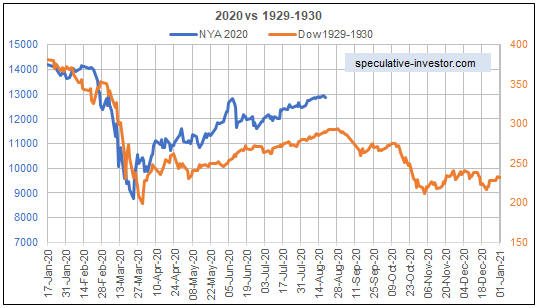
If the Fed continues to do what it has been doing then the stock
market will not follow the 1930s path, but there still could be a shakeout
within the next few weeks that acts as a sentiment reset.
Gold and the Dollar
Gold
Here's how we concluded the Gold discussion in the latest Weekly Update:
"The upshot is that a multi-month price top probably is in place.
If so, it's a good bet that the plunge from the 7th August high to the
12th August low was the initial leg down and that the market is in
consolidation mode pending the start of the next leg down. The
consolidation could encompass a test of the 7th August high."
Nothing changed over the first three days of this week.
Two-way
volatility suddenly picked up on 7th August and remains elevated. For
example, the gold price swung through an $85 range on Wednesday 19th
August.
The elevated volatility is, we think, symptomatic of a
topping process that could involve a test of the early-August high within
the next couple of weeks. Furthermore, the fact that the price closed
slightly below its 20-day MA on Wednesday 19th August does not eliminate,
or even significantly reduce, the probability that the high will be tested
before a larger decline gets underway. On the contrary, oscillations
around the 20-day MA are part and parcel of the increased price volatility
associated with broadening disagreement between large traders regarding
the market's prospects.
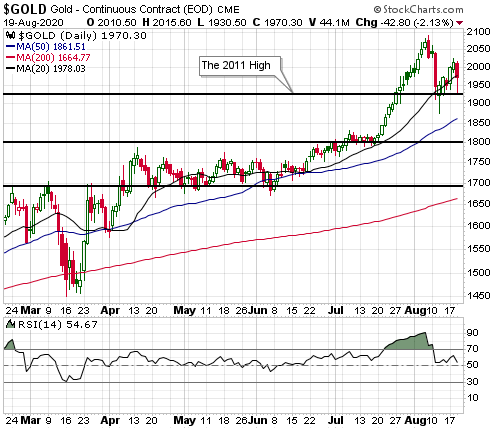
Our guess is that the correction will end in the low-$1800s in
October, but actually there is no need to guess. Instead, decisions should
be made in real time as new facts related to price action, sentiment and
fundamentals become known.
Silver
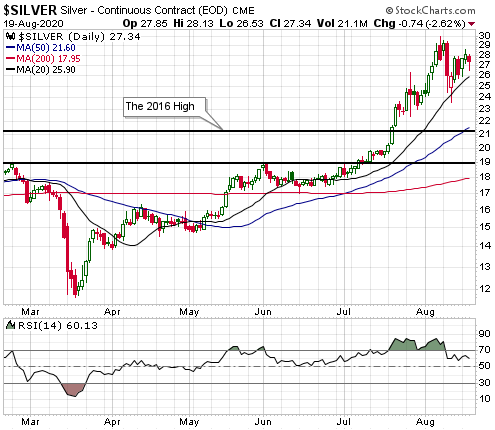
Like the
US$ gold price, the US$ silver price has rebounded from an intra-day low
on Wednesday 12th August. It's possible that the rebound from last week's
low will exceed the early-August high near $30, but if it does it should
be viewed as an excellent short-term selling opportunity rather than a
reason to get enthused about an extension of the upward trend.
Further to comments in recent TSI reports, we think there will be an
opportunity to buy silver near its 200-day MA within the next couple of
months.
Gold Stocks
Regarding the gold mining sector
as represented by the HUI, our thinking, as outlined in recent
commentaries, can be summarised as follows:
1) A multi-month price
top (probably the top for the year) was set on 5th August when the HUI
spiked up to 374.
2) The 11th August low (319 for the HUI) marked
the end of the initial leg down and the start of a consolidation phase.
3) The consolidation could encompass a test of the 5th August high.
4) The most likely place for the HUI's ultimate correction low is 260
or thereabouts. The reason is that the area around 260 contains important
lateral support and will soon encompass the 200-day MA.
5)
Near-term strength in the gold sector should be viewed as an opportunity
to do some selling or hedging, but 'core' exposure should be kept due to
the likelihood that much higher prices -- in line with the very bullish
fundamentals for the industry -- will be seen during the first half of
next year.
The price action during the first three days of this
week was consistent with the above.
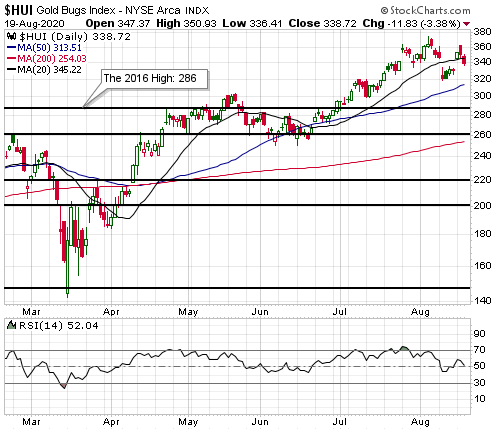
A weekly HUI close above 374 in the near future would indicate that a
different scenario was playing out. If this were to happen it likely would
be because speculators are front-running the coming US "inflation", thus
bringing forward some of next year's expected price action (the risk
mentioned in the Stock Market section of today's report).
The Currency Market
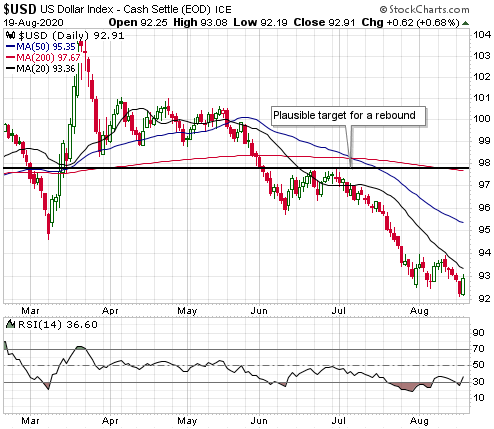
On Tuesday of this week the Dollar
Index fell for the fifth day in a row. In doing so it moved below its
late-July low to its lowest level in more than two years, thus 'stretching
the rubber band' a little further. On Wednesday it reversed upward.
Due to Tuesday's failed downside breakout, the short-term US$ outlook
has become a little more bullish.
Resistance at around 98 is still
a plausible target for a rebound, but a daily close above 94 is required
to confirm a short-term reversal to the upside.
The financial markets are always interconnected, but rarely has the
interconnectedness been as obvious as it is right now. Currently, most
markets are keying off the US dollar's exchange rate. In particular, many
prices are being pushed upward in relentless fashion as the US$ weakens.
This explains the strong positive correlation between the Australian
dollar (A$) and the S&P500 Index (SPX) illustrated by the following chart.
Over the 6-month period covered by this chart, owning an S&P500 index fund
has been almost the same as owning the Australian dollar.
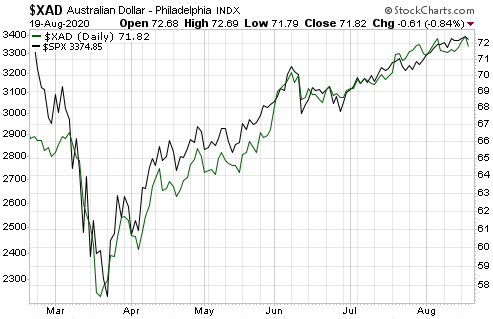
Based on the message of the above chart, the next significant
correction in the US stock market should go with a significant correction
in the A$. By the same token, if the stock market continues on its upward
path for another 1-2 months than so, in all likelihood, will the A$.
Updates on Stock Selections
Notes: 1) To review the complete list of current TSI stock selections, logon at
http://www.speculative-investor.com/new/market_logon.asp
and then click on "Stock Selections" in the menu. When at the Stock
Selections page, click on a stock's symbol to bring-up an archive of
our comments on the stock in question. 2) The Small Stock Watch List is
located at http://www.speculative-investor.com/new/smallstockwatch.html
 Recent
company news/developments:
Recent
company news/developments:
[Note: AISC = All-In Sustaining
Cost, boepd = barrels of oil equivalent per day, dmt = dry metric tonnes,
CIL = Carbon In Leach, E&P = Exploration and Production, EBITDA = Earnings
Before Interest, Tax, Depreciation and Amortisation (a measure of cash
flow), EV = Enterprise Value or Electric Vehicle, FS = Feasibility Study,
FY = Financial Year, IRR = Internal Rate of Return, ISR = In-Situ
Recovery, JV = Joint Venture, MD&A = Management Discussion and Analysis,
M&I = Measured and Indicated, MLP = Master Limited Partnership, NAV = Net
Asset Value, NPV(X%) = Net Present Value using a discount rate of X%, NSR
= Net Smelter Return or Net Smelter Royalty, O&G = Oil and Gas, P&P =
Proven and Probable, PEA = Preliminary Economic Assessment, PFS =
Pre-Feasibility Study]
*Adriatic Metals (ADT.AX):
The all-stock acquisition of Tethyan Resource (TETH.V) by ADT has been
approved by TETH shareholders and is scheduled to close next month. When
the takeover was announced in May we suggested buying shares of TETH at
around C$0.16 as a way of getting into ADT at a discount. Buyers of TETH
shares at that time could have achieved a gain of up to 200%.
The
next milestone for ADT will be completion of the PFS for its Vares project
in Bosnia, which is scheduled to happen in September-2020. As mentioned
previously, if the PFS confirms the economics of the PEA then ADT's
project contains one of the world's most lucrative undeveloped metal
deposits.
*Golden Arrow Resources (GRG.V)
published its financial results for the quarter ending 30th June 2020.
At 30th June the company had no long-term debt and C$29M of working
capital. However, the bulk of its working capital is an investment in SSR
Mining (SSRM), which is worth a bit less today than it was at the end of
June. Current working capital is around C$27M, or about C$0.23/share.
In addition to its working capital, GRG has a portfolio of
early-exploration-stage projects in Chile, Argentina and Paraguay.
The current price of a GRG share (C$0.185) is a discount of about 20% to
the company's liquid financial assets. This means that despite the
increasingly speculative market for gold mining stocks, the stock market
continues to attribute negative value to GRG's exploration-stage projects.
This makes GRG a value proposition, but a large increase in the stock
price will require a discovery.
Adding an all-purpose hedge
The euro probably has
just made or is close to making a short-term top. If so, a routine
correction would take the CurrencyShares Euro Trust (FXE) down to around
$109. However, speculators have piled into long euro positions to the
extent that the coming correction could push the FXE down as far as $106.
That would be the equivalent of the DX rebounding to around 98.
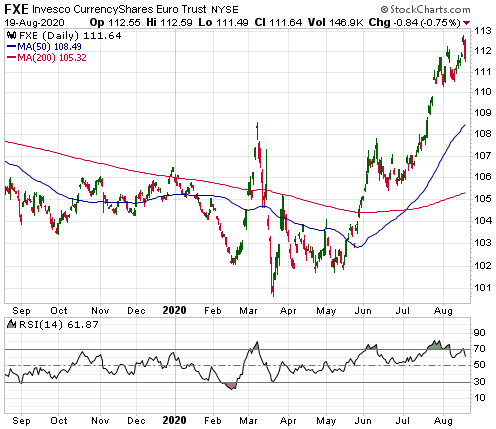
Given that US$ weakness has been the primary driver of rising prices
in the equity and commodity markets over the past few months, FXE put
options could be used to hedge against short-term weakness in these
markets. In effect, a bet against FXE could be viewed as an all-purpose
hedge against short-term weakness in everything that has been boosted in
price by the declining US$.
The FXE December-2020 US$108 put
option has been added to the TSI List at the mid-point of its 19th August
closing bid-offer spread (US$0.75-$0.85), primarily as a hedge or a form
of insurance.
Chart Sources
Charts appearing in today's commentary
are courtesy of:
https://stockcharts.com/
https://research.stlouisfed.org/