|
- Interim Update 19th September 2012
Copyright
Reminder
The commentaries that appear at TSI
may not be distributed, in full or in part, without our written permission.
In particular, please note that the posting of extracts from TSI commentaries
at other web sites or providing links to TSI commentaries at other web
sites (for example, at discussion boards) without our written permission
is prohibited.
We reserve the right to immediately
terminate the subscription of any TSI subscriber who distributes the TSI
commentaries without our written permission.
The real
reason for the Fed's action
One line of thinking is that the Fed's recent decision to
introduce a new inflation program was politically motivated. The
idea is that with Romney having made no secret of his intention to
replace Bernanke as Fed chief, Bernanke is taking actions designed
to improve the chances of an Obama victory. This reasoning isn't
totally implausible, but it isn't the best fit with the facts at
hand. As we said in the latest Weekly Update, the Fed has most
likely done what it has done due to a genuine belief that the
economy can be strengthened, and a sustainable improvement in the
labour market brought about, by counterfeiting money and
manipulating interest rates. With the points in no particular order,
here's why we think true belief in the power of money-printing to
help the economy is behind last week's action:
1. To get to the top echelons of the Fed you have to believe that
counterfeiting money and manipulating interest rates can benefit the
economy. In more general terms, you have to believe that a
well-informed group of technocrats can periodically intervene in the
economy to improve on what a free market would create.
2. Bernanke's job may well be under threat due to the possibility of
a Romney victory, but last week's policy shift can't be attributed
to Bernanke alone. 11 of the 12 members of the FOMC voted in favour
of the action.
3. Obama was clearly favoured to win the election prior to last
week's Fed decision.
4. Regardless of what's happening beneath the surface, the Fed would
want to avoid the appearance of being politically motivated.
However, last week's action effectively propelled the Fed to the
centre of the political stage. This suggests to us that in the wake
of recent weak employment data Bernanke and his cohorts believed
that they had a responsibility to act immediately rather than wait
until after the election. It is beside the point that their previous
inflation-promoting schemes are a large part of the reason for the
current lousy employment situation and that their latest
inflation-promoting scheme is bound to make the employment situation
worse beyond the short-term. It is beside the point because they are
operating within a theoretical framework in which illogical policies
make sense.
5. Monetary inflation can give a temporary and superficial boost to
the economy even while it does longer-term damage, which, of course,
accounts for its appeal. However, it's unlikely that the inflation
program introduced last week will have a material effect on the real
economy between now and the election in early November. This means
that if the Fed has acted for political reasons it has done so
without much hope of actually influencing the outcome of the
election.
6. With Obama already the favourite to win in November, the stock
market near a multi-year peak, the residential property market
showing signs of having bottomed and inflation expectations near a
5-year high, the Fed was taking a risk by announcing a new inflation
program at this time. The move could potentially backfire by causing
greater financial-market instability. It's unlikely that the Fed
would take this risk unless it was driven by the belief that its
actions could turn around a rapidly deteriorating labour market.
The more sinister motives that have been bandied about make for a
better story, but it very much looks like we are actually dealing
with unwavering devotion to bad economic theories -- the theories
that come under the umbrella of "Keynesianism". Bernanke and the
other members of the FOMC truly believe that it is proper for a
committee to be given the power to manipulate money supply and
interest rates with the aim of achieving full employment and price
stability. And they believe that they can go a long way towards
achieving their dual goals by incentivising people to spend more,
totally oblivious to the reality that for an increase in spending to
be sustainable and beneficial it must be preceded by an increase in
production. This makes them even more dangerous than if they were
unprincipled political hacks, because it probably means that they
will continue doing what they've been doing in the face of mounting
evidence that they are on the wrong path.
Whatever the reasons for last week's Fed decision, the biggest
challenge before us is what to do about it. Here's a quick summary
of what should and should not be done:
1. Don't be short the equity or commodity markets. There's still a
lot of risk in the US stock market, but the probability of a large
short-term decline has been reduced and there is now a small chance
of an inflation-fueled surge.
2. Don't be aggressive on the long side of the equity and commodity
markets. In particular, don't employ debt-based leverage. The Fed's
action will lend support to nominal prices, but the current
situation is unprecedented and therefore even more uncertain than
usual. We are referring to the fact that the Fed has never before
initiated an inflation-promoting program with the stock market and
inflation expectations near multi-year highs.
3. Be hedged, preferably via a substantial cash reserve.
4. Do not place any speculations or investments that rely on
meaningful economic progress over the coming 1-2 years. The reason
is that any economic boost stemming from the Fed's actions will be
short-lived at best. Perhaps the official recognition of recession
will be delayed for a couple more quarters, but growth-oriented
investments, including investments in the industrial-metals mining
sector, probably won't achieve much beyond 'oversold' bounces.
5. Stay away from US government bonds. The Fed will be reducing the
supply of 'low-risk' bonds, but the support provided by the Fed
could be swamped by the effects of rising inflation expectations.
6. Maintain large exposure to gold, silver and the stocks of
gold/silver miners, because they are the only clear-cut winners from
the Fed's new policy. The popularity of this view (many analysts
agree that gold and silver will be the biggest winners) suggests
that a multi-week correction will soon begin, but a significant
correction should be welcomed as a buying opportunity.
The calm
in Europe's bond market won't last
Four things in a row recently went right for the
holders of Spanish government bonds. First, ECB chief Draghi promised to do
"whatever it takes" to stabilise the debt situation. Second, the ECB followed
through on Draghi's words by introducing the Outright Monetary Transactions (OMT)
program, via which it will -- assuming certain conditions are met -- buy enough
bonds to the cap interest rates being paid by financially-stressed EZ
governments. Third, Germany's Constitutional Court gave the 'green light' for
the ESM, the EZ's permanent bailout fund. Fourth, the Fed introduced "QE3". The
combination of these events lowered the yield on the 10-year Spanish government
bond from 7.5% less than two months ago to 5.7% as we write.
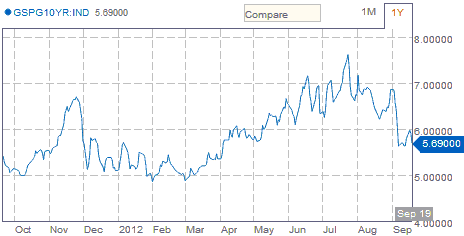
Although there is now a lot less fear in the market, the financial position of
Spain's government is not appreciably better today than it was two months ago.
It is therefore extremely unlikely that the crisis has run its course. It is far
more likely that we are seeing a short period of calm before the resumption of
the storm.
We will continue to keep a close eye on government bond yields in Europe.
The Stock Market
Today we will highlight two charts.
The first chart shows that the Dow World Stock Index (DJW) has returned to its
high for the year and is within about 5% of last year's high. This chart is
evidence of the power of central banks. We regularly read comments from
deflationists to the effect that central banks are powerless to stop the forces
of deflation, but here we are, in the midst of a global recession and
private-sector de-leveraging, with a proxy for global equities within 5% of a
three-year high.
Central banks can't possibly help the economy with their monetary machinations,
but they can boost prices. They can boost prices because they can reduce the
value of money.
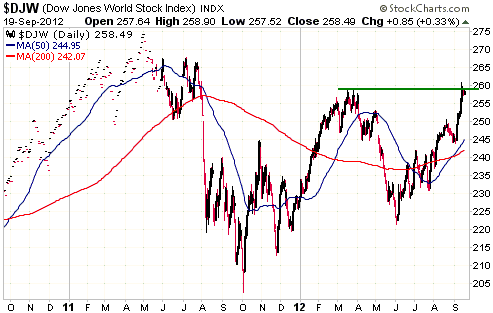
Unlike the US stock market, most stock markets around the world were in
consolidation mode before the central banks recently juiced things up. This gave
the markets considerable rebound potential. With the DJW now 'overbought' and at
intermediate-term resistance, additional near-term gains will be hard to come
by.
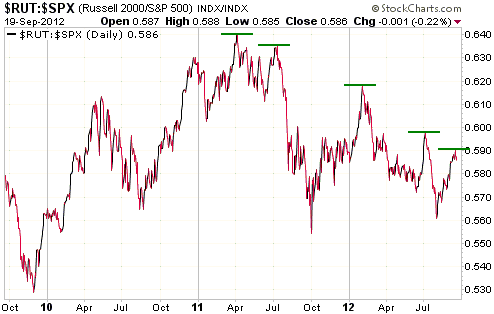
The second chart shows the RUT/SPX ratio (small-cap stocks relative to large-cap
stocks). The inflation-fueled excitement of the past few weeks has boosted
small-cap stocks relative to large-cap stocks, but RUT/SPX still hasn't broken
the sequence of declining tops that began in April of 2011.
Gold and the Dollar
Gold
The US$ gold price has obvious resistance at $1800/oz, but over the past few
days the price has been unable to make it beyond the $1770s. A likely reason
that the $1770s have presented a temporary obstacle for gold is that at the
current euro/US$ exchange rate a US$-denominated gold price in the 1770s
corresponds to a euro-denominated gold price at major resistance defined by last
year's all-time high. This means that in the absence of additional strength in
the euro, a rise to 1800 in the US$ gold price would require a break to a new
all-time high in the euro gold price. This will probably happen within the next
two months, but it is not surprising that the euro-denominated gold price
(gold/euro) is encountering resistance at its all-time high. Here is a daily
chart of gold/euro.
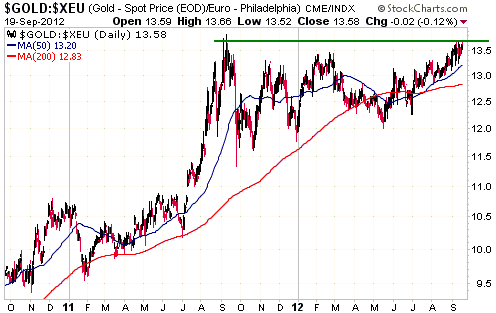
More often than not, gold/euro breaks out to a new multi-year high well in
advance of gold/US$. It's going to be the same story this time around. A
decisive break to a new high by gold/euro within the next two months would point
to break to a new high in the US$ gold price early next year.
Gold Stocks
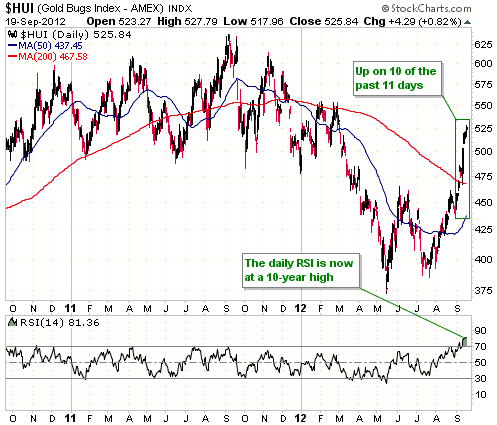
The HUI has risen for 7 trading days in succession and on 10 of the past 11
trading days. Also, the HUI's daily RSI(14) is at a 10-year high, and in
percentage terms the HUI's distance above its 50-day moving average (MA) is near
a 10-year high. The upshot is that on a short-term basis the HUI is now very
'overbought'.
A top hasn't yet been signaled, though, so the HUI could become even more
'overbought' before a downward correction gets underway. As stated in the latest
Weekly Update, the 50-day MA will become a likely target once the next downward
correction does get underway. This is regardless of when/where the correction
starts. The HUI's 50-day MA is now rising at the rate of around 10 points per
week, so if a 3-4 week correction were to begin immediately then the HUI would
probably meet up with its 50-day MA in the 470s.
Our view is that support in the low-460s defines the maximum short-term risk and
that the next correction will be followed by a rally to a new multi-month high.
Currency Market Update
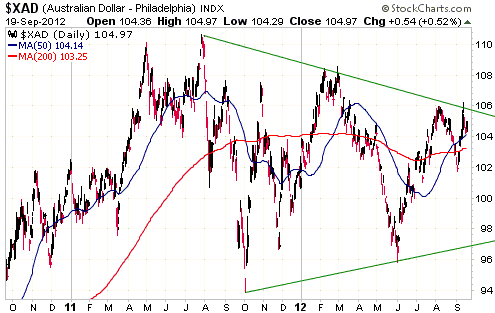
The A$ has been trending up and down with global equities for several years. It
is still doing so, although recently it has been a little weaker than would be
expected based solely on stock market performance. In particular, if the A$ had
matched the DJW's recent performance then it would now be around 108 instead of
104-105. The market appears to be making a concession to the reality that the
very over-valued A$ will likely be losing more of its interest-rate advantage
over the months ahead.
The A$'s chart pattern is neutral. The currency has spent the past 14 months
oscillating in a wide range marked by declining tops and rising bottoms. It is
presently near the top of this range, which means that this is not a good time
to be buying.
Update
on Stock Selections
Notes: 1) To review the complete list of current TSI stock selections, logon at
http://www.speculative-investor.com/new/market_logon.asp
and then click on "Stock Selections" in the menu. When at the Stock
Selections page, click on a stock's symbol to bring-up an archive of
our comments on the stock in question. 2) The Small Stock Watch List is
located at http://www.speculative-investor.com/new/smallstockwatch.html
 Kinross
Gold (KGC) Call Options Kinross
Gold (KGC) Call Options
There are two long-dated (Jan-2014) KGC call-option positions in the TSI Stocks
List. The question before us now is: what would KGC's stock price have to do to
create a profit-taking opportunity in one or both of these option positions?
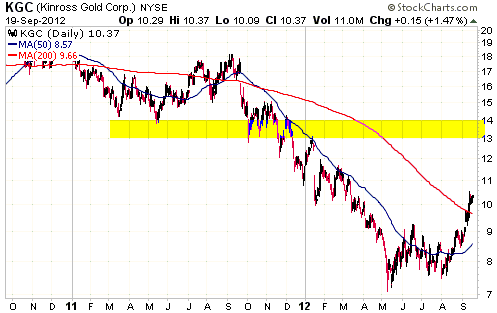
KGC's stock price almost certainly won't move high enough within the next couple
of months to create a good profit-taking opportunity in the $15 call options.
There is, however, a chance that it will gain enough ground to push the $10
calls to a level where a full or partial sale will make sense. A rally in the
stock price to resistance in the $13-$14 range would do it, although the actual
decision regarding when and at what level to sell will be made based on
real-time facts.
$13-$14 is about 30% above the current price. A rise of that magnitude within
two months isn't likely, but it is a realistic possibility due to KGC's low
relative valuation. In the absence of more company-specific bad news, KGC's
relatively low valuation should lead to relative strength in its stock price as
confidence in the gold sector's new upward trend increases. There's also the
potential for KGC to be boosted by takeover speculation.
If a good opportunity to make a full or partial exit from the KGC call options
doesn't present itself over the next couple of months it won't be a big problem.
There's a high probability of a strong rally in KGC's stock price some time
prior to option expiry in January of 2014.
Pretium Resources (TSX and NYSE: PVG)
Current and prospective owners of PVG shares should listen to the
company's webcast that was originally broadcast on 19th September
and has been archived at
http://services.choruscall.ca/links/pretium120919.html#. The
associated slide presentation can be downloaded at
http://118009.choruscall.com/pretium/pretium120919.pdf.
The main purpose of the webcast was to discuss in detail the interim
resource update for the high-grade Brucejack project that was
announced in early September, but most other important aspects of
the project are also covered.
Prodigy Gold (TSXV: PDG). Shares: 293M issued, 313M fully
diluted. Recent price: C$0.68
In the 22nd August Interim Update we wrote: "...C$0.84 is the
short-term chart-based target [for PDG] created by this week's
breakout." The stock subsequently traded as high as C$0.83,
creating a short-term profit-taking opportunity, before pulling
back. It traded in the high-C$0.60s this week before rebounding to
end Wednesday's session at C$0.73.
A decline to support at C$0.65 within the next three weeks would
create a short-term buying opportunity.
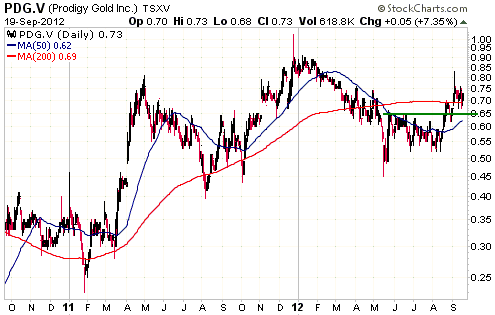
Chart Sources
Charts appearing in today's commentary
are courtesy of:
http://stockcharts.com/index.html

|









