|
- Interim Update 20th February 2013
Copyright
Reminder
The commentaries that appear at TSI
may not be distributed, in full or in part, without our written permission.
In particular, please note that the posting of extracts from TSI commentaries
at other web sites or providing links to TSI commentaries at other web
sites (for example, at discussion boards) without our written permission
is prohibited.
We reserve the right to immediately
terminate the subscription of any TSI subscriber who distributes the TSI
commentaries without our written permission.
Extremes
At no stage over the past 10 years have we been as out-of-synch
with the markets as we have been over the past couple of months. The
problem, from our perspective, is that during this period several
markets and indicators reached extremes that almost always led to
price reversals in the past, but this time around did not. Instead,
the markets and indicators went to even greater extremes.
In some cases, most notably the Yen and the gold sector of the stock
market, what we thought were 'oversold' extremes were surpassed by a
wide margin to the point where records that had held for 10 years or
more were equaled or broken. Other noteworthy extremes have occurred
in stock market volatility (the VIX reached its lowest level since
the first half of 2007) and gold market sentiment (as discussed
later in today's report).
Although the markets have gone much further than we anticipated,
it's important to bear in mind that the more a rubber band gets
stretched the lesser the potential for it to be stretched further
and the greater the potential for a snap-back. You may not want to
bet heavily on the timing of the inevitable snap-back, but you
should at least be prepared for it.
China
and Gold
Numerous gold-related articles penned over the
past year contain the claim that China now dominates the global demand for gold.
Not to put too fine a point on it, this claim is complete hogwash.
The belief that China dominates global gold demand is based on comparisons
between the quantity of gold accumulated by China and the amount of gold
produced by the mining industry. Last year, for instance, the total amount of
gold in China increased by around 900 tonnes due to imports of around 570 tonnes
and internal production. This figure is then compared to global mine supply of
2500 tonnes to arrive at the fallacious conclusion that China's demand for gold
is now 35%-40% of the overall market.
The easiest way for us to explain why the above conclusion is fallacious is via
a hypothetical example. Let's assume that the US money supply was 10 trillion
dollars at the beginning of last year (not far from reality) and grew by 1.5%
over the course of the year (well below the actual growth rate of around 11%).
Our assumption, therefore, is that $150B was added to the US money supply during
the year. Now, in our hypothetical example Warren Buffett sells $60B of shares
and thus increases his cash holding by $60B. Would any moderately knowledgeable
person look at these figures and conclude that Buffett was 40% ($60B being 40%
of $150B) of the global US$ market during the year in question? Would any
moderately knowledgeable person claim that the transfer of $60B to Buffett's
accounts from the accounts of other people was a reason for the US$ to become
more valuable? The answer to both questions is: Of course not! Why, then, do
supposedly knowledgeable people frequently answer similar questions in the
affirmative when discussing the gold market?
The most common mistake in analyses of gold supply and demand is to think that
the supply side of the equation is represented by the gold-mining industry's
annual production. With almost all gold being accumulated and with there being
no difference between an ounce of pure gold mined this year and an ounce of pure
gold mined 100 years ago, the supply side of the equation is actually
represented by the aboveground gold stock. This is estimated to be around
155,000 tonnes (more than 60-times the current annual production rate). Since
the market price is, by definition, the price that momentarily brings supply and
demand into balance, we know that if global gold supply is roughly 155K tonnes
then global gold demand is also roughly 155K tonnes. Therefore, one way to
measure China's influence on the global gold market would be to divide the total
amount of gold in China by 155K tonnes. Including official reserves that are
probably now 2,000-3,000 tonnes, our guess is that the total amount of gold in
China is somewhere between 5,000 and 10,000 tonnes. It could hence be argued
that China constitutes 3.2%-6.4% of the global gold market.
We'll now approach the question of China's influence on the gold market from a
different angle.
A portion of the aboveground gold stock gets traded every year, but you can't
explain past moves in the gold price or obtain useful information about likely
future moves in the gold price by attempting to measure these transfers between
buyers and sellers. For example, every year there is a transfer of several
hundred tonnes of gold to India from the rest of the world. This yearly transfer
occurs regardless of whether gold is in a bull market or a bear market. It
constitutes a net flow of gold to buyers in one part of the world from sellers
in other parts of the world, but it obviously isn't a determinant of gold's
major price trend. It's the same story with the flow of gold into China.
Trying to explain and forecast changes in the gold price by focusing on the
flows of gold between sellers and buyers in different parts of the world is like
trying to understand and forecast changes in a company's share price by focusing
on the number of shares changing hands. It's not the flow of shares or the flow
of gold between sellers and buyers that determines the price; the price is
determined by the average (market-wide) urgency to buy relative to the average
urgency to sell. If buyers are more motivated than sellers, the price will rise;
if sellers are more motivated than buyers, the price will fall. Therefore,
determining the likely future direction of the price involves analysing the
factors that influence the motivations of buyers and sellers on a market-wide
basis.
In the gold market, India may be a special case. It seems that the people of
India routinely accumulate gold through good times and bad. Throughout much of
the rest of the world, however, the general desire to own gold grows due to a
greater desire to save combined with central-bank/government policies that make
it increasingly imprudent to save in terms of the official money. To be a little
more specific, people generally prefer to hold more cash when they become more
uncertain or pessimistic about the economic future, but governments and central
banks often react to the economic conditions that make people want to save more
cash by taking actions that reduce the purchasing power of cash. People are thus
prompted to save in terms of a liquid, money-like asset that the 'authorities'
can't depreciate. This is probably just as true in China as it is in most parts
of the world, meaning that there isn't a good reason to single-out China's gold
demand as if it were a powerful independent force. Aside from the likelihood
that China's gold demand, when properly measured, constitutes less than 6% of
global gold demand, it's reasonable to expect that the investment demand for
gold in China will rise and fall in response to the same influences that drive
the investment demand for gold in most other places.
The Stock Market
The S&P500 Index and many other broad-based equity indices made
new multi-year highs on Tuesday. The most notable exception was the NASDAQ100
Index (NDX), which remained comfortably below last September's high. Almost all
stock indices then reversed downward on Wednesday. Wednesday's downward reversal
could turn out to be significant, but obviously a single day's price action
doesn't make a trend.
Due to its divergence, we continue to fixate on the NDX. Wednesday's action took
the NDX back to the unusually narrow range in which it oscillated from the
second trading day of the year until it broke out to the upside during the week
before last. This upside breakout now looks like a 'head fake', but a daily
close below 2700 is needed to confirm that a top is in place.

Gold and the Dollar
Gold
Current Market Situation
On Tuesday 19th February Market Vane's bullish percentage for gold dropped to
51, equaling the level reached when gold was bottoming in October of 2008.
Considering Wednesday's price action the bullish percentage is probably now in
the high-40s. If so, it would be a 10-year low.
Thanks to the price action over the past two trading days, the weekly RSI shown
at the bottom of the following chart is now at a 10-year low. As mentioned in
the opening section of today's report, we are seeing some record-breaking moves.
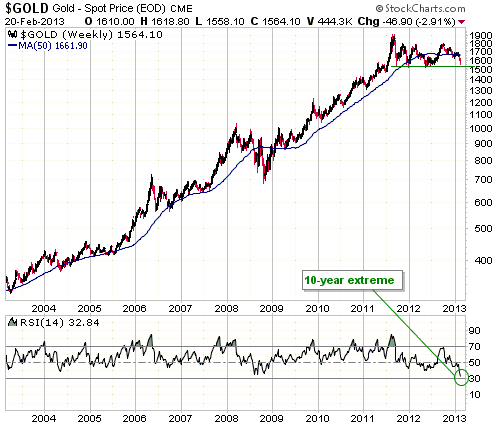
The US$ gold price broke below the bottom of its short-term downward-sloping
channel on Wednesday and is now close to intermediate-term lateral support that
extends from the $1520s to the $1550s. This support is clearly evident on the
weekly chart displayed above. If the support is breached it won't mean that the
bull market is over (the bull market won't be over until after central banks and
governments stop trying to inflate and spend their ways out of economic holes
that were dug by previous inflation and government spending), but it will mean
that the August-2011 peak was more important than we realised.
Considering the extent to which sentiment and momentum indicators are already
stretched, a break below the above-mentioned support is not the most likely
outcome. Actually, that we are even broaching the possibility of this support
giving way prior to the end of the correction could be viewed as another sign of
just how negative sentiment has become. Your own sentiment can be a useful
indicator.
Those dastardly Fed minutes
Gold's price decline accelerated on Wednesday 20th February when the minutes of
the latest FOMC meeting were published. Here's an excerpt from an
article discussing the contents of these Minutes:
"Federal Reserve officials expressed growing unease with the central bank's
easy-money policies at its latest policy meeting and some suggested the Fed
might need to pull them back before the job market is fully back to normal.
Minutes released Wednesday of the Fed's Jan. 29-30 policy meeting showed that
officials worried the central bank's easy-money policies could lead to
instability in financial markets and might be hard to pull back in the future.
The Fed plans to evaluate how the programs are doing at its next meeting March
19 and 20.
Several officials said that the Fed should be prepared to vary the pace of its
asset purchases, depending on how the economy performs and its analysis of the
costs and benefits of the program, according to the minutes. Some Fed officials
suggested the Fed may need to alter its stated course to continue the
bond-buying programs until the job market improves "substantially," a threshold
it hasn't defined.
"A number of participants stated that an ongoing evaluation of the efficacy,
costs, and risks of asset purchases might well lead the Committee to taper or
end its purchases before it judged that a substantial improvement in the outlook
for the labor market had occurred," the minutes stated."
A similar reaction in the gold market was prompted by the release of similar
FOMC Minutes early last month. At that time (in the 7th January Weekly Update)
we wrote:
"The gold market reacted negatively to the 'revelation' that some FOMC
members are becoming concerned about the adverse effects of the Fed's QE
programs and about the difficulty of exiting the extremely loose monetary
policy."
And:
"Some common sense is required during times like these. Senior
representatives of the Fed WILL periodically express concern about their
inflation programs and mention the term "exit strategy", especially when the
stock market is strong and the economic data are OK (not good, but not
terrible). Talk such as this is part of their inflation-expectations management.
However, they will never lay-out a specific exit strategy, let alone actually
begin to exit. The reason is that there is no exit strategy. The US economy has
been weakened to such an extent by earlier monetary inflation that the Fed must
now continue to inflate the money supply at a rapid pace just to postpone a
collapse.
Think of it this way: The Fed implemented QE3 and QE4 when the US stock market
was near a multi-year high and the superficial economic data pointed to an
economy that was growing, albeit growing at a slow pace with persistently high
unemployment. If the monetary central planners were willing to introduce new
inflation-promoting schemes when the economy appeared to be making some progress
and the stock market was performing well, then what will they do when evidence
of a recession becomes obvious and/or the stock market tanks?"
Hopefully everyone capable of being surprised by the Fed's efforts to talk down
inflation expectations is now out of the gold market and won't return anytime
soon, because unless the stock market tanks and/or the economic data take an
obvious turn for the worse the Fed will continue to talk a good game. When the
stock market tanks and/or the economic data take an obvious turn for the worse,
the rhetoric will change from intimations that an exit or tapering-off will soon
begin to assurances that the money-pumping will continue for as long as needed.
Gold Stocks
Let's take a look at a few of the current extremes in the gold sector.
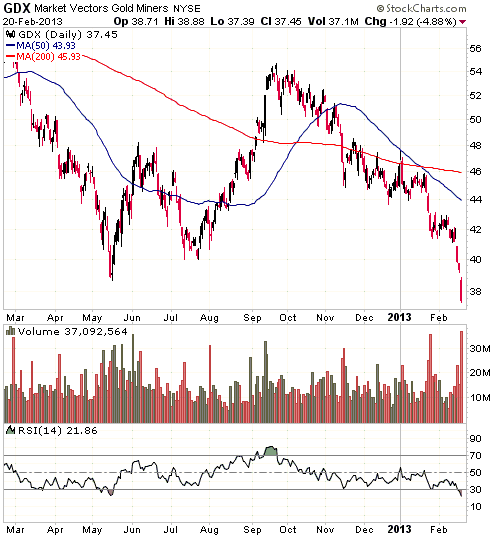
The following daily chart shows the Market Vectors Gold Miners Index (GDX), an
ETF containing large and mid-tier gold mining stocks. In addition to the price
action, the chart shows the daily trading volume and the daily RSI(14).
Due to this week's price plunge, the daily RSI is now at its second-lowest level
ever (which means the second-lowest level since the ETF's introduction in 2006).
There was one slightly lower reading in 2008. Also, reflecting the degree of
capitulation now underway in the gold sector is the fact that the GDX trading
volume on Wednesday 20th February was an all-time high.
The following chart shows the HUI's weekly price action and RSI(14). At the
close of trading on Wednesday 20th February the HUI's weekly RSI was 26.5, which
is the second-lowest level of the past 10 years. The lowest level (24) was
reached during the crash of October-2008.
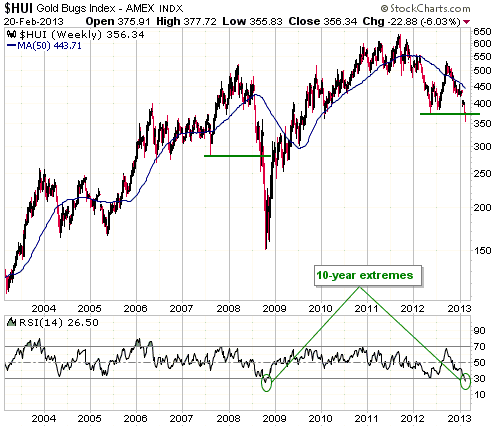
The extremes we are now seeing in the gold sector don't constitute a set-up for
an 'oversold' bounce or an intermediate-term rebound; they constitute a set-up
for a multi-year bull market. That being said, we are wary of sounding too
bullish. The reason is that over the past 24 hours the HUI has entered 'crash
mode'. As weak as the market has been for the past few months, prior to
Wednesday's solid break below last May's low there was a good chance that we
were getting a gut-wrenching test of last year's low as part of a lengthy
bottoming pattern. The "lengthy bottoming pattern" scenario just went out the
window. Instead, we are likely to get a "V bottom".
Gold-sector crashes are followed by rapid recoveries (the HUI doubled in two
months following its October-2008 crash low), but there's no telling how silly
things will get prior to a bottom. A bottom could be put in place today, but if
the crash continues for only a few more days the bottom could be much lower.
Keep this in mind and keep plenty of cash in reserve.
Currency Market Update
Data continue to suggest that "economic depression" is a better label than
"economic recession" for what's happening in the euro-zone (EZ). For example,
data reported early this week revealed that last month's EZ auto sales were down
8.7% on a year-over-year basis, making January-2013 the slowest January in
decades. The weakness was widespread, with even the relatively-strong German
economy suffering a sizeable decline of 8.6%. Auto sales in France were down by
a staggering 15.1% YOY.
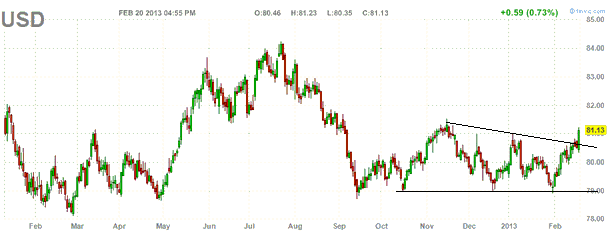
The currency market ignored the EZ's terrible auto-sales figures, but the Dollar
Index broke out to the upside the next day in response to a downward reversal in
the stock market. Further to our comments in the last week's Interim Update, the
upside breakout suggests a short-term target of 83.
Update
on Stock Selections
Notes: 1) To review the complete list of current TSI stock selections, logon at
http://www.speculative-investor.com/new/market_logon.asp
and then click on "Stock Selections" in the menu. When at the Stock
Selections page, click on a stock's symbol to bring-up an archive of
our comments on the stock in question. 2) The Small Stock Watch List is
located at http://www.speculative-investor.com/new/smallstockwatch.html
 Keegan
Resources (TSX: KGN, NYSE: KGN). Shares: 86M issued, 102M fully diluted. Recent
price: US$3.08 Keegan
Resources (TSX: KGN, NYSE: KGN). Shares: 86M issued, 102M fully diluted. Recent
price: US$3.08
The merger between KGN and PMI Gold (PMV.TO) has been called off. The merger was
supported by the majority of shareholders of both companies as well as the
managements of both companies, but it became apparent early this week that
enough PMV shareholders were opposed to the deal to prevent the necessary
two-thirds approval majority from being obtained.
The merger appeared to be in the interests of both companies, given that a) the
companies' flagship development-stage gold projects are similar and located
within 30km of each other in Ghana, and b) the companies have complementary
strengths and weaknesses. PMV's main weakness is that it will need to raise an
additional $200M to fully fund the initial $300M capex for its Obotan project.
KGN's main weakness is that it is more than 12 months behind PMV on the
development path and is therefore at least 12 months further away from having a
cash-flow-generating asset. Combining the two companies would have enabled KGN's
cash to be used to build the Obotan mine without the need for any additional
financing. The cash flow from Obotan could then have been used to fund the mine
construction at KGN's Esaase project.
With the merger having been called off, both stocks are riskier. However,
despite the fact that the merger was ended due to the recalcitrance of some PMV
shareholders, this turn of events creates more risk for PMV than for KGN. KGN
has $205M in the bank and can accelerate the development of the Esaase project
without the need to seek additional money, whereas PMV will quickly have to
arrange a huge (for a company of its size) debt-financing package in a very
difficult market. The debt package will probably involve the forward selling of
gold at a price that will look extremely low two years from now.
Our interest presently lies with KGN, but we will be keeping an eye on PMV.
Depending on the terms of the eventual financing negotiated by PMV, this stock
could be a good speculation in the future.
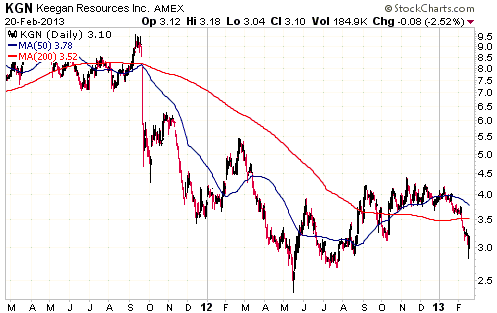
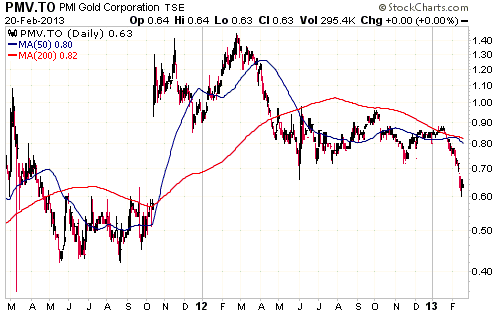
Chart Sources
Charts appearing in today's commentary
are courtesy of:
http://stockcharts.com/index.html

|









