- Interim Update 20th May 2015
Copyright
Reminder
The commentaries that appear at TSI
may not be distributed, in full or in part, without our written permission.
In particular, please note that the posting of extracts from TSI commentaries
at other web sites or providing links to TSI commentaries at other web
sites (for example, at discussion boards) without our written permission
is prohibited.
We reserve the right to immediately
terminate the subscription of any TSI subscriber who distributes the TSI
commentaries without our written permission.
Worry about capital
controls, not gold confiscation
Due to the confiscation of gold
by the Roosevelt Administration in 1933, there remains an undercurrent of
concern among gold owners that the US government or another major government
will confiscate gold in the future. However, the risk of this happening is
presently so low as to not be worth taking into account. Of far greater risk are
capital controls and the confiscation of cash.
Gold confiscation is not a realistic threat under the current monetary system,
because under the current system gold isn't money. To further explain, the
reason that gold was confiscated in the US in 1933 was that gold, at that time
and place, was money, with the dollar essentially being a receipt for gold.
Consequently, the amount of gold in the banking system placed a limitation on
the quantity of dollars. By making gold ownership illegal the US government not
only prevented the public from removing gold from the banking system, it also
forced more gold into the banking system and paved the way for greater monetary
inflation.
Today, gold imposes no limitations on the abilities of the government and its
agents to spend, borrow and inflate, so there is no reason for the government to
confiscate it or even to care about it.
What the government wants to control is the official money, which in 1933 was
gold and today is the dollar or some other fiat currency. The government is
therefore focused on monitoring/controlling the flow of today's currency units,
and you have a much better chance of having your cash confiscated or restricted
in some way than having your gold confiscated.
Moreover, capital controls aren't just a potential future problem, they exist in
almost every country today. In almost every country there are already
restrictions on a) your ability to transfer money across the national border, b)
the transfer of money between different account-holders, and c) the amount of
deposit currency that can be converted to physical cash. If these aren't capital
controls by another name, what are they?
Capital controls are likely to become more draconian over time. People with
significant financial assets should therefore already be managing the
capital-controls risk by diversifying their assets internationally. Also,
everyone (especially US citizens), including those who don't yet have
significant financial assets to protect, should have a second passport as a
guard against future restrictions on freedom in some parts of the world.
*If you are concerned about gold confiscation then you
could also manage this risk by distributing your gold across vaults in different
countries. This is easy to do via Bullionvault.com and the new BitGold service.
The Stock Market
The US
We've had, and still have, two intermediate-term scenarios in mind for the US
stock market. One is that a major top is being put in place near the current
price. The other is that there will be a several-month extension of the cyclical
bull market encompassing a rotation into commodity-related plays. Right now
there is evidence to support both of these very different scenarios. The
evidence is far from conclusive, though, which is why both scenarios remain
plausible.
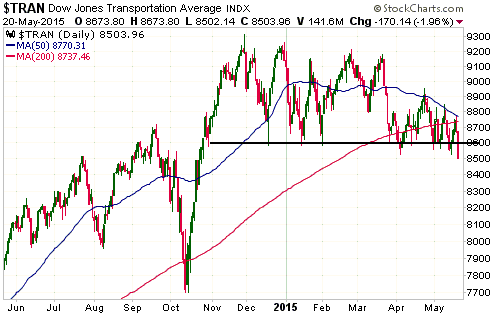
If a major top is being put in place near the current price then the Dow
Transportation Average, the weakest of the important US stock indices over the
past several months, should soon make a sustained break below its 8600 'floor'.
At this time last week it had closed below 8600, but it subsequently failed to
sustain the breakout through to week's end. On Wednesday 20th May it again
closed below 8600 and in fact is now at its lowest level since last October, but
still needs to confirm the breakout by sustaining it over the next two trading
days.
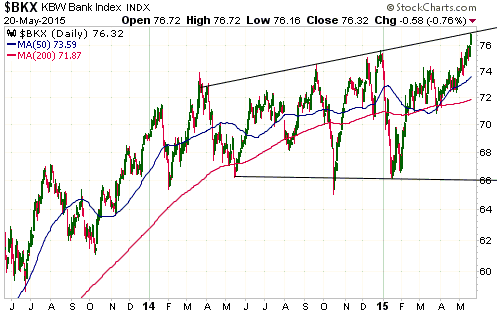
Also, if a major top is being put in place near the current price then the Bank
Index should be about to reverse downward.
As illustrated below, on three previous occasions over the past 18 months the
BKX has reversed downward within a few days of making a new 52-week high. In
doing so it has potentially formed a "broadening top", but for this potential to
remain it should begin to trend lower almost immediately.
Repeating what we wrote in the latest Weekly Update, it would be reasonable to
accumulate a speculative bearish position in the US stock market by, for
example, averaging into put options with an expiry date of January-2016 or later
during days when the market is firm, with risk management initially involving a
plan to exit the bearish position at a loss if the S&P500 makes a new high after
this month.
Japan
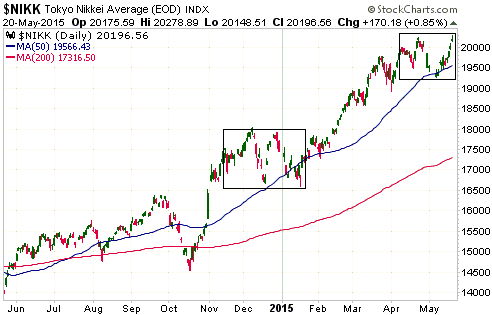
Japan's Nikkei225 Index has moved back to the vicinity of the multi-year top
reached in April. The most likely possibilities are that it has just completed a
mid-trend consolidation and commenced another 1-3 month rally, or that a
mid-tend consolidation is roughly half complete and will end up being similar to
the December-January correction.
Gold and the Dollar
Gold
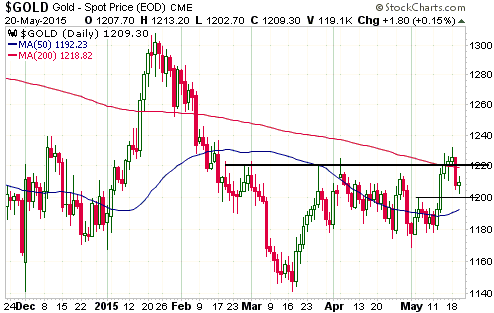
The US$ gold price was unable to sustain last week's unconfirmed (by the
gold-mining sector) break above resistance at $1220.
Gold's chart pattern will leave open the possibility of a near-term surge to
$1250-$1280 as long as the price doesn't close below $1200, but, as noted below,
the recent decline in the HUI/gold ratio warns that short-term tops are already
in place for both gold bullion and the HUI.
Gold Stocks
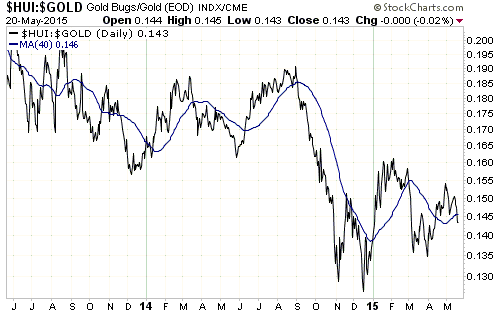
According to what happened over the past 20 years, the HUI/gold ratio's position
relative to its 40-day MA (or 50-day MA) is a good indicator of the short-term
trend for both gold bullion and the gold-mining sector during the final two
years of gold bear markets and the first few years of gold bull markets. During
such periods a trader who bases assumptions about the short-term trend in
gold-related investments on HUI/gold's position relative to the 40-day (or
50-day) MA will occasionally be whipsawed, but will be on the right side of the
market the vast majority of the time. During other periods, such as during the
second halves of long-term gold bull markets, the HUI/gold indicator will
generate too many false signals to be useful.
The HUI/gold ratio has been a reliable short-term trend indicator over the past
18 months and -- assuming that a new cyclical gold bull began last November or
will begin within the next few months following another test of last year's low
-- stands a good chance of being a reliable short-term trend indicator for at
least the next couple of years.
That's why it's significant that the HUI/gold ratio diverged bearishly from the
bullion price late last week and has just closed below its 40-day MA. This could
turn out to be a head fake, but it should be viewed as a genuine breakout (a
short-term bearish signal for the gold-mining indices and gold bullion) until
proved otherwise.
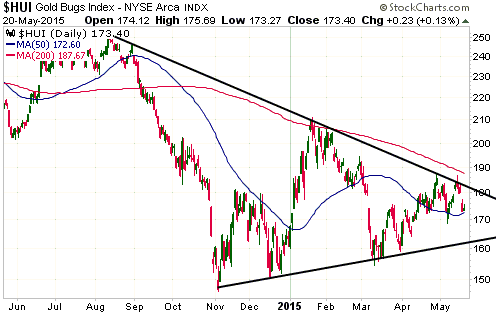
The HUI is currently testing support in the low-170s defined by its 50-day MA
(the blue line on the following daily chart) and the bottom of a short-term
channel (not shown on the chart). Due to the downside breakout in the HUI/gold
ratio, we doubt that this support will hold. If it doesn't, the next support of
significance is the bottom of the intermediate-term triangular pattern that did
such a good job of limiting the HUI's upside over the past month.
On the positive side of the ledger, GDXJ has been relatively strong and up until
now has sustained its break above $25.

Our conclusion is that it will make sense to be cautious and prepared for
short-term weakness until the HUI/gold ratio moves back above its 40-day MA.
The Currency Market
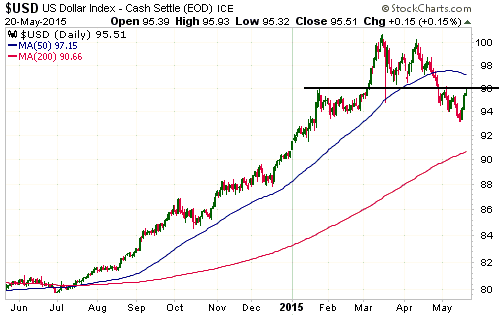
The Dollar Index has quickly rebounded by almost 3 points from last week's low.
The rebound has mostly eliminated the 'oversold' condition and has taken the
price up to near former support (now resistance) at 96. This is roughly where
the rebound should end IF it is the counter-trend variety.
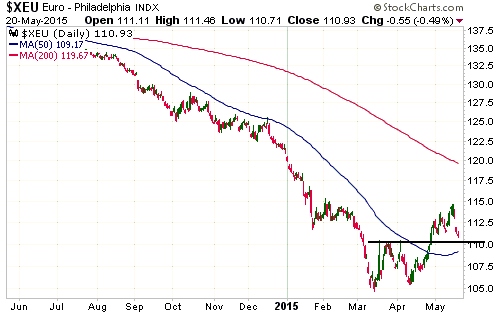
Not surprisingly, since the Dollar Index is effectively the reciprocal of the
euro, the euro's position is similar to that of the Dollar Index, except that
whereas the Dollar Index has rebounded to just below important (with regard to
the short-term trend) resistance the euro has pulled back to just above
important support. The euro should not close below the 110 support level IF the
recent pullback is a counter-trend move within an on-going multi-month rally.
Updates on Stock Selections
Notes: 1) To review the complete list of current TSI stock selections, logon at
http://www.speculative-investor.com/new/market_logon.asp
and then click on "Stock Selections" in the menu. When at the Stock
Selections page, click on a stock's symbol to bring-up an archive of
our comments on the stock in question. 2) The Small Stock Watch List is
located at http://www.speculative-investor.com/new/smallstockwatch.html
 True
Gold Mining (TGM.V) has resumed construction at its Karma gold project in
Burkina Faso. More will be said about this positive news in the coming Weekly
Update, but at this time we wanted to point out that risk and uncertainty have
just been materially reduced for this company and that TGM is a reasonable
candidate for new buying in the low-C$0.20s.
True
Gold Mining (TGM.V) has resumed construction at its Karma gold project in
Burkina Faso. More will be said about this positive news in the coming Weekly
Update, but at this time we wanted to point out that risk and uncertainty have
just been materially reduced for this company and that TGM is a reasonable
candidate for new buying in the low-C$0.20s.
We wouldn't pay a higher price than the low-C$0.20s (say, C$0.22) at this time
because although the political/location risk has just fallen, it is still higher
than we'd like. In the low-C$0.20s the risk/reward is attractive enough for new
buying, but at a significantly higher price it wouldn't be.
Chart Sources
Charts appearing in today's commentary
are courtesy of:
http://stockcharts.com/index.html