|
- Interim Update 20th July 2011
Copyright
Reminder
The commentaries that appear at TSI
may not be distributed, in full or in part, without our written permission.
In particular, please note that the posting of extracts from TSI commentaries
at other web sites or providing links to TSI commentaries at other web
sites (for example, at discussion boards) without our written permission
is prohibited.
We reserve the right to immediately
terminate the subscription of any TSI subscriber who distributes the TSI
commentaries without our written permission.
Money-Supply Surge
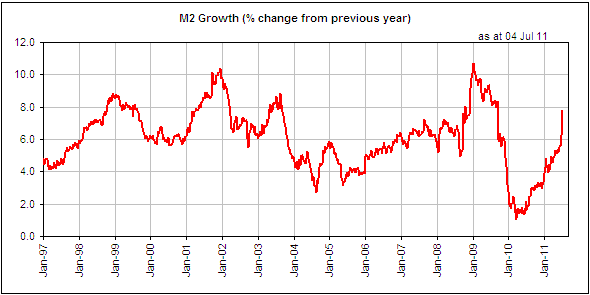
The
following weekly chart shows that the year-over-year growth rate of M2
money supply steadily worked its way higher from early 2010 until two
weeks ago, at which point it 'exploded' upward. This money-supply
explosion is probably part of the reason that gold futures rose a
record-breaking 10 days in succession.
M2 is not a good
measure of US money supply because two of its most important components
(money-market funds and time deposits) are not money. This is why we
don't usually discuss it. Instead, our money-supply discussions usually
refer to the monetary aggregate known as TMS (True Money Supply).
We are making an exception in today's report, partly because the
"mainstream" pays attention to M2 and is blissfully unaware of TMS.
This means that even though TMS is by far the more useful indicator of
what's happening on the monetary front, short-term market psychology is
more likely to be influenced by large changes in M2. Another reason we
don't mind making an exception right now is that the recent surge in M2
was 100% driven by large increases in actual money (as opposed to the
non-monetary components of M2 mentioned above), which means that TMS
also surged. Specifically, over the two-week period ended 4th July 2011
(the latest period for which data are available at the time of writing)
there was an addition of $104B to savings deposits at commercial banks
and an addition of $65B to demand deposits.
Of the $169B added to savings and demand deposits, only $27B was
directly attributable to the Fed. What, then, was the main cause of the
remarkable increase?
$46B of the total increase stems from a draw-down in the federal
government's deposits at the Fed. When the Treasury reduces its cash
holdings at the Fed, the money is 'spent into the economy' and ends up
in commercial-bank savings and demand deposits. Another $23B is due to
a net increase in commercial bank credit (lending new money into
existence or buying securities with newly created money).
That leaves about $73B of deposit growth ($169B minus $27B (Fed) minus
$46B (government) minus $23B (bank credit)) unaccounted for. We don't
know where this $73B came from, but one possibility is that it came
from overseas (the transfer of US dollars from bank accounts outside
the US to bank accounts inside the US). This is a possibility because
with the exception of the defunct M3, the US monetary aggregates do not
include the large quantity of US dollars held outside the US.
Consequently, monetary aggregates such as M2 and TMS get boosted when
US dollars are shifted from outside to inside the US, even though the
shift does not alter the global supply of US dollars.
If foreign-held US dollars have, indeed, recently been returning home
at a rapid rate, the burgeoning problem with PIIGS sovereign debt would
explain it. If the governments of Greece, Portugal and Ireland were to
default, many European banks would become insolvent. In such a
situation the ECB would have the ability to bail out depositors with
euro-denominated accounts, but the ECB can't create US dollars.
The Stock Market
Current Market Situation
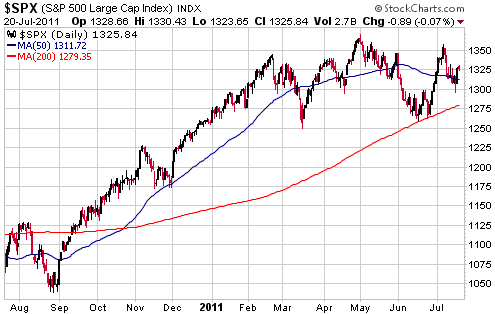
The S&P500's price action remains non-committal. After reaching
some sort of peak in early July, it pulled back to its 50-day moving
average and then rebounded.
The two most likely scenarios are:
1) The early-July peak was a successful test of the early-May peak, and
a substantial downward trend is now in its infancy. This scenario will
take centre-stage if the S&P500 closes below 1295.
2) The pullback from the early-July peak was a routine correction
within a continuing short-term upward trend. The market will move to a
marginal new high for the year before commencing a substantial downward
trend.
This means that both of our favoured scenarios are bearish beyond the next few weeks.
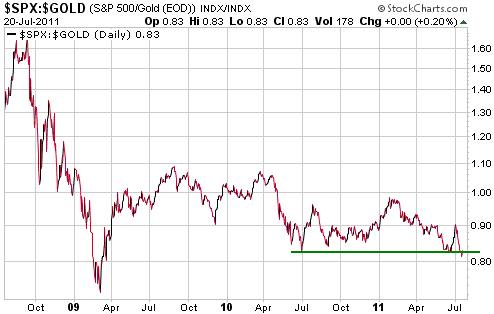
The daily chart
displayed below shows that the S&P500/gold ratio is close to
breaking out to the downside. Similar breakouts to the downside over
the past 10 years have always led to large additional declines within
the 6-month period following the breakout.
Natural Gas Equities
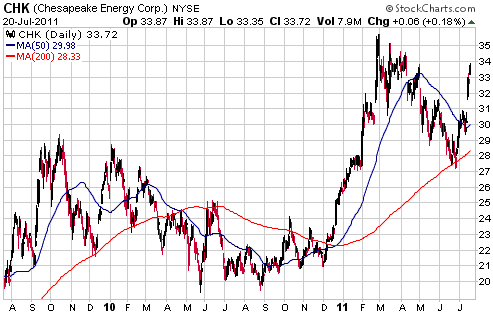
Even though the natural gas price hasn't done much, there has been a
sharp rebound in the prices of natural gas stocks over the past three
weeks. Strength in natural gas equities in parallel with a flat natural
gas market is a continuation of the theme of the past 12 months.
Strength in the stocks of natural gas drillers makes some sense because
these companies could do well even if the natgas price continued to
oscillate at a low level, but some of the large-cap natgas production
stocks have also recently sprung to life. Chesapeake Energy, for
example (see chart below).
The only exposure to
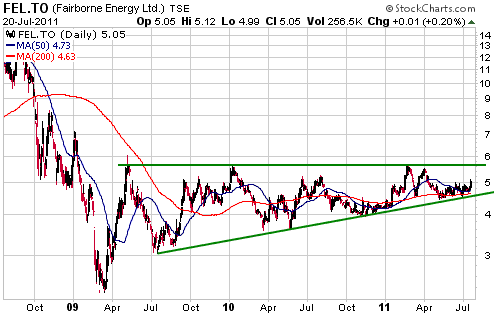
natural gas in the TSI Stocks List is provided by Fairborne Energy
(TSX: FEL). FEL tends to have a strong positive correlation with the
natural gas price, which will be a good thing when natgas eventually
begins to trend upward but has resulted in the stock spending the past
two years in a sideways consolidation.
As illustrated below, FEL's trading range is contracting. This means
that a breakout should occur within the next few months. More often
than not, this type of pattern ends with an upside breakout.
Gold and
the Dollar
Gold
Bernanke gets something right
Last week, Ben Bernanke delivered his semi-annual monetary policy
report to the US House of Representatives. As usual, the policy report
was followed by a Q&A session during which elected representatives
were given a few minutes to question the Fed Chairman. Also as usual,
the most interesting exchanges occurred during Ron Paul's allotted
question time. Unfortunately, in this particular case Ron Paul erred in
his efforts to shed light on the economic damage wrought by the Fed.
In this instance, the line of questioning pursued by the heroic Dr.
Paul was off track. For example, he questioned Bernanke about gold and
asked if gold is money. The Fed Chairman said that gold isn't money;
rather, it is an asset that people hold as protection against tail risk
-- very bad outcomes.
Bernanke is absolutely correct. Today, gold is not money; it is an
asset that people hold to protect themselves against certain bad
economic outcomes. As Ed Bugos noted in a recent blog post, if gold were money then we wouldn't be in the current 'pickle'.
With gold having performed so well and with Bernanke having admitted
that this performance was likely due to people trying to protect
themselves against bad economic outcomes, it would have been nice if
Ron Paul had zeroed in on the point that the Fed's actions were
contributing to the bad economic outcomes that people were worrying
about. However, Dr. Paul was too focused on hammering home the
incorrect point that gold is money.
The biggest problem facing the world is that the money we use is
totally controlled by the financial establishment (the government, the
central banks and the private banks). Naturally, the financial
establishment acts in its own best interest, not in the best interest
of the broad economy. In the US, for example, the Fed has created a
huge amount of new money to help the private banks repair their balance
sheets and to help the Federal government spend like a drunken sailor
on shore leave. This is what matters. The price of gold doesn't matter,
except as an indicator of the damage that the Fed is doing to the
dollar and the economy.
When confronted with the accusation that the Fed has been creating a
lot of new money, we can imagine Bernanke claiming that this is not so;
that the Fed has been boosting bank reserves rather than the money
supply. Refuting such a claim would be easy, because commercial bank
credit has been flat-to-down over the past two years and yet the total
amount of money has increased substantially. A situation like this
could only arise due to money-creation by the Fed.
Money is, by definition, the general medium of exchange. Today,
unfortunately, the general medium of exchange is something that can be
created in unlimited amounts at virtually no cost by central banks and
private banks. It isn't helpful to deny this reality and insist that
gold is money.
Ron Paul quickly gets back on track
Ron Paul on the debt ceiling drama, courtesy of Zero Hedge:
"Perhaps the most
abhorrent bit of chicanery has been the threat that if a deal is not
reached to increase the debt by August 2nd, social security checks may
not go out. In reality, the Chief Actuary of Social Security
confirmed last week that current Social Security tax receipts are more
than enough to cover current outlays. The only reason those
checks would not go out would be if the administration decided to spend
those designated funds elsewhere. It is very telling that the
administration would rather frighten seniors dependent on social
security checks than alarm their big banking friends, who have already
received $5.3 trillion in bailouts, stimulus and quantitative
easing. This instance of trying to blackmail Congress into tax
increases by threatening social security demonstrates how scary it is
to be completely dependent on government promises and why many young
people today would jump at the chance to opt out of Social Security
altogether.
We are headed for rough
economic times either way, but the longer we put it off, the greater
the pain will be when the system implodes. We need to stop adding
more programs and entitlements to the problem. We need to stop
expensive bombing campaigns against people on the other side of the
globe and bring our troops home. We need to stop allowing
secretive banking cartels to endlessly enslave us through monetary
policy trickery. And we need to drastically rethink government's
role in our lives so we can get it out of the way and get back to work."
YES!!
Current Market Situation
The gold futures market completed a (record breaking?) run of 10
consecutive up-days on Monday and has since bounced around near its
high. A normal pullback would take August gold from its current price
of around $1600 to just above the 50-day moving average (around $1540).
We usually consider sentiment to be a secondary indicator, because most
of the time it simply follows the price. It is only important when it
doesn't mesh with the price action, such as when a minor price decline
is accompanied by a plunge in optimism. This year, sentiment has taken
on greater importance than usual in the gold market because the level
of optimism has tended to drop sharply at the first sign of trouble.
This has helped to limit price declines.
Further to the above, to get more information regarding gold's
short-term outlook we will need to see how market sentiment shifts in
response to the next significant pullback in the gold price. For
example, if a pullback to the vicinity of the 50-day moving average is
accompanied by drops of more than 10% in Market Vane's bullish
consensus and the total speculative net-long position in COMEX gold
futures, then it will be reasonable to assume that another rally to a
new all-time high lies in the near future.
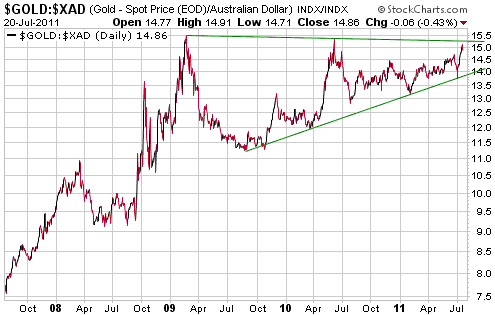
The A$-denominated gold price (gold/A$) has been in consolidation mode
since the first quarter of 2009. The following chart shows that it has
just moved up to the top of its 2.5-year consolidation pattern.
Gold/A$ will probably break out to the upside within the next few
months and start making its way to a much higher level, thus boosting
the profit margins of gold producers with operations in Australia.
Gold Stocks
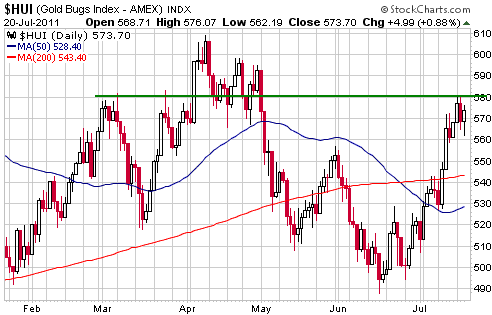
The HUI tested resistance at 580 on both Monday and Tuesday of this
week. We won't be surprised if it spikes up to 600 within the next
week, but the odds are against it making a sustained move above 580
without experiencing a significant intervening pullback.
A normal pullback would take the HUI back to near its 50-day moving
average, which will soon move into the 530s. Depending on the overall
market situation and gold-related sentiment indicators at the time,
such a pullback could create another good short-term buying opportunity.
Currency Market Update
The euro-zone's debt crisis continues to worsen, with the cost to
insure the debt of each of the PIIGS governments hitting a new high
earlier this week. In addition, the euro-zone's debt crisis continues
to be largely ignored by the currency market.
The Dollar Index has now traded sideways for about 2.5 months. If this
sideways move is part of a bottoming pattern (as we suspect), then it
should end by mid August at the latest and be followed by a strong
upward trend.
A multi-day break below the early-May low would clearly invalidate our opinion that the dollar is bottoming.
Update
on Stock Selections
(Notes: 1) To review the complete list of current TSI stock selections, logon at http://www.speculative-investor.com/new/market_logon.asp
and then click on "Stock Selections" in the menu. When at the Stock
Selections page, click on a stock's symbol to bring-up an archive of
our comments on the stock in question. 2) The Small Stock Watch List is
located at http://www.speculative-investor.com/new/smallstockwatch.html)
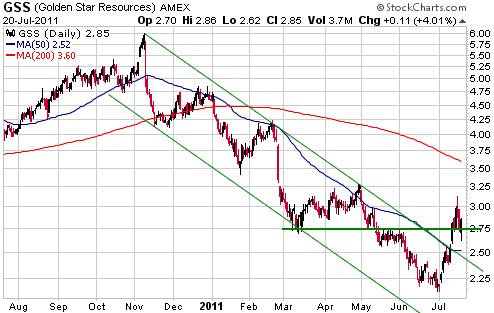
 Golden Star Resources (NYSE: GSS, TSX: GSC). Shares: 259M issued, 265M fully diluted. Recent price: US$2.85 Golden Star Resources (NYSE: GSS, TSX: GSC). Shares: 259M issued, 265M fully diluted. Recent price: US$2.85
GSS is hard to like. For the third or fourth time since last November,
the company's management has downgraded its own production forecast for
2011.
Unlike a stock that has great expectations built into its price, GSS's
stock market performance is now largely immune to a missed production
forecast because expectations are depressed. Consequently, this week's
announcement of another miss was greeted by only a minor pullback. As
things currently stand, the stock has maintained the previous week's
upside breakout.
GSS has support at US$2.75 and then at US$2.50. If a drop to the $2.50s
occurs, it should be viewed as a short-term buying opportunity.
The next significant resistance level is at US$3.50. A move up to near
this resistance within the next few weeks would probably create a
short-term selling opportunity.
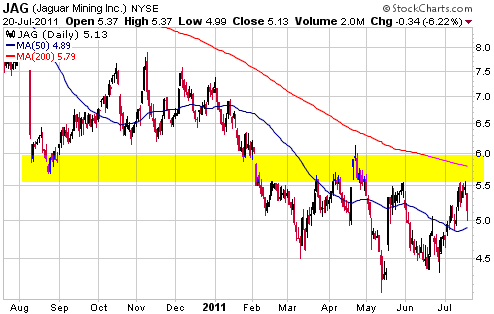
Jaguar Mining (NYSE and TSX: JAG). Shares: 84M issued, 88M fully diluted. Recent price: US$5.13
The market was disappointed by JAG's latest quarterly production
results, which were announced after the close of trading on Tuesday.
The Brazil-based gold mining company produced less gold than expected,
and costs were higher than expected. The stock lost 6% in response.
From our perspective, the results were OK. The two operations that
caused so much trouble last year are continuing to improve, but the
June quarter's production was adversely affected by a temporary mill
outage at the company's newest mine. The increase in costs was due
mostly to the mill outage, although the strength in the Brazilian
currency was also a significant factor.
Importantly, the company is maintaining its 2011 production guidance of
around 200K ounces. At this annual production rate, a gold price of
$1500/oz and a cost of production near that achieved over the past 6
months, JAG is worth at least US$10/share.
New buying would be appropriate near the 50-day moving average. Resistance lies at US$5.50-$6.00 and then at $7.50-$8.00.
Andina Minerals warrants (TSXV: ADM.WT)
The ADM warrants have an exercise price of C$2.25 and an expiry date of
2nd June 2012. This means that they are well out of the money (ADM
shares closed at C$1.34 on Wednesday) with only about 10 months left to
expiry.
We added these warrants to the TSI List back in December of 2009, when
they were trading at C$0.48. The speculation obviously hasn't worked to
date, because they ended Wednesday's trading session at C$0.12-$0.13.
Chances are they will expire worthless, but they could still be of
interest to high-risk speculators due to their outsized reward
potential.
Here are the three most likely outcomes for these warrants:
1) ADM shares remain below C$1.50 over the next 10 months, causing the
warrants to gradually lose all of their value and expire worthless.
2) In response to a large rise in the gold price during the final
quarter of this year and the first half of next year, marginal gold
projects such as the one owned by ADM are assigned much higher
valuations by the stock market. ADM's shares move well above C$3 and
the warrants trade at more than 10-times their current price.
3) At some point over the next 6 months, ADM shares rebound to around
C$2 before reversing course and returning to the sub-C$1.50 area. The
warrants ultimately expire worthless, but the aforementioned rebound
creates an opportunity for those who bought at around C$0.13 to exit
with a 150%-200% profit.
Be aware that the ADM warrants are illiquid as well as risky. With ADM
shares trading below resistance at C$1.40, we advise against paying
more than C$0.13 for the warrants.
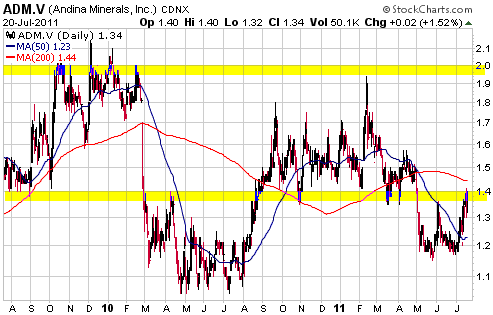
Chart Sources
Charts appearing in today's commentary
are courtesy of:
http://stockcharts.com/index.html

|